When a friend of mine told me she was going to Amsterdam there was one thing I told her to do: visit the begijnhof. There few many physical things still existing to day (besides their manuscripts) that we can connect to the beguines, but some of the buildings the beguines of the Low Countries lived, worked, and worshiped in still stand today and we have some evidence on those that don't.* The buildings that served as a physical reminder of both their attachment to the world and their separation from it still remind us as well. Beguinages or begijnhoven came in two types: courts and convents.
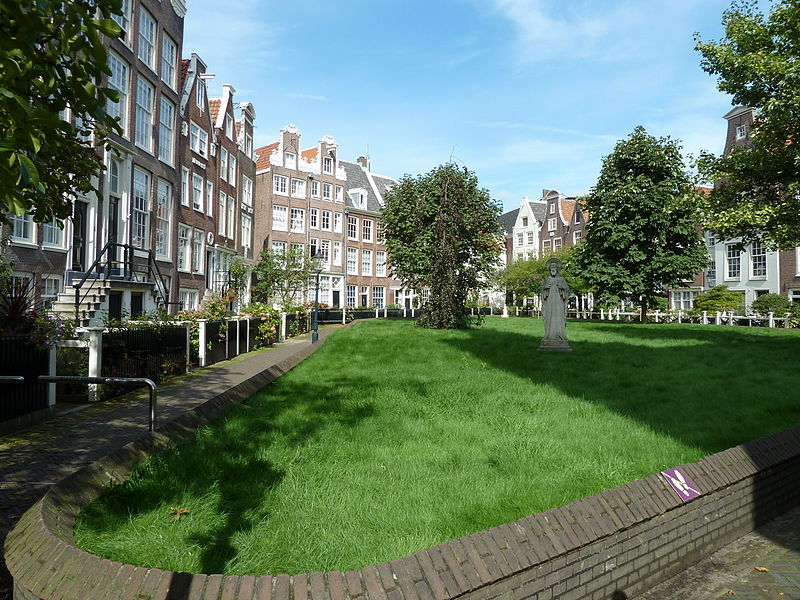
The begijnhof in Amsterdam is probably the best known outside of the Low Countries.
[Begijnhof, Amsterdam, photographed 2011, Source: Wikimedia Commons]
[Begijnhof, Amsterdam, photographed 2011, Source: Wikimedia Commons]
Surprisingly for a movement with such fragmentary origins, the larger court beguinages appeared first. These were unique to the Low Countries and many of them housed between 100 and 300 beguines under a single grand magistra.** They usually consisted of both individual houses for smaller groups of family members or close friends*** and a few “convents” where a larger group of beguines lived with their own magistra. Some were fairly (though not fully) independent communities with their own service buildings (bakeries and such, sometimes even a small farm). The very largest made up their own parishes. Beguines in smaller courts attended church with the lay people.
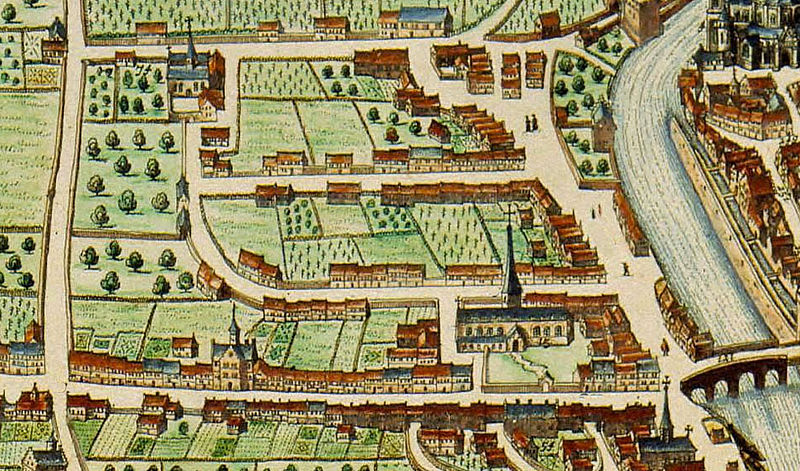
A 17th century drawing of the Beguinage of St. Christophe in Liège.
[Crop from a 1649 map of Liège by Johan Blaeu, Source: Wikimedia Commons]
[Crop from a 1649 map of Liège by Johan Blaeu, Source: Wikimedia Commons]
Convents tended to be much smaller, usually housing a community of 5-16 women under a magistra. Communities like this could be found not only in the Low Countries, but also in parts of what are now France, Germany, and the Czech Republic. Some were founded simply as communal groups of beguines, others had a more specific purpose, such as the care of the sick or the poor.**** Convents, since they did not require as many members or resources to start, were by far the more common, but their buildings tend not to have survived the centuries.
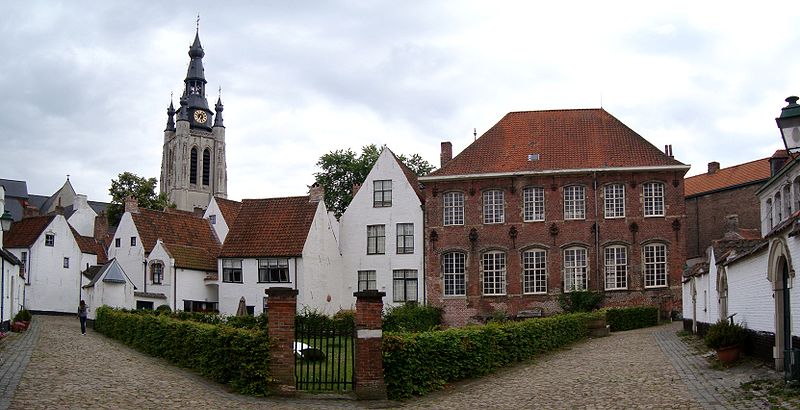
Kortrijk was the home of the last living beguine, Marcella Pattyn, who died in April 2013.
[Beguinage, Kortrijk, photographed 2009, source: Wikimedia Commons]
[Beguinage, Kortrijk, photographed 2009, source: Wikimedia Commons]
The buildings beguines lived (and sometimes worked) in provide a physical example of conceptual middle ground they occupied between nuns and laywomen. The slightly more enclosed spaces of the beguinage emphasized their partial separation from the city and the secular world while still allowing for their work within it. Most of these women spent much of their time working to support themselves. The buildings of a beguinage, court or convent, provided them with space for a semi-religious life in the company of likeminded women.
*Few if any beguinages from outside the Low Countries survive.
**Several, however, were larger. The largest, the Groot Begijnhof in Mechelen, housed between 1500 and 1900 beguines in the 15th century, while the beguinage of St. Christophe in Liège had about 1000 beguines in the middle of the 13th century.
***Walter Simons mentions two unrelated beguines who lived out their lives together and then requested to be buried together as well.
****This was actually why some of the beguines in France survived the years after the French Revolution: they managed to get themselves classified as charities rather than religious institutions.
*Few if any beguinages from outside the Low Countries survive.
**Several, however, were larger. The largest, the Groot Begijnhof in Mechelen, housed between 1500 and 1900 beguines in the 15th century, while the beguinage of St. Christophe in Liège had about 1000 beguines in the middle of the 13th century.
***Walter Simons mentions two unrelated beguines who lived out their lives together and then requested to be buried together as well.
****This was actually why some of the beguines in France survived the years after the French Revolution: they managed to get themselves classified as charities rather than religious institutions.
Sources/Further Reading:
Simons, Walter. Cities of Ladies: Beguine Communities in the Medieval Low Countries, 1200-1565. Philadelphia: University of Pennsylvania Press, 2003.
Simons, Walter. “Architecture of Semi-Religiosity: the Beguinages of the Southern Low Countries, Thirteenth to Sixteenth Centuries.” In Shaping Community: The Art and Archaeology of Monasticism, edited by Sheila McNally, 117-128. Oxford: Archaeopress, 2001.
Woodward, Richard. "A Lost World of Women." 13 July 2008 - New York Times
Begijnhof & Kapel Amsterdam
Flemish Beguinages - UNESCO
Beguines and Beghards - Wikipedia
Beguinage - Wikipedia (English)
Begijnhof - Wikipedia (Dutch)
Begijnhoven in Vlaanderen - Wikipedia (Dutch)
Béguinage - Wikipedia (French)
Béguinages de Liège - Wikipedia (French)
Simons, Walter. Cities of Ladies: Beguine Communities in the Medieval Low Countries, 1200-1565. Philadelphia: University of Pennsylvania Press, 2003.
Simons, Walter. “Architecture of Semi-Religiosity: the Beguinages of the Southern Low Countries, Thirteenth to Sixteenth Centuries.” In Shaping Community: The Art and Archaeology of Monasticism, edited by Sheila McNally, 117-128. Oxford: Archaeopress, 2001.
Woodward, Richard. "A Lost World of Women." 13 July 2008 - New York Times
Begijnhof & Kapel Amsterdam
Flemish Beguinages - UNESCO
Beguines and Beghards - Wikipedia
Beguinage - Wikipedia (English)
Begijnhof - Wikipedia (Dutch)
Begijnhoven in Vlaanderen - Wikipedia (Dutch)
Béguinage - Wikipedia (French)
Béguinages de Liège - Wikipedia (French)
 RSS Feed



