In the history of the Roman Catholic Church there has only been one religious movement that was started by women and remained predominantly female throughout its history. These were the beguines (French) or begijnen (Dutch/Flemish). The exact origins of the movement are unknown, but it was definitely centered around the Low Countries and probably started in the late 12th century, though they spread to what are now France and Germany as well.
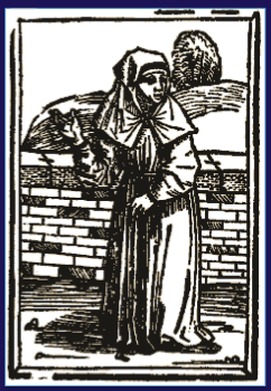
I wonder who she's talking to.
[A drawing of a beguine from Des dodes dantz, 1498, printed in Lübeck]
[Source: Wikimedia Commons]
[A drawing of a beguine from Des dodes dantz, 1498, printed in Lübeck]
[Source: Wikimedia Commons]
These were women who dedicated themselves to a religious life while still living within the world. In other words, while they were not nuns, they were not lay people either. They devoted their lives to God, making promises similar to the vows of nuns: poverty, chastity, and obedience. Promises, not vows. Nor did they seclude themselves from the world as nuns did. Beguines lived and worked in cities. Where there were enough of them, they built their own chapels and homes around secluded courtyards. Where they were fewer, they lived with everybody else.
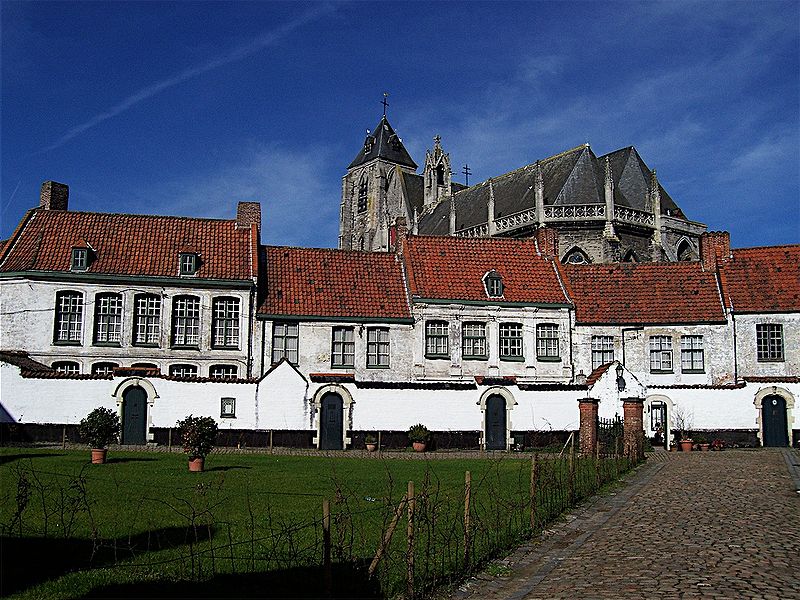
Some beguinages/begijnhoven are still inhabited, though not by beguines. I'm not sure about this one.
["Kortrijk Begijnhof," photographed by Lamadude]
[Source: Wikimedia Commons]
["Kortrijk Begijnhof," photographed by Lamadude]
[Source: Wikimedia Commons]
They have often been compared to the begging orders of Saints Francis and Dominic since they lived and worked for and with the poor in cities, but there is a key difference: for the most part the beguines supported themselves. They were employed in every occupation open to women in the Low Countries of the 12th, 13th and 14th centuries. They owned property individually as members of no other religious order did. It is easier to compare them to Franciscan and Dominican tertiaries* and in some cases it is very difficult to tell whether to place a woman in the category of beguine or mendicant tertiary.
This confusion over categorization is the overarching theme I see here. In their lives they crossed the boundaries of religious and lay, of social class, and, through their reputation for extreme holiness, heaven and humanity. Because of this they were venerated. For a time.
*Lay persons who did/do not take religious vows, but participate(d) in the works of the Order and lived according to some of the Order’s rules.
This confusion over categorization is the overarching theme I see here. In their lives they crossed the boundaries of religious and lay, of social class, and, through their reputation for extreme holiness, heaven and humanity. Because of this they were venerated. For a time.
*Lay persons who did/do not take religious vows, but participate(d) in the works of the Order and lived according to some of the Order’s rules.
Further Reading:
Cities of Ladies by Walter Simons
Beguines and Beghards - Wikipedia
Beguines - Catholic Encyclopedia
Beguines - Kenyon.edu
Note: These websites present as fact some information that is currently being or has recently been disputed by historians. It's interesting stuff, but take it with a grain of salt.
Cities of Ladies by Walter Simons
Beguines and Beghards - Wikipedia
Beguines - Catholic Encyclopedia
Beguines - Kenyon.edu
Note: These websites present as fact some information that is currently being or has recently been disputed by historians. It's interesting stuff, but take it with a grain of salt.
 RSS Feed


