Emily Kittell-Queller
  • Home
  • About Me
  • Blog
  • Projects
  • Resume
  • Contact Me

Isabella II of Jerusalem

29/2/2016

0 Comments

 
Picture
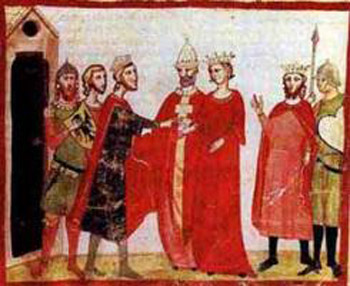
Am I the only one who finds it weird that they're all the same height?
[Marriage of Frederick and Isabella, 13th century, source: Wikimedia Commons]
Isabella II of Jerusalem (1212-1228), also known as Yolande of Brienne, Queen of Jerusalem, never in her own right, partially because the men in her life ruled for her, partially because she died at the age of 16.  We know very little of her actions beyond her marriage, but her position as the Queen of Jerusalem made her the focus of a lot of political attention.  Her father, John of Brienne, and her husband, Holy Roman Emperor Frederick II Hohenstaufen, clashed several times over power, leaving Isabella to be seen as a simple pawn between them.
 
Isabella was the daughter of Maria of Montferrat, Queen of Jerusalem, and John of Brienne.  Her mother died shortly after she was born, leaving Isabella to become queen at only a few days old.  We don’t really know much of anything about her childhood. Her father ruled as regent, having no direct claim to the throne himself.  She was probably raised in the city of Acre.  Though she was titled Queen of Jerusalem, the city itself had last been in her people’s hands during her grandmother’s lifetime.  But plans were being made by Western European leaders to try and take it back and Isabella would come to figure in those plans.
 
Pope Honorius III felt that the Kingdom of Jerusalem needed a strong leader who would be invested in taking back the lands that had been lost to the Saladin and his successors.  The solution was to marry Isabella to Frederick, who would then be King of Jerusalem and would have a much stronger reason to actually try and take the city back.  In 1225, Isabella, then aged 13, married by proxy at Acre and was officially crowned Queen.  She then sailed to Italy to marry in person.
 
As it turned out, Isabella’s father and her husband did not get along and most of our sources were written by John’s sympathizers.  They accuse Frederick of shutting Isabella up in a harem and preferring to sleep with mistresses than with his wife.*  Other evidence does suggest, though, that she may have traveled around Italy with him on more than one occasion.  Even married to the Queen of Jerusalem, Frederick still put off actually going on crusade.  Isabella died in 1228, at the age of 16, before he had even gotten around to it, leaving Frederick no longer King of Jerusalem, but merely regent for their infant son, Conrad.
 
 
*To be fair, she was thirteen.  How do we know she wasn’t glad he wasn’t sleeping with her much?  Or that she didn’t ask him to leave her alone?

Sources/Further Reading:
Abulafia, David. Frederick II: A Medieval Emperor. Oxford: Oxford University Press, 1988.  [Note: found on Google Books here]
Isabella II of Jerusalem - Wikipedia
Le Quattro Mogli di Federico II - Stupormundi.it

0 Comments

Contraception in Medieval Law

25/2/2016

0 Comments

 
Up until the 12th century or so, medieval legal writers weren’t particularly concerned with contraception.  They certainly didn’t look at it positively, but they also didn’t consider it an issue worth spending much time on except where it came up in connection with other concerns.  The 12th century saw greater focus on the issue, but specific condemnation of it independently of other issues only came 400 years later, in the 16th century.  It’s worth nothing though, that however much contraceptive practices were condemned, no serious effort was ever made to stop them.
 
St. Augustine argued that sex with any sort of contraceptive intent was a serious sin.  Married couples should simply stop having sex at all once they’d had a couple of children.  Beyond this statement, he seems not to have touched on the issue.  Similarly, the Penitentials of the next several centuries didn’t really focus on or specifically mention contraception much.  Instead, as a rule, they tended to discourage any sexual position that didn’t have a chance of resulting in a pregnancy as sinful in and of themselves.
 
The 11th and 12th centuries saw rising concern with what was “natural” and what wasn’t.  St. Peter Damian considered most forms of contraceptive sex to be “against nature.”  A bit more than a century later, Gratian called it “inappropriate use of sex organs,” but also considered such things only mildly sinful when the people involved were married to each other.
 
The 12th century was also when legal and religious writers began paying more attention to the issue.  A few people argued that both the use of contraception and sex with contraceptive intent invalidated a marriage entirely.  Others said that while marriages entered into with the intent to avoid having children were illegal, they were still binding.  Some compared the use of contraception to adultery, while many considered it serious spiritual pollution at the very least.
 
The thing is, though, for all that several writers had opinions on the topic, contraception wasn’t considered seriously as a separate issue until the 16th century.  It was mostly a minor point among far greater concerns.

Sources/Further Reading:
Brundage, James A. Law, Sex and Christian Society in Medieval Europe. Chicago: University of Chicago Press, 1987.
Birth Control and Abortion in the Middle Ages - Medievalists.net
0 Comments

Ada of Caria

22/2/2016

0 Comments

 
Picture
The theater of Alinda, Ada's stronghold.
[Theater of Alinda, Ancient Carian City, Turkey, photographed by Ana al'ain, 2009, source: Wikimedia Commons]
Ada of Caria (died c. 326 BCE) ruled Caria first alongside her brother-husband Idrieus, then as a rival claimant to her youngest brother Pixodaurus, and finally on her own and seemingly unopposed as client-king to Alexander the Great.  She was not the first woman to rule Caria alone and in her own right, as Artemisia I and her own sister Artemisia II had done so before her.  She was also the first local ruler in Asia Minor to remain in power instead of being replaced after Alexander came through with his army.
 
Ada was the younger of the two daughters of Hecatomnus of Caria.  At some point she married the middle of her three brothers, Idrieus.  When their father died, her elder brother and sister Mausolus and Artemisia took the throne.  Following Mausolus’ death, Artemisia ruled alone.  On Artemisia’s death, Idrieus and Ada succeeded her, ruling together for seven years from 351 to 344.  Though Caria was a satrapy or client state* to the Persian Empire, Idrieus and Ada seem not to have been on terribly good terms with the Persians, preferring to maintain close ties with Greece.
 
Ada should have become the sole ruler when Idrieus died in 344, but her youngest brother Pixodaurus had other plans.  He seized power and drove her out of Halicarnassus, Caria’s main city.  Ada kept control of Alinda and the surrounding areas and contested her brother’s right to the throne but Pixodaurus had the support of the Persians and she was unable to take power back from him on her own, for all her popularity with the Carian people.
 
Ada saw her chance in 334 when Alexander the Great brought his army through Caria.  She allied herself with him and adopted him as her son.  He, in turn, besieged Halicarnassus for her and took the city back.  When he moved on, he left her in charge of the last of the fighting, specifically the siege of the acropolis and made her Queen, not just satrap, of Caria.  This was a first for Alexander.  All of the other rulers he had put in power were Greek, and therefore foreigners.  By adopting him, she gained his help, while he gained control of Caria as the legitimate heir of its queen.  Ada died eight years later, ruler of Caria in her own right.
 
 
*Which it was is rather unclear.

Sources/Further Reading:
Strabo, Geography 14.2.17 - Perseus
Sears, Mathew. "Alexander and Ada Reconsidered" - Academia.edu
Ada - Livius.org
0 Comments

Adoptio and Adrogatio

18/2/2016

1 Comment

 
In Ancient Roman law, the basic purpose of adoption was to create a legal relationship of father and son between two people, often for the purpose of providing the father with an heir.  It recognized two types of legal adoption: adoptio and adrogatio, respectively the adoption of someone still in patria potestas and the adoption of someone already sui iuris.  If we define adoption as the acquisition or designation of an heir who was not one’s biological child we can add a third type: what is now known as “testamentary adoption.”  Adoptio and adrogatio were limited to men as adopters.*  Only testamentary adoption was available to women as well.  An adoptee could be any free person, but were usually adult men.
 
Adoptio was legally the simplest of the three, the passing of someone in patria potestas from the power of one person to that of another.**  Adrogatio meanwhile, was far more complicated.  This involved the adoption, and therefore return to being under patria potestas, of a man*** who was already sui iuris and therefore legally under no one’s power.   But the caput (status/rights) of a Roman citizen could not be negatively affected except with the involvement of a court.  In other words, adoption by adrogatio couldn’t happen without both the potential adopter and the adoptee presenting a satisfactory case and having it voted on, with the possibility of conditions being imposed.  Originally this could only happen in the city of Rome.  As time went on, restrictions were loosened; people didn’t have to go to Rome and one only had to go before the pontifices.  Some may have found their way around the restrictions entirely.
 
What is now called “testamentary adoption” was its own special case.  A person could name someone else in their will as their heir on the condition that the inheritor took the dead person’s name.  This condition though, could be avoided, especially when the person making the will was an enemy of the state.  Whether or not it made the new heir part of a different family was unclear and could be legally challenged.  This was the only form of adoption open to women as adopters and was a way a woman could pass on her name and bring someone into her family.


*The wife of an adoptive father was not legally the new son’s mother.
**I’ll get more into the technicalities of this when I talk about adoption as a familial and political strategy.
***Women couldn’t be adopted by adrogatio.

Sources/Further Reading:
Corbier, Mireille. "Divorce and Adoption as Roman Familial Strategies." In Marriage, Divorce, and Children in Ancient Rome, edited by Beryl Rawson, 47-78. Oxford: Oxford University Press, 1991.
Adoptio - Lacus Curtius
Lindsay, Hugh. Adoption in the Roman World. Cambridge: Cambridge University Press, 2009.
Frier, Bruce. Review of Lindsay, Adoption in the Roman World - Bryn Mawr
1 Comment

Maria of Montferrat

15/2/2016

0 Comments

 
Picture
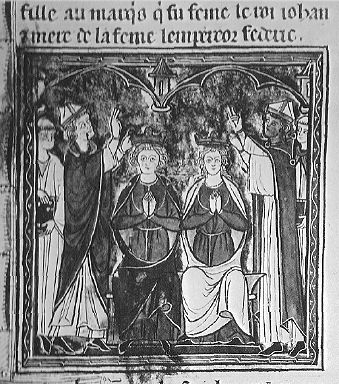
[Coronation of Maria of Montferrat and John of Brienne, 13th century, source: Wikimedia Commons]
Maria of Montferrat (1192-1212), Queen of Jerusalem, inherited the throne from her mother Isabella of Jerusalem at the age of 13.  Both her reign and her life were relatively short and she ruled without a regent for only three years.  As a result, we know little of her life and reign beyond the usual concerns about marriage and continuing the line despite the fact that she was the Kingdom of Jerusalem’s third Queen Regnant in a row.
 
Maria was only child of Isabella of Jerusalem and Conrad of Montferrat.  She was born after her father’s death and her mother’s subsequent remarriage to Henri of Champagne.  Isabella was actually visibly pregnant at the wedding.  Maria herself was born at the end of both the Third Crusade and Guy of Luisignan’s attempts to remain King of Jerusalem.  The city itself had long since been lost and the crusaders were unable to get it back.  As a result Maria probably spent much of her childhood in the cities of Tyre and Acre.
 
Isabella died in 1205 and since Maria’s only half-brother, the four-year-old Amalric, Isabella’s son by Amalric II, had died earlier that same year, Maria was crowned Queen of Jerusalem at age thirteen.  Her uncle, John of Ibelin, Isabella’s half-brother and son of Maria Komnene and Balian of Ibelin, ruled as regent until she turned seventeen.
 
Once she came of age, the issue of Maria’s marriage became a major political issue, as it had been for her mother and her aunt Sibylla.  She soon married the French nobleman John of Brienne at the suggestion of the king of France Philip Augustus.  The couple would only rule together for three years, maintaining a policy of peace with the neighboring Muslim sultanates.  In 1212 Maria gave birth to their only child, a daughter, Isabella II of Jerusalem, also known as Yolande.  The child survived.  Maria did not, dying a few days after the birth and leaving her infant daughter as the next Queen of Jerusalem.

Sources/Further Reading:
Maria of Montferrat - Epistolae
Setton, Kenneth Meyer, Robert Lee Wolff, and Harry W. Hazard. A History of the Crusades, Volume 2. Madison, WI: University of Wisconsin Press, 1969.
Maria of Montferrat - Fact Index
0 Comments

The Franciscan Schism

11/2/2016

1 Comment

 
For all of its popularity, the Franciscan Order was not founded by someone with any particular gift for administration.  By the 1270s, less than 50 years after St. Francis’s death, the Order was on the verge of schism.  The two sides, now called the Spirituals and the Conventuals, disagreed almost violently on the question of poverty and how to interpret St. Francis’s intention that the Friars Minor should own nothing.
 
The Spirituals argued that this was meant very literally.  The Friars Minor should neither have nor use as their own goods or money of any sort.  The Conventuals found this highly impractical, especially given the work of preaching and teaching that the Church had given them.  How could one study without having books or a space to study in?  And how could one teach without having studied?  How could one be an effective teacher when one had no idea where the next meal might come from?*  Were they to just turn away the gifts of grateful, generous donors?  A Papal Bull by Gregory IX authorized Franciscan communities to appoint a ‘spiritual friend’ who would act as a trustee for their goods and property.  Thus they could maintain the fiction of owning nothing while still having the things they needed.  The stricter view, it was felt, was impractical and unnecessarily harsh.
 
The Spirituals rejected this interpretation.  They saw themselves as the only true inheritors of Francis’s vision for his Order and felt that the Conventuals had succumbed to the materiality of the world.  Absolute poverty, not owning anything or having a fixed home was what St. Francis had intended for them.  Many of them were also heavily influenced by the works of Joachim of Fiore, which were then considered heretical.
 
Conflict raged between the two groups, and many Conventual abbots complained of the disobedience of Spirituals among their communities.  Various authority figures tried to mediate, with little success.  In 1317, things came to a head with the election of Pope John XXII, who threw his support entirely behind the Conventuals.  Spiritual Franciscans were subject to excommunication and accusations of heresy.  Some were burned at the stake.  Others were reconciled to the Conventual view.  A few Spirituals remained, but they no longer posed a threat to the Conventual point of view.  The Conventuals had won.  The Order would hold property.  Absolute poverty was no longer the goal.
 
 
*It’s also worth noting that many of the Order’s recruits at this point in time came from the middle and upper classes as well as from the Masters and students of the universities.

Sources/Further Reading:
Lawrence, C. H. Medieval Monasticism. London: Longman, 1984.
Briggs, Charles. The Body Broken. New York: Routledge, 2011.
Barber, Malcolm. The Two Cities. London: Routledge, 1992.
Spirituals - Catholic Encyclopedia
The Spiritual Franciscans and Beguins - Virginia Tech
1 Comment

Cleopatra IV of Egypt

8/2/2016

1 Comment

 
Note: As usual, to reduce confusion and make things flow better, “Cleopatra” here refers to Cleopatra IV.  All others will be given further identification.


Cleopatra IV (d. 112 BCE), like her sisters Tryphaena and Cleopatra Selene I, ended up being more heavily involved in Seleukid politics and wars than in affairs in Egypt, where she was born.  Though some make her out to be merely the victim of others’ plots, she acted on her own as well, helping on one occasion to turn the tide for her last husband, Antiochos IX Cyzicenus.
 
Cleopatra was the child of Cleopatra III and Ptolemy VIII, probably the middle of their three daughters who survived to adulthood.  She grew up on Cyprus, well away from the civil war between her parents and stepmother/aunt/grandmother, Cleopatra II.  She first married the elder of her two brothers, the future Ptolemy IX, and had at least one son sometime before their father died.  With Ptolemy VIII’s death, Cleopatra III would have preferred to make her younger son king, but when forced to choose the elder, she made him divorce Cleopatra and marry Cleopatra Selene instead.
 
Cleopatra herself was still on Cyprus when she found out she had been divorced and deprived of a throne.  She assembled an army, mostly persuading the men of the Seleukid king Antiochos VIII Grypus, her sister Tryphaena’s husband, to follow her instead.  Rather than march on Egypt though, she took them to Antiochos IX Cyzicenus, Grypus’s younger brother and rival and offered him both the army and her hand in marriage.  He agreed and the two were married.
 
With the army Cleopatra brought him, Cyzicenus finaly had enough men to rebel against his brother, starting a civil war.  Tryphaena, however, took her sister and sister-in-law’s actions as a very badly and accused Cleopatra of invading the country out of rivalry and envy and of bringing in a foreign army to deal with a dispute between brothers.  When Cleopatra was trapped in Antioch and too refuge in a temple, Tryphaena had her dragged out and killed.  Tryphaena herself would not live even a year beyond that.  Cyzicenus captured her and had her executed in revenge for his wife’s murder.

Sources/Further Reading:
Justin, Epitome of the Philippic HIstory 39.3 - Attalus.org
Cleopatra IV - Egyptian Royal Genealogy
Cleopatra IV - Livius.org
1 Comment

Living Spaces in Pompeii and Herculaneum

5/2/2016

0 Comments

 
The people of Pompeii generally lived in one of two types of buildings: houses and insulae.  The former tended to be organized along some variation of the atrium-tablinum-hortus/peristyle layout, while the latter has been characterized essentially as an apartment block.  The thing is, neither of these, but especially houses, were necessarily limited to just the family in terms of who could or did live there.
 
It’s very difficult, nearly impossible even, to find evidence of these sorts of arrangements in apartments, but it’s a little easier to figure out with houses.  It seems to have been not uncommon for house owners to rent out a room or rooms on the upper floor as living spaces, most likely to freedpersons and clients.  Being on the upper floor more easily separated the rented space from family space.  If the rooms were at the very front of the house, an external staircase could even be added to allow easy access from the street.  People living in rooms further back in the house, on the other hand, would have to go into the house and through the atrium.
 
Staircases in Pompeii mostly didn’t survive, though a few did in Herculaneum.  In Pompeii many upper floors didn’t survive either, making it harder for archaeologists to determine which rooms might have been rented out.  The easiest way to find such spaces, especially at Herculaneum, is to look for a separate hearth.  Rooms that are structurally part of the house but only open onto the street and not the house might be separate living spaces, but if they’re on the ground floor they might also just be a shop.  Or both.  Another possible, though less definitive indicator are the secondary reception rooms Wallace-Hadrill finds in his study of Pompeiian houses.
 
As Wallace-Hadrill argues, houses were not necessarily just “family” homes.  They could, and sometimes did, hold multiple, unrelated households in secondary spaces.

Sources/Further Reading:
Wallace-Hadrill, Andrew. "Houses and Households: Sampling Pompeii and Herculaneum." In Marriage, Divorce, and Children in Ancient Rome, edited by Beryl Rawson, 191-227. Oxford: Oxford University Press, 1991.
0 Comments

Maria Komnene

1/2/2016

0 Comments

 
Aaaand back to new stuff!
Picture
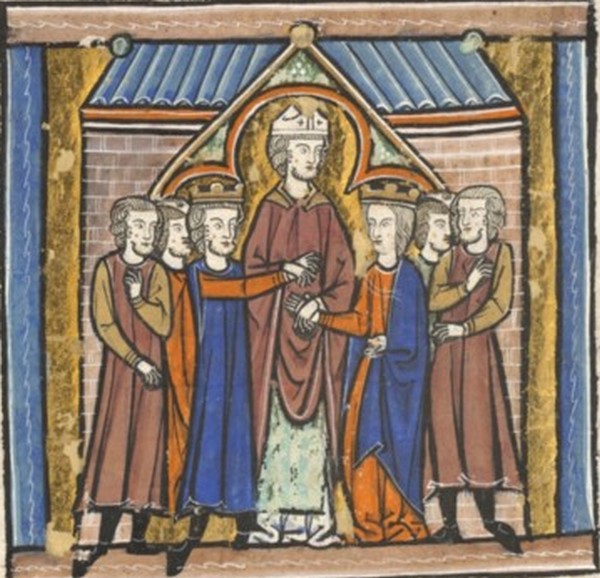
I like how some of the people in the background aren't even paying attention.
[Marriage of Amalric I and Maria Komnene, 13th century, source: Wikimedia Commons]
Maria Komnene (c. 1154 – before 1217), Queen of Jerusalem, held power by virtue of both her connections to the Byzantine Imperial family and her first marriage to King Amalric of Jerusalem.  How well she used that power continues to be debated and people’s positions seem at least partially based on their opinions of her second husband, Balian of Ibelin.  She lived in tumultuous times, seeing the fall of the city of Jerusalem (though not the Kingdom) to Saladin and playing her own significant role in the events of the time, first as Queen, then as Dowager.
 
Maria was the daughter of John Doukas Komnenos and Maria Tronitissa.  Through her father she was grand-niece and cousin to the Byzantine emperors while through her mother she was descended from Armenian royalty.  She grew up in Constantinople, where she received a broad education befitting a Byzantine princess.
 
In 1167, when she was about 13, Maria was crowned Queen of Jerusalem and married its king, Amalric as his second wife.*  The couple had only one surviving child in their seven years of marriage: a daughter, Isabella.  Amalric died in 1174, leaving Baldwin IV as king and Sybilla as his heir, the children of his first wife.  Maria, now the dowager queen, retired with her daughter to Nablus, left to her by her husband for her lifetime.
 
For several years Maria mostly stayed out of politics.  She was against the betrothal of her daughter Isabella to Humphrey of Toron, but was unable to stop it.  She eventually married Balian of Ibelin** and had at least four children with him.  Once Baldwin IV died, Maria and her husband reentered politics, opposing Sybilla’s husband Guy of Lusignan.  It was Maria who eventually persuaded Isabella to agree to a divorce from Humphrey so she could marry Conrad of Montferrat instead.
 
When Saladin besieged Jerusalem, Maria was among those trapped in the city.  Balian arrived to secure safe passage for her and her children, and Saladin granted it on the condition that Balian not take up arms.  Balian went back on his word.  Saladin, however, still provided safe passage, probably in large part because he didn’t want to anger the Byzantine Emperor by injuring part of his family.
 
Maria continued to play a role in selecting her daughter’s husbands as each died.  She also had a hand in negotiating the marriage of her granddaughter Alice of Champagne’s marriage in 1208.  She disappears from the historical record after this, leaving her ultimate fate unkown.
 
 
*He’d been required to divorce Agnes of Courtenay, his first wife before becoming king.  Maria’s coronation actually happened before her marriage, though she only became queen because of said marriage.
**As far as we can tell it was for no reason other than that she wanted to.

Sources/Further Reading:
William of Tyre, History of Deeds Done Beyond the Sea - Internet History Sourcebooks Project
Claster, Jill N. Sacred Violence: the European Crusades to the Middle East, 1095-1396. Toronto: University of Toronto Press, 2009.
Maria Comnena, Byzantine Princess and Dowager Queen of Jerusalem - Defender of Jerusalem
Maria Comnena, Lady of Ibelin and Founder of Two Dynasties - Defender of Jerusalem
0 Comments

    My Blog

    Translation of the above: where I post the interesting things I find researching the Classical and Medieval periods in my free time.

    Currently Reading:
    -
    Medieval Monasticism by C. H. Lawrence

    Archives

    March 2016
    February 2016
    January 2016
    December 2015
    November 2015
    October 2015
    September 2015
    August 2015
    July 2015
    June 2015
    May 2015
    April 2015
    March 2015
    February 2015
    January 2015
    December 2014
    November 2014
    October 2014
    September 2014
    August 2014
    July 2014
    June 2014
    May 2014
    April 2014
    March 2014
    February 2014
    January 2014
    December 2013
    November 2013
    October 2013
    September 2013

    Categories

    All
    Architecture
    Biography
    Classical
    Law
    Marriage (legal And Otherwise)
    Medicine
    Medieval
    Misconceptions
    Monasticism
    Overview
    References
    Religion
    Review

    RSS Feed

Powered by Create your own unique website with customizable templates.