Emily Kittell-Queller
  • Home
  • About Me
  • Blog
  • Projects
  • Resume
  • Contact Me

Nuns and Social Class in Northwestern Europe

31/1/2014

0 Comments

 
The examination of nuns and social class suffers from a scarcity of sources, but in this case the problem is more complicated than “we don’t have many sources.”  Monasteries full of nuns who came from wealthier and more aristocratic backgrounds were generally going to have more resources and as a result, were more likely to leave behind documents and other evidence.  So already we have a historical record that tends to obscure the existence of non-aristocratic nuns.

One thing the records do seem to show is a growing interest in Benedictine monasticism for women in the 10th and 11th centuries in what is now France.  Several aristocratic women decided to found their own communities and often became their first abbesses.*  Most of the nuns in these monasteries would have come from the same class as the founder, partially out of economic necessity.  Some of them, however, did accept members from other classes in society, even former serfs.

Picture
Ronceray, one of the few monasteries we know for sure took women from a variety of social classes, at least for a time.
[The abbey church at Ronceray, 11th & 12th centuries, photographed by Sémhur]
[Source: Wikimedia Commons]

There is a pair of letters between the head of a community of canonesses Tenxwind von Andernach and Hildegard von Bingen wherein Tenxwind criticizes Hildegard’s ostentation and her practice of accepting almost no nuns not from aristocratic backgrounds.  Hildegard’s reply makes clear her opinion that nuns should be recruited almost entirely from the upper classes.

Poverty was always a problem for the women’s monasteries of northwestern Europe.  One of the ways they supported themselves was to request a gift of any new member entering the monastery, which ended up shutting out those who could not afford it.  The also depended on donations because of the presence of a relic or simply out of pious generosity, both of which were easier to get if one had connections to wealthy people.  Economic necessity pushed some monasteries towards accepting mostly nuns from wealthier backgrounds.  The simple fact that poorer monasteries were less likely to leave behind evidence of their members and their existence has skewed our perception even further.

*The fact that so many of these original abbesses were aristocratic women may have been why so many of them either tried to associate themselves with Cluniac Reforms or found other ways of excluding the local bishop at least from interfering with the election of their abbesses if not from all decisions regarding the monastery.
Sources/Further Reading:
-The Rule of St. Benedict
-Jewell, Helen M., Women in Dark Age and Early Medieval Europe c. 500-1200, 2007.
-Nichols, John A. and Lillian Thomas Shank, eds., Distant Echoes: Medieval Religious Women, Volume One. 1984
0 Comments

Widowhood in Ancient Greece

29/1/2014

2 Comments

 
Picture
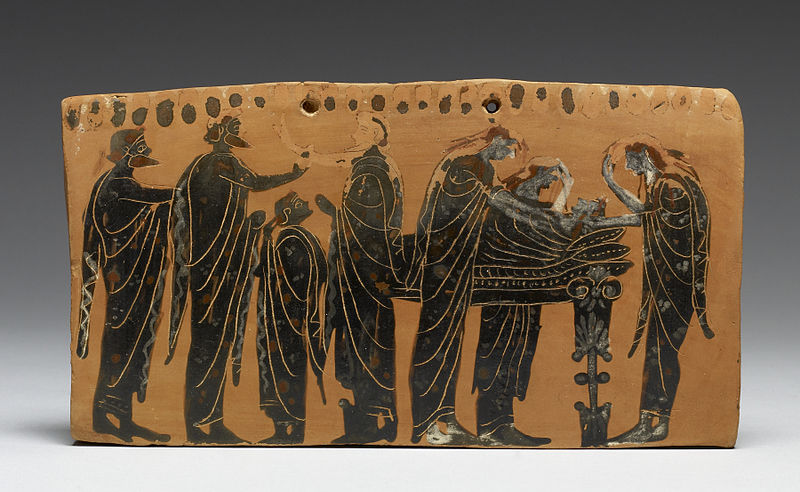
No idea who is actually being buried here, but for the sake of this post I'm pretending they left a widow.
[Pinax depicting a funeral, 6th cent. BCE, photograped by the Walters Art Museum]
[Source: Wikimedia Commons]
As usual when it comes to studying Ancient Greece, most of our sources come from Athens.  There isn’t a whole lot of information on other city-states, but there is some.  In Athens it was felt that one of the worst things one could do to a citizen woman was to leave her unmarried.  Most widows remarried or were at least betrothed again shortly after the death of a husband.  Many husbands even made these arrangements themselves.  In general, they were expected to provide her with a dowry equal to or larger than the one they received on marrying her or provide a good excuse.

If a widow didn’t remarry, it was generally because she was past childbearing age.  This was a precarious position to be in.  A widow with adult sons who did not remarry would usually have one of them for her kyrios, or guardian.  The law provided for protection from abuse by her sons.  How reliable that protection might have been seems likely to have depended on social class at the very least.  Childless widows and those with underage children were dependent on the power of their male relatives and only those with children were permitted to stay in their late husband’s household.  None of this is to say that they were completely powerless, but they were dependent on the standing they had with those relatives.*

Outside of Athens it seems that widows had more control over their own lives.  At the very least, many city-states allowed women to own property in their own right, even if they couldn’t dispose of it without the permission of their kyrios.**  In the city of Gortyn a man could not leave property to anyone but the legal (male) heir except to leave a gift to his wife.  City-states other than Athens also seem to have had less of an emphasis on remarrying a widow right away, probably in part because they at least allowed women to own property.


*A good example of this is the case of the widow of Diodotus, who with the help of her other male relatives, took her kyrios to the task for recklessly spending her underage sons’ inheritance.  We also see widows working to support themselves or their children.  Nearly all of the women we see making business transactions were non-citizens, childless widows and widows with young children.
**This also seems to have meant that a woman’s kyrios couldn’t dispose of it without her permission.

Sources/Further Reading:
-Mary R. Lefkowitz and Maureen B. Fant, Women's Life in Greece & Rome: a Sourcebook in Translation, 1992. (The index is unfortunately lacking the term "widow" for some reason, but you can search the book for it here on Google Books.  Most of the sources in there refer to Rome, but there are a few from Greece.)
-David M. Schaps, Economic Rights of Women in Ancient Greece, 1979.
2 Comments

Hadewijch

27/1/2014

0 Comments

 
Hadewijch of Brabant, also known as Hadewijch of Antwerp*, was a beguine, poet, and mystic sometime between the mid-thirteenth and early fourteenth centuries.  Despite the fact that she is actually one of the best-known beguines, we actually know very little about her life.  We don’t even really know quite when she lived other than a very general estimate.**  Pretty much all the information we do have comes from writings: letters, poetry, and a very small work on visions. 

She was probably from a wealthy family, as shown by her ability to reference both theological works in Latin and courtly poetry in French.  At some point in her life, she seems to have been the head of a beguine community for a while before leaving.   At this point she took up a wandering life, unusual but not unheard of for a beguine.
Picture
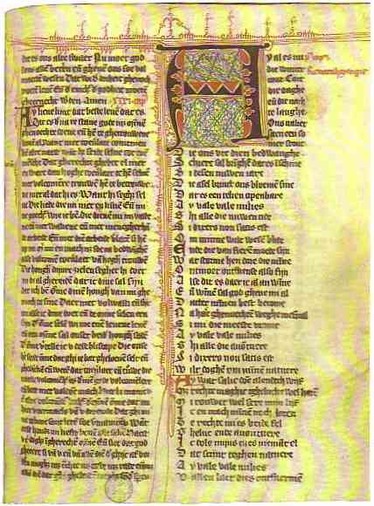
[Manuscript page of one of Hadewijch's songs, 14th century, source: Wikimedia Commons]
Her writings are among the first medieval works of prose we have in the vernacular, in this case Brabintian Middle Dutch.  Most of her works show her strong interest in Love of the spiritual variety.  Love, characterized as female, is powerful, overwhelming, and painful, but She is also glorious.  Hadewijch, as shown by the tone of most of her letters, felt this very strongly and felt that she had been given this information to share it and to teach her fellow beguines.  Interestingly enough, the way most of her poems are structured, it seems likely that she intended them to be sung, not spoken.  Some scholars have argued that they were meant to be danced to as well. For all that she lived out a significant portion of her life as a solitary beguine and was quite clearly a mystic, she had a stronger interest in community and her fellow beguines than in the mystical glory of God.


* Though we don’t actually know for sure that she lived there.
** Some argue that she died in the 1260’s.  Others think she was still writing poetry in 1300. 

Sources/Further Reading:

General:
Walter Simons, Cities of Ladies: Beguine Communities in the Medieval Low Countries, 1200-1565, 2001.  (Note: To read bits of this book, try here.)
Hadewijch of Antwerp: The Love Mystic - Medieval Women Writers
Hadewijch - Wikipedia

Poetry:

Hadewijch of Brabant and the High Palace of Love - Amazing Grace
Poems in Stanzas by Hadewijch of Brabant - Medieval Christianity
Hadewijch - Poetry Chaikhana
Stanzaic Poems - Medieval Women Writers

Letters:
Hadewijch Letters - Medieval Women Writers
Hadewijch - Digitale Bibliotheek voor de Nederlanse letteren (Note: This site is all in Dutch.  As a result, I've only puzzled out a bit of it, but it looks pretty useful if you speak the language.)
0 Comments

Constantine I and the Conversion of the Empire

24/1/2014

0 Comments

 
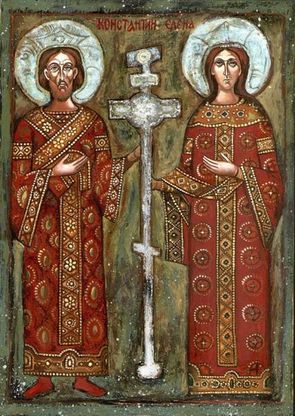
Picture
[Orthodox Bulgarian icon of Constantine & his mother St. Helena, scanned by Brosen]
[Source: Wikimedia Commons]

I see these around a lot: “Constantine converted the Roman Empire to Christianity” or “Constantine made Christianity the official religion of the Roman Empire.”  It comes from all sorts of people, too.  It gets used as a background fact in all kinds of different arguments.  Thing is, it’s not true.

It’s a well-known story.  In 312 Constantine marched his army towards Rome so he could claim the title of Emperor.  He encountered the army of his main rival near the Milvian Bridge north of the city.  The night before the battle, he had a vision of a particular Christian symbol and the words “under this sign you will conquer.”  He had his soldiers paint that mark on their shields, won the battle, and became Emperor.  As a result, he immediately converted to Christianity and made it the official religion of the Roman Empire.

The story is pretty accurate except for that last sentence.  Constantine did eventually convert to Christianity, but was not baptized until just before he died.  Even so, he had a strong interest in the Christian religion.  Wit the Edict of Milan in 313 he declared the state neutral in matters of religion.  He also financed the building of churches, gave the clergy certain privileges, and gave Christian men important positions in the government.  He encouraged the religion’s leaders to come to an agreement about their theology by holding big church councils like the Council of Nicaea.**  By the time he died, Christianity was the dominant religion within the Empire.

The thing is, neither Constantine nor the Empire was just going to let go of their gods so quickly.  Constantine dedicated the Arch of Constantine to Victoria and made sacrifices to Apollo, Diana, and Hercules.  He used Apollo’s symbols at the dedication of Constantinople, not those of Christian God.  Lastly, it was Theodosius I who made Christianity the official religion of the empire, 43 years after Constantine’s death.


*A lot of people assume it was a cross.  Actually it was a Chi Rho.
**Whence comes the Nicene Creed, for anyone who’s encountered that one in church.  And no, please don’t make me explain the theology discussed in this one.  I don’t fully understand it myself.  A lot of it has to do with the nature of Jesus and God the Father.   The one in-depth discussion about it that I was part of in class led to general confusion and quotes like “So, is he two people or four people or all one big ball?”  A theologian I most definitely am not.

Further Reading:
Eusebius of Caesarea: Life of Constantine - Internet History Sourcebookss
Constantine I - Wikipedia
Constantine & Christianity - Wikipedia
Constantine & Judaism - Wikipedia
Eusebius of Caesarea - Wikipedia
0 Comments

Anchoresses and Anchorites

22/1/2014

0 Comments

 
The life of an anchoress* or anchorite was an especially popular form of religious life in the high Middle Ages, particularly in northwestern Europe.  A person, usually a nun, monk, or beguine, but sometimes a new convert, would retreat from the world to live an enclosed, contemplative, and ascetic life.  They were considered dead to the world, having been reborn into the life of a solitary.  Given that and the fact that an anchoress’s living space was often known as a “cell,” it’s unsurprising that we often picture them shut up all alone in a tiny space with no contact with the outside world.  The thing is, well, that wasn’t really the case.
Picture
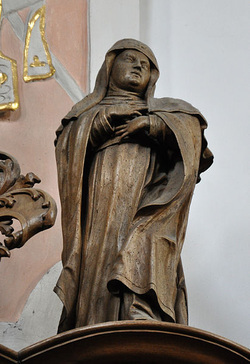
This lady, Juliana of Liège (aka Juliana of Mont-Cornillon) started out as a beguine before becoming an anchoress.
[Juliana of Liège, Church of St. Magnus, carved by Georg Anton Machein, 1717-1715]

[source: Wikimedia Commons]
While it’s true that some lived alone in a single small room, some of them had multiple rooms, or even an entire house.  There are even examples of women living enclosed in groups of two or three.  Usually, but not always, this was because there weren’t enough spaces for women wanting to be anchoresses and having to join someone who was already enclosed.

Anchoresses were not left on their own.  There was always some church official keeping an eye on them.  They also received a lot of visitors, frequently pilgrims, most of them seeking advice.  Many anchoresses also lived in cells attached to churches and some of them weren’t restricted just to their cell, but to the church building as a whole.
Picture
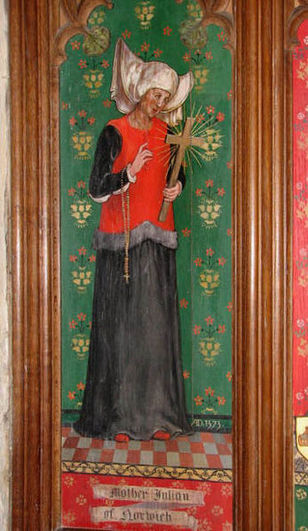
One of the most famous medieval anchoresses and mystics.
[St. Julian of Norwich in the Church of SS Andrew and Mary]
[Photographed by Evelyn Simak, source: Wikimedia Commons]
Lastly, while the ideal was for this to be permanent, it often wasn’t.  Some did stay until they died.**  Others left because they couldn’t handle it or because they felt their time as an anchoress was done or for any number of reasons.  Some anchoresses also started alone or with one other person and eventually gained so many students and companions that they ended up founding their own monasteries instead.***  Maybe they were supposed to be permanently enclosed and shut off from everyone else, but that’s not how it worked in practice.


*I’ll be defaulting mostly to the feminine terms for three reasons:  1) “because everybody does it” is a stupid reason to default to masculine terminology, 2) women tended to outnumber men among anchoresses and anchorites anyway, and 3) why not?
**Julian of Norwich, for example
***Hildegard von Bingen, for example, was enclosed as an anchoress with Jutta of Sponheim.  Jutta is considered to have remained an anchoress until she died despite the number of nuns living with her.  Hildegard, on the other hand, is considered the head of a community.

Sources/Further Reading:

Ann K. Warren, "The Nun as Anchoress: England 1100-1500," in Distant Echoes: Medieval Religious Women, 1984.

Walter Simons, Cities of Ladies: Beguine Communities in the Medieval Low Countries, 1200-1565, 2001.

Anchorite - Wikipedia

How I Became a Medieval-style Anchorite - Catholic Herald
0 Comments

Sulpicia I

20/1/2014

0 Comments

 
At last the love I’ve waited for has come.
(No shame to say so: more to cover up.)
My Camenae called on her in prayer,
and Cytherea brought him to my heart.
Venus kept her promise: now she can tell
my tale of joy to those who don’t believe.
I hardly want to give this letter up
so no one else sees it before he does.
I’m glad I did it—why wear a prudish mask,
as if he wasn’t good enough for me!

-Sulpicia, Tibullus 3.13, translated by Anne Mahoney, Source

In the third book of elegies by the Roman poet Tibullus can be found six poems by a student of his.  Under most circumstances such a thing wouldn’t rate much more than a note in some academic text. Depending on the scholar, they might also be used as an example of a Roman poet giving a beloved person a pseudonym.  These poems, however, are important for other reasons as well: their author is the only female poet from Ancient Rome whose poetry we still have.*

Sulpicia, daughter of Servius Sulpicius, probably lived during the reign of Emperor Augustus.  We don’t have much evidence of her life other than what is in her poems, but we do know some things.  Her father died sometime before she started writing poetry and she became the ward of her uncle, Messalla Corvinus.  As her uncle fancied himself a patron of the arts, he gathered around him a circle of authors and poets.  As a result, Sulpicia had access to Tibullus, Horace, possibly Ovid, and several others and eventually became part of what is known as “the Messalla circle.”

All of Sulpicia’s poems make some reference to love or her beloved.  Like many other Roman poets, she did not use her beloved’s real name, but gave him the name Cerinthus.  She directs most of her poems to her beloved, though as we know, these would have been written for a wider audience.  Her poems describe the strength of her love, her joy at getting to spend her birthday in Rome with Cerinthus instead of out in the country, her concern that she cared more for him than he for her, and her frustration when he fell for a prostitute.

Unsurprisingly, several scholars argued that these poems were actually the work of a man writing in a woman’s voice, because a woman clearly couldn’t be learned enough to make all of those obscure references or write poetry well.  They have by now mostly been discredited.  In fact, one scholar, Judith Hallett, has made the argument that an additional five poems should be considered her work.

*There is a single fragment [link] attributed to another female poet who lived 100-150 years later whose name was also Sulpicia.  Other than this fragment, we know of this Sulpicia (known as Sulpicia II in contrast to Sulpicia I) through references to her in the works of others, Martial in particular.  She seems to have celebrated the sexual love between herself and her husband while also being a strict moralist.

Further Reading:

Judith Hallett, "The Eleven Elegies of the Augustan Poet Sulpicia," in Women Writing Latin: Women Writing in Latin in Roman Antiquity, Late Antiquity, and the Early Christian Era, edited by Laurie J. Churchill, Phyllis Rugg Brown, and Jane E. Jeffrey

Translations of Sulpicia's Poetry:
-Perseus
-Diotima
-Roman Elegy

Sulpicia - Wikipedia
0 Comments

Maes Howe: Viking Graffiti in a Prehistoric Tomb

17/1/2014

0 Comments

 
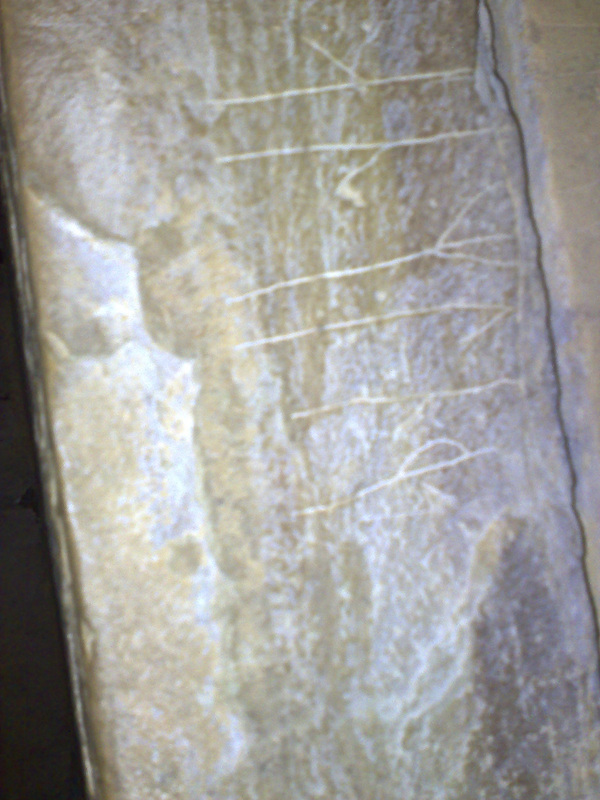
According to the Orkneyinga Saga, a group of Vikings under Earl Rognvald found shelter from a storm in a prehistoric burial chamber in Orkney sometime around 1250-1254.  The place is known as Maes Howe.  Whether or not this was the first time Vikings in the area entered the Howe is unknown, but the evidence that they really did spend some time in there is pretty clear.  They left graffiti on the walls.
Picture
["12th century graffiti," Maes Howe, Photographed by James Morrison]
[Source: Flickr]

Several inscriptions make specific reference to Christianity.  Some people simply drew crosses on the wall, one of whom felt it necessary to identify himself: “Benedikt made this cross.”*  Two make reference to the fact that at least some of these Vikings went on crusade, referring to the ones who broke in as “Jerusalem men.”  Interestingly enough, the author of one of these identifies herself, yes herself, as the Earl’s housekeeper, a position that would only have been held by a slave woman.  “Jerusalem-travelers broke Orkhaugr.  Hilf, the Earl’s housekeeper, carved.”  Whether or not this indicates a high level of literacy among free women and slaves of all genders in this area is up for debate, but at the very least it shows that this slave woman was not totally barred from reading and writing.

A few felt it necessary to make sexual comments.  “Ingigerther is the most beautiful” can be found right next to a drawing of a drooling dog.  Others make references to treasure that may or may not have been carried off from the mound.  “Happy is he who can find the great wealth.”  “Hókon alone carried treasure from this mound.”

As was the case in Pompeii, a fair number of the inscriptions follow the pattern “x was here” or “x carved these runes.”  Another, however, took this even further: “the man most skilled in runes west of the ocean carved these runes with the axe which Gaukr Trandilsson [a famous Icelandic hero of the century before] owned in the south of the country.”  No modesty here.

*It’s also worth noting that Benedikt very definitely was not a Scandinavian name.

Sources/Further Reading:
C.A. Cooijmans, "Between the Cracks: A Socio-historical Context of the Runic Inscriptions of Maes Howe, Orkney," University of Utrecht
12th century Viking Runes in Maes Howe - Maes Howe Winter Solstice
Maeshowe - Wikipedia
0 Comments

Divorce in Ancient Rome

15/1/2014

0 Comments

 
Picture
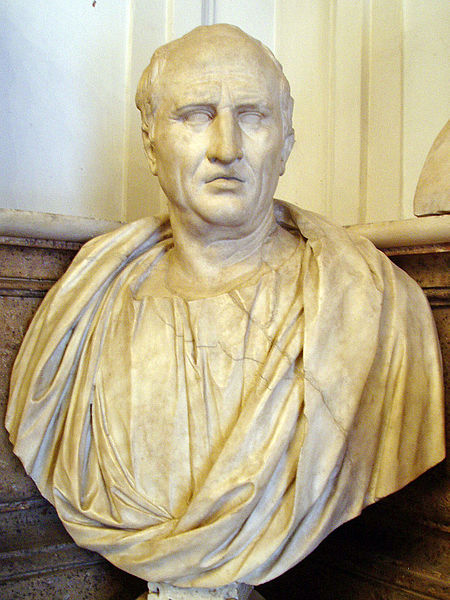
Cicero is known to have divorced his first wife, Terentia, in part because their relationship began to fall apart, but perhaps also in part because she could no longer support him economically.
[Marcus Tullius Cicero, 1st century, Musei Capitolini, Source: Wikimedia Commons]
Divorce was legally allowed throughout Roman history, a fact that was not infrequently taken advantage of.  As in many other places and times throughout history, the husband had a lot more freedom in initiating divorce than the wife.  During the time of the monarchy, a man might divorce his wife without penalty for use of drugs or magic on account of children, counterfeiting the keys, or adultery.  If he divorced her for any other reason, part of his estate had to go with her.* 

As time went on, both the Roman legal system and public opinion became a bit more even more open to divorce.  At least part of this probably had to do with the fact that the only legal basis for marriage affectio maritalis, essentially the intent to be married (which I've talked about before here).**  As a result, if a couple (or one of their fathers if one or both of them were still legally under a father’s power) decided that for some reason they lacked that intent, they had every legal right to dissolve their marriage.

By the time of the Empire the law had very little to say about the conditions under which one could or should divorce other than Augustus’s decree that a man must divorce his wife if she were convicted of adultery.  For the most part, jurists focused their energies on dealing with the consequences of divorce.  When a woman divorced, her dowry was returned to her, minus one-fifth of it per child she produced, and she or her father had the legal right to sue if she did not get it.  Her husband retained an additional sixth of it if she had committed adultery.  If woman found she was pregnant within thirty days after a divorce, her ex-husband was legally required to recognize and support the child.

This isn’t to say that Romans moved in and out of marriage as they willed.  Marriage was still the socially preferred state for Roman citizens, but forcing people to remain married in perpetuity was never considered an option.


*It’s worth noting that though a wife was not permitted to divorce her husband, there was a way in this time period for her to retain the respectability of the married status while avoiding being legally under her husband’s control.  By absenting herself from his household for three nights in a row every year, she interrupted his prescriptive right to her.  (Table VI)  This practice fell out of favour by the time of the Empire. (Gaius, Institutes 1.111)

**Not necessarily love.  Yes, the literal translation of the term is “marital affection,” but it’s important to remember that romantic love wasn’t really considered a factor in western European marriages until the Modern period.  In a lot of marriages this had to do with politics on one scale or another.

Further Reading:
The Laws of the Kings, 7th/8th cent. BC - Diotima
The Twelve Tables (excerpts), 450 BC - Diotima
The Julian Marriage Laws - Diotima
Consent as the Basis of Marriage - Diotima
Pregnancy, Status, and Paternity - Diotima
Marriage in Ancient Rome: Divorce - Wikipedia
0 Comments

Hildegard von Bingen (1098-1179)

13/1/2014

0 Comments

 
Picture
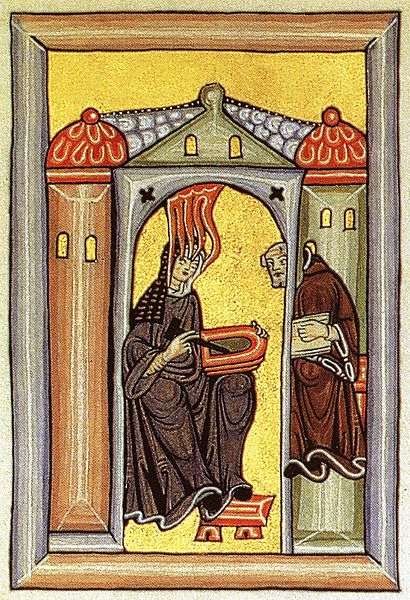
Probably the most well-known picture of Hildegard in existence.
[Hildegard and Volmar, Scivias, Rupertsberg Codex, Source: Wikimedia Commons]
I know I’ve talked about Hildegard of Bingen before, but really only in the context of her migraines.  I really should have talked about who she was and I love her so much before now.  So, doing that now.

Hildegard was born in to a family of the lower nobility in what is now southwestern Germany.  She was enclosed with Jutta of Sponheim as an anchoress at the monastery of Disibodenberg at the age of fourteen.*  When Jutta died in 1136, the community of nuns that had collected around them elected her magistra.**

Relations between the nuns and their abbot were not peaceful, and in 1150 Hildegard moved herself and her nuns out of Disibodenberg to build their own monastery at Rupertsberg, near modern-day Bingen.  The monks were not pleased, in large part because they lost the income derived from the nuns’ dowries that had previously come to Disibodenberg.

Hildegard had visions all of her life, but kept them mostly secret until 1141, when one of them caused her to feel she had to write them down.  She began seeking, and soon got, the approval of the Church authorities.  She ended up writing three visionary works which found readers all over Europe, usually dictating them to her confessor Volmar or her assistant Richardis, both of whom were close friends.  Her fame as a visionary spread and she became known as the Sybil on the Rhine.

She didn’t restrict herself only to visionary works though.  She also produced two medical texts, a wide variety of songs, two saints’ lives, and a gospel commentary.  She invented both the genre of the morality play and her own language.  She is one of the few saints from this period whose Vita includes autobiographical passages.  She gave homilies on biblical texts within her own monastery and went on four preaching tours where she preached to mixed audiences of men and women, religious and lay.  This was something women in this time simply did not do.  But she did it.  She also wrote and received letters, almost 400 of which survive.  She corresponded with a wide variety of people, from popes and emperors, to bishops, lords, and abbots, to ordinary lay people, answering questions and berating people in power for actions she felt went against God’s will. 

After her death, attempts were made to declare her a saint, but due to some bureaucratic mix-ups, the process took long enough that it was eventually dropped.  It was only in 2012, 850 years after her death that she was finally officially named Saint and Doctor of the Church.

*A lot of sources imply that she was much younger, around eight, at this point.  However, the only two sources to give a definitive date say this happened in 1112, when Hildegard was fourteen.  The general assumption now is that she was put under Jutta’s care at age eight and the two were enclosed together six years later.
**Not abbess.  As part of a female community attached to an older male community, she could not hold that post since it was already taken by the monks’ abbot.  Hildegard never held that title despite presiding over two independent monasteries.  This would be used against her several times in her life.

Further Reading:
-Flanagan, Sabina. Hildegard of Bingen: a Visionary Life. 1989. (Parts of this book can be found here.)
-Newman, Barbara, ed. Voice of the Living Light: Hildegard of Bingen and Her World. 1998. (Parts of this book can be found here.)
-The Life and Works of Hildegard von Bingen (1098-1179) - Internet History Soucebooks Project
-Saint Hildegard of Bingen  (Note: this site has a whole bunch of links to other good sources)
0 Comments

The City of Delphi

11/1/2014

0 Comments

 
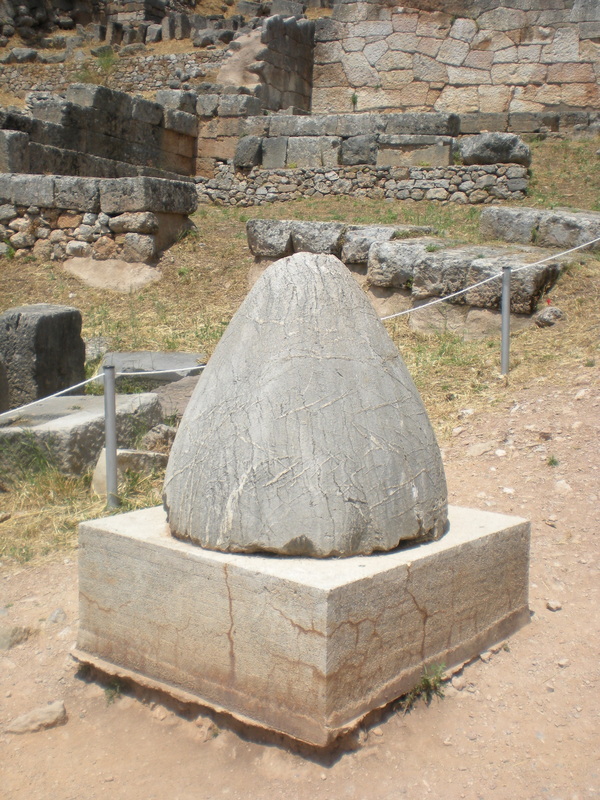
That the Oracle in the Temple of Apollo at Delphi was one of the most important sources of prophecy in Ancient Greece is fairly common knowledge.  There is, however, much more to the story than that.  According to the myth, Delphi was originally associated with Gaia (Earth), as this was the location of Her center, represented by the Navel of the World.  The site became sacred to Apollo after he slew Pytho, the dragon guarding it.  To atone for murdering Gaia’s son, he had to spend eight years in menial service.
Picture
["Navel of the World," Ruins of Delphi, Photographed by me]
This myth was held as a central part of the Pythian Games,* which were the second most important of the four panhellenic games after the ones at Olympia.  Unlike the Olympics of the time, these games also included competitions in art, acting, and dance. These actually started before the athletic competitions were ever introduced, probably in part because of the site’s dedication to Apollo.
Picture
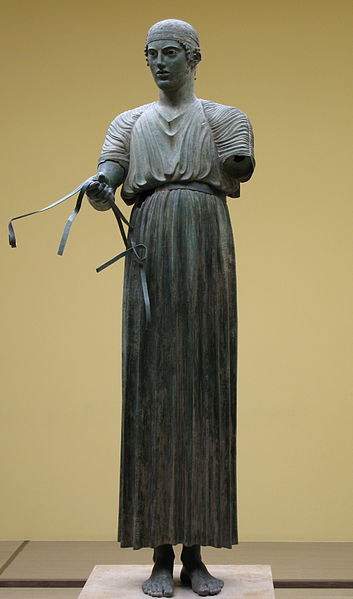
["The Charioteer of Delphi," 470's BCE, Delphi Museum]
[photographed by RaminusFalcon, Source: Wikimedia Commons]

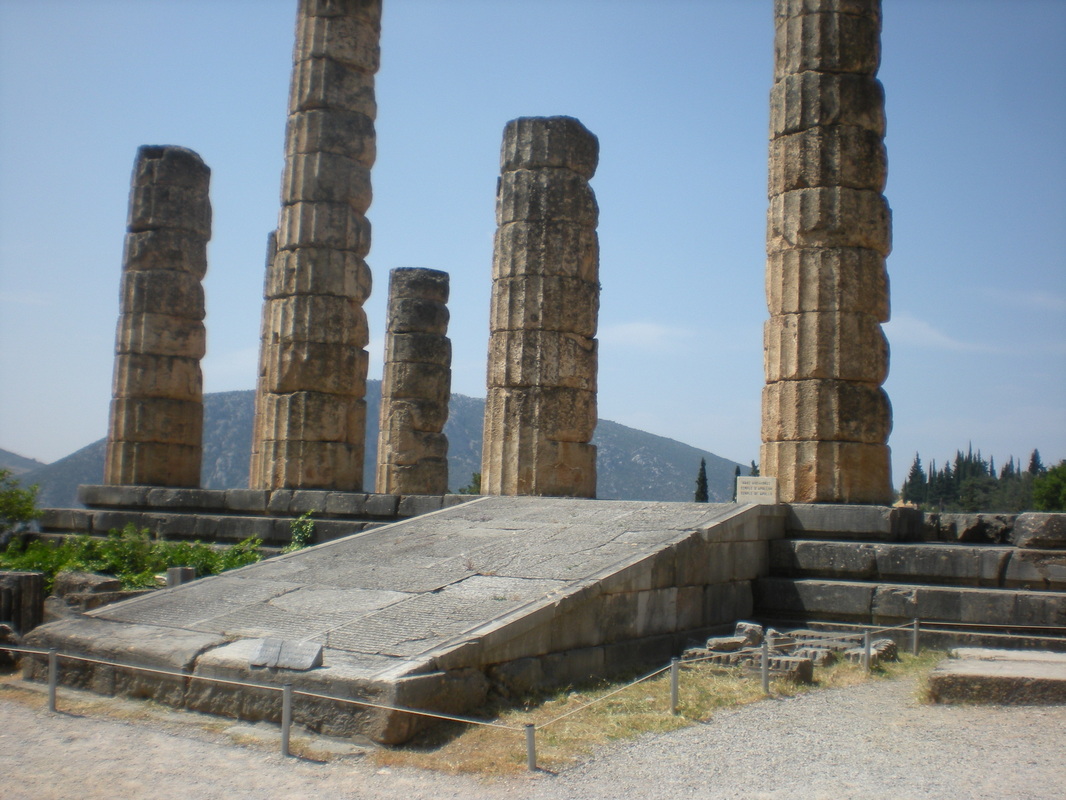
Pytho is also likely the source for the title given to the Oracle here, the most prestigious of the Ancient Greek Oracles: Pythia.**  Important people from all over the Hellenistic world came to Delphi to ask questions of this priestess of Apollo.  The responses she gave between the 6th century BCE and the late 4th century CE played a large role in shaping the history of Greece through how suppliants reacted to her prophecies.
Picture
["Temple of Apollo at Delphi," 4th century BCE, photographed by me]
It’s also worth pointing out that Delphi was and is also a town in its own right.  A town centered for a time around a really important religious site, but its own town nonetheless.  The ruins include a theater, a stoa, a gymnasium and a residential area in addition to the buildings related to the Games and the Oracle.  People still live in the area, though they were talked into relocating over the hill by archaeologists who wanted to excavate the site.

Note: I am well aware that I spent barely any time on the Oracle herself.  She’ll be getting a post to herself.

*Yup, named for Pytho
**For anyone who has seen Battlestar Galactica, yes, they were referencing the Oracle at Delphi.
Further Reading:
Delphi - Wikipedia
Pythia - Wikipedia
Charioteer of Delphi - Wikipedia
Temple of Apollo at Delphi - Ancient-Greece.org
Delphi - Sacred Sites
0 Comments
<<Previous

    My Blog

    Translation of the above: where I post the interesting things I find researching the Classical and Medieval periods in my free time.

    Currently Reading:
    -
    Medieval Monasticism by C. H. Lawrence

    Archives

    March 2016
    February 2016
    January 2016
    December 2015
    November 2015
    October 2015
    September 2015
    August 2015
    July 2015
    June 2015
    May 2015
    April 2015
    March 2015
    February 2015
    January 2015
    December 2014
    November 2014
    October 2014
    September 2014
    August 2014
    July 2014
    June 2014
    May 2014
    April 2014
    March 2014
    February 2014
    January 2014
    December 2013
    November 2013
    October 2013
    September 2013

    Categories

    All
    Architecture
    Biography
    Classical
    Law
    Marriage (legal And Otherwise)
    Medicine
    Medieval
    Misconceptions
    Monasticism
    Overview
    References
    Religion
    Review

    RSS Feed

Powered by Create your own unique website with customizable templates.