Emily Kittell-Queller
  • Home
  • About Me
  • Blog
  • Projects
  • Resume
  • Contact Me

Hildegard of Bingen's Letters

31/12/2015

0 Comments

 
Picture
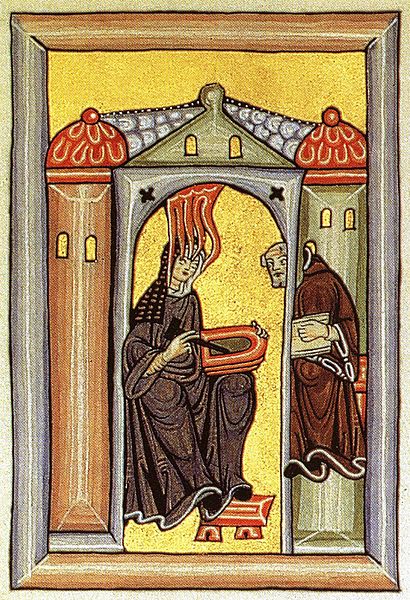
I love this picture.  Not my absolute favorite but I'll still take any excuse to use it again.
[Hildegard and her secretary and close friend Volmar, , Scivias, Rupertsberg Codex, source: Wikimedia Commons]
He who knows and discerns all creatures, Who rouses them and is watchful over them, the Living Eye sees and says: the valleys are complaining against the mountains, and the mountains are falling into the valleys.  What does this mean?  Subordinates are no longer disciplined by the fear of God, and madness sends them scaling the heights of the mountains to rail at their superiors.  And they are too blind to see the error of their evil ways.
--Hildegard von Bingen to Pope Eugenius III, 1153
Among the works by Hildegard of Bingen is a collection of letters, many written by her, but others written to her asking, or in a few cases giving, advice.  People from popes to abbesses to ordinary monks, from kings to laywomen wrote to her for counsel and information and received letters in reply.  At the beginning of her career and during two of the three major crises in her life* she wrote to powerful male churchmen seeking advice or, more commonly, relying on her utter certainty that God was on her side.  She is best known for her visionary texts, but her letters may well have had the most immediate effect on a broader range of people.
 
Most of her letters we know of come from a manuscript known as the Riesencodex** and were organized not by date, but by the status of the correspondent.***  Her letter to Bernard of Clairvaux comes first, followed by letters to popes and archbishops, kings and queens, bishops, nobles, and abbots/abbesses, and finally ordinary monks, nuns, and members of the laity.  The majority of the letters involve people writing to her for advice and her responses to them.  The higher status the person, the sharper she is with them, while abbots, abbesses, ordinary monks and nuns, and non-noble laypeople saw the more compassionate side of her.  The ones concerning the major crises of her life (see *) show more personal investment and give a clearer indication of her own strong feelings.
 
Most of these letters follow a general format: a description of a vision followed by its interpretation.  But it’s not actually that simple.  First of all, it’s not always clear whose voice she is using.  Many of her visions are spoken with the voice of the Living Light,**** but sometimes she switches back to her own words.  More often it’s uncertain precisely who the speaker is.  Second, it’s also unclear where vision ends and interpretation begins.  Vision bleeds into interpretation and interpretation into vision.  This was probably purposeful.  By obscuring the distinction, Hildegard was able to say things she wouldn’t have been able to get away with without divine backing.
 
 
*The election of the nun Richardis as Abbess of Bassum and the interdict placed on her community resulting from Hildegard’s dispute with Church authorities over a nobleman’s burial.  We have almost no letters concerning the third crisis (first chronologically), the dispute with her superiors at Disibodenberg, but the bad feelings resulting from it left their mark on subsequent letters exchanged between them.
**A collection of all her works except her medical texts, put together primarily by her last secretary, Guibert of Gembloux.  Hildegard herself seems to have had significant influence over any editing done.
***Which makes dating some of them kinda dicey at best.
****Her term for the divine speaking through her.

Sources/Further Reading:
Baird, Joseph L. and Radd K. Ehrman, trans. The Letters of Hildegard of Bingen. New York: Oxford University Press, 1994, 1998, 2004.
Ferrante, Joan. "Correspondent: 'Blessed Is the Speech of Your Mouth.'" In Voice of the Living Light: Hildegard of Bingen and Her World, edited by Barbara Newman, 91-109. Berkeley: University of California Press, 1998.
Flanagan, Sabina. Hildegard of Bingen, 1098-1179: a Visionary Life. London: Routledge, 1989.
0 Comments

Tryphaena

28/12/2015

2 Comments

 
Tryphaena (d.111 BCE) was a Ptolemaic princess who like her ancestor Berenike Phernophoros and her sisters Cleopatra Selene I and Cleopatra IV, she was more heavily involved in the politics of the Seleukid Empire than in the goings on in Egypt.  She was an active queen, who seems to have been comfortable acting independently of her husband on several occasions.
 
Tryphaena was the daughter of Cleopatra III and Ptolemy VIII Physcon.  She was born during their reign with Cleopatra II and married Antiochos VIII Grypus at around the same time the three of them reconciled in 124.  The Seleukids had been dealing with their own internal strife with several different men claiming the throne.  Tryphaena’s marriage brought Egyptian political support and troops in to support her new husband Grypus.  Her resources swung things in his favor and soon he was king, with her as queen.  The couple went on to have probably five sons and one daughter.
 
In 115, things changed.  Her sister, Cleopatra IV, was divorced from her husband, Ptolemy IX Soter, on the orders of their mother.  Rather than pursue queenship in Egypt once more, she raised an army and offered her own hand in marriage to Antiochos IX Cyzicenus, Grypus’ half-brother, cousin, and rival for the throne.  Tryhpaena was furious.  She accused her sister of bringing a foreign army into a dispute between brothers and of marrying outside of Egypt without their mother’s permission.  Three years later, she saw her chance.  When Cleopatra took refuge in a temple, Tryphaena ordered her executed there, despite people’s warnings about angering the gods by such an act.
 
Tryphaena herself would not live long after this.  Her brother-in-law captured her less than a year later and had her executed.  Her sister Selene eventually married Grypus herself.

Sources/Further Reading:
Justin, Epitome of the Philippic History of Pompeius Trogus 39.2-3 - Forumromanum.org
Flavius Josephus, Antiquities of the Jews 13.13.4 - Perseus
Tryphaena - Egyptian Royal Genealogy
Tryphaena - Livius.org
2 Comments

Children of Roman Freedwomen

24/12/2015

0 Comments

 
The children of Roman freedwomen existed in an odd position, both legally and socially.  Their mother’s legal status throughout her pregnancy and at the time of childbirth determined their status as freeborn or slave.  It also governed whether they legally and socially belonged to her or her (former) owners, a question that on at least one occasion prompted a lawsuit.  Lastly, only her freeborn children counted towards the four children necessary for her freedom from guardianship under the Julian Marriage Laws.
 
Children born outside of a Roman marriage followed the status of their mother.  So the child of as slave was a slave, but if she was freed before its birth, her child would be freeborn and had all the associated benefits.  This did not necessarily include citizenship though.  A freedperson automatically got citizenship if they were freed formally.  Informal manumission, however, meant that the woman any children she had would be Junian Latins, not Roman citizens, with some of the same rights, but without other significant ones.  Marriage was limited to citizens, as was the right to make a will.  And since only children born from a marriage were legitimate and illegitimate children followed their mother’s status, any children a woman who was informally freed would be Junian Latins as she was.  There were ways to gain citizenship, but it was an involved process and if the woman died before completing it, her property went not to her offspring, but to her patrons.
 
If, however, the woman was formally freed, whether in front of a magistrate or through someone’s will, she gained citizenship.  In that case, if she married, any children she had after that would also be citizens and would be under the potestas of her husband.  If she didn’t marry, any children she had would still be citizens, but they would be sui iuris, free from potestas but not necessarily guardianship, from birth.

Sources/Further Reading:
Gardner, Jane F. “Legal Stumbling-Blocks for Lower-Class Families in Rome.” In The Roman Family in Italy: Status, Sentiment, Space, edited by Beryl Rawson and Paul Weaver, 35-54. Oxford: Oxford University Press, 1999.
Pomeroy, Sarah B.  Goddesses, Whores, Wives, and Slaves. New York: Schocken, 1995.
Rawson, 7-30. Oxford: Oxford University Press, 1991.
Weaver, P. R. C. “Children of Freedmen (and Freedwomen).” In Marriage, Divorce and Children in Ancient Rome, edited by Beryl Rawson, 166-190. Oxford: Oxford University Press, 1991.
0 Comments

Isabella I of Jerusalem

21/12/2015

0 Comments

 
Picture
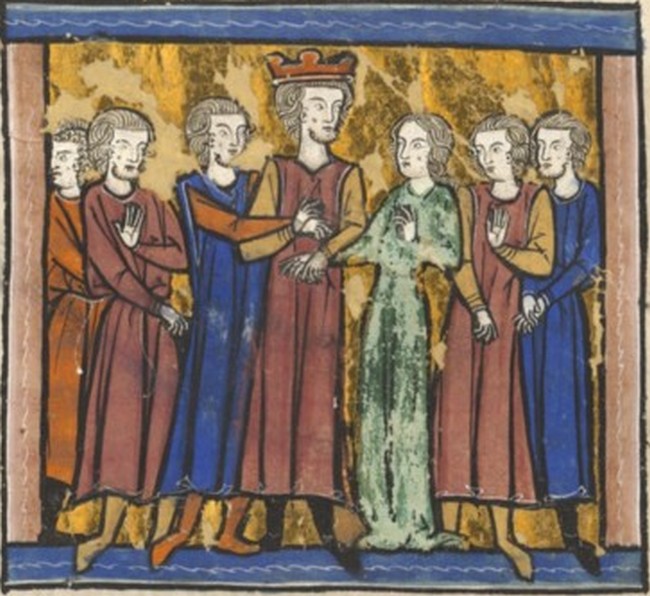
Husband one of four.  And possibly the one she liked the best.
[Marriage of Isabella of Jerusalem and Humphrey of Toron, 13th century, source: Wikimedia Commons]
Isabella of Jerusalem (1172-1205) reigned as Queen of after her elder half-sister Sibylla despite the city’s technical capture by Saladin in 1187.  She married four separate times, mostly for political reasons as keeping the throne would be a lot easier with an apparently strong and ambitious husband at her side.
 
Isabella was the daughter of Almaric I of Jerusalem and Maria Komnene.  Though her father’s previous marriage had been annulled, her half-siblings Baldwin and Sibylla were considered legitimate and were ahead of her in line for the throne.  Since Baldwin had contracted leprosy and it was unexpected that he would have children, Sibylla became his heir, though there were some who wanted to contest her legitimacy and put Isabella on the throne.
 
A few nobles actually tried to do this, but Isabella’s first husband, Humphrey of Toron, would have none of it.  The pair had been betrothed when she was 8 and he 14.  They married three years later.  Instead of trying to take the throne though, Humphrey, who did not want to be king, did homage to Guy of Lusignan, Sibylla’s husband, recognizing him as his lord.
 
When Sibylla died in 1190 and Guy refused to give up his crown, Maria insisted Isabella find a new husband who could take it back for her.  Isabella next married Conrad of Monferrat and the pair were acclaimed King and Queen of Jerusalem.  But it didn’t last long.  In 1192 Conrad got himself stabbed to death, leaving Isabella pregnant with a daughter, Maria.
 
Isabella chose to remarry very quickly, this time to Henry II of Champagne, who was closely connected to the kings of England and France and was politically a fantastic match.  The marriage only lasted three years though and ended when Henry fell out a window and died, leaving her with three more daughters.
 
She last married Almaric of Cyprus, Guy of Lusignan’s brother by whom she had two daughters and a son, who died in infancy.  They ruled together for seven years, dying days apart from each other in 1205.  Isabella's thirteen-year-old daughter Maria succeeded them as Queen.
Sources/Further Reading:
Isabella of Jerusalem - Epistolae
Queens Regnant: Isabella I of Jerusalem - History of Royal Women
0 Comments

Merchet

19/12/2015

0 Comments

 
Note: My most sincere apologies for the lateness of this post.

When a peasant woman married, there were either one or two notable expenses besides the wedding itself: the dowry and the merchet.  This second item was a fee paid to the lord on the marriage of an unfree peasant woman, essentially intended to counter her loss as a worker and some land as dowry.  How much the merchet actually was depended on the lord, his bailiff, the woman’s own property, and the size of her dowry.  Non-payment, no matter the size, could result in the seizure of all of her family’s property.
 
The thing is, merchet applied only to two groups of peasants: unfree peasants (i.e. serfs) and peasants who held land that was designated unfree but were themselves free.  In other words, the obligations of work and taxes that were required of serfs could also be tied to the land itself instead of or as well as to the people who worked it.*  So technically the lord or his bailiff could demand merchet from a free peasant woman, provided her family held unfree land.  How often that happened though is unknown.
 
It’s also worth noting, though, that not all unfree peasants paid the merchet either.  Before the 13th century (and perhaps even after in more out-of-the-way places) there was the question of clandestine marriage.  Some people might be declared married and required to pay the merchet, but others might simply live together as married without anything official.  Also, as time went by some families managed to conceal their serf status and get out a lot of their obligations.**
 
Then there was the question of dowry and who the woman married.  The amount owed for merchet often depended on the size of the dowry.  A woman with a dowry small enough might not have to pay anything.  If she married someone under the lord’s jurisdiction, the merchet would be smaller.  If she married farther afield, though, the payment was correspondingly larger.
 
A lot depended on circumstance and location.  The amount owed varied depending on who the woman married, where she lived, and what her family owned.  Some families managed to hide the fact that they owed merchet entirely, either by obscuring their serf status or obscuring whether or not there was actually a marriage.


*There are a number of ways a free peasant could come to hold unfree land.  To name a few, they could inherit it from a relative who was a serf, or even from a free relative who already held unfree land.  Or they could buy it from another free peasant.
**In some cases it became a secret they were willing to kill to protect.

Sources/Further Reading:
Payment of Merchet, Pope Gregory the Great - Internet History Sourcebooks Project
Searle, Eleanor. "Seigneruial Control of Women's Marriage: The Antecedents and Function of Merchet in England." Past and Present82 (1979): 3-43.
Gies, Frances and Joseph Gies. Marriage and Family i the Middle Ages. New York: Harper & Row, 1987.
0 Comments

Berenike III

14/12/2015

0 Comments

 
Like many Ptolemaic queens before her, Berenike III (d. 80 BCE), also known as Cleopatra Berenike, played an active role in the politics of her time.  She survived several regime changes and was eventually taken as the person to be connected to for a claim to the throne to be considered legitimate.  It’s possible that, like her great-grandmother Cleopatra II, she ruled Egypt on her own for a brief period of time.
 
She was the daughter of and the elder of Cleopatra III’s sons Ptolemy IX Soter and probably Cleopatra Selene I.*  She married her uncle Ptolemy X Alexander in 101 BCE, when she was somewhere between the ages of 15 and 20.  This was only a few years after he took the throne from her father (his elder brother), at the behest of his mother Cleopatra III.  Shortly after the marriage, he had his mother murdered.
 
Berenike had one child, possibly Cleopatra V, with Ptolemy X, but she also became stepmother to his son Ptolemy XI Alexander.  Their reign lasted until 88 BCE when Ptolemy X returned, took back his throne, and expelled them from Alexandria.  Berenike didn’t stay away long though and was able to return sometime before 81 BCE.  It’s possible, though not certain, that she may have co-ruled with her father during the last few years.  Some scholars even claim that he married her, but this seems less likely.
 
On her father’s death, Berenike briefly became sole ruler of Egypt.  Her reign lasted only six months before her stepson Ptolemy XI returned from Rome to take the throne and marry her.  Berenike’s status as both daughter of one previous king and wife of another granted legitimacy to bother her own rule and Ptolemy XI’s and it didn’t help that she was extremely popular with the people of Alexandria.  But her marriage and co-rule with Ptolemy XI didn’t last long.  Only 19 days after they married, Ptolemy had her murdered, only to die himself at the hands of a mob of angry Alexandrians, who had loved their queen.  The throne passed to Berenike’s half-brother Ptolemy XII.**
 
 
*It’s also possible that Cleopatra IV, not her sister Cleopatra Selene I, was Berenike’s mother.
**Who might have been illegitimate.

Sources/Further Reading:
Pausanias, Description of Greece 1.9.3 - Perseus
Eusebius, Chronicle 1.165 - Attalus.org
Berenice III - Egyptian Royal Genealogy
Cleopatra Berenice III - Livius.org
0 Comments

Sumptuary Laws in Ancient Rome

10/12/2015

0 Comments

 
As in Ancient Athens, Ancient Roman sumptuary laws (laws that regulate consumption and display of wealth) were mostly aimed at the upper classes.  There are two in particular that we know of by name, plus a third instituted by the Emperor Elagabalus.  In all three of these instances, the laws were aimed far more directly at women and their property than the Greek laws had been and may have been even more specifically intended to control wealthy women, perhaps because of the widespread notion that women were more likely to spend money uselessly on luxury goods.
 
The earliest of these, the Oppian Law, dates to 215 BCE, at the height of the Second Punic War.  It prohibited women from owning more than a certain amount of gold, wearing purple-trimmed or otherwise multicolored clothing, or riding in animal-drawn vehicles in cities and towns.  There were two reasons for this specific focus on women.  First, with the deaths of so many men in the war, women inherited most of the wealth.  Second women were associated with extravagant and useless displays of luxury, considered inappropriate with the fear of Hannibal’s approaching armies and with so many in mourning.  Men, it was presumably assumed would spend more on the war effort than women.  The law wasn’t repealed until 20 years later, six years after the end of the war, when the women of Rome demonstrated in the streets.
 
The Voconian Law, from 169 BCE barred the wealthiest of Rome from making a woman their heir or allowing a woman to inherit more than a small portion of their property.  It only applied to cases where a will existed.  Women could still inherit in cases where no will was made.*  Again, the point was to keep wealth out of the hands of women, who it was assumed would spend it on frivolous things.  Augustus’ marriage legislation relaxed the terms of this law enough that it essentially had no force.
 
The Emperor Elagabalus instituted a series of laws detailing what specifically women of different ranks could wear and display.  The story of a senate of women put together to decide one the details is almost certainly not true.  The laws were repealed on Elagabalus’ death.


*Another way around this was by fideicommissum, or nominally making someone one’s heir with the understanding that they would pass it on to a third party after one’s death.

Sources/Further Reading:
Pomeroy, Sarah B.  Goddesses, Whores, Wives, and Slaves. New York: Schocken, 1995.
Pomeroy, Sarah B. Women's History & Ancient History. Chapel Hill: University of North Carolina Press, 1991.
0 Comments

Sibylla of Jerusalem

7/12/2015

4 Comments

 
Picture
Sibylla is played by Eva Green in the wildly inaccurate movie Kingdom of Heaven.
[Eva Green as Sibylla of Jerusalem, Kingdom of Heaven, dir. Ridley Scott, 2005, source: evagreenweb.com]
Sibylla of Jerusalem (1160-1190), Countess of Ascalon and Jaffa, was the last Queen to reign in the Latin Kingdom of Jerusalem before its capture by Saladin.  Though perhaps not the wisest of queens, as evidenced by her loyalty to her husband over her loyalty to her kingdom, she otherwise proved a shrewd ruler, right up until the loss of her kingdom.
 
Sibylla was the daughter of Almaric I of Jerusalem and Agnes of Courtenay.  Her parents’ marriage was annulled not long after her father became king in 1163, supposedly due to consanguinity.  Sybilla herself was sent away to be raised by her great-aunt, the abbess Ioveta of Bethany, younger sister of Queen Melisende of Jerusalem.
 
Sybilla soon became important as more than just the heir’s younger sister though.  Her brother Baldwin IV had contracted leprosy and would not be able to produce children of his own.  Sybilla and the question of who she might marry suddenly became a significant political question, since she and her husband would rule on her brother’s death.  In 1176, two years after her brother took the throne, the sixteen-year-old princess married William of Montferrat, only for him to die nine months later, leaving her pregnant with a son, Baldwin.

Picture
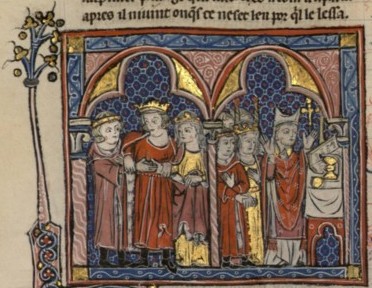
She doesn't look particularly happy about getting married.
[Marriage of Guy and Sibylla, 13th century, source: Wikimedia Commons]
She didn’t marry again for three years.  Phillip of Flanders tried to have her married to one of his vassals,* but the nobility of Jerusalem refused the match.  Her mother persuaded her to wed Guy of Lusignan, with whom she went on to have four daughters.  She seems to have loved him, but it turned out to be a bad political move. Baldwin IV appointed him regent only to revoke the appointment after he turned out to be terrible at the job.  Instead he made Sybilla’s son Baldwin V his heir with Raymond of Tripoli as regent.
 
Unfortunately, the young Baldwin V died only a year after his uncle, leaving Sybilla as Queen.  Unfortunately for her, her husband Guy was extremely unpopular.  She agreed to annul the marriage if she could choose whom she would marry next.  In a personally clever but politically stupid move, she chose Guy himself.
 
Only a year later, disaster struck for the new Queen, as her kingdom fell to Saladin and his armies.  Guy was captured, but released shortly thereafter when Saladin apparently decided he was a terrible leader would do him more good free and working for the Third Crusade, which had just arrived, than as his prisoner.  Sybilla and Guy joined the Crusade as they marched on Tyre and then Acre.  It was there that Sybilla died in an epidemic that swept the camp.  Her half-sister Isabella took the throne next.  Guy, however, refused to give up his crown for another two years.
 
 
*Which would have given him power over the Kingdom of Jerusalem without actually having to rule or defend the place.

Sources/Further Reading:
Sibylla of Jerusalem - Epistolae
Sibyl, Queen of Jerusalem - History and Other Thoughts
4 Comments

The Rise of Primogeniture

3/12/2015

0 Comments

 
Primogeniture, where the eldest son inherits all (or nearly all) of the family property, especially land, was not universal throughout the Middle Ages.  By the eleventh century it had become fairly common, especially among the upper classes, but it was still nowhere near universal.  Even where it was the rule, people sometimes found ways around it.  It certainly had benefits for the family as a whole, but it also created a number of problems, both for individuals and for society.
 
In the Early Middle Ages, even noble titles didn’t necessarily follow the male line by primogeniture.  At first they weren’t even inheritable.  Instead, the king decided who would get the title and the associated land on the previous person’s death.  Eventually though, it just became easier to give it to one of the person’s heirs.  Over time, “heir” became codified as “eldest son or next male relative”
 
Before primogeniture became the rule (and in places where it never took hold), the inheritance was generally divided up between siblings, usually but not always equally.  The benefit of this system was that parents could make sure each of their offspring had a share and therefore a way to support themselves, daughters included, though sometimes they received less.  The problem, of course, was that it meant family land got broken down into smaller and smaller pieces over time, reducing the resources any one individual could draw on.
 
Primogeniture meant that family land and other wealth stayed mostly in one piece, keeping the inheritance largely intact for each successive generation.  This system, though, had its own problems.  For one thing, it meant that unless all of their brothers died,* daughters inherited nothing more than their dowries, which usually weren’t under their control.  Younger sons had no hope of an inheritance either unless their older brothers died or they married an heiress.  It also meant that if a man failed to produce a son or something happened to all of his sons, the property might well pass right out of the family’s hands, going with his daughter to a new family.
 
 
*Or were otherwise made unable to inherit.  Monks, for example, renounced any claim on the family property.

Sources/Further Reading:
Gies, Frances and Joseph Gies. Marriage and Family i the Middle Ages. New York: Harper & Row, 1987.
Erler, Mary and Maryanne Kowaleski, eds. Women and Power in the Middle Ages. Athens, GA: University of Georgia Press, 1988.
Winks, Robin W. and Teofilo F Ruiz. Medieval Europe and the World. Oxford: Oxford University Press, 2005.
0 Comments

    My Blog

    Translation of the above: where I post the interesting things I find researching the Classical and Medieval periods in my free time.

    Currently Reading:
    -
    Medieval Monasticism by C. H. Lawrence

    Archives

    March 2016
    February 2016
    January 2016
    December 2015
    November 2015
    October 2015
    September 2015
    August 2015
    July 2015
    June 2015
    May 2015
    April 2015
    March 2015
    February 2015
    January 2015
    December 2014
    November 2014
    October 2014
    September 2014
    August 2014
    July 2014
    June 2014
    May 2014
    April 2014
    March 2014
    February 2014
    January 2014
    December 2013
    November 2013
    October 2013
    September 2013

    Categories

    All
    Architecture
    Biography
    Classical
    Law
    Marriage (legal And Otherwise)
    Medicine
    Medieval
    Misconceptions
    Monasticism
    Overview
    References
    Religion
    Review

    RSS Feed

Powered by Create your own unique website with customizable templates.