Emily Kittell-Queller
  • Home
  • About Me
  • Blog
  • Projects
  • Resume
  • Contact Me

Blanche of Castile

31/8/2015

0 Comments

 
Note:  This post is dedicated to my mom, who absolutely adores this lady.  Quite frankly, I don't blame her.
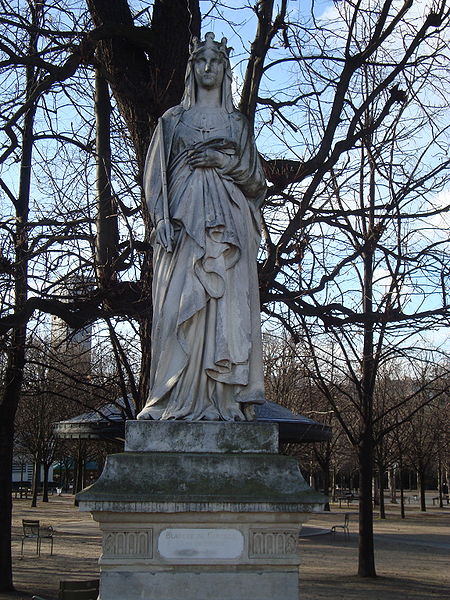
Picture
She who basically ran the country of France for nearly thirty years.
[Auguste Dumont, Statue of Blanche of Castile, 19th century, Jardin du Luxembourg, Paris, source: Wikimedia Commons]
Blanche of Castile (1188-1252), Queen of France, in the words of my mother, “basically ran the place” for much of her life, even when she wasn’t officially Queen Regent.  Officially, she held power during her son’s minority (1226-1234) and when he went on crusade (1248-1252), but she remained heavily involved in the government at least from 1226 onward, though it’s entirely possible she started earlier, before she even became queen.

Blanche was the daughter of Alfonso VIII of Castile and Leonor of England and the granddaughter of Eleanor of Aquitaine.  She was not originally supposed to marry Louis VIII of France.  Her sister Urraca was betrothed to him, but when their grandmother showed up in Castile to escort the bride to France, she decided Blanche was the better candidate.*
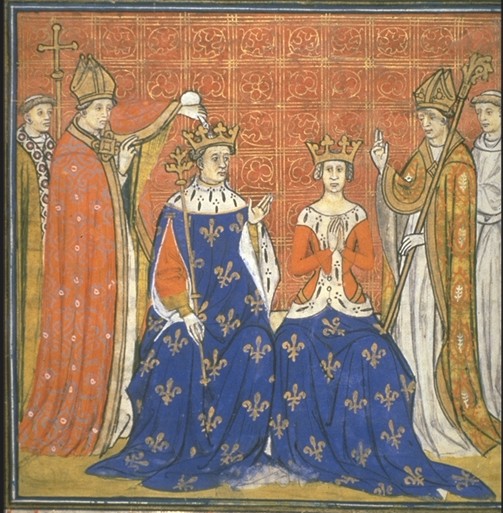
Picture
Not often you see the guy in some sort of spine twisting pose.  But yes, they were crowned together.
[Coronation of Louis VIII and Blanche of Castile, 14th century, source: Wikimedia Commons]
In 1200, 12-year-old Blanche was married to 13-year-old Louis as part of a treaty between John of England and Phillip Augustus of France.  She had her first child at age 17 and soon went on to have 12 more, five of whom survived to adulthood.  She was involved in politics long before her coronation as Queen, even getting money out of her father-in-law to support her husband’s invasion of England.**

She went from princess to Queen Consort to Queen Regent in a very short time, when her husband died three years into his reign, leaving their 12-year-old son Louis IX as his heir.  Blanche took to ruling like a duck to water.  When the western barons rebelled, she rode out to negotiate with them herself.  She also found the time to see to her children’s upbringing and was personally responsible for a lot of their teaching.
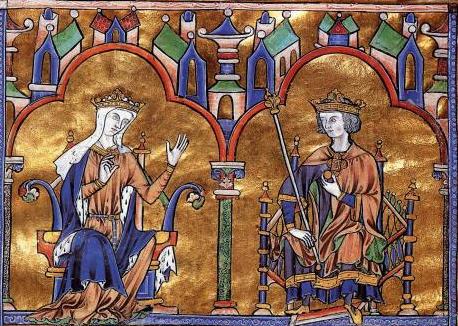
Picture
Louis XI was actually her fifth child and fourth son.  By the time her husband died though, he was her oldest surviving child.
[Blanche of Castile and Louis IX, Bible of St. Louis, 13th century, source: Wikimedia Common]
She stayed involved in government once Louis came of age, receiving and dealing with reports on the Albigensian Crusade, for example.  It was she who negotiated the marriage between her son Alphonse and Jeanne, daughter and heir of Count Raymond of Toulouse.  She took over officially once more when Louis left on the Eighth Crusade.  She was incredibly devout, but saw nothing wrong with opposing the pope politically.  She sided with Frederick II in his struggles and even confiscated the property of those of her vassals who fought against his son Conrad.  She is also known for her protection of the Jews, actively opposing her son’s desire to burn Jewish books and taking Jewish rabbis under her personal protection.

In 1252 Blanche decided it was time to retire.  She joined a monastery died there a few months later, while Louis was still on crusade.


*Urraca went on to marry Alphonso of Portugal.  Two of her other sisters, Berengaria and Eleanor, became queens of León and Aragon respectively.
**She, uh, may have threatened to use her children as hostages.

Sources/Further Reading:
Blanche of Castile - Epistolae
Barber, Malcolm. The Two Cities: Medieval Europe 1050-1320. London: Routledge, 1993.
Bériou, Nicole. "The Right of Women to Give Religious Instruction in the Thirteenth Century." In Women Preachers and Prophets through Two Millennia of Christianity, edited by Beverly Mayne Kienzle  and Pamela J. Walker, 134-145. Berkeley: University of California Press, 1998.
Jewell, Helen M. Women in Late Medieval and Reformation Europe 1200-1550. New York: Palgrave Macmillan, 2007.
0 Comments

The Peace of God Movement

27/8/2015

0 Comments

 
The Peace of God movement started in what is now southern France, around the same time as castles started appearing with more frequency.  It was a time of feuds and violence.  Farmers and merchants frequently faced the risk of being attacked by knights, either directly or merely as collateral damage and often as part of disputes with other knights or other members of the nobility.  In the 980s, bishops began promoting what they called the Peace of God, followed by the Truce of God.

The main way the Peace of God movement tried to reduce this violence involved getting members of the nobility, especially knights, to take an oath not to harm clerics or the unarmed.  They had a lot of support, especially from more powerful individuals, including at least one Duke of Aquitaine.

The phrase “members of the nobility” is rather flexible here since this was a time when the definition of who actually counted as noble was changing and expanding.  For all that the desire to curb the violence against those with fewer means to defend themselves was absolutely genuine, the bishops’ motives weren’t entirely altruistic.  The primary targets of their initiative were the newly powerful castellans and knights, whom they regarded as disruptive.

As time went on, the movement gained momentum and recognition and the idea of the Truce of God was added, under which people agreed not to fight or kill anyone at first just on Sundays, later on Fridays, Saturdays, important feasts, and seasons like Advent and Lent.  By the late 11th century, nearly every ecclesiastical council in France acknowledged its importance.

This doesn’t mean that the movement was terribly effective.  Actually, in practical terms, it probably wasn’t.  But the bishops’ efforts would eventually have an impact on how members of nobility thought of themselves and their place in society throughout the next few hundred years.  A lot of these ideals would eventually show up in both concepts of chivalry and the great romances.


*Including the Council of Cleremont, which launched the First Crusade.  So, uh... yeah.  Nice job with that one.

Sources/Further Reading:
Bouchard, Constance Brittain.  Strong of Body, Brave & Noble: Chivalry & Society in Medieval France. Ithaca, NY: Cornell University Press, 1998.
Barber, Malcolm. The Two Cities: Medieval Europe 1050-1320. London: Routledge, 1993.
0 Comments

Plancia Magna

24/8/2015

0 Comments

 
Picture
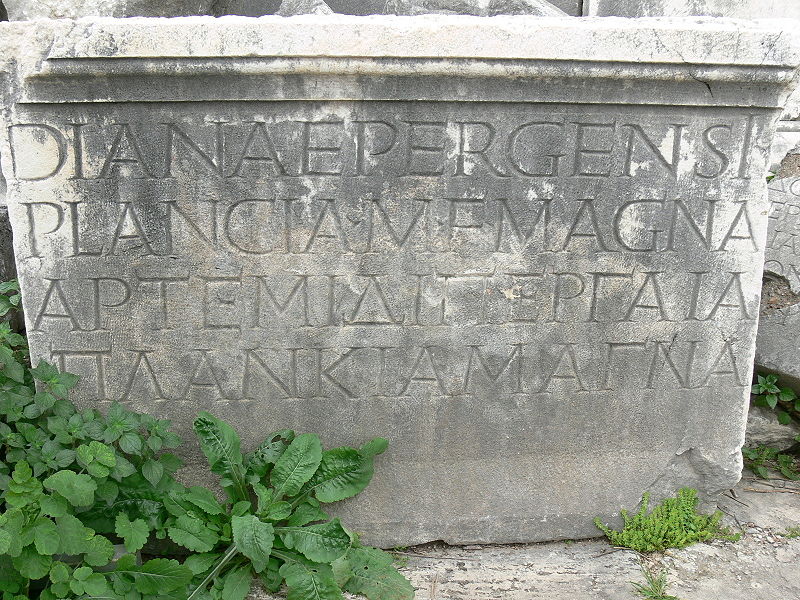
[Inscription dedicated to Diana/Artemis by Plancia Magna, c. 120 CE, Perge, Turkey, photographed by Wolfgang Sauber, source: Wikimedia Commons]
Plancia Magna (1st and 2nd centuries CE) is remarkable in that she had a lot of her own personal wealth under her own control and used it in a very public fashion in her hometown of Perge, in Anatolia.*  This, of course, runs contrary to the ideals presented in the writings of the time of women being dutiful, submissive, and fading into the background behind their husbands, fathers, and brothers.  But perhaps her wealth and behaviour were not so remarkable.

Plancia’s ancestors, the Plancii, were among those Roman families that left Italy towards the end of the Republic.  They made their fortune out in what is now Turkey, quite possibly in Perge, where Plancia Magna would eventually make her mark.  She was the daughter of M. Plancius Varus and had a brother, C. Plancius Varus.  At some point, probably when she was fairly young, she married C. Iulius Cornutus Tertullus, a man even more wealthy and powerful than her father, at least on a local level.  The couple had a son, C. Iulius Plancius Varus Cornutus.

At some point in her life, probably in her younger years, Plancia began donating significant amounts of money for public works.  Her most ostentatious project was the renovation of the city gate and inner courtyard in the early 2nd century.  Among the statues are a pair depicting her father and brother, identified by their relationship to her** instead of the usual practice of identifying offspring by their father.  Since she’s identified as the only donor, she probably paid for all of this from her own money, inherited from her father, and not from her husband’s coffers.

The gate and courtyard wasn’t her only donation, but it was probably her biggest.  The city of Perge didn’t forget who had paid for all of it either.  They named her “daughter of the city” and made her director of the gymnasium.  She held three priesthoods, of Artemis (patron of the city”, of the Mother of the Gods,*** and of the imperial cult, and was named demiourgos.****

Plancia Magna was not the only wealthy woman to make extravagant public donations.  She had the example of Empresses like Plotina and Vibia Sabina to look to, while women elsewhere in Anatolia made similar, though smaller donations to their own cities. 

*Now Turkey.
**This never happens.  Ever.  So this is a pretty big deal.
***She seems to have been the only one to ever hold this priesthood in Perge.
****A yearly magistrate whose name is used for dating events.

Sources/Further Reading:
Boatwright, Mary Taliaferro. "Plancia Magna of Perge: Women's Status and Roles in Roman Asia Minor." In Women's History Ancient History, edited by Sarah B. Pomeroy, 249-272.  Chapel Hill: University of North Carolina Press, 1991.
Salisbury, Joyce E. "Plancia Magna."  In Encyclopedia of Women in the Ancient World, 279-281. ABC-CLIO, Inc., 2001.
Plancia Magna, Aurelia Paulina, and Regilla: Civic Donors - vroma.org
0 Comments

Illegitimacy in Ancient Rome

20/8/2015

0 Comments

 
The legitimacy of children was, in Ancient Rome, an issue of concern, though it had perhaps less stigma associated with it than it would in later eras.  By definition, any child born outside of a valid, Roman marriage between citizens was considered illegitimate.  In other words, no matter how valid the relationships of their parents, the children of concubines, contubernales, and Roman citizens who wed non-citizens were all denied the legitimate status.

Much of what we know about illegitimacy concerns the wealthier classes.  As far as we can tell, it was not that much of an issue during the Republic.  Recorded examples of illegitimate children are few, and it’s likely that most such children were aborted, exposed, or simply raised as though they were the legitimate children of the mother’s husband.  By the time of the Empire illegitimacy was a bit more of a concern.  Augustus and other emperors created laws criminalizing adultery and regulating inheritance by illegitimate children.  How strongly these were enforced though, depended on the emperor.

Originally, illegitimate children weren’t entitled to any inheritance unless they were named in a will.  Eventually, they were allowed to inherit from their mothers even without a will, where before property had gone first to legitimate children, then to her male relatives (brothers, fathers, uncles, cousins).  At this point the mother of an illegitimate child was also allowed to inherit from her child if they died intestate.*

Among the lower classes, one’s status as freeborn, freed, or unfree was far more important and relevant than legitimacy.  In the case of a child born outside of a valid Roman marriage, the child followed the status of the mother.  The child of a slave was born a slave.  The child of a free woman** was freeborn.  This would cause some concern with the rising numbers of free women living as the contubernales of highly influential slave men.  The child’s illegitimacy was only really important here in that it meant they inherited their mother’s free status rather than being unfree like their father.

*Without making a will.

**Or a woman freed and subsequently enslaved again during her pregnancy.  Legally, at least.  How that worked out in practice was most likely another matter entirely.

Sources/Further Reading:
Edwards, Catharine. The Politics of Immorality in Ancient Rome. Cambridge: Cambridge University Press: 1993.
Rawson, Beryl. The Family in Ancient Rome: New Perspectives. Ithaca, NY: Cornell University Press, 1986.
McGinn, Thomas A.J. Prostitution, Sexuality, and the Law in Ancient Rome. New York: Oxford University Press, 1998.
0 Comments

Agnes of Savoy

17/8/2015

0 Comments

 
Agnes of Savoy (died after 1110), granddaughter of Adelaide of Turin, found herself in a very similar situation to the one her grandmother had faced fifty years earlier.  Her father, Peter of Savoy, had died sonless, with her as his heir.  Her father’s brother Amadeus took the title for two years before dying as well, leaving Agnes as the next in line.  Agnes had legitimate right to inherit her grandmother’s lands in Turin and Susa, though not her grandfather’s county of Savoy, and the lands presumably passed to her sons.

Agnes was the daughter of Peter of Savoy and Agnes of Aquitaine.  Through her father she was the granddaughter of Adelaide of Turin and Odo of Savoy.  While he was alive, her father was nominally lord of Savoy, Turin, and Susa, but real power remained in Adelaide’s hands.  When Agnes was a teenager, her father died, leaving her heir to Turin and Susa.  The County of Savoy had always been passed down in the male line, which meant Agnes had no claim on it, but the March of Turin had been inherited by daughters many times and there was uncertainty as to whether she or Amadeus had the right to it.  Two years later, the question became obsolete with Amadeus’ death.

In order to ensure her inheritance though, Agnes had to do what her grandmother had done.  She had to get married.  She wed Frederick of Montbéliard, who was first cousin (through his mother) to Matilda of Tuscany.  This had to have happened no later than 1080, when Frederick officially became Marquis of Turin.  He didn’t take control though, since power remained firmly in Adelaide’s hands.  Whether that power would eventually have passed to Agnes and Frederick is unknown.  Frederick died five months before Adelaide did.

What happened to Agnes after that is somewhat unclear.  She had three sons with Frederick, so presumably one of them took the title, but whether Agnes ruled as regent or simply alongside her sons as her grandmother had done is unknown.  At some point, like so many other noblewomen, she retired to a monastery.  The last known reference to her is the record of a donation she made to the monastery of Fruttuaria in 1110.

Sources/Further Reading:
Agnes of Savoy - Epistolae
Previté-Orton. C.W. The Early History of the House of Savoy (1000-1233). Cambridge, 1912. - Archive.org
0 Comments

Castellans

13/8/2015

0 Comments

 
Building or controlling a castle between the 9th and 15th centuries meant controlling the surrounding land as well.  If, as a member of the nobility in this time period, your lands were relatively spread out, having several castles was a good idea, especially in France, where power was less centralized.  A castle was both a symbol and an example of power.  But if you had several, you also had to have people in charge of them.  You needed someone loyal.  This is where the position of castellan came from.

Originally, a count or other noble would simply appoint a dependant as his representative to take charge of the castle.  This wasn’t intended to be a hereditary position.  When the old castellan died, the count could appoint a new one.  The thing is, having charge of a castle gives one a certain amount of power and many began to take advantage of that.  By the mid-11th century in France,* the position had become hereditary and castellan families had joined the ranks of the nobility.  They still owed loyalty to their count,** but they were able to maintain a fair amount of independence.

It was in the 12th century though, that castellan families really began to rise to prominence.  They began to take on the right of Banal Lordship.  Where before they could only collect rents and had few political and no judicial powers, a Banal Lord had the right of command and could both extract taxes and judge disputes.  They also began to hold a fair amount of power within the Church.  By the end of the 12th century, members of castellan families dominated the Cathedral chapters in France and would soon come to do so elsewhere as well.

None of this is to say that a castellan couldn’t be removed from control of their castle*** or that one couldn’t appoint a new one, but by this point certain families had gained power and entered the nobility because they had charge of a castle, even if they didn’t own it themselves.


*It took a bit longer elsewhere.
**Or other lord.
***Though given that they had charge of a castle, it would be rather difficult to get them out if they decided to fight it.

Sources/Further Reading:
Bouchard, Constance Brittain.  Strong of Body, Brave & Noble: Chivalry & Society in Medieval France. Ithaca, NY: Cornell University Press, 1998.
Bouchard, Constance Brittain. Philadelphia, PA: University of Pennsylvania Press, 2001.
Gies, Frances and Joseph Gies. Marriage and Family in the Middle Ages. New York: Harper & Row, 1987.
0 Comments

Julia, Caesar's Daughter

11/8/2015

1 Comment

 
A day late because Weebly was having trouble yesterday.

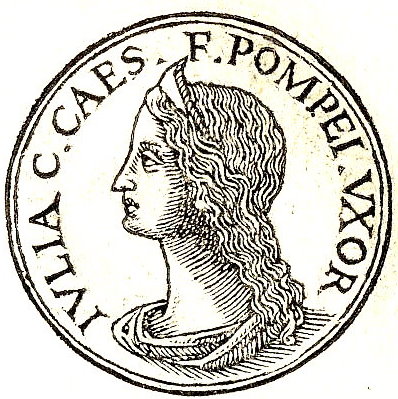
Picture
As is distressingly common, we have no contemporary images of the lady in question, so have one from the 16th century.
[Julia Caesaris, Wife of Pompey, 1553, Guillaume Rouille, source: Wikimedia Commons]
Julia Caesaris* (c.80-54 BCE), daughter of Julius Caesar and wife of Pompey Magnus, was a woman known less for her actions than for the relationships she had with the men in her life and the effect those relationships had on Roman politics.  Her close connections to two members of the First Triumvirate played some part in holding it together.  With her death, the relationship between Caesar and Pompey became significantly less certain and more tenuous.

Julia was the only known daughter of Julius Caesar and his only legitimate child to survive to adulthood.  After the death of her mother when she was a small child, she was probably raised by her maternal grandmother, Aurelia Cotta.  She was eventually engaged to marry one Quintus Servilius Caepio in 59 BCE, but her father broke off the engagement shortly before the wedding to have her marry his ally Gnaeus Pompeius Magnus.  Meanwhile, her father married Calpurnia Pisonis, who was younger than Julia herself.

Despite a pretty significant difference in ages (he was 47, she was in her late teens or early twenties), this political marriage was a good match on a personal level and Julia and Pompey fell deeply love with each other.  When Pompey was given governorship of Hispania Ulterior, he handed over control to his subordinates and remained in Rome, far contrary to the usual practice, partially so that he could stay with his wife.

In 53 BCE, Julia received a great shock.  She saw the servants bringing home her husband’s bloodstained toga.  Thinking her husband dead, she collapsed and ended up having a miscarriage.  This incident may have contributed to her death in childbirth a year later.  The daughter she bore only survived her mother by a few days.

With Julia’s death, one of the bonds between Julius Caesar and Pompey was broken, weakening their alliance.  Her loss didn’t sever all ties between them, but it only made the eventual break between them unavoidable.


*One of many to have that name, but perhaps the best known.

Sources/Further Reading:
Plutarch, “Life of Caesar” - Lacus Curtius
Plutarch, “Life of Pompey” - Lacus Curtius
Goldsworthy, Adrian. Caesar: Life of a Colossus. Yale University Press, 2008.
Leach, John. Pompey the Great. Routledge, 2014.
Julia (2) - Livius.org
Pompey and Julia - Livius.org
1 Comment

Hiatus

3/8/2015

0 Comments

 
Taking a break for a week.  See you next Monday!
0 Comments

    My Blog

    Translation of the above: where I post the interesting things I find researching the Classical and Medieval periods in my free time.

    Currently Reading:
    -
    Medieval Monasticism by C. H. Lawrence

    Archives

    March 2016
    February 2016
    January 2016
    December 2015
    November 2015
    October 2015
    September 2015
    August 2015
    July 2015
    June 2015
    May 2015
    April 2015
    March 2015
    February 2015
    January 2015
    December 2014
    November 2014
    October 2014
    September 2014
    August 2014
    July 2014
    June 2014
    May 2014
    April 2014
    March 2014
    February 2014
    January 2014
    December 2013
    November 2013
    October 2013
    September 2013

    Categories

    All
    Architecture
    Biography
    Classical
    Law
    Marriage (legal And Otherwise)
    Medicine
    Medieval
    Misconceptions
    Monasticism
    Overview
    References
    Religion
    Review

    RSS Feed

Powered by Create your own unique website with customizable templates.