Emily Kittell-Queller
  • Home
  • About Me
  • Blog
  • Projects
  • Resume
  • Contact Me

Parents and Children in Classical Athens

24/3/2016

0 Comments

 
There is some evidence that Athenians considered the birth of the first child as the point when a marriage was secured.  Before that, the connection between husband and wife was uncertain (not least because girls first married around 14 and men around 30), but a child was held in common between them* and so bound them together.  Having children was considered the entire point of marriage.  But with the age differences between them and the highly gendered expectations laid on them, what children meant to a father and to a mother, what each of their relationships were with the child, differed greatly.
 
Mothers were, perhaps unsurprisingly, expected to be the more nurturing parent.  It was mostly unquestioned that a mother loved her children deeply and would do anything for them.  She would almost certainly be closer in age to her children than her husband was, which might even lead to her being closer to them emotionally than she was to her spouse.  Certainly a mother being more likely to take her son’s side in a quarrel with his father was a common rhetorical trope.  The age difference also meant that she was far more likely to end up a single parent than she was, though she would never end up legally in charge of them.
 
The relationships between fathers and their children were generally not expected to be so close and probably weren’t in practice.  Tension between fathers and their adult sons who hadn’t yet received an inheritance yet certainly seem to have not been uncommon.  But fathers were still expected to care deeply for their offspring.  To say in court that a man did not love his children was a serious strike against him. 
 
 
*Not legally certainly, but emotionally.

Sources/Further Reading:
Golden, Mark. Children and Childhood in Classical Athens. 2nd Edition. Baltimore, MD: Johns Hopkins University Press, 1990, 2015.
0 Comments

Adoption as Roman Political Strategy

3/3/2016

0 Comments

 
Nearly all of what we know about formal adoption in Ancient Rome has to do with the upper classes.  For them it was political strategy.  It was a way for a man* to formally and legally restructure his family and appoint his heirs according to his own wishes.  Both adoptio and adrogatio were commonly used, though testamentary adoption was an option as well.
 
Because of the way we think about adoption now, probably the first thing that springs to mind is a man without an heir who then adopts one.  This did happen, but men who already had sons adopted more just as frequently, strengthening their chances of having descendants.  Sometimes this was a way of legitimizing an illegitimate son, but that was less common.  Usually they took legitimate sons of their own social class instead.
 
It was also unusual but not unheard of for a man to adopt a woman as his heir, as in the case of Curtilius Mancia, who hated his son-in-law and so adopted his granddaughter instead.  Adoption allowed men to be highly selective about who became their heirs, but it also meant they weren’t just dependent on their offspring for security.  When the Leges Iuliae came into effect, some childless men adopted others to take advantage of the benefits of having children and then emancipated them shortly thereafter.
 
There were benefits to the person being adopted as well, beyond just the chance at inheriting their stuff.  Since adoption didn’t prevent him from inheriting from their birth parents, a young man adopted by another man of wealth could then inherit from two fathers instead of one.  He might also gain the status of his new father.  This led to several men of senatorial rank having themselves adopted by plebeians so they were eligible to become the Tribune of the Plebs.  For Romans of the upper classes at least, adoption could be more of political strategy than anything else.
 
 
*Most forms of adoption weren’t open to women, and the wife of someone’s adoptive father was not considered to be one’s adoptive mother.

Sources/Further Reading:
Corbier, Mireille. "Divorce and Adoption as Roman Familial Strategies." In Marriage, Divorce, and Children in Ancient Rome, edited by Beryl Rawson, 47-78. Oxford: Oxford University Press, 1991.
Adoptio - Lacus Curtius
Lindsay, Hugh. Adoption in the Roman World. Cambridge: Cambridge University Press, 2009.
Frier, Bruce. Review of Lindsay, Adoption in the Roman World - Bryn Mawr
0 Comments

Adoptio and Adrogatio

18/2/2016

1 Comment

 
In Ancient Roman law, the basic purpose of adoption was to create a legal relationship of father and son between two people, often for the purpose of providing the father with an heir.  It recognized two types of legal adoption: adoptio and adrogatio, respectively the adoption of someone still in patria potestas and the adoption of someone already sui iuris.  If we define adoption as the acquisition or designation of an heir who was not one’s biological child we can add a third type: what is now known as “testamentary adoption.”  Adoptio and adrogatio were limited to men as adopters.*  Only testamentary adoption was available to women as well.  An adoptee could be any free person, but were usually adult men.
 
Adoptio was legally the simplest of the three, the passing of someone in patria potestas from the power of one person to that of another.**  Adrogatio meanwhile, was far more complicated.  This involved the adoption, and therefore return to being under patria potestas, of a man*** who was already sui iuris and therefore legally under no one’s power.   But the caput (status/rights) of a Roman citizen could not be negatively affected except with the involvement of a court.  In other words, adoption by adrogatio couldn’t happen without both the potential adopter and the adoptee presenting a satisfactory case and having it voted on, with the possibility of conditions being imposed.  Originally this could only happen in the city of Rome.  As time went on, restrictions were loosened; people didn’t have to go to Rome and one only had to go before the pontifices.  Some may have found their way around the restrictions entirely.
 
What is now called “testamentary adoption” was its own special case.  A person could name someone else in their will as their heir on the condition that the inheritor took the dead person’s name.  This condition though, could be avoided, especially when the person making the will was an enemy of the state.  Whether or not it made the new heir part of a different family was unclear and could be legally challenged.  This was the only form of adoption open to women as adopters and was a way a woman could pass on her name and bring someone into her family.


*The wife of an adoptive father was not legally the new son’s mother.
**I’ll get more into the technicalities of this when I talk about adoption as a familial and political strategy.
***Women couldn’t be adopted by adrogatio.

Sources/Further Reading:
Corbier, Mireille. "Divorce and Adoption as Roman Familial Strategies." In Marriage, Divorce, and Children in Ancient Rome, edited by Beryl Rawson, 47-78. Oxford: Oxford University Press, 1991.
Adoptio - Lacus Curtius
Lindsay, Hugh. Adoption in the Roman World. Cambridge: Cambridge University Press, 2009.
Frier, Bruce. Review of Lindsay, Adoption in the Roman World - Bryn Mawr
1 Comment

The Rise of Primogeniture

3/12/2015

0 Comments

 
Primogeniture, where the eldest son inherits all (or nearly all) of the family property, especially land, was not universal throughout the Middle Ages.  By the eleventh century it had become fairly common, especially among the upper classes, but it was still nowhere near universal.  Even where it was the rule, people sometimes found ways around it.  It certainly had benefits for the family as a whole, but it also created a number of problems, both for individuals and for society.
 
In the Early Middle Ages, even noble titles didn’t necessarily follow the male line by primogeniture.  At first they weren’t even inheritable.  Instead, the king decided who would get the title and the associated land on the previous person’s death.  Eventually though, it just became easier to give it to one of the person’s heirs.  Over time, “heir” became codified as “eldest son or next male relative”
 
Before primogeniture became the rule (and in places where it never took hold), the inheritance was generally divided up between siblings, usually but not always equally.  The benefit of this system was that parents could make sure each of their offspring had a share and therefore a way to support themselves, daughters included, though sometimes they received less.  The problem, of course, was that it meant family land got broken down into smaller and smaller pieces over time, reducing the resources any one individual could draw on.
 
Primogeniture meant that family land and other wealth stayed mostly in one piece, keeping the inheritance largely intact for each successive generation.  This system, though, had its own problems.  For one thing, it meant that unless all of their brothers died,* daughters inherited nothing more than their dowries, which usually weren’t under their control.  Younger sons had no hope of an inheritance either unless their older brothers died or they married an heiress.  It also meant that if a man failed to produce a son or something happened to all of his sons, the property might well pass right out of the family’s hands, going with his daughter to a new family.
 
 
*Or were otherwise made unable to inherit.  Monks, for example, renounced any claim on the family property.

Sources/Further Reading:
Gies, Frances and Joseph Gies. Marriage and Family i the Middle Ages. New York: Harper & Row, 1987.
Erler, Mary and Maryanne Kowaleski, eds. Women and Power in the Middle Ages. Athens, GA: University of Georgia Press, 1988.
Winks, Robin W. and Teofilo F Ruiz. Medieval Europe and the World. Oxford: Oxford University Press, 2005.
0 Comments

Roman Women's Clothing

29/10/2015

0 Comments

 
Picture
A woman draped in modestly and elegantly in a palla.
[Source: vroma.org]
Roman women’s clothing was in some ways similar to what Greek women wore.  Tunics similar to the chiton and the peplos were very popular, not surprising given their how easy they were to make.  That said, there were several differences.  Roman women’s garments were generally fuller (that is, they had more fabric in them) than what most Athenian women would have worn and were therefore probably easier to move in.  On the other hand, no respectable Roman woman would wear an outer tunic that was open at the side or shorter than ankle length, as Spartan women sometimes did.
 
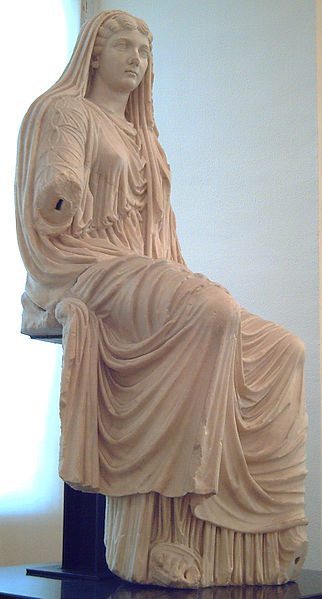
Women and girls of all ages generally wore several layers of clothing.  An undertunic formed the lowest layer.  It generally only fell to the knee and was usually solid in color.  A band of cloth could be wrapped around the upper chest over or under this tunic to support the breasts.  A second, floor-length outer tunic went over everything.  If she stayed inside, this was all a respectable woman needed.  Out of doors and in cooler weather she added a palla, a large, usually woolen, rectangular shawl.  This was generally draped over the left shoulder from behind, wrapped around the back of the body, drawn over or under the right arm, and then thrown over the left shoulder or arm.  It could be pulled up to cover the head or not.  An additional scarf or shawl could also go over the head.
Picture
Notice the fastenings along the top of her sleeve, how her stola is a separate garment from her undertunic, and how she's presented as the traditional Roman matron.
[Livia Drusilla, 1st century CE, National Archaeological Museum of Spain, source: Wikimedia Commons]
A woman who had the status of matron had the right to wear a stola, a sleeveless tunic generally held up by narrow bands of cloth over the shoulders.  To wear one of these was to show one’s respectability and support of tradition.  A woman convicted of adultery, on the other hand, may have been required to wear a toga instead.
 
Generally speaking, women’s clothing wasn’t particularly ornamental.  It was all generally the same shape and usually solid in color.  When a woman wanted to show off her appearance, she turned to jewelry and elaborate hairstyles instead.  While the Roman women’s clothing stayed generally the same over time, hairstyles changed drastically, from the poofy orbis comarum of the Flavian period to simpler-looking* buns or looped braids.
 
 
*Though not necessarily actually simpler.
Sources/Further Reading:
Pomeroy, Sarah B.  Goddesses, Whores, Wives, and Slaves. New York: Schocken, 1995.
Roman Clothing: Women - VRoma.org
Clothing of Women and Girls - Classics Unveiled
Roman Clothing for Women -Tribunes and Triumphs
0 Comments

Citizen Women's Clothing in Athens and Sparta

4/9/2015

4 Comments

 
Picture
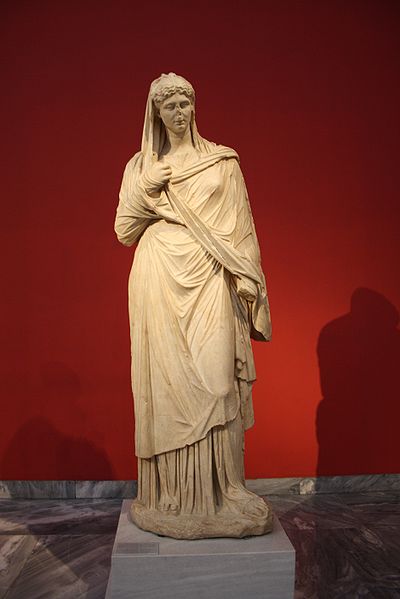
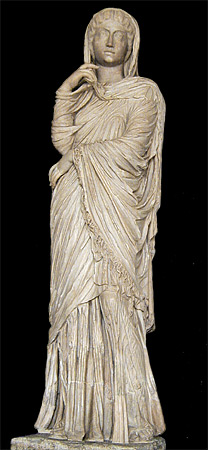
A thoroughly modest Athenian woman.
[Funerary statue, 1st cent. CE Roman copy of a 4th cent. BCE Greek original, Archaeological Museum of Athens, source: Wikimedia Commons]
At one point, according to Herodotus, all Greek women wore the same type of clothing: the Dorian peplos.*  But after the women of Athens stabbed the lone survivor of a battle to death with the pins on their dresses, the Athenians banned their women from wearing Dorian dress.  Instead, they were to wear the Ionic chiton, which didn’t necessarily require pins.  How true is this?  There’s really no way of knowing for sure.  But what we do know is that women in Classical Athens and Sparta typically wore two different kinds of clothing and had different relationships with them.

Picture
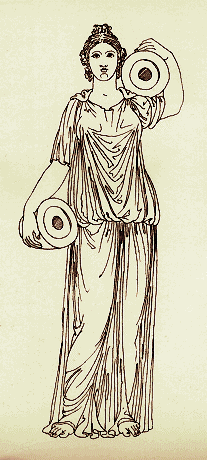
Maybe this shows her legs a bit better than a regular chiton would.
[Engraving of a woman in a chiton, 19th century, source: Wikimedia Commons]
Athenian women typically wore the Ionic chiton, which was essentially a long tunic, a rectancle of cloth sewed into a cylinder, belted at the waist and pinned or sewed at the shoulders.  It was usually worn by both men and women.  While a man’s chiton could be quite short, a woman’s had to reach her ankles.  The garment contained a lot of fabric and the lower it reached, the harder it was to move freely in.  It was usually made of linen or wool.  Over this went the himation, or cloak, draped not just over the shoulders, but around the entire body.

Picture
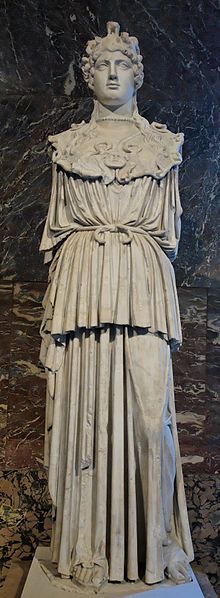
The fold over on Athena's peplos here hangs really low and her ornamentation obscures the neckline, but you get the gist of it.
[Athena Parthenos sculpture, 1st cent. CE Roman copy of a 5th century BCE Greek original, Louvre, source: Wikimedia Commons]
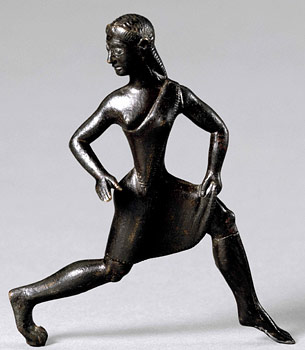
Spartan women probably dressed more for the weather than for modesty.  Certainly the Dorian peplos contained far less fabric and was generally less restrictive.  It was made much in the same way as a chiton, but with an extra fold of fabric hanging down from the shoulders over the torso.  It was pinned rather than sewn; the sharp pins could be used as weapons if necessary.  Spartan women wore chitons as well, but they were often sleeveless, or even covered only one shoulder and/or only fell to the knee rather than the ankle.  Sometimes women simply exercised naked.  At other times they wore a longer peplos that reached all the way to the ankle.  A himation could be worn because of weather or personal inclination, but it wasn’t required.

Picture
See how her clothes only cover one shoulder?
[Statue of a girl running or dancing from Prizren or Dodona, Spartan, c. 500 BCE, source: Wikimedia Commons]
An Athenian citizen woman would never dream going anywhere anyone besides immediate members of her household or birth family could see her without wearing a himation.  Modesty was incredibly important for her.  Often she wore clothing she herself had made or supervised the making of.  A Spartan citizen woman, meanwhile, usually dressed more for personal comfort than for modesty.  Very rarely would she have made her own clothing.


*Sometimes also called a chiton.  Yes, it’s confusing.

Sources/Further Reading:
Pomeroy, Sarah B.  Goddesses, Whores, Wives, and Slaves. New York: Schocken, 1995.
Pomeroy, Sarah B. Spartan Women. New York: Oxford University Press, 2002.

Greek Dress - Roman Life
4 Comments

Polygamy in the Hellenistic Dynasties

16/7/2015

0 Comments

 
Many Hellenistic queens are known for their plotting and scheming on behalf of their sons.  It was often at least partially through a mother’s efforts that her son took his father’s place on the throne.  Hellenistic queens were often close to their sons, less so to their husbands.  A major reason for all of this was the fact that many Hellenistic kings practiced polygamy and married multiple wives.

This was probably a holdover from Macedonian practice and seems to have been a relatively fluid system.  Most kings didn’t designate a primary wife and neither wife nor son’s prominence was certain.  A favored wife could find her power given to another.  A son who was named heir presumptive could see that position taken from him by his father and bestowed on another.  Half-brothers scrambled to prove each other illegitimate.  Infighting was semi-constant and power never secure.

Why would a king risk that sort of instability?  For several reasons.  Having multiple wives allowed for the possibility of multiple marriage alliances with both local families and foreign powers.  It also meant that if one wife didn’t produce any male heirs, another might.  The potential for infighting was preferable to the lack of an heir.

What about the women themselves?  Marriage alliances could benefit a wife almost as much as they did her husband, especially if her family was physically nearby.  If she had a son, she could rise to become the king’s most important wife and then maybe even the next king’s mother, both positions of significant power.  Even if a wife had no sons, she could ally herself with one who did and obtain power and prestige that way.

Some examples are pretty clear-cut.  Phillip II had seven wives, the most famous of whom, Olympias, was the mother of Alexander the Great and a fierce political player herself.  Ptolemy VIII married both his sister Cleopatra II and his niece Cleopatra III.  The marriages of Antiochos II first to Laodike I, then to Berenike, follow more in terms of serial monogamy, but his return to Laodike might share continuity with his predecessors’ practice.

Sources/Further Reading:
Pomeroy, Sarah. Goddesses, Whores, Wives, and Slaves: Women in Classical Antiquity. New York: Pantheon Books, 1995.
Shipley, Graham. The Greek World after Alexander 323-30 B.C. New York: Routledge, 2000.
Carney, Elizabeth Donnelly. Women and Monarchy in Macedonia. University of Oklahoma Press, 2000. [Can be found on Google Books here.]
Review of Ogden, Polygamy, Prostitutes, and Death: the Hellenistic Dynasties - Bryn Mawr Classical Review
0 Comments

Third Orders

9/7/2015

0 Comments

 
Several religious orders, have what is known as a Third Order.  The term comes from the idea that the First Order* was made up of the friars or monks, the Second of nuns, and the Third of people living by the ideals of the First and Second Orders, while maintaining their connection to the secular world.  Their members, known as “tertiaries,” share in the works of the Order and sometimes live by a modified version of their Rule, but remain distinct.  Third Orders continue to exist today, not just in the Catholic tradition.**

The earliest formal Third Orders date back to the 13th century, though similar associations of people based certainly existed before then.  The timing isn’t particularly surprising, given the rising popular interest in access to the religious life at the time.  The Humiliati were the first official Third Order, but the best known is the Third Order of St. Francis.  It’s uncertain exactly how it came about,*** but according to the story, their Rule came directly from Francis himself.

The Dominicans and Carmelites soon gained their own Third Orders.  The Lay Carmelites came about much as the Fransican Third Order did.  The Dominican Third Order, on the other hand, originated as a group of Franciscans who were heavily influenced by the teachings of Dominican friars.

The reaction to the creation of Third Orders was not entirely positive.  Several groups ran into trouble with their city governments because their Rule forbade them to bear arms.  Individual tertiaries, like Catherine of Siena, often met with significant resistance from their families.

There were, and still are today, two sorts of tertiaries: regular and secular.  Third Orders Regular, as they are known, existed almost from the beginning, but weren’t officially a distinct group until the 15th century.  They take vows and live in organized communities.  Seculars make less binding promises and usually live separately, though they still have a strong connection to their community.

Well-known medieval tertiaries include the Franciscans St. Elisabeth of Hungary, St. Rosa of Viterbo, and Dante Alighieri, as well as the Dominican St. Catherine of Siena.


*So called mostly because the male order was founded first.  This was generally the case throughout the Middle Ages, with the notable exception being the beguines, who were never really unified enough to get that sort of formal recognition.
**There are, for example both Anglican and Lutheran Orders of St. Francis, which function as and consider themselves part of the Franciscan Third Order.  The Lutheran one in the US is, I believe, affiliated with the ELCA.
***Thomas of Celano’s Vita prima claims that Francis started the Third Order, but there is also evidence for a more independent community that only later claimed to have been created by him.

Sources/Further Reading:
Barber, Malcolm. The Two Cities: Medieval Europe 1050-1320. London: Routledge, 1993.
Bynum, Caroline Walker. Holy Feast and Holy Fast: the Religious Significance of Food to Medieval Women.
Berkeley: University of California Press, 1987.
Cook, William R. and Ronald B. Herzman. The Medieval Worldview: an Introduction. New York: Oxford University Press, 2004.
Kienzle, Beverly Mayne and Pamela J. Walker. Women Preachers and Prophets thorugh Two Millennia of Christianity. Berkeley: University of California Press, 1998.
Stephenson, Carl and Bryce Lyon. Mediaeval HIstory: Europe from the Second to the Sixteenth Century. New York: Harper & Row, 1962.
Gobry, Ivan. Saint Francis of Assisi. Ignatius Press, 2006.
Third Orders - Catholic Encyclopedia
History of the Franciscan Third Order Regular - The Franciscan Friars, TOR
tssf.org - Third Order, Society of St. Francis [The Anglican Third Order of St. Francis, Province of the Americas]
lutheranfranciscans.org - Order of Lutheran Franciscans

0 Comments

Helots in Sparta

2/7/2015

0 Comments

 
Slavery in Ancient Sparta functioned a bit differently than it did elsewhere in Greece.  For a significant portion of Spartan history, until the 4th century or so, most of the unfree people in Sparta and the surrounding area were helots: unfree, publically owned people, who were probably tied to plots of land, more serfs than slaves.  Originally inhabitants of Messenia and Laconia, they had been conquered by the Spartans in the seventh century or so BCE and made property of the state, not of individuals.

Most helots presumably worked as farmers, something that was considered beneath the dignity of Spartan citizens.  They owed whichever Spartiate had been assigned their plot of land a certain portion of whatever they farmed.  Most of them probably lived out on that land rather than in the city.  A minority of them worked in Spartiate houses as servants, guards, and grooms.  The responsibility for clothing the Spartiate class fell almost entirely on them, since unlike citizen women elsewhere in Greece, Spartan women spent very little time on textile work.

Helots outnumbered Spartan citizens by around seven to one and unlike other slave populations, the number of helots expanded mostly through reproduction, meaning that their population could stay relatively stable without expansionist policies.  Given this difference in numbers, it’s not really surprising that the Spartiate class lived in fear of a helot rebellion.  Every year they declared “war” on the Messenians and during this time would actively hunt them down, especially the strongest among them.

There are also instances of Spartan men having children with helot women.  The resulting offspring were termed mothakes* and were free but not citizens.  Most remained in the lower levels of Spartan society, but a few rose to prominence as generals.  Spartans may also have recruited some helot men as soldiers, especially in the early 4th century, typically rewarding them with freedom if they survived the campaign.**

The helots of Sparta remained a distinct and subject population, considered part of Spartan society but also considered property.  When Epaminodas invaded the Peloponnese in 371 BCE, he freed the Messenian helots.  The Laconian helots wouldn’t be freed for another hundred years or so when the reformer kings came to power.

*Probably.  Ancient writers used this term to mean a couple of different, but similar, things.  We have no written sources from Spartans on the topic.  The closest we’ve got is Xenophon, an Athenian who lived in Sparta for much of his life.

**There’s some uncertainty regarding this claim.  It may be that they recruited already freed helots to fight instead.

Sources/Further Reading:
Pomeroy, Sarah B.  Goddesses, Whores, Wives, and Slaves. New York: Schocken, 1995.
Pomeroy, Sarah B. Spartan Women. New York: Oxford University Press, 2002.

Talbert, Richard J. A. "The Role of Helots in the Class Struggle at Sparta." Historia: Zeitschrift für Alte Geschichte 38.1 (1989): 22-40.
Hunt, Peter. "Arming Slaves and Helots in Classical Greece." In Arming Slaves: From Classical Times to the Modern Age, edited by Christopher Leslie Brown and Phillip D. Morgan, 14-39. Yale University, 2006. [Note: May be found on Google Books here.
Helot - Livius.org
0 Comments

Divorce in Ancient Athens

18/6/2015

3 Comments

 
From a legal perspective, getting a divorce was relatively easy for an Athenian citizen.  Marriage and divorce were largely regarded as a private, familial affair.  These things were contracted between families with little to no involvement by authorities.  The state only stepped when conflict arose or public verification of a woman’s statement was needed.  Socially though, a divorce could be quite difficult to get and as a result seems to have remained relatively rare.

There were several ways a divorce could go.  The husband could simply declare the marriage over and send his wife away.  No justification was required, but he did have to either return the dowry or pay 18 percent interest on it to his ex-wife’s guardian, which could prove a significant financial burden.  The political and social consequences that might result from angering a wife’s family also made many men think twice.  Women with less influential families might not have that protection.  In a amicable divorce, the soon-to-be-ex-husband would often arrange his wife’s next marriage, so she would spend little to no time unmarried.*

A wife could also divorce her husband, though not so easily.  She had to appear before the archon with a male relative and ask for the divorce.  The one example we have was not successful.  The wife, Hipparete, was seized by her husband, Alcibiades, and dragged back to his house.  Women who appealed to their male relatives to negotiate a divorce generally had more luck.  A wife with an influential family or with a big dowry could hold a fair amount of power in her husband’s house.

There were two other ways a divorce could go.  A husband whose wife committed adultery or was raped was legally required to divorce her.  She then lost the right to participate in religious festivals and usually could not leave her family’s house at all.  The possibility of remarriage was not lost to her,** but it was unlikely.

There was also the case of the epikleros.  A married woman who became an heiress might be required to divorce and marry one of her kinsmen.  A married man who had the opportunity to marry an heiress was quite likely to do so.

A divorce might happen for any of several reasons including an inability to get along, childlessness, possibility of increased inheritance, or adultery, to name a few.  Though it could be as simple as a man sending his wife away, negotiation between families generally played a major part in the proceedings.


*Being unmarried was considered a terrible fate for a citizen woman in Athens.
**See note*

Sources/Further Reading:
Pomeroy, Sarah B.  Goddesses, Whores, Wives, and Slaves. New York: Schocken, 1995.
Powell, Anton. Athens and Sparta: Constructing Greek Political and Social History from 478 BC. 2nd ed. London: Routledge, 2001.
Tetlow, Elizabeth Meier. Women, Crime and Punishment in Ancient Law: Volume 2 Ancient Greece. New York: Continuum International Publishing Group, 2005.
Cohn-Haft, Louis. "Divorce in Classical Athens." The Journal of Hellenic Studies 115 (1995): 1-14.
3 Comments
<<Previous

    My Blog

    Translation of the above: where I post the interesting things I find researching the Classical and Medieval periods in my free time.

    Currently Reading:
    -
    Medieval Monasticism by C. H. Lawrence

    Archives

    March 2016
    February 2016
    January 2016
    December 2015
    November 2015
    October 2015
    September 2015
    August 2015
    July 2015
    June 2015
    May 2015
    April 2015
    March 2015
    February 2015
    January 2015
    December 2014
    November 2014
    October 2014
    September 2014
    August 2014
    July 2014
    June 2014
    May 2014
    April 2014
    March 2014
    February 2014
    January 2014
    December 2013
    November 2013
    October 2013
    September 2013

    Categories

    All
    Architecture
    Biography
    Classical
    Law
    Marriage (legal And Otherwise)
    Medicine
    Medieval
    Misconceptions
    Monasticism
    Overview
    References
    Religion
    Review

    RSS Feed

Powered by Create your own unique website with customizable templates.