Emily Kittell-Queller
  • Home
  • About Me
  • Blog
  • Projects
  • Resume
  • Contact Me

Julian Marriage Laws

28/2/2014

0 Comments

 
The Leges Iuliae (singular Lex Iulia) were a series of laws introduced by members of the Julian family.  The term is most commonly applied to a series of laws introduced by Augustus in 18-17 BCE.  Though we don’t have the actual text of the laws, we have enough other sources that discuss them that we can get some idea of what was in them.  Augustus and those who commented on his laws seem to have been particularly concerned with marriage, birthrates, and adultery.

In particular, Augustus seems to have wanted to encourage people to get married.  He instituted a tax on unmarried adult citizens, regardless of gender, something that was not terribly well received.  He also loosened the restrictions on who could marry whom, restricting only senators, their children, and grandchildren from marrying freedpersons.*

Related to these were his laws relating to childbearing.  If a freeborn woman had three children, she would be considered sui iuris and would no longer require a guardian.  The same applied to freedwomen, though they had to produce four children rather than three. 

Lastly, Augustus was very concerned about the problem of adultery.  His laws go into detail regarding who can kill someone they catch in the act and under what circumstances they may do so.  Anyone convicted of adultery was to be punished with a loss of goods and exile to an island.**  A husband whose wife was convicted was expected to divorce her or be prosecuted as a pimp.
Picture
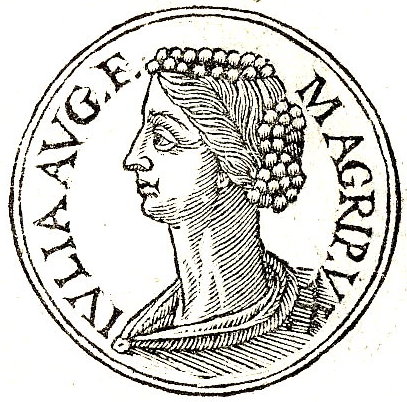
Julia the Elder, daughter of Augustus, fell afoul of the adultery laws and was exiled.
[Julia Augusti Filia, 1553, Guillaume Rouille, Source: Wikimedia Commons]
It’s worth noting that these laws were just that: laws.  From what evidence we do have, not all of them went over terribly well, especially the tax on unmarried adults and the requirement to divorce one’s wife if she were caught in adultery.  What these laws do show are the practices Augustus might have been reacting to and what he found important about them.


*Given the Roman distaste for the idea of a woman marrying someone lower in rank than herself one would assume this applied only to men marrying freedwomen.  However, during the time of the Empire there were a number of free women in de facto marriages with slave men who then married them on manumission.  This law may have applied to them as well.  For more information on such unions, see this post.
**The jurist Paul even makes sure to note that two people caught in adultery with each other should be sent to two different islands.

Sources/Further Reading:
Primary Sources on the Julian Marriage Laws - Women's Life in Greece and Rome (Diotima)
Augustus' Laws; Lex Iulia and Papia Poppaea (18-9 BC) - University of Houston
Lex Iulia - Wikipedia
0 Comments

Basic Layout of a Benedictine Monastery

26/2/2014

9 Comments

 
Note: as in my other post, I’m using “religious” as a term to refer to monks and nuns.
Picture
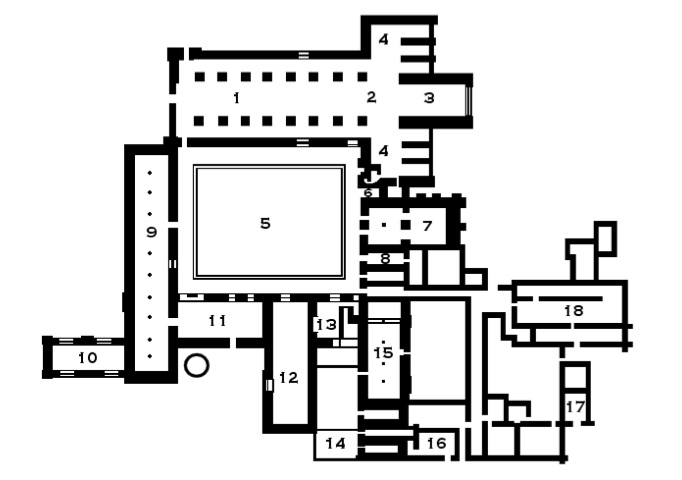
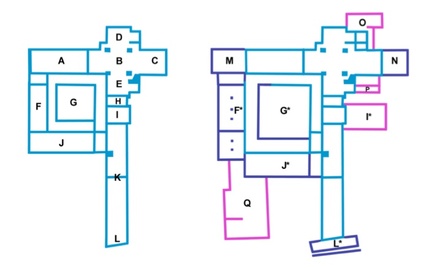
Norton Priory floor plan.  Original 12th century buildings on the left, 13th century expansions on the right.
[Espresso Addict, 2010, Source: Wikimedia Commons]
-Benedictine monasteries were centered around a cloister or courtyard.  This was the space everyone passed through to get anywhere else in the monastery, but it was also where the inhabitants of the monastery performed certain tasks such as reading, laundry, and perhaps writing.  In northern European monasteries, the walkways around the sides would have walls or windows to keep them warmer.

-The church (A-E) was almost always on the north side of the monastery, allowing it to face east (very important) and preventing it from blocking the sun from the cloister. If the terrain didn’t allow that, it was built in the south instead, though in northern Europe especially this made the cloister even colder.

-The sacristy (H), where everything necessary for performing Mass was kept, and the chapter house (I), where the religious held their chapter meetings were located next to the church along the east side of the cloister.

-The dormitory was located on the upper floor of the east side of the cloister, often with the latrines (L) at the south end.  Underneath this was the undercroft.  This may have been where the scriptorium was located, though a lack of light might have caused problems.

-The refectory (J), where the religious ate took up the south side of the cloister.  In Cistercian monasteries, this was generally perpendicular, to allow for a kitchen (Q) and warming room (unmarked) by the cloister as well.  In other monasteries the kitchen was generally attached to the refectory but not the cloister.*

-The buildings along the western side of the cloister could be used for a number of things.  Many monasteries used them for storage.  Cistercian male monasteries used this space as a dormitory for their lay brothers.

-Other buildings** would be located outside this general group and did not have a standard location.

It’s important to remember that none of this was set in stone (pardon the pun).  It was more of a starting point.  Builders could and did rearrange things to fit the terrain and add buildings to suit the needs of the monastery.***


*This had the advantage that if the kitchen caught fire, it would be less likely to spread to the rest of the monastery.  Fire, particularly kitchen fires were one of the major reasons monasteries had to rebuild.

** For example, Abbot’s/Abbess’s House, infirmary, guest house, and school if the monastery had any of these.

***At least in drawing up the plans.  Moving buildings after they had been constructed would have been a bit difficult.


Finally, for reference, a Cistercian monastery:
Picture
Kirkstall Abbey.  For an exact match up of numbers and buildings, try the Wikipedia page.
[Adrian de Montfort, Kirkstall Online, Source: Wikimedia Commons]
Sources/Further Reading:
Lawrence, C. H. Medieval Monasticism. London: Longman, 1984.
Stalley, Roger. Early Medieval Architecture. Oxford: Oxford University Press, 1999.

For an example of a monastery with only slight differences, look at the St. Gall Plan.

For an example of a monastery where the builders started with this basic layout in mind and then had to deviate strongly from it, look at the floor plan of Mont St. Michel in France: Upper Level, Lower Level.  (It's in French.  I couldn't find an English version.)
9 Comments

Eudokia Makrembolitissa

24/2/2014

3 Comments

 
Eudokia Makrembolitissa (1021-1096) is one of the few Byzantine Empresses to have taken over the administration of the Empire. When her husband Constantine X Doukas died in 1067, she was crowned Augusta set up as co-regent with her brother-in-law, John Doukas.*  In practice this actually meant that she ran the place quite competently.  She also took care to include her eldest son Michael in the governing of the Empire in order to prepare him for his later role as Emperor in his own right.

In 1068, Eudokia made what many later considered an ill-advised decision.  In order to strengthen the Empire’s eastern borders she went back on her oath to never remarry and took Romanos Diogenes as her second husband on the condition that he defer to her in matters of state.  Theirs was a tempestuous marriage.  Though Romanos bowed to her experience originally, he soon took power for himself at the expense of both Eudokia and Michael.  His love of war brought about his downfall when he was captured by the Turks at the Battle of Manzikert in 1071.
Picture
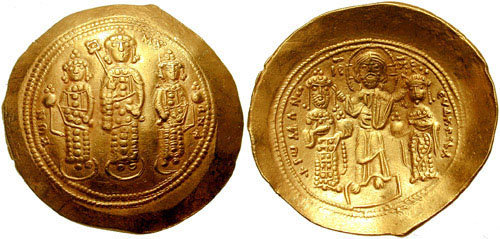
Eudokia is the one on the far right.  She and Romanos IV are depicted being crowned by Jesus.  The other side of the coin shows her three sons by Constantine.
[Constantinople mint, 1067-1017, Classical Numismatic Group, Source: Wikimedia Commons]
Thinking him dead, Eudokia and Michael tried to take power into their own hands once more.  However, reached Constantinople that Romanos had survived and was on his way to take the throne again.  The government was thrown into turmoil and split into several factions.  Finally, though he had previously deferred to her, John Doukas forced Eudoka to abdicate her claim and to retire to a monastery where she died 20 years later.**  Meanwhile, Michael and John’s army defeated Romanos and captured him.***  Michael took the throne as Michael VII Doukas.

In addition to running an empire, Eudokia also found time to write her own dictionary, which she probably completed sometime between 1068 and 1071, given the dedication to her second husband.  It was not so much a dictionary as we know the term today as a compilation of stories about gods, heroes, and heroines with some additional commentary by philosophers.


*It’s worth noting that she was Augusta while John Doukas was only Caesar.  It’s pretty clear who was supposed to be in charge here.
**He didn’t, at first, force her to become a nun.  That came a bit later.
***As was the usual punishment for traitors, they had him blinded and sent him to a monastery.

Sources/Further Reading:
Michael Psellos: Chronographia, Book 7 - Internet History Sourcebooks Project
Eudokia Makrembolitissa - Wikipedia
3 Comments

Kyrios - Guardianship of Women in Ancient Greece

21/2/2014

3 Comments

 
The life of a woman in many of the Ancient Greek city-states was lived in the power of others.  From her birth to her death she had a guardian known as a kyrios.*  Ideally a woman’s kyrios would be first her father and then her husband and no one else.  Under other circumstances, a son, son-in-law, or more distant relative might take guardianship.

It’s important to remember that Ancient Greece was not so much a single entity as a collection of city-states that alternately fought with each other and got along.  How great the power of the kyrios actually was depended largely on where she lived and her citizenship status.  In general, a woman could not marry without permission of her kyrios.  A woman could own property but without her kyrios she couldn’t make economic transactions over a certain value.  It’s worth pointing out though, that as it was her property, he couldn’t do anything with it without her either.  Not all of these necessarily held in all city-states, but these seem to be the common restrictions.

The two exceptions were Athens and Gortyn (on Crete).  In Athens, all property within a family was part of the oikos and was therefore under the management of the kyrios.  Legally, a woman could not make transactions greater than the value of a bushel of barley.  According to Dio Chrysostom Athens was much more restrictive in this than other Greek cities.  We do have evidence of woman accusing her kyrios** and having it appear in court.  Even in Athens a woman’s kyrios did not have total power over her.

According to the Law Code of Gortyn, a woman’s kyrios still had control over who she married.  He was still responsible for providing her dowry.  Children born to a marriage still belonged to the father.  He had, however, no power over her property.  Anything she brought to her marriage was hers and her husband’s consent was not required for her to do anything with it.  It’s important to remember, however, that these two cities, especially Gortyn, were exceptions rather than the rule.

*Minor children and elderly parents also had kyrioi.  The latter case is not universal, but in Athens at least, a man could retire from public life when he got old and would then acquire a kyrios.

**In this case her father.  It’s worth noting that she could not bring a case against him herself.  Her family, however, could speak for her.

Sources/Further Reading:
Schaps, David M. Economic Rights of Women in Ancient Greece. Edinburgh: University of Edinburgh Press, 1979.
Dio Chrysostom 74.9 (on the Athenian law) - Lacus Curtius
Lysias, Against Diogeiton 32.11-18 (the Widow of Diodotus) - Perseus
Excerpts from the Law Code of Gortyn - Diotima
3 Comments

Beguines and Literacy in the Medieval Low Countries

19/2/2014

4 Comments

 
Before getting into this topic, I need to define literacy.  In this time period,* to say someone was literate meant they could read and write in Latin.  Being able to read and maybe write in the vernacular** didn’t count.  There are also some broader definitions: being able to read at all and being able to both read and write.  I will mostly be talking about texts in the vernacular, but it’s important to remember that the people who read these would not necessarily have been considered “literate.”

The cities of the medieval Low Countries established secular elementary schools open to urban middle and upper class children, as well as many from poorer families.  As a result, many adults, regardless of gender, could at least read in their native language.  As many beguines came from middle class families, we can assume that many of them could read and write.  Many made their livings as teachers.  By the 15th century, many Rules for beguines actually distinguished between those who could and could not read, though some communities expected that all of their members be able to do so.
Picture
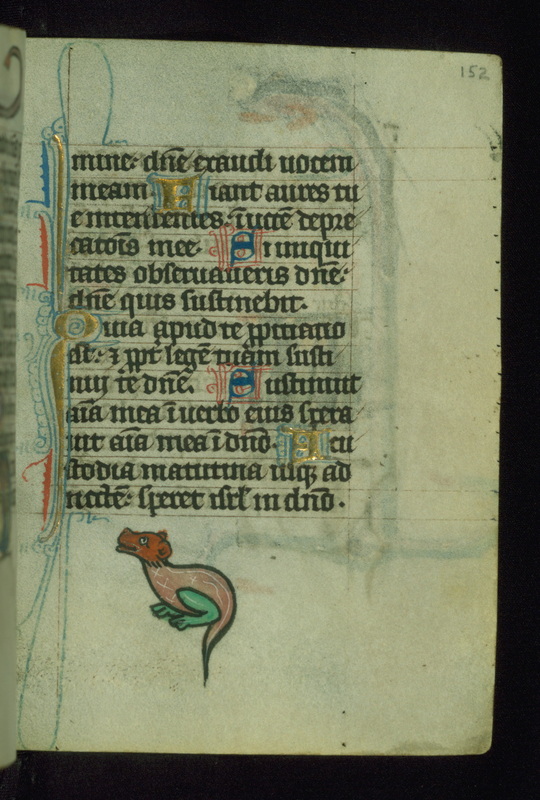
Dragon!  I mean what?  It's cute, okay!
[Page from a Book of Hours probably made for a beguine living in Huy]
[Walters Museum MS W.37, Source: Flicker]

Books played a large part in beguine life.  Very few beguines could read Latin, but these were women who had been drawn to the religious life.  They wanted access to religious texts, which the Church was highly ambivalent about.  Despite this, some beguines owned copies of the Bible or other religious texts in the vernacular or wrote their own works on religion.  When they worked in groups, they often appointed one among them to read to them or to start a discussion.  There is also some evidence that though beguine communities tended not to have a common library those beguines who owned books or manuscripts would lend them out for others to read.  Even if a beguine could not afford her own books, she had access to them through her community.  Books and literacy held an important place in beguine life, whether or not the Church approved.


*For a more specific idea of where and when I’m talking about and/or what on earth a beguine might be, try this post.
**The language of the people.  In the times and places I’m talking about, that would be French and/or Dutch.  Many people in the Low Countries at this time were bilingual or multilingual.

Sources/Further Reading:

Simons, Walter. Cities of Ladies: Beguine Communities in the Medieval Low Countries, 1200-1565. Philadelphia: University of Pennsylvania Press, 2003. (Note: Parts of this book can be read here.  Pages 3-7 are particularly relevant, as are pages 80-85.)

Simons, Walter. “‘Staining the Speech of Things Divine’: the Uses of Literacy in Medieval Beguine Communities.” In The Voice of Silence: Women’s Literacy in a Men’s Church, edited by Thérèse de Hemptinne and Maria Eugenia Góngora, 85-110. Turnhout, Belgium: Brepols Publishers, 2004.
4 Comments

Neaera

17/2/2014

0 Comments

 
Picture
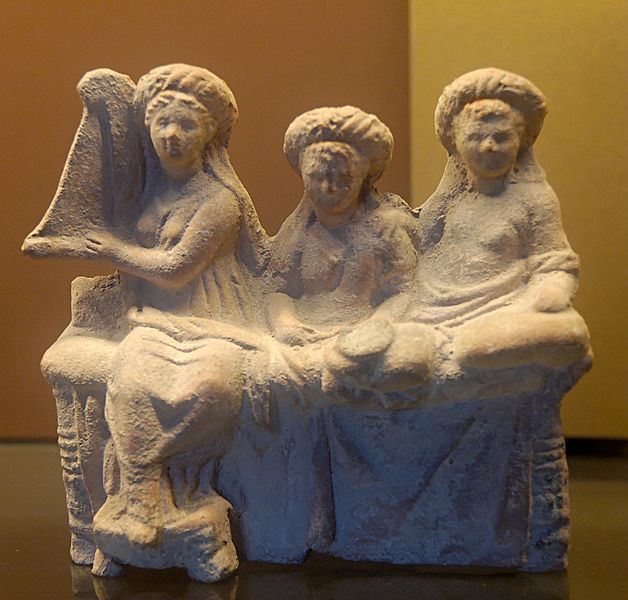
[A hetaera and two men at a banquet, 25 BCE, Myrina, Mysia, Source: Wikimedia Commons]
The only real source we have on Neaera (4th century BCE) comes from a court case against her and her partner Stephanos.  Athenian courts were not so bound by rules of evidence as modern courts, making appeals to the jury’s sense of morals more important than to proof.  To make matters worse, all we have is a speech by the prosecution, which would have been designed to show her in the worst light possible.  Both the defense speech and any information as to the actual outcome or any other details of the trial have been lost.

This is the story our one source tells.  When she was about ten, Neaera, then a slave, was purchased by a Corinthian madam named Nikarete and raised along with several other girls to be a hetaera, or courtesan.  Sixteen years later, two men purchased her and took her with them to Athens.  After a few years, neither of them could afford to maintain her and offered her the chance to buy her freedom on the condition that she leave Corinth.  With some help from others,* she did just that before moving to Athens with her primary benefactor, Phrynion.  When he treated her badly, she packed up her household and moved to Megara, where she met Stephanos, who then moved in with her.  He eventually persuaded her to take her three children and move back to Athens with him as his wife.  Phrynion found out and demanded the return of his woman and his goods.  The matter was settled in arbitration rather than the court and both men were given access to her, but were also required to support her.**  The prosecution then goes on to talk about her daughter Phano.

In the context of the court case, the importance of this story lies in the question of Neaera’s citizenship and marital status.  The case itself rested on Phano’s citizenship, parentage, and sexual behaviour.  The prosecution claimed she was illegitimate, a prostitute, not Stephanos’s child, and not a citizen, and therefore could not be given in marriage.  As a result, it was incredibly important for the prosecution to prove that Neaera’s claim to Athenian citizenship was false.  It was only slightly less important to prove that she remained a prostitute while living with Stephanos.  How much of this story and the associated claims was made up, we will probably never know.

*Interestingly enough, this makes her the only example we have of a woman receiving eranos or money raised by a group of friends to help someone meet an extraordinary expense.  It was considered a charitable (read: interest-free) loan.  There is some evidence that women could and did contribute to these, but there are no direct examples of this.
**Bear in mind that at this point she would have been legally free, not a slave.  It was also decided that she had to return all of Phrynion’s goods except those he had bought specifically for her.  This is one of the few sources we have that gives us some idea of what might have been considered in Athens to be a woman’s property as opposed to goods owned by a man for a woman’s use.

Sources/Further Reading:

Apollodorus, Against Neaera, 4th century BCE, Athens.
-Translation by Lefkowitz & Fant at Diotima
-Translation by A.T. Murray at Perseus

Schaps, David M. Economic Rights of Women in Ancient Greece. Edinburgh: Edinburgh University Press, 1979.

Neaira - Wikipedia

0 Comments

Monasteries & Construction

14/2/2014

0 Comments

 
Or: Quiet Contemplation? What quiet contemplation?

Note: I’ll be using “religious” as a gender-neutral noun to refer to monks and nuns.  It’s less clunky than “monastics.”

The general perception of a medieval monastery is one of quiet, of contemplation, and of peace.  Seclusion from the chaotic outside world certainly was part of the ideal.  The thing is, that wasn’t always entirely practical.  Leaving aside the slightly more frequent issues of visitors and the Abbot or Abbess’s duty to represent the monastery to the outside world* as well as the bits of daily life that caused their own disruptions, there was also the more fundamental need to construct, maintain, and renovate the actual buildings of the monastery.

The usual order of things for monasteries was to collect a community first and only then build the place.  In the meantime, the community lived in temporary wooden structures and moved into the stone buildings as they were completed.  In many cases it seems likely they went about their lives as structured by their Rule, as the construction work went on nearby.  For their first several years (Hildegard von Bingen’s monastery at Rupertsberg, for example, seems to have taken at least 3 years to build), a community of religious lived their lives next to a construction site, sometimes almost within it.
Picture
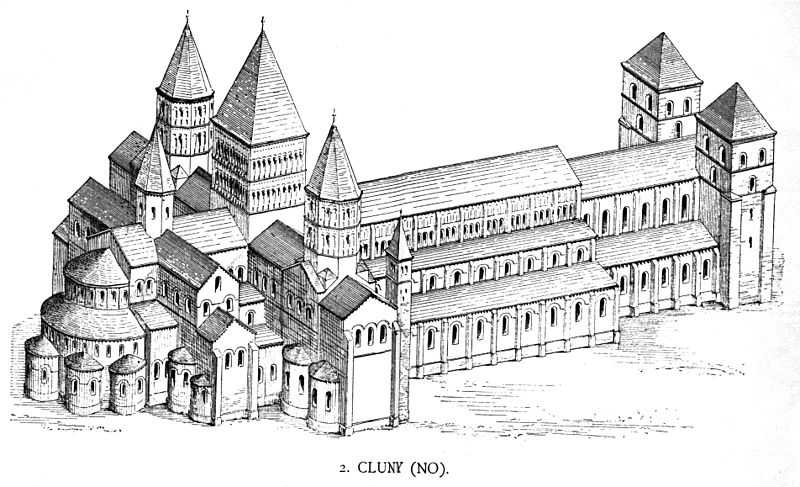
Can you imagine trying to sing the hours while that was being built?
[Reconstruction of what Cluny III might have looked like, Georg Dehio & Gustav von Bezold]
[Kirchliche Baukunzt des Abendlandes, 1887, source: Wikimedia Commons]

It wasn’t just at the beginning though.  Even stone buildings need maintenance every not-so-often, especially if people are living in them.  Some monasteries grew big enough that they needed to rebuild just so they could fit everybody in the church and the dormitories.  Some abbots and abbesses felt that their duty was to make the buildings of their monastery, especially the church, bigger and more beautiful than they had been before.  Some abbots and some monasteries had a reputation for being builders.  Angilbert, abbot of St. Riquier was one such, while the abbots of Cluny demolished and rebuilt their church twice over the course of around 200 years.  Meanwhile, the religious who had vowed themselves to these monasteries continued to live there, even as buildings went up around them.

*Two of the biggest reasons for this were the need to solicit donations to ensure the economic wellbeing of the monastery and the need to be involved in politics, both secular and ecclesiastical, for the aforementioned economic reasons as well as to advance or maintain the other interests of the monastery.

Sources/Further Reading:
Lawrence, C. H. Medieval Monasticism. London: Longman, 1984.
Stalley, Roger. Early Medieval Architecture. Oxford: Oxford University Press, 1999.
Building a Monastery the Medieval Way - Brush off the Dust!  History Now!
0 Comments

The Pythia

12/2/2014

0 Comments

 
Picture
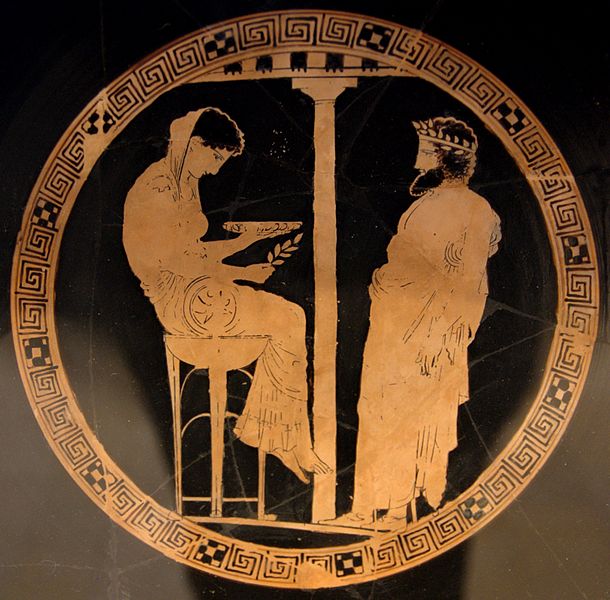
[Themis as the Oracle answers Aegeus. Attic red-figure kylix, 440–430 BC. From Vulci.]
[Source: Wikimedia Commons]

The Oracle at Delphi, known as the Pythia, is probably the most famous and respected oracle in the Ancient Greek world.*  People came from all over Greece, the surrounding lands, and later from Rome, Egypt, and even farther away to ask the advice of the Oracle on the seventh day of each of the nine warm months of the year.  Apollo was said to abandon Delphi in the cold months.**

The people who came to the Pythia were not asking for nebulous predictions of the future. They generally had specific questions about what they should or should not do.  Should we set up a settlement in a particular place?  Should I make war on this or that group of people?  These were some of the most common sorts of questions.
Picture
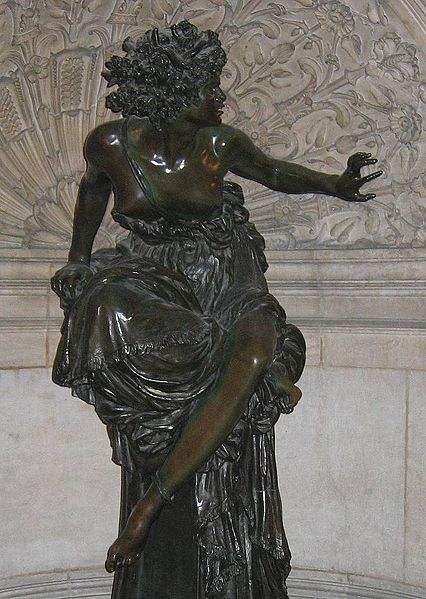
[Pythia, 1870,  Marcello (actually Adèle d'Affry, Duchess of Castiglione-Colonna]
[Source: Wikimedia Commons]

Two things about the Pythia remain unclear: who could be the Oracle and whether hallucinogenic fumes rising from a crack in the floor were the cause of her trances.  Some scholars claim that the Pythia was originally always a virgin priestess but that later the decision was made to only have older, married women.  Others argue that a priestess of any age and marital status could become the Pythia.  What we do know for sure is that social rank did not play much if any role in selecting the new Oracle and when a woman took on the position, she left behind all familial ties.

The other debate is more hotly contested.  The original excavations led to the widely accepted idea that the prophecies could have no connection to hallucinogenic gasses because there was no source for them.  This was proven wrong when geologists discovered two different faults that intersect under the ruins of the Temple of Apollo at Delphi.  These could easily have released ethylene, which has been known to cause trance states, up into the Temple.  Ethylene, however, does not cause one to speak in gibberish, nor do the ancient sources give any support for this theory.  The Pythia spoke in her own voice.


*It wasn’t, however, the only one.  Other important Greek oracles include the shrine to Dione (who is also identified with Rhea and Gaia) and Zeus at Dodona, the shrine to Trophonius at Lebadaea in Boeotia, and several others at various shrines to Apollo.
**It makes one wonder how many people drew a connection or parallel with Demeter here.

Sources/Further Reading:
The Pythia - Priestess of Ancient Delphi - Ancient History Encyclopedia
Pythia - Wikipedia
List of oracular statements from Delphi - Wikipedia
The Oracle of Delphi--Was She Really Stoned? - Biblical Archaeology Society
Delphic Oracle's Lips May Have Been Loosened by Gas Vapors - National Geographic
0 Comments

Angelberga

10/2/2014

0 Comments

 
Many of the Holy Roman Empire’s empresses were called “consorts in power.”  Angelberga,* daughter of the powerful Supponid family and wife of Louis II, really lived up to it.  She became associated with Louis in 851, though whether she married him at this point is unclear.  There is evidence to suggest that she may have been his concubine for a few years before becoming his wife.
Picture
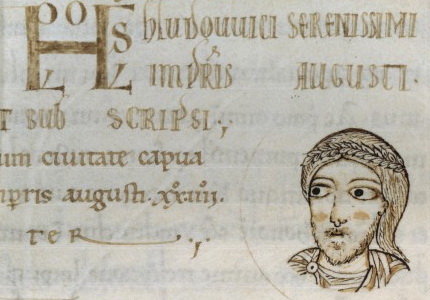
I couldn't find any images of Angelberga, so here, have a drawing of her spouse looking confused.
[Emperor Louis II, Chronicon Casauriense, Johannes Berardi, 12th century]
[Source: Wikimedia Commons]

Angelberga was a very politically active empress.  Not only did she regularly advise her husband, but she also involved herself in the political troubles of her brother-in-law Lothar II.  She acted as regent for Louis’s Italian lands from871-874.  Her worst year as Empress was 872, when the Italian nobles revolted and her husband, bowing to pressure from his nobles, attempted to divorce her.  It was claimed that her arrogance caused the former and her adultery the latter, but all of the evidence for both of these come from documents written by her political enemies.**  It seems likely that these claims were based more in a desire to discredit her than in reality.  Both the attempted rebellion and the attempted divorce were unsuccessful.

Though she had no sons, which for most queens would mean decline into obscurity, Angelberga remained a powerful player on the political stage after her husband’s death in 875.  She presided over the council that decided who would succeed Louis as Holy Roman Emperor.  No one ignored her power and several courted her help by confirming her lands and titles.  In the 880, the council decided on Charles the Fat, no ally of Angelberga, but no enemy of hers either.  He was wary enough of her to imprison her in a monastery until he felt secure enough to release her in 882.  She then retired to another monastery, her own this time.  She didn’t take vows though and continued to involve herself in politics until 887, after which point there is no record of her.


*Also spelled Engelberga and Angilberga
**We have the word of a single writer who claims to have fourth-hand knowledge that she tried to seduce one Hucbald.  Considering that the story reads like someone took a common accusation against noblewomen and queens and replaced the names to fit his purposes, the fact that he has it fourth-hand, and the fact that the writer was one of her political enemies, it seems highly likely that the entire story is false.  As for the rebellion, well, you sound a lot better if you call her arrogant than if you say “I wanted more power.”

Sources/Further Reading:

Stafford, Pauline. Queens, Concubines, and Dowagers: The King's Wife in the Early Middle Ages. Athens, GA: University of Georgia Press, 1983.

Angelberga - Epistolae: Medieval Women's Latin Letters [Note: this website includes some of Pope John VIII's letters to her]
0 Comments

The De Facto Marriages of Roman Soldiers

7/2/2014

1 Comment

 
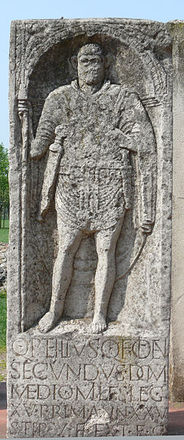
Roman soldiers during the first 200 years of the Empire* were not allowed to marry.  It was, however, impossible to enforce.  A marriage contracted by a soldier was not legal and if a man was married before he enlisted, his marriage was considered annulled.  That didn’t stop them from behaving as though they were married.
Picture
[Gravestone of Legionary Quintus Pentilius Secundus, 1st century CE]
[Photographed by Ad Meskens, source: Wikimedia Commons]

This produced a bit of a gap between practice and law.  Socially, a soldier and his wife were considered married and the word uxor, meaning a legal wife, was used.  Legally, the wife was often considered a concubine.  This created a number of complications.  A dowry would not have been required and woman who brought a dowry to her marriage with a soldier would have no legal recourse if they divorced and he refused to return it. Any children the couple had during his military service would be illegitimate, meaning that unless their father made a will, they couldn’t inherit from him.  If a soldier’s wife wasn’t a citizen, neither she nor they could inherit even if there was a will.  This situation also meant a soldier couldn’t legally accuse his wife of adultery.  This is not to say that there weren’t social consequences, merely that according to Roman law she could not commit adultery.

Despite these problems, the Roman army tended to encourage such unions, since the children they produced could eventually be recruited to serve as well.  This would especially have been the case where the army had settled down more permanently and soldiers were recruited from the local population.

The ban was eventually repealed by Septimius Severus, probably early in his reign (193-211), probably in part to keep himself in the army’s favour.  However, he only lifted the ban on soldiers marrying citizens.  A soldier who married a non-citizen woman would have to wait until he was discharged for the union to be legally recognized.

*The Republic may have been another matter.  The earliest mention of this prohibition refers to the reign of Claudius, but it seems most likely that it was instituted under Augustus.


Sources/Further Reading:


Campbell, Brian. "The Marriage of Soldiers under the Empire." The Journal of Roman Studies 68 (1978): 153-166.

Watson, G.R. The Roman Soldier. Ithaca, NY: Cornell University Press, 1969.

A letter from a soldier's wife, 4th century CE, Grenfell Papyrus - Diotima [Note: this comes from after the time period under discussion, but it's an interesting read nonetheless.]
1 Comment
<<Previous

    My Blog

    Translation of the above: where I post the interesting things I find researching the Classical and Medieval periods in my free time.

    Currently Reading:
    -
    Medieval Monasticism by C. H. Lawrence

    Archives

    March 2016
    February 2016
    January 2016
    December 2015
    November 2015
    October 2015
    September 2015
    August 2015
    July 2015
    June 2015
    May 2015
    April 2015
    March 2015
    February 2015
    January 2015
    December 2014
    November 2014
    October 2014
    September 2014
    August 2014
    July 2014
    June 2014
    May 2014
    April 2014
    March 2014
    February 2014
    January 2014
    December 2013
    November 2013
    October 2013
    September 2013

    Categories

    All
    Architecture
    Biography
    Classical
    Law
    Marriage (legal And Otherwise)
    Medicine
    Medieval
    Misconceptions
    Monasticism
    Overview
    References
    Religion
    Review

    RSS Feed

Powered by Create your own unique website with customizable templates.