Emily Kittell-Queller
  • Home
  • About Me
  • Blog
  • Projects
  • Resume
  • Contact Me

Emma of Italy

29/6/2015

1 Comment

 
The life of Emma of Italy (born c. 948), also known as Emma, Queen of the Franks, gives us an example of a high status woman whose family connections did not serve her particularly well.  Despite being the daughter of Holy Roman Empress and Saint Adelaide of Italy, the half-sister of Otto II, and mother of the Carolingian king Louis V,* or perhaps because of some of these things, she found herself ousted after her husband’s death and died in obscurity.

Emma was born the only child of Lothair and Adelaide of Italy.  Her father died within a few years of her birth, leaving her mother to face her great rival Berengar of Ivrea.  He imprisoned Adelaide and seized power, but she escaped soon afterwards and married Otto the Great.  With Otto’s help, she ousted Berengar and brought northern Italy under Otto’s control.  Emma’s half-brother, the future Otto II, was born in 955.

Otto’s coronation as Holy Roman Emperor in 962 made Emma a desirable marriage candidate.  She wed Lothair of France in 965, becoming Queen of the Franks.  She soon found herself in an uncomfortable position: her husband and her half-brother, now Emperor, were military rivals, frequently invading each other’s lands.  They eventually made peace in the last years of Otto’s reign.  Meanwhile, Emma made a political rival of her brother-in-law, Charles of Lower Lorraine.

In 977, when her son Louis was ten, Charles accused her of adultery with Adalbero, Bishop of Laon.  Though she was found innocent and Charles was forced to flee, the accusation would come back to haunt her.  It came up again after Lothair’s death in 986, with the support of Emma and Lothair’s son, Louis.  This time it was Charles who emerged victorious.  She found herself once more accused of adultery, ousted from her position as regent, and imprisoned.  She was eventually released, but did not return to Court, dying in obscurity.

Emma found not allies but rivals in her husband’s family.  Her own mother refused to answer her pleas for help, possibly because of her husband’s rivalry with her half-brother, and while her sister-in-law, the Empress Theophanu, tried to free her from her imprisonment, her attempts came to nothing.  The very familial connections that had made her mother Adelaide so powerful had betrayed her daughter Emma.


*Considered the last Carolingian king.

Sources/Further Reading:
Stafford, Pauline. Queens, Concubines, and Dowagers: the King's Wife in the Early Middle Ages. Athens, Georgia: University of Georgia Press, 1983.
Emma, Queen of the Franks - Epistolae
Adelaide of Burgundy - Epistolae
Theophanu - Epistolae
Emma of Italy - Wikipedia
1 Comment

The Utrecht Psalter

25/6/2015

1 Comment

 
Picture
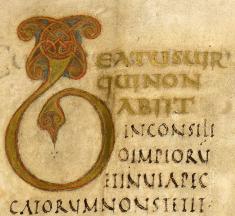
The first words of the first Psalm.
[Psalm 1 opening, Utrecht Psalter, 9th century, source: Universiteitsbibliotheek Utrecht]
Among my absolute favorite medieval manuscripts is one that some people, at first glance, might call rather plain: the Utrecht Psalter.  It’s anything but plain.  This Psalter, dating probably to the early 9th century, was one of the most influential manuscripts of its time and is currently the most valuable book in the Netherlands.  It contains all 150 psalms, 16 hymns, and illustrations for each of them.

The Psalter began its existence in Reims, France, probably in the early 9th century.  It may have been commissioned by Archbishop Ebbo, or possibly his successor Hincmar, as a gift for someone in the royal family.*  It may well have been kept at court but by the year 1000 it had been moved to Canterbury Cathedral in England, where it would remain for the next several hundred years. With the Dissolution of the Monasteries it fell into private hands, eventually ending up at the University of Utrecht where it resides now.

Picture
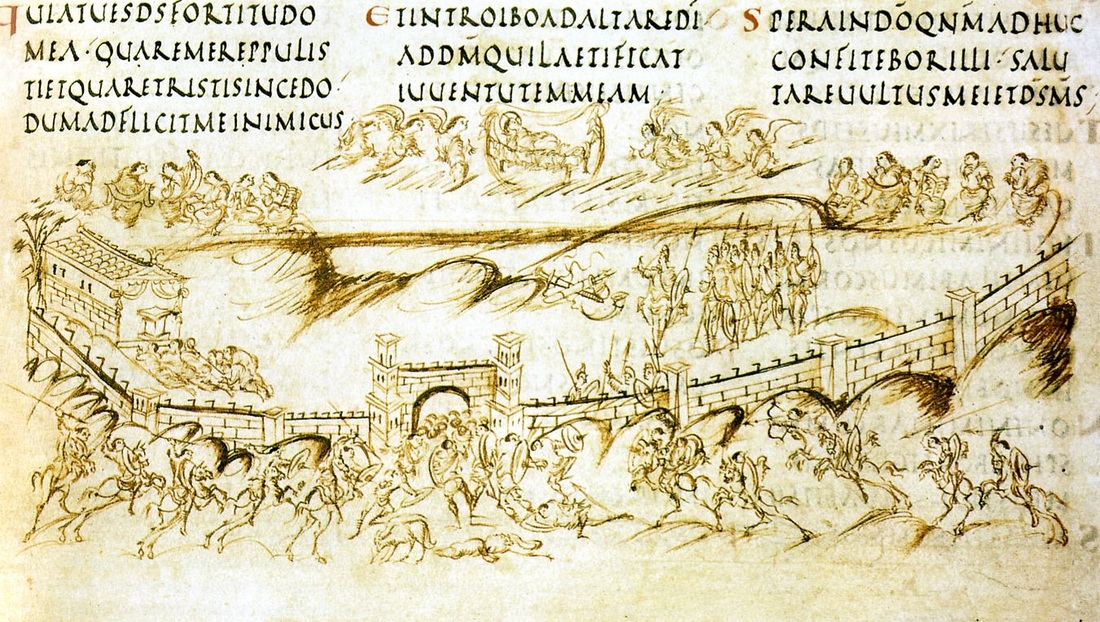
That's a rather empty city there.
[Psalm 43, Utrecht Psalter, 9th century, Universiteitsbibliotheek Utrecht, Source: Early Morning Discussions]
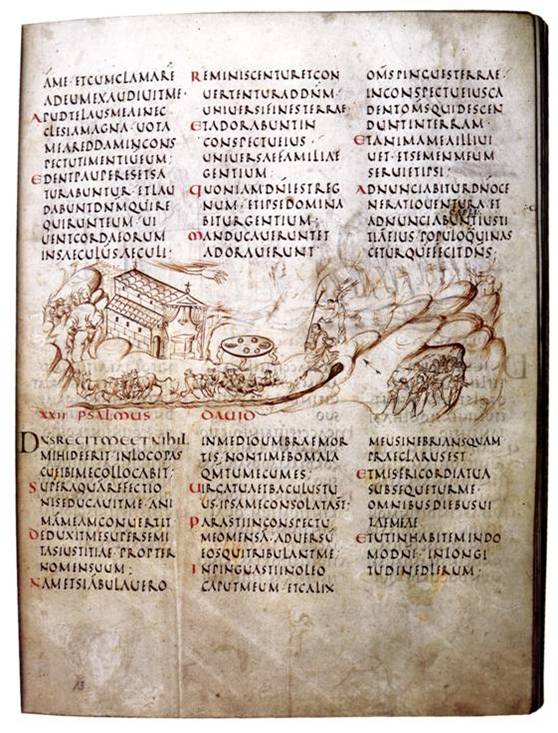
Its illustrations, the work of eight scribes, depict the contents of the psalms to which they are attached, sometimes very literally.  A few verses from Psalm 44 (43 in the Psalter) that ask God to wake up and stop the speaker’s people from being slaughtered occasions a drawing of God sleeping while a the city is attacked.  Psalm 23, with its lines about still waters, protection, a table set with food, the speaker’s enemies, and the Lord’s house, has images of all of those things.

Picture
Probably the most famous Psalm.
[Psalm 23, Utrecht Psalter, 9th century, Universiteitsbibliotheek Utrecht, source: Memerise]
The sketchy, dynamic style of these illustrations inspired several other works.  The ivory covers on Charles the Bald’s copy some of these drawings almost exactly.  During the Psalter’s time in England it three copies were made: the Harley Psalter, the Eadwine Psalter, and the Anglo-Catalan (Paris) Psalter. Its influence has extended even to the present.  There is some evidence that Dr. Seuss used its illustrations as the inspiration for the images in some of his own books.  It is, in some ways a rather whimsical manuscript.  In others, it’s completely serious.  For its time period it’s style was something wholly new.  All of these things contribute to a fascination that has lasted centuries.


*Most likely Louis the Pious, his wife Judith, or Charles the Bald.

Sources/Further Reading:
Psalterium Latinum  - Universiteitsbibliotheek Utrecht (Digital copy of the Psalter)
The Utrecht Psalter - Universiteitsbibliotheek Utrecht
About the Psalter - Universiteitsbibliotheek Utrecht [Go watch the videos at this link!  They're really cool!]
Beckwith, John. Early Medieval Art. New York: Frederick A. Praeger, Publishers, 1964.
De Hamel, Christopher. A History of Illuminated Manuscripts. London: Phaidon Press Limited, 1994.
HInks, Roger. Carolingian Art. Ann Arbor: University of Michigan Press, 1962.
The Utrecht Psalter - History of Information
Dr. Seuss and the Utrecht Psalter - Burnable Books
1 Comment

Berenike Phernophorus

22/6/2015

0 Comments

 
The marriage of Berenike Phernophorus (d. 246 BCE) to the Seleukid king Antiochos II provides a clear example of how family and politics were intertwined among the ruling classes of the Hellenistic period.  When Seleukid-Ptolemaic Egyptian relations were good, Berenike’s marriage and status remained good.  When things fell apart, her very life was in danger.

Berenike was the daughter of Ptolemy II Philadelphos and his first wife, Arsinoe I.  Her mother’s apparent treason cast suspicion on her as a traitor’s daughter and made her legitimacy questionable.  Ptolemy arranged to have Berenike and her siblings legally adopted by his second wife (and sister) Arsinoë II after her death, ensuring their high status once more.  When she was still a child, Berenike’s horses won victories in the Isthmean, Nemean, and Olympic games.*

In 252 she became the second wife of Antiochos II as part of a peace agreement between him and her father.  As part of this agreement, Antiochos would divorce his first wife, Laodike I and any children he had with Berenike would inherit the throne before his children with Laodike.  We know little of the years of their marriage other than the fact that they did have at least one child together, a son named Antiochos.

This stability couldn’t last.  Ptolemy II’s death signaled the end for Berenike and her son.  Antiochos II left her to return to Laodike, only to die six months later, possibly by poison.  Berenike had little to no protection against Laodike and her sons and she and her own son were soon killed, almost certainly with the involvement of both Laodike and her son Seleukos II.  The peace between the Ptolemies and the Seleukids was broken as Ptolemy III invaded to avenge his sister and nephew, sparking off the Third Syrian War.


*Some have suggested that this might actually have been Berenike II.

Sources/Further Reading:
Shipley, Graham. The Greek World after Alexander 323-30 B.C. New York: Routledge, 2000.
Pomeroy, Sarah. Goddesses, Whores, Wives, and Slaves: Women in Classical Antiquity. New York: Pantheon Books, 1995.
Berenice Phernophorus - Egyptian Royal Genealogy
Berenice Phernophorus - Livius.org
Berenice (Seleucid queen) - Wikipedia
0 Comments

Divorce in Ancient Athens

18/6/2015

3 Comments

 
From a legal perspective, getting a divorce was relatively easy for an Athenian citizen.  Marriage and divorce were largely regarded as a private, familial affair.  These things were contracted between families with little to no involvement by authorities.  The state only stepped when conflict arose or public verification of a woman’s statement was needed.  Socially though, a divorce could be quite difficult to get and as a result seems to have remained relatively rare.

There were several ways a divorce could go.  The husband could simply declare the marriage over and send his wife away.  No justification was required, but he did have to either return the dowry or pay 18 percent interest on it to his ex-wife’s guardian, which could prove a significant financial burden.  The political and social consequences that might result from angering a wife’s family also made many men think twice.  Women with less influential families might not have that protection.  In a amicable divorce, the soon-to-be-ex-husband would often arrange his wife’s next marriage, so she would spend little to no time unmarried.*

A wife could also divorce her husband, though not so easily.  She had to appear before the archon with a male relative and ask for the divorce.  The one example we have was not successful.  The wife, Hipparete, was seized by her husband, Alcibiades, and dragged back to his house.  Women who appealed to their male relatives to negotiate a divorce generally had more luck.  A wife with an influential family or with a big dowry could hold a fair amount of power in her husband’s house.

There were two other ways a divorce could go.  A husband whose wife committed adultery or was raped was legally required to divorce her.  She then lost the right to participate in religious festivals and usually could not leave her family’s house at all.  The possibility of remarriage was not lost to her,** but it was unlikely.

There was also the case of the epikleros.  A married woman who became an heiress might be required to divorce and marry one of her kinsmen.  A married man who had the opportunity to marry an heiress was quite likely to do so.

A divorce might happen for any of several reasons including an inability to get along, childlessness, possibility of increased inheritance, or adultery, to name a few.  Though it could be as simple as a man sending his wife away, negotiation between families generally played a major part in the proceedings.


*Being unmarried was considered a terrible fate for a citizen woman in Athens.
**See note*

Sources/Further Reading:
Pomeroy, Sarah B.  Goddesses, Whores, Wives, and Slaves. New York: Schocken, 1995.
Powell, Anton. Athens and Sparta: Constructing Greek Political and Social History from 478 BC. 2nd ed. London: Routledge, 2001.
Tetlow, Elizabeth Meier. Women, Crime and Punishment in Ancient Law: Volume 2 Ancient Greece. New York: Continuum International Publishing Group, 2005.
Cohn-Haft, Louis. "Divorce in Classical Athens." The Journal of Hellenic Studies 115 (1995): 1-14.
3 Comments

Bertha of Savoy

15/6/2015

0 Comments

 
Picture
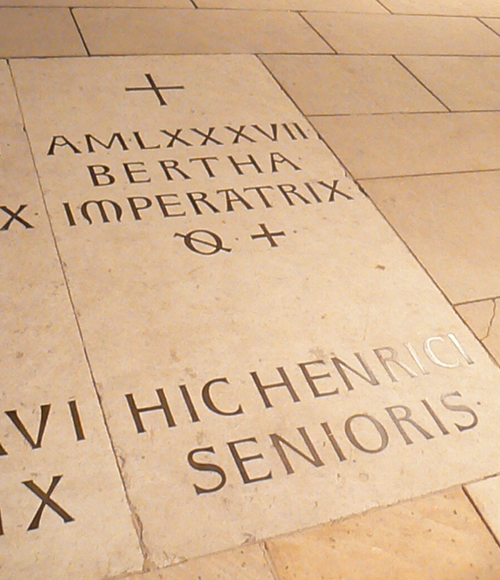
Something tells me this may not be the original gravestone.
[Gravestone of Bertha of Savoy in Speyer Cathetral, photographed 2008 by Acoma, source: Wikimedia Commons]
Bertha of Savoy (1051-1087), daughter of Adelaide of Turin and sister of Adelaide of Savoy, is best known for her marriage to the Holy Roman Emperor Henry IV and the political connections she brought to both her husband and her mother.  These relationships positioned her at the center of Imperial politics in Italy, especially the Investiture Conflict.

Bertha was born the daughter of Adelaide of Susa and Otto of Savoy.  Her parents betrothed her at the age of four to the five year old future Henry IV, Holy Roman Emperor.  Her father died not much more than a year after the betrothal, leaving Adelaide to run the counties of Savoy, Susa, and Turin and raise Bertha and her siblings.  The betrothal, though, was unaffected and in 1066, Bertha married Henry at age fifteen, becoming Queen of Germany, though not yet Empress.

Their marriage was not a peaceful one.  Henry strongly disliked Bertha and tried to repudiate her in 1069.  The German bishops, however, could find no grounds for a divorce (Henry even admitted there weren’t any other than his dislike of her), and called on the Pope.  The request for a divorce was denied and the German princes urged Henry to obey.  Not only was the Church hierarchy opposed to a divorce, but the alliance with Adelaide and her family remained an important consideration.  The first of the couple’s children was born in 1070.

The attempt would not be forgotten though, and Henry found himself paying a high price in land for his mother-in-law’s help in his conflict with the Pope.  With Adelaide’s help, Henry, Bertha, and their young son Conrad traveled to Canossa.  It was not just Bertha’s relationship with her mother that affected events though.  During the time of Henry’s excommunication, another man set himself up as king, only to be defeated two years later: Rudolf of Rheinfelden, husband of her sister Adelaide.

Bertha was not crowned Empress until 1084, after Henry conquered Rome, forced Pope Gregory VII, and appointed his own antipope, Clement III.  She would die only three years later at the age of 36.

Sources/Further Reading:
Robinson, I. S. Henry IV of Germany, 1056-1106. Cambridge: Cambridge University Press, 1999.
Adelaide of Susa - Epistolae
Previté-Orton. C.W. The Early History of the House of Savoy (1000-1233). Cambridge, 1912. - Archive.org

Bertha of Savoy - Wikipedia
0 Comments

Books of Hours

11/6/2015

0 Comments

 
Picture
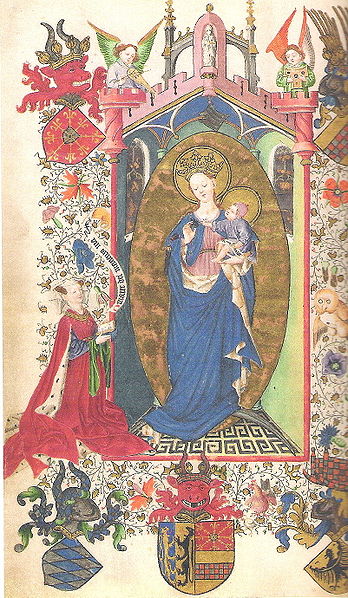
In richer books of hours, the commissioner would often be depicted kneeling before the Virgin.
[Hours of Catherine of Cleves, c. 1440, Morgan Library & Museum, source: Wikimedia Commons]
The twelfth century Europe saw a rise in popular interest, and indeed a sense of ownership over, the Catholic faith.  Over the next few centuries this resulted in the rise of foundations of new monastic orders, like the Cistercians and the beguines, and heresies, like the Cathars.  But it didn’t just lead to sweeping social movements and new institutions.  People wanted ways to participate in religion more on their own terms.  A particular type of book, known as a Book of Hours, allowed anyone who could afford one to bring a small piece of religious life into the privacy of their own home.

Picture
Picture
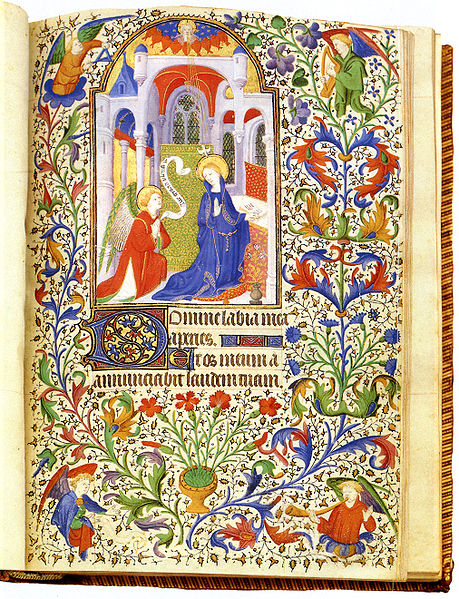
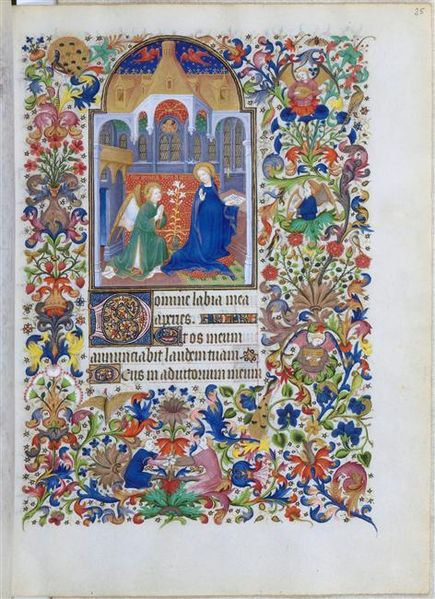
An image of the Annunciation often marked the beginning of the Hours of the Virgin.  Also, notice how similar these two pages look.  These two books came from the same workshop.  It's likely these pages were copied from the same template.
[Annunciation, Boucicaut Master, c. 1410, Paris, source: Wikimedia Commons]
[Annunciation, Boucicaut Master, Heures de Guise, c. 1410, Musée Condé, source: Wikimedia Commons]

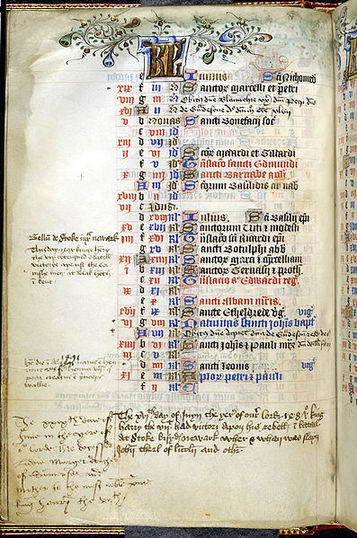
The core piece of any Book of Hours was a text known as the Hours of the Virgin, essentially an abbreviated form of the Divine Office sung by monks and nuns.  Besides this, nearly every Book of Hours opened with a calendar of Church feasts, providing the books owner with the appropriate dates and indicating feasts of particular importance to the Church or to the person who commissioned the book.

Picture
I think my birthday's on there.
[Calendar page, July, Beaufort Hours, 15th century, British Library, source: Wikimedia Commons]
Technically everything else besides two things was optional, but there are several texts that appear regularly.  The usual order for the most common of these was as follows:
  • Calendar
  • Readings from the Gospels
  • Hours of the Virgin
  • The seven Penitential Psalms
  • The Office for the Dead

Other texts were also frequently included, but varied a bit more according to what the person commissioning the book wanted.

Picture
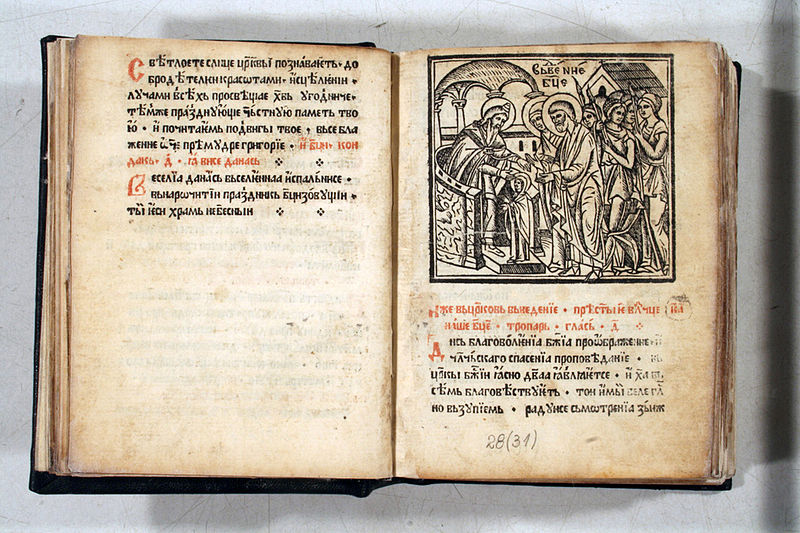
An example of a printed book of hours.  This one's Bulgarian.
[Page 31, Yakov Kraykov, "Chasoslov," 1566, source: Wikimedia Commons]
These were books owned by people at many levels of society.  They ranged from the fantastically opulent books commissioned individually by the Duc de Berry and Mary of Burgundy, to mass produced books that were bought and commissioned by middle class people and may have been the only books they owned.*  They were primarily used as devotional texts, but they served other purposes as well.  Children learned to read from their personal or family Book of Hours.  A wealthy young woman might be given one of these books as part of her trousseau.

The Book of Hours is the most common type of medieval text to survive today.  They rose in popularity from the 13th century onwards.  With the advent of printing in Europe, books of hours were eventually mass-produced, allowing many people, women especially, personal access to their religion.


*There's even one manuscript that was made husband and wife who may have done so because they couldn’t afford to buy one.

Sources/Further Reading:
De Hamel, Christopher. A History of Illuminated Manuscripts. London: Phaidon Press Limited, 1994.
Bell, Susan Groag. "Medieval Women Book Owners: Arbiters of Lay Piety and Ambassadors of Culture." In Women & Power in the Middle Ages, edited by Mary Erler and Maryanne Kowaleski, 149-187. Athens, GA: University of Georgia Press, 1988.
Jewell, Helen M. Women in Late Medieval and Reformation Europe 1200-1550. New York: Palgrave Macmillan, 2007.
Books of Hours, Les Enluminures -  Medieval Books of Hours
Books of Hours - University of Texas at Austin
Picturing Prayer, Books of Hours in Houghton Library - Harvard University
Book of Hours - Wikipedia
Seriously, just go google books of hours or dig through Wikimedia Commons.  There are so many beautiful examples out there and so many people who may well have said these things better than me.
0 Comments

Laodike I

8/6/2015

0 Comments

 
The life of Laodike I (d. after 236 BCE), also spelled Laodice, wife of the Seleukid king Antoichos II, provides an example of the rising power of Hellenistic queens brought about by their increased importance in the 3rd century BCE.  Her investment in dynastic considerations meant that she had a significant motive to involve herself in politics even, or perhaps especially during the period of her divorce from her husband.

Laodike was the daughter of nobleman named Achaios and had both Greek and Persian ancestry.  We first hear of her through her marriage Antiochos II, the son of her father’s elder brother, the Seleukid king Antiochos I.  At the time of their marriage Antiochos was only a second son, not yet his father’s heir.  It was only after the execution of his elder brother Selukos that Laodike knew she would be queen.  The couple had five children together, two sons and three daughters.

Antiochos took power in 261 with Laodike as his queen.  We know little of the next nine years of Laodike’s life.  In 252, after the Second Syrian War, Antiochos found it necessary to make peace with Ptolemy II Philadelphos.  He divorced Laodike to marry Ptolemy’s daughter Berenike, with the understanding that her children, and not Laodike’s, would inherit the throne.  Laodike, meanwhile, received a generous settlement, mostly comprised of land, which she could decide to keep or sell, so long as she did so within a certain amount of time. If she sold it she had the right to attach that land to whichever city she wished, something apparently usually reserved to the king.

Antiochos and Berenike had a son together.  Ptolemy II’s death in 246, however, led Antiochos to repudiate Berenike and return to Laodike and once again name her eldest son Seleukos his heir.  Antiochos died six months later, supposedly poisoned by Laodike.  It is more certain that either she or her allies were involved in the murder of Berenike and her son Antiochos.  It was this action among others that sparked the Third Syrian war,* as Ptolemy III invaded to avenge his sister and nephew.  Two other things happened around the same time: Laodike married her daughter off in a successful political match to Mithridates II of Pontus and her younger son Antiochos rose in revolt against his elder brother with his mother’s support, taking Sardis under his own control.  Laodike died sometime before 236 BCE.


*Also known as the Laodicean war.

Sources/Further Reading:
Aperghis, G.G. The Seleukid Royal Economy: The Finances and Financial Administration of the Seleukid Empire. Cambridge: Cambridge University Press, 2004.
Shipley, Graham. The Greek World after Alexander 323-30 B.C. New York: Routledge, 2000.
Pomeroy, Sarah. Goddesses, Whores, Wives, and Slaves: Women in Classical Antiquity. New York: Pantheon Books, 1995.
Laodice I - Livius.org
Laodice I - Wikipedia

0 Comments

The Panathenaia

4/6/2015

0 Comments

 
The Panathenaia was a yearly festival celebrated in Athens* probably in what are now late July and early August.  It commemorated the birth of Athena, and honored her in several forms.  It also served as a show of force, portraying a unified Athens by bringing together the entire population for one festival.  The Lesser Panathenaia, celebrated every year, formed the nucleus of the far more splendid and extravagant Greater Panathenaia, which was celebrated only every four years.

Most of our information refers to the 5th century BCE, though we can assume some continuity across time.  Tradition held that Thesus had founded the festival, though the introduction of athletic contests and the separation between Greater and Lesser didn’t happen until the archonship of Hippoclides in the mid 6th century BCE.

The Greater Panathenaia probably lasted 6-8 days, with the Lesser taking up only 2-3.  Three musical competitions took up the first part of the Greater festival.  The victors received olive crowns set with gold.  These competitions were followed by the gymnastic contests for boys, adolescents, and adult men.  The winners received a number of amphorai of olive oil, which they could sell duty free.  Tribal competitions followed, including a beauty contest for athletes, a pyrrhic dance, and a torch race, with the winner’s torch being used to light the sacrificial fire on the altar of Athena.

The morning after the torch race came the procession, perhaps the most important part of the festival besides the sacrifices themselves.  Every free person in Athens could participate, though only Athenian citizens were allowed past the Gateway to the Acropolis.  One of the most important positions in the procession was held by young girls from prominent families carrying baskets.  To deny this position to a well-born girl was an enormous insult.  Also of note in the procession was the enormous peplos or robe woven new by upper class women** every four years for the statue of Athena Polias.  It was large enough to be hung on a ship’s mast and traditionally depicted Athena’s defeat of the giants.

The procession ended with sacrifices to Athena: one at the Gateway, one to Athena Nike, and finally a hectatomb to Athena Polias (Athena of the City).  This was followed by feasting and celebrations that lasted for at least the next day, possibly two days.  The Lesser Panathenaia included this procession and sacrifice, but not most of the contests.


*There’s some evidence it was celebrated elsewhere as well, but this is the one we know about.
**Until the Hellenistic period it was actually considered a bad thing to mention the names or families of those who had done the weaving, though it may be they had a special place in the procession.

Sources/Further Reading:
Panathenaia - Theoi
Panathenaia - Perseus
Thyucidides, Peloponnesian War 6.56 - Perseus
Pomeroy, Sarah. Goddesses, Whores, Wives, and Slaves: Women in Classical Antiquity. New York: Pantheon Books, 1995.
Herington, C.J. Athena Parthenos and Athena Polias: A Study in the Religion of Periclean Athens. Manchester, England: Manchester University Press, 1955.

Panathenaic Festival - Athenian Daily Live, University of Massachusetts Boston
Panathenaic Festival - Ancient World History
The Panathenaia - Classical Period

0 Comments

Adelaide of Susa

1/6/2015

0 Comments

 
Picture
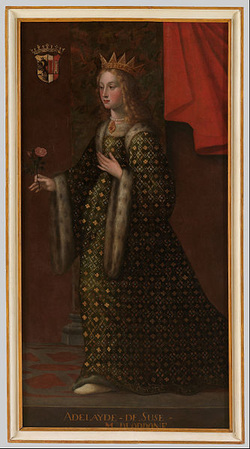
Places to go, people to see.
[Adelaide of Susa, Oddone's wife, 18th century, Unknown artist, source: Wikimedia Commons]
Adelaide of Susa (c.1015-c.1091), Marchioness of Turin, second cousin to Matilda of Tuscany and mother-in-law to Henry IV, inherited the county of Turin from her father, outlived three husbands, and ruled not only Turin, but also Savoy during the turbulent time of the Investiture Controversy.  She chose to walk a middle path between Pope and Holy Roman Emperor, somewhat favoring her son-in-law, but remaining at least somewhat militarily and politically neutral.

Adelaide was the eldest of three daughters of Ulric Manfred of Turin and Bertha of Milan.  Since she had no brothers, Adelaide inherited her father’s title and most of his property.  Officially though, since the title came with military duties,* she could not rule entirely on her own.  So in 1036 she contracted the first of her three marriages, to Herman, Duke of Swabia.  He died two years later.  Adelaide remained single for about three years before marrying Henry of Monferrat.  This union would also be short-lived and childless, with Henry dying in 1044.  Adelaide remained at least partially in control of her holdings, ruling jointly with her husbands and by herself when widowed.

In 1045, she married Odo, Count of Savoy.**  The couple had five children together and it was through three of these, her sons Peter and Amadeus and her daughter Bertha that Adelaide reached the height of her power.  Odo died sometime between 1057 and 1060, leaving Adelaide first as regent for her sons, then ruling with them once they came of age.  In 1070, she burned the town of Asti for trying to remove itself from her rule.

She sent her daughter Bertha to marry Henry IV, which meant that she had some reason to support him in the Investiture Controversy, but generally took a more neutral path.  She accompanied both him and Bertha to Canossa and acted as witness for him, but she demanded land from him in return.  She supported his invasion of Italy and may have accompanied him on campaign, but she also tried to mediate between him and Matilda of Tuscany.  She seems to have supported Gregorian Reform only as it suited her, resulting in praise from several leading churchmen for her enforcing of clerical celibacy and protection of monasteries and condemnation from the same for her approval of simoniac bishops.***

Eventually, Adelaide retired to spend her last years in the village of Canischio, dying in 1091.


*Not to mention the anxiety about young, unmarried, noblewomen with power.
**It was through this marriage that the House of Savoy would get its holdings in Italy.
***That is, those who had bought their offices.

Sources/Further Reading:
Adelaide of Susa - Epistolae
Previté-Orton. C.W. The Early History of the House of Savoy (1000-1233). Cambridge, 1912. - Archive.org
Adelaide of Susa - Wikipedia
0 Comments

    My Blog

    Translation of the above: where I post the interesting things I find researching the Classical and Medieval periods in my free time.

    Currently Reading:
    -
    Medieval Monasticism by C. H. Lawrence

    Archives

    March 2016
    February 2016
    January 2016
    December 2015
    November 2015
    October 2015
    September 2015
    August 2015
    July 2015
    June 2015
    May 2015
    April 2015
    March 2015
    February 2015
    January 2015
    December 2014
    November 2014
    October 2014
    September 2014
    August 2014
    July 2014
    June 2014
    May 2014
    April 2014
    March 2014
    February 2014
    January 2014
    December 2013
    November 2013
    October 2013
    September 2013

    Categories

    All
    Architecture
    Biography
    Classical
    Law
    Marriage (legal And Otherwise)
    Medicine
    Medieval
    Misconceptions
    Monasticism
    Overview
    References
    Religion
    Review

    RSS Feed

Powered by Create your own unique website with customizable templates.