Emily Kittell-Queller
  • Home
  • About Me
  • Blog
  • Projects
  • Resume
  • Contact Me

Galla Placidia

29/9/2014

0 Comments

 
Picture
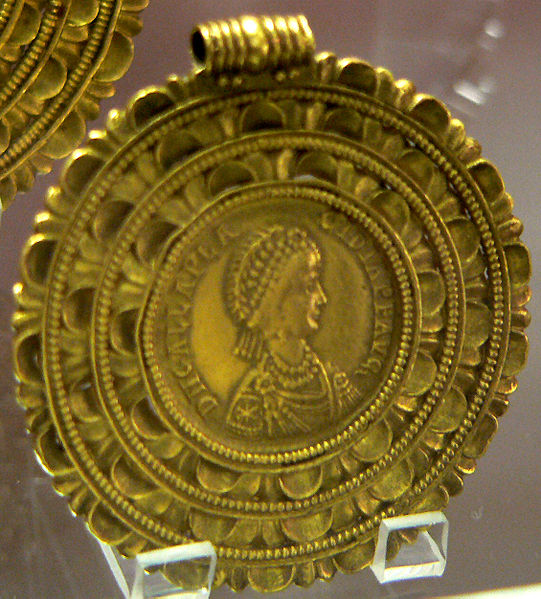
I wanted to use this image, which is traditionally identified with her, but it's been established that that one isn't her.  Phooey.
[Medallion of Galla Placidia, 425 CE, Ravenna, source: Wikimedia Commons]
Galla Placidia (392-423 CE) was daughter, sister, regent, and mother* of various late Roman Western Emperors.  She also spent some time married to the King of the Goths.  Her later years were spent heavily involved in the politics of the then declining Western Roman Empire.  She is best known for her Mausoleum in Ravenna.

She was the daughter of Emperor Theodosius I and his wife Galla.  Both of her parents died by the time she was three and she came into the care of her cousin Serena and her husband Stilicho the Vandal, a high-ranking general.  Growing up she learned the traditionally feminine task of weaving and presumably received a classical education.**

In 408, when Placidia was 16, Stilicho was killed in a coup d’état; Serena was executed less than two years later.  Placidia was captured by the Goths and taken north shortly before the sack of Rome in 410.  She their king Ataulf two years later.  Ataulf was assassinated a year later, leaving Placidia to return to Rome and her brother, Emperor Honorius.

In 417, Honorius forced Placidia to marry his general Constantinus III, by whom she had two children.  For the next four years she involved herself heavily in politics, particularly in matters of religion.  It was she who personally summoned the African bishops to a synod in Rome.  Her husband became co-emperor in 421, but died seven months later.

Within a few months, Placidia moved herself and her children to Constantinople.  She and the Eastern Roman Empress Eudokia arranged the betrothal and eventual marriage of Placidia’s son Valentinian and Eudokia’s daughter Likinia Eudoxia, an advantageous match for both sides as Valentinian was being groomed to take control of the Western Empire once Honorius died, which he did in 423.
Picture
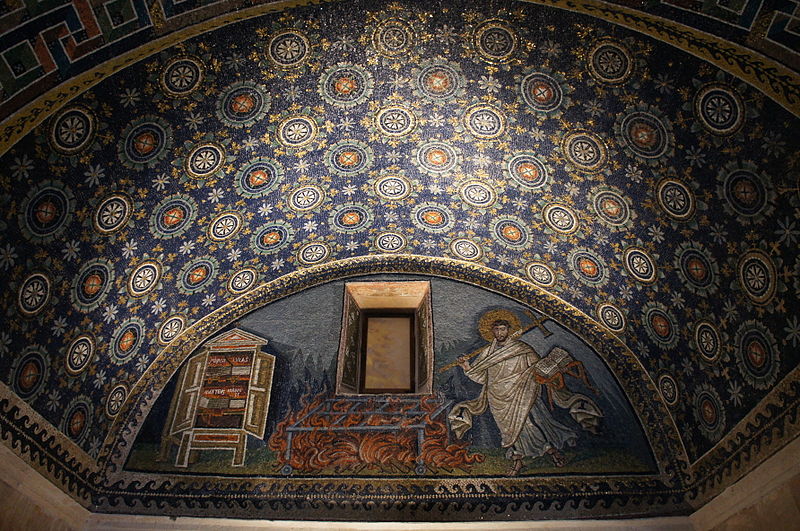
She is best known for her Mausoleum in Ravenna.  It's unknown whether or not she was buried there.  You get this picture of it because I like this particular mosaic.  Not sure why.
[St. Lawrence or St. Vincent of Saragossa, south lunette, Mausoleum of Galla Placidia]
[5th century CE, source: Wikimedia Commons]

With the help of Theodosius II, the eastern Roman Emperor, Placidia took the charge of the Western Empire for her underage son after two years of fighting the usurper Johannes.  She ruled as regent from 425 until her son took over in 437.  She dealt skillfully with several political conflicts in this time, of particular note being the power-hungry Aetius, who eventually wrested much of her political power from her hands in 433.  She is also known for several religious building projects, building restoring several churches in Rome and Ravenna.  She remained active in politics until her death in 450.


*And wife of yet another, but he only lasted about 7 months as co-emperor before dying in 421.
**That is, learning from the works of well-respected poets and philosophers.

Sources/Further Reading:
Sivan, Hagith. Galla Placidia: The Last Roman Empress. New York: Oxford University Press, 2011.
Galla Placidia - De Imperatoribus Romanis
Galla Placidia - Wikipedia
Mausoleum of Galla Placidia - Wikipedia
The Mausoleum of Galla Placidia, Ravenna - Smart History, Khan Academy, YouTube
0 Comments

Raptus in Medieval Law

26/9/2014

1 Comment

 
Note: Well, several notes really.  First, trigger warning, rape and abduction.  Second, if I say or imply anything icky please please tell me.  Third, throughout this post I will really only be talking about situations where a man is or is considered to be the violent party and a woman his victim.   Very few medieval legalists seem to have even considered the possibility that a man could be raped, especially by a woman.  Fourth and last, it’s important to remember that once again I am mostly talking about law here, not actual practice or general attitudes.

When talking about raptus in medieval law, it is important to remember that for a long time it was not an explicitly sexual crime.  It was certainly part of it, but was usually not the main focus.  Elopement, abduction, and sex by force* all fell under one legal term.  Over time, however, legalists (both church and civil) began making a distinction between these three things, assigning different penalties for each.  Offenses were almost always graded by the status of the woman, upper or lower class, virgin or not.

Late Roman and early medieval law regarded all three of these things somewhat equally.  In all cases the punishment was severe, usually death or the confiscation of property depending on the woman’s status, both if she were a nun.  Any marriage between the two, even if the woman and her family consented, even if they had already been betrothed, was prohibited.  In cases of abduction or elopement, there was not necessarily the assumption that any sort of sex had occurred.

By the 11th century it began to be defined as a specifically sexual crime and the question of the woman’s consent to sex** became central in defining what kind of offense had occurred.  Canon law regarded raptus as an offense against the woman and allowed for the excommunication of the offender.  It also forbid marriage between the two people involved, even if the woman consented to it.  Civil law, meanwhile, viewed it as an offense against the woman’s father, in many places allowed for capital punishment,*** and in some places ran directly counter to canon law and required a woman to marry her rapist.  Some lawyers regarded what we would now call spousal rape as a crime, others did not.  All of them insisted on the return of a married woman to her spouse.

Over the course of the 12th and 13th centuries, the requirement that a woman noticeably resist and protest became more and more important.  The restrictions on subsequent marriage were loosened as well, though the woman’s consent was imperative.****  It was a crime to rape one’s betrothed but not one’s wife, though the later was considered a mortal sin.  The penalties remained mostly the same: capital punishment in some cases, loss of property in most.  In most places, Sicily being the notable exception, the law also provided no protection for prostitutes. 

By the 14th and 15th centuries, the legal term raptus had come much closer to the modern definitions of rape.  Elopement and abduction were still considered related but lesser crimes, and the woman’s protests and resistance were key elements in defining the difference.


*Seduction was a separate, though related issue.  Some of what we call rape now would have fallen under seduction rather than raptus.
**Not to running away.  Her consent there defined the difference between abduction and elopement.
***In practice, of course, this was very much affected by class differences.  A merchant who raped a noblewoman would be lucky to escape with his life.  A lord who raped a peasant could get away with just giving her a dowry or even without any penalty at all.
****Her family’s consent was not.  Her father could disinherit her, but several legal texts include the requirement that he give her a dowry anyway provided she married someone of the appropriate station.

Sources/Further Reading:
Brundage, James A. Law, Sex, and Christian Society in Medieval Europe. Chicago: University of Chicago Press, 1987.
Jewell, Helen M. Women in Dark Age and Early Medieval Europe c. 500-1200. New York: Palgrave Macmillan, 2007.
Marriage Canons in The Decretum of Gratian - Catholic University of America
1 Comment

Worship of Artemis

24/9/2014

3 Comments

 
Note: I am not primarily concerned here with the mythology surrounding Artemis.  I will touch on the stories as they are relevant, but they are not my focus here.
Picture
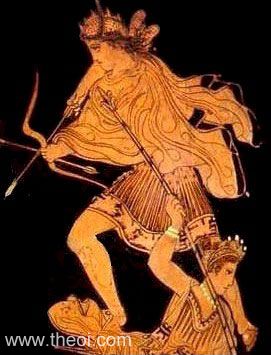
[Detail of Artemis on a vase depicting the War of the Giants, 4th century BCE]
[Source: Theoi.com]

The cult of Artemis by the ancient Greeks, like the goddess herself, is difficult to confine to a simple description.  Her worship varied widely across Greece as different groups of people found different things to represent in her.  The Attic Artemis, Ephesian Artemis, Arcadian Artemis and Artemis Orthia of the Spartans all represented different goddesses in one.  Over time she took on further roles, becoming identified with Selene (the moon), Hekate, and even the Egyptian goddess Bastet.  She was closely connected with her brother Apollo, who shared some of her complementary yet contradictory aspects, and where one was worshiped, the other usually received some attention.

Artemis was widely known as the goddess of wilderness and the hunt.  Outside of the cities, this was her primary aspect as she governed not only animals and the hunt, but also fishing, springs, and forest fires.  Her identification with wild things, however, also had great, if indirect, bearing on how she was perceived and approached as a deity.

In terms of everyday worship, Artemis was a life-cycle goddess.  She was far more likely to be called upon with regard to matters of birth, marriage, and death, all rites of passage.  Women in childbirth called on her to ease their suffering* and all infants were under her protection.  Boys passed into her brother Apollo’s responsibility as soon as they were weaned, but girls remained under her care until they wed.  Young Athenian women, at least those of a certain class, were sent to Brauron to be her priestesses** and girls all over Greece sacrificed to her as part of their passage from childhood to marriage and adulthood.  In Gortyn, a woman wishing to absolve herself of an accusation of theft on her divorce was required to swear before Artemis that she had not done so.

There was, however, a dark side to her care.  A woman who died suddenly for any reason, but especially in childbirth or of plague was said to have been shot by Artemis.  The death of any girl-child was also laid at her feet.  Artemis Orthia of Sparta was said to require human blood, acquired through the tradition of scourging boys.  This was also where her wild side came in.  She was not an orderly goddess and she was swift in her retribution.  There are more stories of her anger than of her favour and while she protected, she was also one to be feared.


*She was also sometimes identified with Eileithiya, goddess of childbirth.
**This was called “playing the bear,” and its purpose was to appease the goddess.  According to myth, some young men had killed a bear for scratching their sister after she provoked it.  Artemis sent a plague to Athens until they began this practice of sending their daughters as her priestesses.

Sources/Further Reading:
A prayer to Artemis, AP VI.273, found in Lefkowitz & Fant, Women's Life in Greece and Rome - Google Books
Law Code of Gortyn - Diotima
Alkman 1.5-101 - Diotima
Pausanias, Description of Greece 3.16.7-17.2 - Perseus
Artemis - Theoi (This site gives a whole lot more primary sources.  And it's really cool in general)
Pomeroy, Sarah B.  Goddesses, Whores, Wives, and Slaves. New York: Schocken, 1995.
Pomeroy, Sarah B. Spartan Women. New York: Oxford University Press, 2002.
Artemis - Wikipedia
Sanctuary of Artemis Orthia - Wikipedia
Cult of Artemis at Brauron - Wikipedia
3 Comments

Wallada bint al-Mustakfi

22/9/2014

3 Comments

 
By Allah I am made for higher positions and I walk with pride,
I blow kisses to anyone but reserve my cheeks for my man.
-Wallada bint al-Mustakfi, embroidered on her clothes
Wallada bint al-Mustakfi (994-1091 CE), was a well-known noblewoman and poet of Al-Andalus (Islamic Spain).  She is best known for the tempestuous love affair that is the subject of her surviving poetry.  While it certainly marked her life, she should also be remembered as a strong-willed patron of the arts, who thought little of the opinions of others and who collected about herself poets of many different backgrounds and gave them the opportunity to write their own works.

We know nothing of Wallada’s childhood, though it is certain that she was well educated and probably wanted for nothing.  Her father was extremely wealthy and she was only child.  In her late childhood and adolescence she witnessed the fitna of Al-Andalus, a violent period of instability leading up to the collapse of the Caliphate of Cordoba and its breakup into numerous smaller states.  Her father* was one of the men who took the throne in these tumultuous years only to be deposed and assassinated shortly thereafter, leaving her, his only child, fabulously wealthy.

Wallada used this wealth for two things: to live in extreme comfort with little thought for the disapproval of others and to collect about herself a wide variety of people, women and men from all classes of society, all of whom had some poetic ability.  This group of people some of whom she supported financially met freely in her house with little care for others’ ideas of propriety.  It is said that Wallada went outdoors unveiled, scandalizing the local mullahs, though whether this means she left her hair uncovered or just her face is unclear.**  She dressed richly and had her poetry embroidered on her clothing.

She never married, choosing instead to have multiple love affairs, the most famous and passionate of which is the subject of nearly all of her surviving poetry: her relationship with the poet Ibn Zaydún.  This was not a peaceful relationship, and it ended rather abruptly when she caught him having sex with her slave girl.  Things escalated quickly between them until Ibn Zaydun was exiled from Cordoba.  The two were eventually reconciled but never resumed their relationship.

Wallada lived a long and presumably comfortable life, never really changing her ways.  She died in Cordoba where she had lived at the ripe old age of 97.


*Muhammad III of Cordoba.
**To me anyway and what sources I can find available to me on short notice aren’t really helping.  Anyone know more about hijab in 11th century Al-Andalus and care to make a judgement?  I’m honestly curious now.

Sources/Further Reading:
"Wallada bint al-Mustakfi" in Poems for the New Millenium: Volume Four, edited by Pierre Jouris, Habib Tengour.  Berkeley: University of California Press, 2012. [text is here]
Guthrie, Shirley. Arab Women in the Middle Ages. London: Saqi Books, 2001.
Fletcher, Richard. Moorish Spain. Berkeley, University of California Press, 1992.
Wallada: una mujer fatal del siglo XI - Segunda Republica (in Spanish)
Wallada bint al-Mustakfi - Wikipedia
Muhammad III of Cordoba - Wikipedia
Ibn Zaydun - Wikipedia

Fitna of Al-Andalus - Wikipedia
3 Comments

Midwives in Ancient Rome

19/9/2014

0 Comments

 
Picture
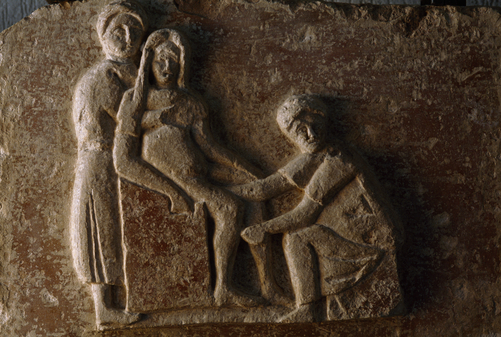
[Relief of a midwife delivering a baby, from a tomb on the Isola Sacra, 2nd cent. CE]
[Museo di Ostia, source: National Geographic]

As they had been in Greece, midwives in the Roman period were responsible for more than just childbirth.  They helped women through nursing, menopause, and difficulties related to menstruation.  Though physicians had themselves become more interested in these things, primary responsibility for dealing with them rested in the hands of midwives.

Not just anyone could be a good midwife.  She had to be quick to learn skills in several areas, up to and including some very basic surgical techniques.  She had to know what to do in the face of any complication that might arise.  She also had to be able to distinguish which infants might not be worth raising and should instead be exposed.*  She had to be quick-thinking and patient.  She also had to be discreet enough to keep the mother’s secrets.

Many of the midwives whose names we know (from funerary inscriptions) were slaves or freedwomen, though a few were freeborn.  It was not uncommon for a wealthy household to have a midwife who was either a slave or freedwoman client.  This was probably a matter of convenience for wealthier women, who were responsible for the health of their entire household.  Midwifery was also among the only training a woman captured elsewhere and enslaved in adulthood was likely to have, particularly if she was Greek, as the most skilled midwives of the time were.

Midwives handled not only the birthing process, but also concerned themselves with the mother’s health before and afterwards as well as dealing with other gynecological concerns.  They helped new mothers through nursing and presumably found a wet-nurse should one be needed.  They are also known to have performed abortions.

Midwives were important people in Roman society.  Perhaps they didn’t have quite the same prestige they held in Greek society, but they were invaluable nonetheless.  Childbirth was still dangerous, painful, and terrifying.  Death was not uncommon.  Midwives had to be able to navigate these metaphorical waters on a regular basis.


*This was less common in Rome than it was in Greece, but it definitely happened.

Sources/Further Reading:
Soranus, Gynaecology, 1.3-4, 1.67-9 - Diotima
Pomeroy, Sarah B.  Goddesses, Whores, Wives, and Slaves. New York: Schocken, 1995.
Childbirth and Obstetrics in Antiquity - Wikipedia
Diana - Wikipedia
0 Comments

Byzantine Laywomen and Female Monasteries

17/9/2014

0 Comments

 
Though most of the important positions within a Byzantine female monastery were restricted either to nuns or men, there were two major roles laywomen could play in these communities.  Numerous women acted as donors and patrons, giving money and property either during their lifetimes or in their wills.  A select few women acted as official protectorss.

Women of all levels of society contributed financially to these communities.  Those who contributed on a smaller scale could be sure at the very least that this would gain them some spiritual benefit.  On a more practical level, a woman who attached herself to a monastery by making such donations would have an easier time joining the community later.  Some women actually exchanged their property for lifelong support.  An older single woman (whether unmarried or widowed) with a modest amount of property might give it all to the monastery with the caveat that they provide for her for the rest of her life.

Wealthier women often gave much larger donations, receiving correspondingly larger benefits in return.  Many founders stipulated* that they be buried in the church there and that particular services be said for their souls and for those of their family members.  Their relatives often got preferential treatment should they chose to join the community.  Some reserved the right to appoint the community’s superior.  A wealthy donor could also have services said for her soul, and of course, no matter the size of the donation, this very act of charity was considered a pious benefit.

Many monasteries (both male and female) also had an official protector.  Some founders desired a male protector for their nuns, others felt a female protector was more suitable.** This person was responsible for the physical and political wellbeing of the community.  They acted as a liaison between the nuns and the outside world, seeing that the community had the resources it needed, making arrangements for building repair, and heading off any political threats.

Very few women ever became monastic protectors.  Many, however, contributed financially to the benefit of themselves and the communities they gave to.  They did so for several reasons ranging from the pious to the practical, usually a mix of them.


*The sources we have for this are the typika, the foundation documents for Byzantine monasteries.  Similar to a monastic “Rule” in the western Church.
**For example, the protector of the monasteries of Kecharitomene (early 12th century) had to be a female relative of the founder, Irene Doukaina Komnene, while the founders of Lips (late 13th century) and Bebaia Elpis (early 14th century) felt that a male protector would be more suitable.  While in some cases a woman could officially be the protector of a male community, it was expected that her husband or son would actually do the job.

Sources/Further Reading:
Thomas, John and Angela Constantinides Hero, eds. Byzantine Monastic Foundation Documents: A Complete Translation of the Surviving Founders' Typika and Testaments. Washington, DC: Dumbarton Oaks, 2000. [Text may be found here.]
Chapter Three, "The Protectorate" - Dumbarton Oaks
Empress Irene Doukaina, Typikon of Kecharitomene, 1110-1116, translated by Robert Jordan - Dumbarton Oaks
Theodora Palaiologina, Typikon of Lips, 1294-1301, translated by Alice-Mary Talbot - Dumbarton Oaks
Theodora Synadene, Typikon of Bebaia Elpis, 1327-1335, translated by Alice-Mary Talbot - Dumbarton Oaks
Talbot, Alice-Mary. "The Devotional Life of Laywomen." In Byzantine Christianity, edited by Derek Krueger, 201-220. Minneapolis: Augsburg Fortress, 2006.
0 Comments

Arsinoë II

15/9/2014

0 Comments

 
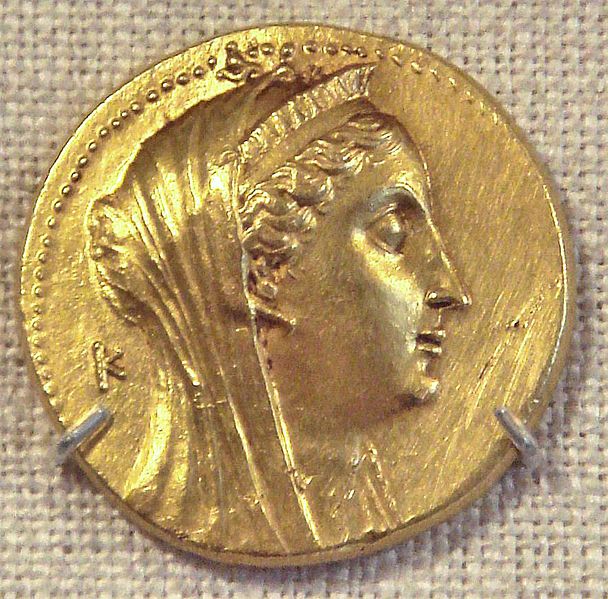
Arsinoë II (c. 316 BCE – early 260s BCE), Ptolemaic Greek princess, married thrice and through those marriages became Queen of Macedonia and Thrace, then later co-ruler of Egypt with her brother-husband Ptolemy II Philadelphos.  Though none of her descendants ever ruled, after her death she was looked to as an example of a Ptolemaic queen and worshiped as a goddess.
Picture
A Greek image of Arsinoë II.  Something about her in this picture reminds me of Victoria.  Not sure what.
[Coin of Ptolemy II with Arsinoë II on the obverse, 3rd century BCE, Egypt]
[S
ource: Wikimedia Commons]

Arsinoë II (c. 316 BCE – early 260s BCE), Ptolemaic Greek princess, married thrice and through those marriages became Queen of Macedonia and Thrace, then later co-ruler of Egypt with her brother-husband Ptolemy II Philadelphos.  Though none of her descendants ever ruled, after her death she was looked to as an example of a Ptolemaic queen and worshiped as a goddess.

She was the daughter of Ptolemy I Soter and Berenike I.*  Her father, formerly one of Alexander the Great’s generals, had taken control of Egypt after his friend and leader’s death.  The exact date of her birth is unknown, with 316 being the accepted guess.
Her first husband was Lysimachos, king of Macedonia and Thrace.  The couple had three sons** together: Ptolemy the Son, Lysimachos, and Phillip.  Arsinoë wanted one of them to inherit the throne, but Lysimachos already had a son, Agathokles, from a previous marriage.  He was, however, arrested for treason and killed in 284.  What sources we have claim it was Arsinoë’s doing.***

When Lysimachos died in battle in 281, Arsinoë took control of the city of Cassandreia and stayed there until she married her half-brother Ptolemy Keraunos a year later.  Both of them claimed the Macedonian throne, so the hope was that a match between them would protect each from the other’s claim and instead strengthen both of their positions in a time when Alexander’s successors were all at war with each other.  The marriage ended Keraunos accused his wife of treason, killed her two younger sons, attempted to kill the eldest and cast Arsinoë out.  Justin, who is basically our only source on this, gives no clear explanation for why.

Picture
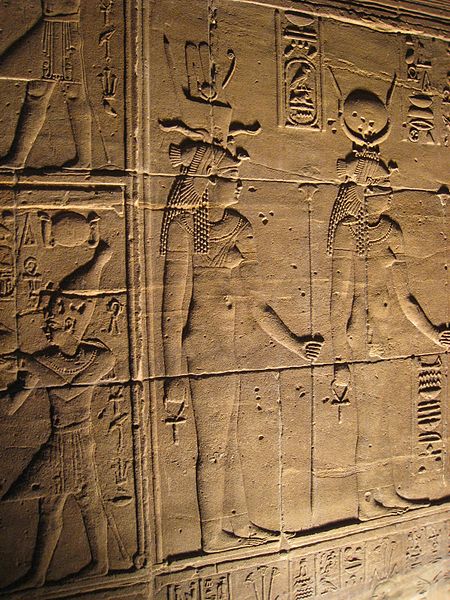
Arsinoë II as Isis.  She's the one on the right.
[Arsinoë II depicted as Isis, relief in the Philae temple of Isis, 3rd century BCE, Egypt]
[Source: Wikimedia Commons]

She then returned to Egypt where her full brother Ptolemy ruled.  The pair of siblings decided to follow the practice of prior rulers of Egypt and married c. 280.   While this scandalized their Greek subjects, it cemented their position as the successors to the previous dynasties of pharaohs.  They ruled Egypt together for the next 10 years or so.  Arsinoë shared all of her brother-husband’s titles and was apparently heavily involved in his rule.  When she died, she was worshiped as a goddess by both Egyptians and Greeks throughout Egypt.  Her cult provided one of the primary bridges between Egyptian and Greek cultures, and her life would provide an example for Ptolemaic queens to come.


*Ptolemy was Berenike’s 2nd husband, while she in turn was his 4th wife.  Arsinoë II and Ptolemy II had a lot of half-siblings.
**Whether or not they had any daughters is unrecorded.  As usual.
***Pausanias says that some of his sources claim it was because Arsinoë fell in love with him and he spurned her advances.  Given how standard this accusation is, it can probably be discarded in favor of the political explanation.  If, that is, we accept that she had a hand in it, which is very possible but not a given.

Sources/Further Reading:
Pausanias, Description of Greece, 1.6.8, 1.7.1 - Perseus
Marcus Junius Justinianus,
Epitome of the Philippic History of Pompeius Trogus, 17.2, 24.2-3 - Forum Romanum
Donnelly Carney, Elizabeth. Arsinoë of Egypt and Macedon. New York: Oxford University Press, 2013.
Arsinoe II - Wikipedia
Arsinoe II - Egyptian Royal Genealogy
0 Comments

Beguines' Saints

12/9/2014

0 Comments

 
Note: If you don't know who some of these saints are, I have provided links to their vitae in the Golden Legend and their Wikipedia pages below.  I chose the Golden Legend (which is known for its... sensationalism) because it was widely circulated at this time and was perhaps one of the best known sources on who some of these saints might be.

The Virgin Mary was, unsurprisingly, the most popular patron for beguinages and held a certain status as the object of individual veneration as well.  Though her cult was enormously popular at the time, we can also see why she might have especially appealed to beguines.  She was chaste, but a mother.  She was holy but lived in the world, not secluded from it.

Many beguines associated with hospitals took St. Elisabeth of Thuringia as their patron.  This holy woman devoted her energies to caring for the poor and the sick, especially lepers.  For 13th and 14th century beguines, she was also a much closer holy figure than some of the others, at least in terms of time, having been canonized in 1235.  In fact, the beguines of the Low Countries were among the first to venerate her.

Catherine of Alexandria represented another aspect of beguine life: teaching.*  According to legend, she defeated fifty pagan philosophers in a debate.  Her martyrdom was less important than her intelligence and knowledge.  As a virgin teacher, she represented an ideal many beguines reached for.

Mary Magdalen was another teaching saint.  People knew the story that she was a reformed prostitute, but she was better known as Jesus’ follower and the preacher who converted Gaul.  She had devoted herself to Christ while still living within the world, which was exactly what the beguines did.

Most of the other saints who were especially venerated by beguines were also women who lived and worked in the secular world, usually widows or virgins.  The few male saints who were taken as patrons of beguinages or depicted in chapel artwork tended to be those who were known for their devotion to the poor (e.g. Francis of Assisi and St. Alexis) or their humble preaching (e.g. John the Baptist).**

The saints a community chooses to venerate shows what they value.  The beguines chose primarily women who were known for their work within the secular world and for their devotion to charity or teaching.  Cloistered saints and male saints in general tended to have little relevance to their lives.

*And possibly preaching as well.
**The key word there is “humble.”  No sainted bishops for these women.

Sources/Further Reading:
Simons, Walter. Cities of Ladies: Beguine Communities in the Medieval Low Countries, 1200-1565. Philadelphia: University of Pennsylvania Press, 2003.
Mary, Mother of Jesus - Wikipedia
Life of Elizabeth of Thuringia (Jacobus de Voragine, Golden Legend) - Internet History Sourcebooks Project
Elisabeth of Thuringia - Wikipedia
Life of Catherine of Alexandria (Jacobus de Voragine, Golden Legend) - Internet History Sourcebooks Project
Catherine of Alexandria - Wikipedia
Life of Mary Magdalene
(Jacobus de Voragine, Golden Legend) - Internet History Sourcebooks Project
Mary Magdalene - Wikipedia
Life of Alexis of Rome
(Jacobus de Voragine, Golden Legend) - Internet History Sourcebooks Project
Alexius of Rome - Wikipedia
Francis of Assisi (Jacobus de Voragine, Golden Legend) - Internet History Sourcebooks Project
Francis of Assisi - Wikipedia
(I am not linking to any more of Francis of Assisi's vitae.  There are too many of them and too much politics surrounding them.  Go look them up yourself.)
0 Comments

Slave and Freedwomen's Work in Ancient Greece

10/9/2014

1 Comment

 
In terms of work, there was less of a distinction between free and enslaved women in Greece than there was in Rome.  In some cases, the difference lay more in authority than in the actual sorts of work done.

Their primary responsibility in most city-states was the care of the household.  Jobs like cleaning, childcare, nursing sick family members and slaves, making cloth, and especially cooking* all fell to the women of the household, slave and free.  The woman of the household, usually the wife, supervised everyone else, taking the highest status tasks and assigning others as necessary.  Babies’ wet-nurses were usually slaves, women from Sparta being particularly sought after for their ability to raise healthy children.

One household task, however, that was almost always performed by a slave woman and not by freeborn women was that of fetching water.  Until the Roman period, most Greek cities did not have the advantages of aqueducts and the like, meaning that all water had to be fetched and carried from a city well or other source and respectable freeborn women did not leave the house.

The helot** women of Sparta deserve special consideration.  Since Spartiate women spent more of their time on athletics and motherhood, a greater portion of the housework fell on the shoulders of the helot women.  They also made nearly all of the cloth produced in Sparta, taking over the primary task performed by free women elsewhere in Greece.

As in Rome, some slave women worked more publically as entertainers (flute-players, tumblers, actresses).  Prostitution was an extremely lucrative business and a significant number of prostitutes were slaves.

Freedwomen in Greece still owed service to their former masters after their manumission.  They were less likely to have specialized training than their Roman counterparts and were more likely to continue in the same sort of jobs they had held as slaves, usually domestic service or textile work.  There are, however, records freedwomen in other occupations such as wet-nurses and even market vendors.

Even so, it is difficult to find information on slave and freedwomen in Greece.  This is in part because much of their work was basically the same as that of freeborn women and its value not quite equivalent.  Neither ancient sources nor modern research has much to say about them.


*Which was decidedly not something men did, in Athens at least.
**The helots were a subject population in Sparta.  They were, essentially, publically-owned slaves and were the primary farmers in the area, the Spartiates being more concerned with warfare.  It is not really possible or profitable to say whether they held a higher or lower status than slaves from elsewhere.

Sources/Further Reading:
"Occupations of freedwomen, Athens, 4th cent. BC" (nos. 329-332) in Lefkowitz, Mary R. and Maureen B. Fant, trans. Women’s Life in Greece and Rome: a Source Book in Translation. Baltimore, MD: Johns Hopkins University Press, 1992.
Pomeroy, Sarah B.  Goddesses, Whores, Wives, and Slaves. New York: Schocken, 1995.
1 Comment

Emma of Normandy

8/9/2014

0 Comments

 
Picture
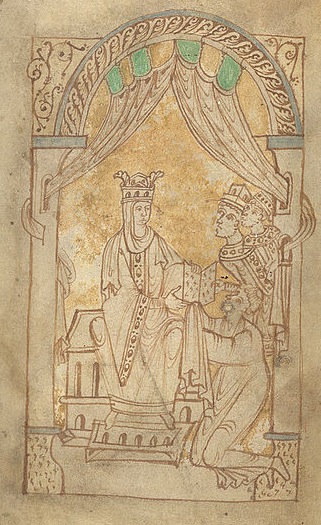
Hey, we actually have a contemporary image of her!
[Emma receiving the Encomium, 1050, from The Encomium of Queen Emma]
[Source: Wikipedia]

Emma of Normandy (c.985-1052 CE) was caught in a difficult position between an earlier dynasty of English rulers and their Viking conquerors.  Even so, she stayed a politically active queen throughout her second marriage and widowhood, playing things to her own advantage.  In 1041 she commissioned the Encomium Emmae Reginae, a political work justifying her actions, which is now one of the major sources on Emma’s life, and one of the only early medieval sources written in support of a queen.

Emma became the second wife of Æthelred the Unready, as part of an alliance between Normandy and England against the Viking threat.  She had three children with him, Edward the Confessor, Goda, and Alfred.  Æthelred, however, died in 1016, leaving the way open for Cnut the Great of Denmark, who had invaded the year before, to conquer England.  Emma, seeing a political opportunity, married him.

Though there is no evidence that Emma was particularly active as Æthelred’s wife, we do know that Cnut married her in part for her understanding of English politics, though marrying the previous king’s wife also helped legitimate his own claim to the throne.  Emma ruled England, acting as regent for him when he returned to Denmark and his other wife, Ælfgifu of Northampton.*  Emma had two children with him, Harthacnut and Gunhilda, who went on to become Holy Roman Empress.

After Cnut’s death in 1035, her sons Edward and Alfred returned to England from their exile in Normandy, supposedly in response to a letter from their mother.  They were attacked and though Edward escaped, Alfred was blinded and killed.**  One can only imagine how much this soured Edward’s relationship with his mother, who had already married the man who took the throne they thought theirs by right and then after his death, threw her support behind Harthacnut rather than the children of her first husband.

Emma’s support of her youngest son, however, was doomed.  Things went well for a while, but soon Emma’s key ally, Godwin of Wessex, switched his allegiance to Emma’s stepson, Harold Harefoot, despite Emma’s control of the treasury.  Harthacnut did manage to take the throne after Harold’s death, but he only ruled two years before he died.  Edward, who became sole ruler of England in 1042, had little use for a mother who had abandoned him.


*Who, incidentally, ruled as regent for Cnut in Denmark and Norway when he returned to England.  It is notable that when Emma attacked the right of Ælfgifu’s son Harold Harefoot, she did so not with the claim that Ælfgifu was not married to Cnut, but rather that Harold was not Cnut’s son and perhaps not even Ælfgifu’s son.
**The Encomium places the blame for this incident squarely on the shoulders of Harold Harefoot and claims that the letter asking Emma’s sons to visit her had been his trick to entrap them.

Sources/Further Reading:
Stafford, Pauline. Queens, Concubines, and Dowagers: the King’s Wife in the Early Middle Ages. Athens, Georgia: University of Georgia Press, 1983.
Emma of Normandy - Medieval Lands
Emma of Normandy - English Monarchs
Emma of Normandy - Wikipedia
0 Comments
<<Previous

    My Blog

    Translation of the above: where I post the interesting things I find researching the Classical and Medieval periods in my free time.

    Currently Reading:
    -
    Medieval Monasticism by C. H. Lawrence

    Archives

    March 2016
    February 2016
    January 2016
    December 2015
    November 2015
    October 2015
    September 2015
    August 2015
    July 2015
    June 2015
    May 2015
    April 2015
    March 2015
    February 2015
    January 2015
    December 2014
    November 2014
    October 2014
    September 2014
    August 2014
    July 2014
    June 2014
    May 2014
    April 2014
    March 2014
    February 2014
    January 2014
    December 2013
    November 2013
    October 2013
    September 2013

    Categories

    All
    Architecture
    Biography
    Classical
    Law
    Marriage (legal And Otherwise)
    Medicine
    Medieval
    Misconceptions
    Monasticism
    Overview
    References
    Religion
    Review

    RSS Feed

Powered by Create your own unique website with customizable templates.