Emily Kittell-Queller
  • Home
  • About Me
  • Blog
  • Projects
  • Resume
  • Contact Me

Married Roman Women and their Fathers

30/1/2015

0 Comments

 
The typical relationship between a Roman married woman and her father doubtlessly varied as widely as the relationships between women and their fathers in any given society.  The ideal relationship was a close one, but not too close.  A married woman’s first thought, after all, should be for her husband.  Still, the expectation was that the connection between father and daughter remain even after her marriage.

A certain amount of affection, though not too much, was considered normal.  It was considered a father’s responsibility to see his daughter married well, not just for the good of the family, but also out of affection for her.  Cicero, at least, played successfully on these expectations in several of his speeches, making several references to his daughter Tullia. 

A father had several rights and obligations with regard to his daughter.  He was her guardian and she remained within his patria potestas until she married, sometimes longer.  What exactly that meant changed over time as a father’s power over his children lessened.*  Most relevant here is his right and responsibility to arrange a good marriage for her.  It was his right in the sense that the choice was his, with only as much input from her as he chose, but his responsibility in the sense that a bad marriage** reflected back on him. 

Regardless of how well or poorly he married her, however, he was expected to guard her interests and those of his son-in-law. 
An adult daughter, though her first thought should be for the interests of her husband, should also look out for her father’s prospects.

If she married cum manu, she entered her husband’s potestas or that of his father and remained within it until the person in question died or she divorced.  If she married sine manu though, she stayed in her father’s potestas*** and retained that connection to him and to her birth family.  Even if she passed into her husband’s potestas, however, her father retained certain rights, including that of killing her if he caught her in the act of adultery, something a husband was not allowed to do.  If she divorced or was widowed, a woman’s father was expected to help find her a new husband if he still lived.  In these cases though, she had a stronger position.  Custom and law granted her greater voice in choosing whether or not to remarry and who with.  She was an adult by this point.  The expectation of care for her dictated that he be involved if he still lived, but his was not officially the sole voice anymore.


*Where in earlier centuries a father could kill his children or sell them into slavery, for example, by the time of Hadrian a man who killed his son was stripped of his citizenship and selling one’s child into slavery was regarded as an act of desperation.
**A “bad marriage” did not mean the same thing it does now.  The issue was not romantic love (which throughout most of Western history has been considered a bonus at best, at least in the context of marriage), but the character and status of the bridegroom and thus the status and situation of the daughter after her marriage.
***Technically, if her father were not yet sui iuris, she was in the potestas of the same person as her father.

Sources/Further Reading:
On Marital Subordination (Gaius, Institutes 1.108-118, 136-137a)  - Diotima/WLGR
On guardianship (Gaius, Institutes 1. 144-5, 190-1.) - Diotima
A funeral eulogy, ILS 8393, 1st century CE - Diotima/WLGR
Papinian, On Adultery, book 2 (Digest 48.5.11) - Diotima
Papinian, On Adultery, book 1 (Digest 48.5.23) - Diotima
Pronouncement of the emperors Diocletian and Maximian - found in hardcopy of WLGR (Lefkowitz & Fant), no link available
Pomeroy, Sarah. Goddesses, Whores, Wives, and Slaves: Women in Classical Antiquity. New York: Pantheon Books, 1995.
Treggiari, Susan. Roman Social History. London: Routledge, 2002.
Excerpts from Sarah Pomeroy's "The Roman Matron of the Late Republic and Early Empire" - Stetson.edu
Marriage in Ancient Rome - Wikipedia
Manus Marriage - Wikipedia
Women in Ancient Rome - Wikipedia

0 Comments

Medieval Nuns' Work

28/1/2015

0 Comments

 
Throughout the Middle Ages in Western Europe it was commonly agreed that a nun’s primary work was to concern herself with the glory of God through singing the hours.  This usually didn’t occupy all of her time though and most Rules, most notably the Rule of St. Benedict,* require a certain amount of labor beyond that.  This is not so much a consideration of how that category might be defined as much as an attempt to show some of the things nuns did as work.

Like other women throughout history, many communities of nuns turned their hands to textile work.  They made altar cloths, priests’ vestments, and quite possibly their own clothing.  The repeated orders of a 13th century Norman bishop that nuns should restrict themselves to weaving and sewing liturgical cloths rather than creating frill collars and silk accessories to sell makes it clear that some communities were doing just that, probably to support themselves financially.  It’s unlikely that they were the only ones to do so.

Some also did agricultural work, usually on a much smaller scale than monks did.**  They grew crops and kept farm animals, often dairy cows, pigs, and sheep.  Those communities with vineyards almost certainly made wine as well.  Some grew medicinal herbs and practiced medicine, either through a hospital connected to the monastery or independently.***  This was not usually the predominant work in a monastery and the nuns working in the hospital were outnumbered by their sisters who remained entirely cloistered.

Early medieval English nuns in monasteries closely connected with missionaries often spent much of their time copying manuscripts, especially Gospels, for use by newly Christian communities.  A few, notably St. Leoba, engaged in missionary work themselves.  Nuns in later centuries continued to work with texts, copying and interpreting them, while some communities took in secular girls and educated them.  The houses of Gandersheim in the 9th century and Helfta in the 13th, for example, were known for their high level of scholarship.

Nuns’ labor varied widely across and centuries and localities.  The wealthier the house, the less likely they were to do more physical work and the more likely they were to focus on education, though most communities did certain amounts of both.  This is, of course, based on a certain definition of the word “work” that may not have really fit how these nuns thought about their own lives.


*On which many reformers based their own Rules.
**Communities of monks sometimes had plow oxen.  Communities of nuns did not.
***As Hildegard of Bingen may have.  She certainly had enough practical and scholarly experience to write two medical texts.

Sources/Further Reading:
Herlihy, David. Opera Muliebria: Women and Work in Medieval Europe. New York: McGraw Hill, 1990.
Jewell, Helen M. Women in Dark Age and Early Medieval Europe c. 500-1200. New York: Palgrave Macmillan, 2007.
Jewell, Helen M. Women in Late Medieval and Reformation Europe 1200-1550. New York: Palgrave Macmillan, 2007.
Nichols, John A. and Lillian Thomas Shank, eds., Distant Echoes: Medieval Religious Women, Volume One. Kalamazoo, MI: Cistercian Publications, 1984.
0 Comments

Lamia of Athens

26/1/2015

0 Comments

 
Lamia of Athens (late 4th/early 3rd century BCE) was an influential hetaira* associated with Demetrius Poliorcetes and possibly Ptolemy I Soter.  As is usually the case with hetairai, we know almost nothing about her life beyond her relationships with these influential men and what we do know about her is skewed by the viewpoint of upper class men writing about a woman who lived outside the so valorized role of chaste wife.

Most sources that mention her name her the daughter of an Athenian man by the name of Cleanor, though who he may be beyond her father is unknown.  According to Plutarch, she spent the early part of her career as a flute-player before eventually becoming a hetaira.  Precisely who she associated with at first remains unknown, but she was present at the battle of Salamis in the fleet of Ptolemy I.  Some have assumed this means she was the mistress of Ptolemy I, but others have pointed out that it’s equally possible that she was actually associated with one of his close friends.

It was during this battle that Demetrius Poliorcetes capture the boat she was on.  He proceeded to fall madly in love with her and took her as his mistress.  Since she was older than him, ancient sources like Plutarch and Athenaeus assume that her looks played little to no part in his attraction to her.  They attribute this entirely to her wit and “talent.”  Her wit and intelligence, at least, are shown in anecdotes by Athenaeus. 
At some point she had a daughter, Phila, by him.

No sources tell of her later years.  As far as we know, she may have lived comfortably with Demetrius for the rest of her life.  Or maybe she left him later, by her own will or his.  Her detractors didn’t hesitate to accuse her of immorality, unchastity, and extravagance, the usual insults leveled against hetairai.**  She spent money public works as well as on herself, building a stoa for the people of Sicyon and may have contributed in other ways to Demetrius’ efforts to rebuild the city.  But beyond this, as is the case with so many other women’s lives, for lack of information the story must end here.


*The Ancient Greek equivalent of a courtesan.
**And against women in similar positions throughout history.  Unimaginative much?

Sources/Further Reading:
Plutarch, Life of Demetrius 16.3, 19.4, 24.1, 25.6, 27.1-6 - Lacus Curtius
Athenaeus, The Deipnosophists 576-7 - Attalus.org

Pomeroy, Sarah. Goddesses, Whores, Wives, and Slaves: Women in Classical Antiquity. New York: Pantheon Books, 1995.
Ogden, Daniel. "Courtesans and the Sacred in the Early Hellenistic Courts." In Tempelprostitution im Altertum, edited by Tanja Susanne Scheer, 344-376. Oldenburg: Verlag Antike, 2009.
Lamia of Athens - Ptolemaic Dynasty
Lamia of Athens - Wikipedia

0 Comments

Flying Buttresses

23/1/2015

4 Comments

 
Picture
Picture
Pretty.  So pretty.... Ahem, what?  I'm not distracted.  Not at all.
[Church of the Abbaye de la Trinité in Vendôme, France, 13th century, photographed by Chatmouettes, source: Wikimedia Commons]
[Marienkirche in Lübeck, Germany, 13th century, photographed by Thomas Möller Roggenhorst, source, Wikimedia Commons]

This post gets a little story and a departure from my usual style.  When I was little, my mom used to buy these 3D puzzles and paper models of Gothic cathedrals and spend hours putting them together.  I thought they were pretty enough but for the most part wasn’t terribly interested.  Except for one thing.  I thought flying buttresses were so cool.*

The use of pointed arches allowed 11th and 12th century (already widely used in the Arab world) allowed European architects to build their churches somewhat taller, but until the invention of the flying buttress, there was only so high they could go.  Where rounded arches direct much of the weight resting on them outward, pointed arches send more of that force downward.  As a result, they can be made taller without making the base any wider.

Picture
Picture
Now imagine a significant amount of weigh pressing down on each of these arches.  You can sort of see how the pointed arch directs the force more down than out, at least in comparison to the rounded arch.
[Rounded Arch and Equilateral Pointed Arch, 2005, drawn by Mats Halldin, source: Wikimedia Commons (here and here)]
Stone ceilings are really heavy though and even a pointed arch will direct some of that force outwards.  Build too high and the top part of the wall will push out, collapsing the whole structure.  Simple buttresses helped counter some of that.  A basic buttress is a pillar of stone built against a wall to provide support.
Picture
There's a flyer hiding behind the wall, but there's also a smaller, simple buttress on the right here.
[Westminster Cathedral, photographed by Tagishsimon, 19th century, source: Wikimedia Commons]
A regular buttress works to a certain extent, but what really allowed medieval architects to build so high was the invention of the flying buttress.  This involved pulling the vertical part of the buttress away from the wall and connecting it to the building using a flying arch.  If properly placed** the flyer angles more of the weight down into the ground, countering the outward force generated by the arches of the ceiling.

Now obviously I didn’t know any of this as a small child, but they looked awesome and I thought that if “buttress” was a really cool word,*** then “flying buttress” sounded even cooler.  Years later, learning just how they work and what they made possible only made my love of them stronger.  They really are so cool.

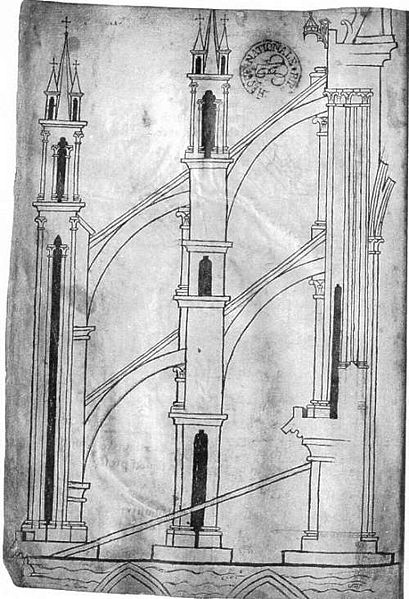
Picture
Distracted by the pretty again.
[Page from the sketchbook of Villard de Honnecourt, c. 1230, France, source: Wikimedia Commons]
*They’re still my favorite architectural element.  Well, flying buttresses and ribbed vaulting are my two favorites.  I never was any good at picking just one favorite.
**Well, it works even if it’s placed a little too low, but it doesn’t work nearly as well.
***You can’t tell me the word “buttress” doesn’t have a really cool sound to it.  Well, you can.  You’ll just be wrong.

Cool Pictures I Didn't Get to Use:
Beverley Minster at Beverley, England
Santa Maria in Cosmedin at Rome, Italy
Ambulatory of St. Denis at Paris, France
Notre Dame du Port at Clermont-Ferrand, France
Cross-section of a Gothic Cathedral

Sources/Further Reading:
Stalley, Roger. Early Medieval Architecture. Oxford: Oxford University Press, 1999.
Stephenson, Carl. Mediaeval HIstory: Europe from the Second to the Sixteenth Century. New York: Harper & Row, 1962.
David Macaulay, "Cathedral," PBS, aired 1985.  Found on YouTube.
Flying Buttress - Wikipedia

4 Comments

Pregnancy in Roman Law

21/1/2015

0 Comments

 
Roman law concerning pregnancy dealt almost entirely with the status of the offspring.  Many of the things we would consider worth writing laws about were deemed less important.  What mattered more was to whom the child belonged and in what way.  In particular the law dealt with the question of slave or free status and if free, into whose potestas the child would be born and therefore who had rights over it.

The child of never married parents followed the status of its mother.  Under Roman law, only Roman marriage was relevant.*  If the people in question were subject to local law and custom, local definitions presumably applied.**  As I mentioned before, according to jurists in the Imperial period, a slave woman who was free at any point during her pregnancy gave birth to a freeborn child, even if she had been re-enslaved.  It is doubtful, however, that this law was strictly enforced.  The question of who had rights over the child was born followed similar, but even simpler logic: the child was in the potestas of the same person as its mother.

The status of the child of free parents who were married, on the other hand, seems on the surface to be a little bit more straightforward.  The child would be freeborn and belonged in its father’s power.  If, however, the father was not sui iuris (i.e. not in anyone else’s power) when the child was conceived, he did not have the same rights over it.  Rather, the child was born into the potestas of the same person as its father, be that its grandfather or whoever had adopted its father.

When Roman law on pregnancy did not deal directly with the status of the child, it still held repercussions for it.  When a marriage ended through divorce or the death of the husband and one party claimed that the former wife was pregnant, it was necessary to have some way of confirming or denying the assertion.  She was to be examined by five midwives and the decision of the majority ruled.  If she knew herself to be pregnant but didn’t inform her former husband or his father, neither was required to support the child, though this didn’t prevent it from being the father’s heir.


*The children of parents in relationships of concubinage or contubernium were considered children of unmarried parents, because, in fact their parents were not married even if they were in a recognized relationship.
**This is where I admit I know very little about how Roman law interacted with local law and custom.  Anyone care to share what they know?

Sources/Further Reading:
Paul, Opinions 2.24.1-9 - Diotima
Pomeroy, Sarah. Goddesses, Whores, Wives, and Slaves: Women in Classical Antiquity. New York: Pantheon Books, 1995.
Hunter, William Alexander. A Systematic and Historical Exposition of Roman Law in the Order of a Code. London: Sweet & Maxwell Ltd., 1803.
0 Comments

Margaret, Duchess of Norfolk

19/1/2015

0 Comments

 
Margaret, Duchess of Norfolk (c. 1320-1399) holds the distinction of being the only woman to ever have held the office of Earl Marshal of England alone.  Unfortunately, though perhaps unsurprisingly, most of our sources seem less interested this fact than in her marriages and issue. She seems, however, to have been a strong-minded woman.  At the very least, she had little fear of directly disobeying the orders of her king on more than one occasion.

She was born the daughter of Thomas Brotherton, Earl of Norfolk, and Alice Hales.  She had two younger siblings, Edward and Alice.  It was Edward’s death sometime before late 1334 that made Margaret her father’s heir.  In 1335, when she was about 15, she married Baron John Segrave.  Three years later, her father died, leaving her the earldom of Norfolk.

Whether or not Margaret ever actually acted as Earl Marshal is unknown.  At this point in time, most of the responsibilities of the office pertained mostly to overseeing the care of the king’s horses, though it was in this century that the position became associated with law courts as well.  We have no record of her discharging any of these responsibilities. Her request to do so in 1377 was ignored and Henry Percy was appointed to the office.

In 1350, Margaret demanded a divorce from her husband on the grounds that she had been betrothed before she was of an age to consent* and had never agreed to live with him.  To obtain this sort of separation, however, Margaret had to get the consent of the Pope, which would go easier if she traveled to Rome.  King Edward III forbade her to go, but with a letter of safe conduct from the King of France and the help of Sir Walter de Mauny, she crossed the Channel in secret.

She never made it to Rome and her case was heard at Poitiers.  In 1353, however, John Segrave died before anything could actually be finalized,.  A year later, Margaret once again ignored Edward’s wishes and married Walter de Mauny without the King’s license. It took her some time to get back into the King’s good graces after that, but there was little he could do.  In 1397 his successor Richard II created her Duchess of Norfolk** for life.  She died two years later in 1399, with only daughters as her heirs.


*According to Church law, at least, this was a valid reason to grant a divorce as it was a violation of the doctrine of consent.
**As opposed to merely Countess which she had been before.

Sources/Further Reading:
Richardson, Douglas. Plantagenet Ancestry: A Study in Colonial and Medieval Families. Salt Lake City, 2011.
Margaret, Duchess of Norfolk - Wikipedia
0 Comments

Spartiate Mothers and Sons

16/1/2015

0 Comments

 
Being asked by a woman from Attica, "Why is it that you Spartan women are the only women that lord it over your men," [Gorgo] said, "Because we are the only women that are mothers of men."
-Plutarch "Sayings of Spartan Women"
The most important thing a Spartiate* woman could be was a mother.  She was to produce strong soldiers and mothers of more mothers and soldiers for the Spartan city-state.  Beyond the process of actually giving birth, however, mothering a son differed drastically from mothering a daughter.  To lose a child was an honorable sacrifice, but a daughter stayed in Sparta, close to her family, and was most likely to if she died in childbirth.  A son on the other hand, left home at an early age and would go off to war.

A woman could expect a certain distance, both emotional and physical, from her sons after he turned seven.  A girl lived in her mother’s house until she had her first child and was declared married, but a boy left the house at age seven and did not return to live there.  His mother may have seen him occasionally, but for the most part he belonged to his cohort.

There are some stories of Spartiate mothers interacting with their own sons and all show the importance placed on honor in battle.  The best-known of these, of course, is that of the mother handing her son his shield and telling him to return with it or on it, that is, having acquitted himself well in battle or dead.  Others tell of mothers refusing to mourn their sons who died in battle, preferring to express joy at the honorable sacrifice they had made.  The flipside of this pride could be deadly for sons who displayed cowardice or even survived most of their cohort.  A woman named Damatria, for example, is said to have killed her son when she learned he had deserted his post. 
To be the mother or sister of a celebrated warrior was a high honor, but to be related to a coward was the greatest disgrace.

How widespread and deeply held this attitude was and how much of it was merely propaganda is difficult to tell,** but it almost certainly varied by time period.  It is important to remember, however, that Sparta was a society whose common morals were geared very strongly towards the good of the community and such an ideology suited such a warlike state quite well.


*Spartiate as opposed to free non-citizens (perioikoi) and helots.
**Sarah Pomeroy shows that millennia later many Confederate mothers during the American Civil War seem to have taken this propaganda to heart at least.

Sources/Further Reading:
Plutarch, "Sayings of Spartan Women," Moralia - Lacus Curtius
Pomeroy, Sarah B. Spartan Women. New York: Oxford University Press, 2002.
0 Comments

Medieval Women as Pilgrims

14/1/2015

0 Comments

 
No matter how holy the act might be, there was a certain anxiety that surrounded the idea of women going on pilgrimage, especially if they went without a man.  Safety, propriety, and the frivolousness of women were the most commonly voiced concerns, the first two of which seem to have deterred many women from going on longer pilgrimages.  Additionally, in many places a woman required the permission of her father or husband to take such a long journey.  Regardless of length, women on pilgrimage almost always went in groups with people they knew,* either with other women or with their families.

Part of the problem was that to go on any sort of a journey was seen to some extent as an abandonment of responsibility at home.  No mater how holy the intent, it was seen as selfish, even if she only left for a day.  There were also concerns that, considering women’s supposed lightness of mind, even a short pilgrimage might be made more out of a desire for a day off than for any truly holy purpose.

An added difficulty for married women was the fact of childbearing.  It was not only difficult, but also frowned upon for a most women to travel long distances when pregnant.  Some married women did go on pilgrimage during their childbearing years, but these were mostly shorter journeys.  A longer trip to Santiago de Compostela, Rome, or Jerusalem was usually out of the question until later in life, when many were too old to do so.

Nuns who wished to visit holy sites had to deal with two sets of concerns, since they were not only women but also cloistered religious.  Some are known to have gone on pilgrimage, mostly abbesses accompanied by a few nuns, but this was something churchmen generally advised against, out of fear for their vows of chastity and stability, out of concern for the communities left behind,** and in some cases out of a desire to control the nuns.***

Despite all of this, there are women known to have gone on pilgrimages long and short.  They flocked to local shrines showing their piety and seeking miracles.  They traveled with their parents, husbands and children, and in groups of other women from their hometowns.  Some, like Margery Kempe, attached themselves to whatever group would have them.  Whatever their reasons, some women found a way.


*One could simply say that women almost always traveled in groups without the qualification that they usually knew their companions, but this was true of male pilgrims as well and would be disingenuous.
**A monastery without its abbess/abbot was often left somewhat vulnerable.
***For all that they had vowed obedience, many abbesses were not known for simply going along with their superiors, especially if they came from a noble background.

Sources/Further Reading:
Webb, Diana. Medieval European Pilgrimage. New York: Palgrave, 2002.
Jewell, Helen M. Women in Late Medieval and Reformation Europe 1200-1550. New York: Palgrave Macmillan, 2007.
Stalley, Roger. Early Medieval Architecture. Oxford: Oxford University Press, 1999.
0 Comments

Faustina Minor

12/1/2015

0 Comments

 
Picture
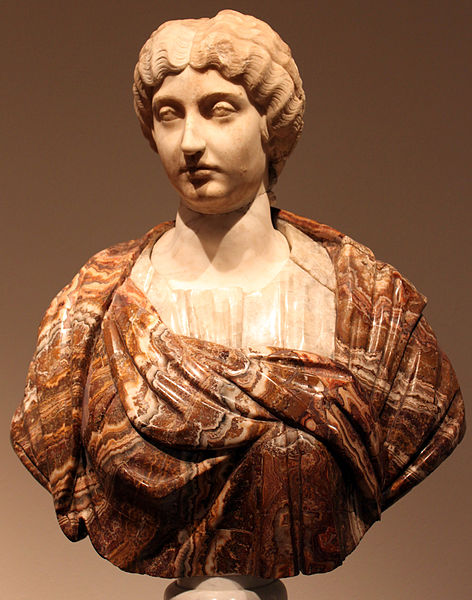
[Bust of Faustina Minor, 2nd century CE, Altes Museum, Berlin, photographed by Anagoria]
[Source: Wikimedia Commons]

Faustina the Younger (between 125 and 130 - 175 CE) was the first woman to succeed her own mother as Empress of Rome.  Ancient historians portray her as an adulteress and poisoner.  Modern scholars, however, tend to agree that such accusations were entirely false.  Not only were what sources we have mostly written by her enemies, but other evidence also paints a different picture: a close relationship with her husband, behaviour appropriate to a Roman wife, and the respect of the Roman military.

She was born the daughter of Antoninus Pius and Faustina the Elder.  In 138, Emperor Hadrian betrothed her to Lucius Verus, whom Hadrian intended as his successor after Antoninus.  After Hadrian died, however, her parents broke off the arrangement and betrothed her to her maternal uncle’s son, Marcus Aurelius, with the intention that the couple succeed Antoninus and Faustina as Emperor and Empress.  They were married in 145.

In 147, Faustina gave birth to their first child, a daughter.  The next day the senate named her Augusta, meaning that Faustina technically outranked her husband, as he was not yet Emperor.  The couple went on to have at least 14 children, six of whom survived to adulthood.*  The marriage seems to have been a happy one,** though some sources claim she had numerous lovers, and that she supported a usurper when her husband lay ill.  When she wasn’t pregnant, and possibly also when she was, Faustina accompanied her husband when he traveled around the Empire.  She was well-respected by the soldiers, even earning the title Mater Castrorum (Mother of the Camp).

Picture
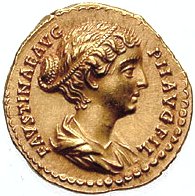
Unlike her mother, who had a single signature hairstyle, Faustina Minor changed her hairstyle regularly.  One theory suggests that she picked a new hairstyle every time she had another child.
[Faustina Minor on an aureus, 2nd century CE, Classical Numismatic Group]
[Source: Wikimedia Commons]

The one event that most affected her reputation after her death happened in 174.  The governor of Athens, Herodes Atticus, a celebrated orator who had been Marcus Aurelius’s tutor who was known for playing tyrant, accused three city officials of conspiracy.  Fourteen years earlier he had his pregnant wife Regilla, who may have been Faustina’s childhood friend beaten to death.  Faustina and her 3-year-old daughter Sabina*** begged Marcus Aurelius to ensure the safety of the Athenians who came to the Emperor to plead their case.  When the time came to justify his actions, Atticus complained bitterly that he had been “sacrificed to the whim of a woman and a three-year-old child.”  He was exiled from Athens for a year, possibly voluntarily.  He outlived Faustina by at least five years and died surrounded by loyal students, orators and writers, most of whom were perfectly willing to take his view about the Empress he so resented.

Faustina died in 175, failing to recover form some accident in a military camp in Cappadocia.  Her husband mourned her deeply and refused to remarry.


*Comodus was the only one of their sons to survive to adulthood.  He is also known as one of the worst Roman Emperors.  This may be another reason Faustina wound up with such a bad reputation after her death.  What better way to drive home the fact that a man was a terrible person than by attacking his mother’s character?  Hey wait, that reminds me of someone else.
**At the very least, Marcus Aurelius wrote in his Meditations, “I have been blessed with a wife so obedient, so affectionate, so genuine.”  Since this was not written for anyone but himself, there is no reason to doubt his sincerity.
***Named Vibia Aurelia Sabina for Hadrian’s wife, Vibia Sabina.
Sources/Further Reading:
Cassius Dio, Roman History 72 - Lacus Curtius
"Life of Marcus Aurelius" (Part 1, Part 2), Historia Augusta - Lacus Curtius
Burns, Jasper. Great Women of Imperial Rome: Mothers and Wives of the Caesars. New York: Routledge, 2007. [Note: This book can be found on Google Books here.  An early draft of the chapter concerning Faustina Minor may be found here.]
Lightman, Marjorie and Benjamin Lightman. A to Z of Ancient Greek and Roman Women. New York: Infobase Publishing, 2008. [Note: May be found on Google Books here.]
Faustina the Younger - Wikipedia
0 Comments

People and Pilgrimages in Medieval Europe

9/1/2015

0 Comments

 
Note: There's a bit about relics and bits of bodies in here, so if you're bothered by that maybe skip the footnote.
One of the most public pious acts one could perform in Medieval Europe was to go on pilgrimage.  One might go on pilgrimage for a number of reasons: religious devotion, needing a cure for an illness, fulfilling an earlier vow to go (sometimes made on the condition that a desired event occur), as penance for some crime or sin, or even out of a secret desire to get away from home for a bit.

Pilgrimages could be short or long, with different sorts of people taking them up for different reason.  Shorter pilgrimages to local shrines were more frequently undertaken by the lower classes and especially by women.  They often sought simple cures and solutions to problems considered petty and small by their social superiors.  Such journeys usually only took a few days at most, sometimes being short enough that the pilgrim could return home the same day.

Longer pilgrimages were dominated by the upper classes, especially men, though people from all levels of society undertook them.  The three most famous destinations, Santiago de Compostela, Rome, and Jerusalem, brought the greatest benefits, but also required the greatest preparation and were the most dangerous journeys.  What evidence we have of pilgrimage vows usually concerns promises to undertake this sort of journey and pilgrims arriving at such sites had often already received their miracle or had gone more out of religious devotion than a desire for something other than an experience in exchange.*

One result of the large numbers of people visiting these sites was the growth of an industry, or rather, several industries around pilgrimage.  There was money to be made from pilgrims, in provisioning them, in caring for them on their journey, and in selling them souvenirs.  The shrines they visited also acquired money through the donations of pious visitors, so having an effective, miracle-working relic, or even just one with a particularly holy reputation, could bring in significant income.  Here lay the shadier industry: the acquisition and falsification of relics.  This is not to say that pilgrimage shrines were rife with false relics or that the Church did not try to crack down thefts and false relics.**  But pilgrimage was at times as much an industry as a religious experience.


*And then there were the Crusades, which were also considered pilgrimages.  Urgh.
**Nor were all churchmen entirely scrupulous about such matters.  My favorite story is the one about how in the 12th century, Bishop Hugh of Lincoln, after attempting to cut off part of the purported arm of St. Mary Magdalene, bit off a finger before anyone could stop him and took it back to Lincoln with him.

Sources/Further Reading:
Webb, Diana. Medieval European Pilgrimage. New York: Palgrave, 2002.
Stalley, Roger. Early Medieval Architecture. Oxford: Oxford University Press, 1999.
0 Comments
<<Previous

    My Blog

    Translation of the above: where I post the interesting things I find researching the Classical and Medieval periods in my free time.

    Currently Reading:
    -
    Medieval Monasticism by C. H. Lawrence

    Archives

    March 2016
    February 2016
    January 2016
    December 2015
    November 2015
    October 2015
    September 2015
    August 2015
    July 2015
    June 2015
    May 2015
    April 2015
    March 2015
    February 2015
    January 2015
    December 2014
    November 2014
    October 2014
    September 2014
    August 2014
    July 2014
    June 2014
    May 2014
    April 2014
    March 2014
    February 2014
    January 2014
    December 2013
    November 2013
    October 2013
    September 2013

    Categories

    All
    Architecture
    Biography
    Classical
    Law
    Marriage (legal And Otherwise)
    Medicine
    Medieval
    Misconceptions
    Monasticism
    Overview
    References
    Religion
    Review

    RSS Feed

Powered by Create your own unique website with customizable templates.