Emily Kittell-Queller
  • Home
  • About Me
  • Blog
  • Projects
  • Resume
  • Contact Me

Cathar Goodwomen

31/3/2016

0 Comments

 
One of the things about the Cathars that really freaked out Catholic authorities was that they allowed women into the ranks of their equivalent of clergy, the bonhommes and bonnefemmes (sometimes translated to Goodmen and Goodwomen).  Part of the Cathar reasoning behind this stated that since material things were bad and that people’s souls were simply trapped in material bodies, a soul could not be male or female.  Therefore, women were considered to have largely the same capacity to teach as men.
 
Most Cathar bonnefemmes seem to have gathered in small communities and schools, entirely separate from men.  They lived together, worked together (mostly in textiles, it seems), and studied together.  This was also where they taught potential new bonnefemmes along with other women who simply came to learn from them.  They also used these communities as a home base when they went out in pairs to talk to people.  Possibly the most famous, was the one founded by Esclarmonde de Foix and her sister-in-law Philippa.
 
The Cathars didn’t tend towards large gatherings or dramatic preaching.  Instead, people tended to gather in small groups in private homes to listen to a pair of bonhommes or bonnefemmes speak.  Before the Albigenisan Crusade, when the Cathars were peacefully integrated with the rest of the local population and generally left alone, bonnefemmes seem to have mostly spoken to small groups of women in their homes.  Once the persecutions began, they continued to preach mostly in homes, but were more likely to speak to small groups of both men and women and bonnefemmes began to more frequently perform the Consolamentum ceremony that made one a bonhomme or bonnefemme, where before it was mostly done by a bonhomme if possible.  They did this in hiding, at risk of persecution.  As the Cathars died out, so too did their bonnefemmes.  The last known Cathar Goodwoman, Stephane de Proaudes, staunch in her refusal to convert from Catharism, was given over by the Inquisitor Bernard Gui to be executed for heresy in the early years of the 14th century.
 
 
*Most Cathars as far as we can tell anyway.  This was not the most cohesive or organized of religious groups, so there seems to have been a fair amount of diversity of belief.

Sources/Further Reading:
Brenon, Anne. "The Voice of the God Women." In Women Preachers and Prophets through Two Millennia of Christianity, edited by Beverly Mayne Kienzle and Pamela J. Walker, 114-133. Berkeley: University of California Press, 1998.
O'Shea, Stephen. The Perfect Heresy. New York: Walker Publishing Company, Inc., 2000.
Cathar Beliefs - Cathar.info
0 Comments

The Franciscan Schism

11/2/2016

1 Comment

 
For all of its popularity, the Franciscan Order was not founded by someone with any particular gift for administration.  By the 1270s, less than 50 years after St. Francis’s death, the Order was on the verge of schism.  The two sides, now called the Spirituals and the Conventuals, disagreed almost violently on the question of poverty and how to interpret St. Francis’s intention that the Friars Minor should own nothing.
 
The Spirituals argued that this was meant very literally.  The Friars Minor should neither have nor use as their own goods or money of any sort.  The Conventuals found this highly impractical, especially given the work of preaching and teaching that the Church had given them.  How could one study without having books or a space to study in?  And how could one teach without having studied?  How could one be an effective teacher when one had no idea where the next meal might come from?*  Were they to just turn away the gifts of grateful, generous donors?  A Papal Bull by Gregory IX authorized Franciscan communities to appoint a ‘spiritual friend’ who would act as a trustee for their goods and property.  Thus they could maintain the fiction of owning nothing while still having the things they needed.  The stricter view, it was felt, was impractical and unnecessarily harsh.
 
The Spirituals rejected this interpretation.  They saw themselves as the only true inheritors of Francis’s vision for his Order and felt that the Conventuals had succumbed to the materiality of the world.  Absolute poverty, not owning anything or having a fixed home was what St. Francis had intended for them.  Many of them were also heavily influenced by the works of Joachim of Fiore, which were then considered heretical.
 
Conflict raged between the two groups, and many Conventual abbots complained of the disobedience of Spirituals among their communities.  Various authority figures tried to mediate, with little success.  In 1317, things came to a head with the election of Pope John XXII, who threw his support entirely behind the Conventuals.  Spiritual Franciscans were subject to excommunication and accusations of heresy.  Some were burned at the stake.  Others were reconciled to the Conventual view.  A few Spirituals remained, but they no longer posed a threat to the Conventual point of view.  The Conventuals had won.  The Order would hold property.  Absolute poverty was no longer the goal.
 
 
*It’s also worth noting that many of the Order’s recruits at this point in time came from the middle and upper classes as well as from the Masters and students of the universities.

Sources/Further Reading:
Lawrence, C. H. Medieval Monasticism. London: Longman, 1984.
Briggs, Charles. The Body Broken. New York: Routledge, 2011.
Barber, Malcolm. The Two Cities. London: Routledge, 1992.
Spirituals - Catholic Encyclopedia
The Spiritual Franciscans and Beguins - Virginia Tech
1 Comment

Catholic Jubilee Years

19/11/2015

0 Comments

 
Pope Boniface VIII declared the first Jubilee, or Holy Year, in 1300.  Pilgrims were flocking to Rome in greater numbers than usual, and they seemed to expect something special beyond the usual indulgences for the turn of the century.  Though some cardinals complained about apocalyptic nonsense, some response had to be given.  Boniface hit on the idea of a Jubilee Year.*  Anyone who made the pilgrimage to Rome and visited the churches of Sts. Peter, Paul, and John the Lateran could gain remission of all penances for their sins.**  Smaller jubilees also happened at Canterbury Cathedral on specific anniversaries of the translation of St. Thomas Becket.
 
When Boniface introduced the idea in this form, he intended for Jubilees to happen every 100 years, but in 1343, Pope Clement VI shortened the interval to 50 years.  Their popularity was such that Urban VI declared 40 years later that every 33 years was an appropriate way to remember the life of Christ and made 1390 a Jubilee as well.  Enough people flocked to Rome in 1400 that an unofficial Holy Year took place then too.  Finally, people settled on 25 years as the appropriate interval.
 
The declaration of a Jubilee produced more than just spiritual benefits.  The great numbers of pilgrims crowding to Rome brought economic prosperity to the city and to those towns on the way there as well.  Charitable institutions, particularly religious ones, received large donations.
 
However, the large numbers had the potential to create problems too, some more serious than others.  As space ran out in inns and hospitals, some pilgrims found themselves without somewhere to sleep until householders began offering space in their homes.  More pressing was the danger presented by large numbers of people in small places.  A spooked donkey or simply a few individuals suddenly inspired to religious fervor could cause a crush of people, leading to a number of deaths and serious injuries, as happened in St. Peter’s in 1300 and on the Ponte Sant’ Angelo in 1450.
 
Jubilees have continued to occur every 50 years up to the present day, with the most recent in 2000.  While ordinarily the next one would not occur ‘til 2050, the current pope, Francis, has declared a special Jubilee from December 2015 to November 2016, the Year of Mercy.
 
 
*He pulled the idea from Leviticus and the Jewish idea of a Jubilee Year.  Jews, however, no longer celebrate Jubilees as they are only observed when the twelve tribes all reside in Israel.
**This would not gain them absolution.  It simply meant they did not have to perform the penance imposed.

Sources/Further Reading:
Webb, Diana. Medieval European Pilgrimage. New York: Palgrave, 2002.
Barber, Malcolm. The Two Cities: Medieval Europe 1050-1320. London: Routledge, 1993.
The First Jubilee - Medievalists.net
Francis Announces New Global Jubilee - National Catholic Reporter
0 Comments

Pilgrimage Accounts

22/10/2015

0 Comments

 
Among the best medieval sources we have on what making a pilgrimage was like are what are sometimes called “pilgrims’ guidebooks”.  Generally these were written by someone who had actually made the pilgrimage and varied in the amount and quality of their commentary, at least in terms of their usefulness to someone wanting to follow in their footsteps.  They range from simple lists of must-see sites to detailed descriptions of what can feel like every minor shrine along the way and the distances between them.
 
Most of the works we have describe the trip to one of the three great pilgrimage destinations of the time: Jerusalem, Rome, and Santiago de Compostela.  All three of these destinations offer the opportunity to describe several sites (and perhaps the writer’s reactions to them) both along the way and at the city in question.  Jerusalem seems to have been the most popular destination to write about, but the best-known guidebook these days is the Pilgrim’s Guide in the Codex Calixtinus, describing the route to Santiago de Compostela.  The funny thing, though, is that this one was probably never actually used by pilgrims on their way there.  It almost never appears in manuscripts except as a part of the larger Codex Calixtinus and there are no shorter, more portable versions that a pilgrim might actually carry with them, as there are of a few other texts.
 
Some of these works, don’t give the reader more than a simple list of sites to visit at their destination or along the way.  Others are far more detailed.  Still others include very little information that might be useful to someone wanting to actually make the pilgrimage, focusing much more on the writer’s personal experiences.  Many of these accounts, both the ones that might be useful to travelers and those that certainly weren’t, seem to be written as much for people who just wanted to read about a holy adventure as for those who wanted to travel themselves.  Pilgrim accounts, then, may well have been used as much for entertainment as for navigating the actual pilgrimage.

Sources/Further Reading:
Webb, Diana. Medieval European Pilgrimage. New York: Palgrave, 2002.
Barber, Malcolm. The Two Cities: Medieval Europe 1050-1320. London: Routledge, 1993.
0 Comments

Pilgrimage Vows

8/10/2015

0 Comments

 
At its simplest, a vow of pilgrimage was exactly what it sounds like: a promise to undertake a pilgrimage to a particular shrine at a later date.  Such a simple thing, though, could be followed by a number of complications, in carrying it out as well as in avoiding having to make good on the promise.  The specifics of the vow usually included the destination and could also cover conditions that would have to be fulfilled before the person would actually have to go.
 
The person making the vow could be from any class in society, though some might have more trouble fulfilling it than others, especially when the pilgrimage in question was a long one.  Married women usually had responsibilities at home and usually had to get the permission of their husbands.  Nuns needed permission from their abbess and sometimes the bishop.  Priests had responsibilities to their parishes, while many nobles needed the permission of their king.
 
A vow of pilgrimage could be made privately to oneself, in the presence of a few witnesses, or publicly.  Some were made with the serious intention of going, but it was not unknown for people to make these vows more frivolously, without thinking things through, and then find themselves bound by them.  Women especially were warned against it, partially due to the common belief that they were less likely to really think things through and partially because it was simply harder for women to get away to go on pilgrimage.  When people did find themselves unable to keep their vows, they would have to apply to a Church authority to be freed from them.
 
It was almost impossible to prove that someone had made a private vow.  If making the pilgrimage turned out to be impossible and one’s conscience didn’t see it as a problem, nobody ever had to know.  On the other hand, it was also impossible to prove someone hadn’t made a vow.  So it was probably equally easy to claim the vow had been made and, provided there wasn’t too much to do at home, take a day off by going to visit some nearby shrine.  A vow, after all, had to be fulfilled.

Sources/Further Reading:
Webb, Diana. Medieval European Pilgrimage. New York: Palgrave, 2002.
Webb, Diana.  Pilgrims and Pilgrimage in the Medieval West. London: I.B.Tauris
Publishers, 2001.
0 Comments

September 26th, 2015

26/9/2015

0 Comments

 
One of many reasons the beguines flourished in the Low Countries and why they are more often remembered in connection with that area than with any other part of Europe where they established themselves is because they had the protection and patronage of the local nobility.  Many of the greater court beguinages and hospitals were founded by countesses.  Later, in the 14th and 15th centuries, when the beguines faced scrutiny and repression, these greater beguinages were able to survive with the help of their patrons.

The interest in beguinages on the part of the nobility of the Low Countries seems to have started with the sisters and successive countesses Jeanne and Margaret of Flanders and Hainaut.  The pair of them set the precedent with their foundations in several cities, most notably Ten Wijngaerde in Bruges and the Groot Begijnhoof in Ghent.  The latter of these also shows the close association between the beguines and the Cistercians,* since it was closely associated with the convent of Mary’s Haven founded at the same time and the hospital associated with both communities was largely staffed by the beguines.  Both of these countesses also involved themselves in legal issues related the communities within their lands and took steps to protect the beguines living in them.**  They both left significant amounts of money in their wills to a number of communities, including many they had no hand in starting.

Jeanne and Margaret’s successors followed in their footsteps, as did many people of less powerful origins.  Patronage of the beguines increased in the 13th and early 14th centuries as new communities were paid for and various counts confirmed earlier donations.  But by the late 14th century, serious suspicions about the beguine’s morals and orthodoxy had begun to arise.  These were “disorderly” single women*** who were not enclosed and could move about among lay people.  Smaller convents began to disappear as their members died off, joined larger communities, or joined more regular Orders.  They lacked the resources to continue in the face of first Catholic and then later Protestant disapproval.  It was the courts that were best off, in part because they were big enough to have patrons among the nobility, who could provide resources and legal protection.  Some of these communities survived all the way into the late 21st century, with the last beguine, Marcella Pattyn dying in 2013.

*Both Countesses were closely tied with this Order too and may have developed their respect for it through their encounters with Blanche of Castile during their childhood.
**Not only from those who would take advantage of women living “on their own,” but also from family members who wanted to force them to renounce the life of a beguine to come home and marry.
***Literally.  They did not belong to any monastic Order.  And don’t blame me for the pun.  I stole it from Walter Simons’ Cities of Ladies.


Sources/Further Reading:
Simons, Walter. Cities of Ladies: Beguine Communities in the Medieval Low Countries, 1200-1565. Philadelphia: University of Pennsylvania Press, 2003.
Ward, Jennifer. Women in Medieval Europe: 1200-1500. New York: Routledge, 2002.
Joan of Constantinople, Countess of Flanders - Epistolae
Margaret of Constantinople, Countess of Flanders - Epistolae
0 Comments

The Camino de Santiago

10/9/2015

0 Comments

 
Picture
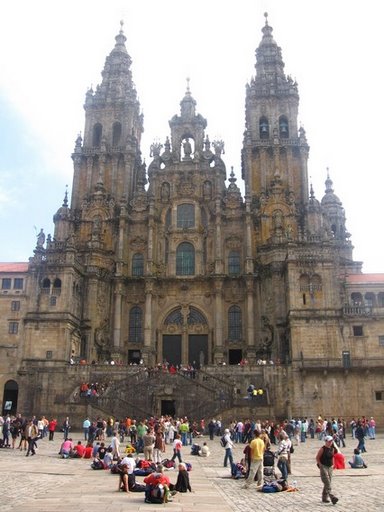
I could have picked a version without all the people, but in a way they're the whole point here.
[Cathedral of Santiago de Compostela (Church of St. James), Obradoio facade, 2007, photographed by jonathan jacobi, source: Wikimedia Commons]
At the height of its popularity, from the 10th century to the 14th, Santiago de Compostela was one of the three most important pilgrimage destinations for European Catholics.  According to tradition, St. James, one of Jesus’ disciples, preached for a time in Spain before returning to Jerusalem to be martyred.  After his death, his body was transported to what is now northwestern Spain.*  Over time, this saint in particular came to be associated with pilgrimage and took on the symbol of the scallop shell which was, and still is, used to identify pilgrims to his shrine.

Sometime in the late 9th century, Alfonso III of Asturias began promoting the shrine as a pilgrimage destination, rebuilding the church there and talking to French bishops about it.  This may have prompted the first French pilgrims to make their ways there.  By the late 10th century, the shrine was attracting people from as far away as Armenia and had become the third most important pilgrimage destination for Europeans after Jerusalem and Rome.

Picture
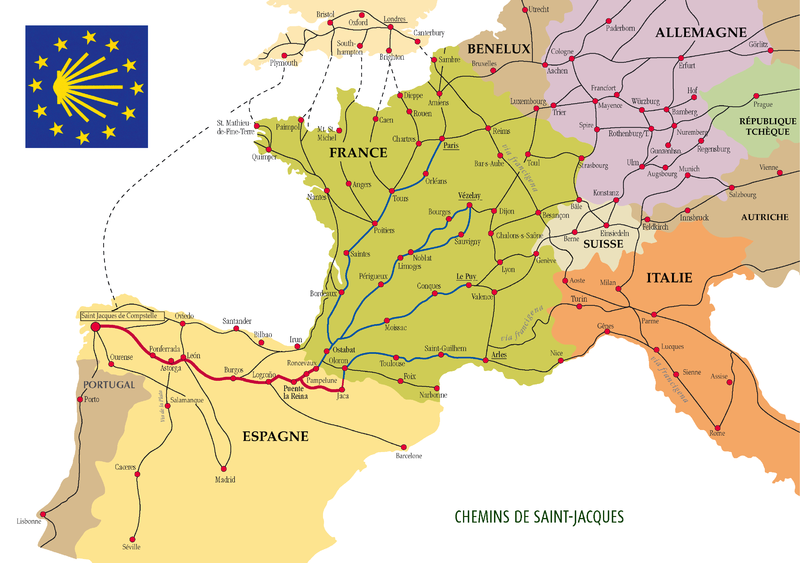
Seriously, if you like maps at all go look at the big version of this at its source.
[Map of the Camino de Santiago in Europe, Manfred Zentgraf, source: Wikimedia Commons]
Interest in the shrine would only grow, especially after Cluniac monks started actively promoting the pilgrimage.  With the large number of people along the Camino, as the route is now commonly known, came the need for services such as hostels and eating places.  Entire towns grew up or expanded to meet the needs of the numbers of people coming through.  Some of the shrines along the route became pilgrimage destinations in their own right.  Music was apparently quite common along the route.  An account from the 12th century describes pilgrims thronged in the Church of Santiago, many of them carrying instruments, others singing along.

Picture
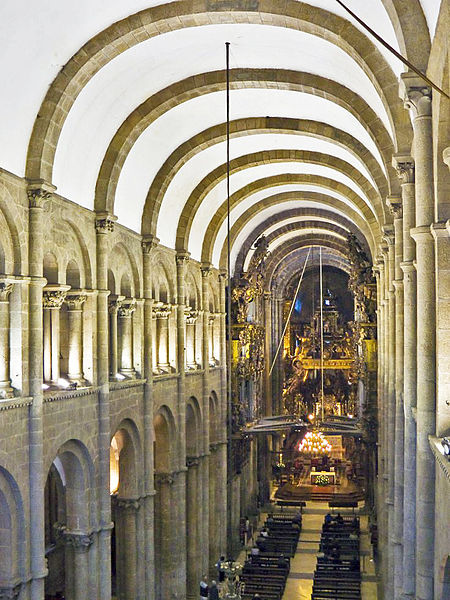
I'm a sucker for vaulting.  It would be more surprising if a picture like this weren't included in this post.
[Cathedral of Santiago de Compostela from the Tribuna, 2009, photographed by Lansbricae, source: Wikimedia Commons]
With the upheavals of the 14th century, pilgrimage to Santiago de Compostela became less popular.  It was never completely abandoned though, and pilgrims carrying the scallop shell can still be seen making their ways south and west through France and northern Spain.


*There are many stories as to how this is supposed to have happened.

Sources/Further Reading:
Webb, Diana. Medieval European Pilgrimage. New York: Palgrave, 2002.
Barber, Malcolm. The Two Cities: Medieval Europe 1050-1320. London: Routledge, 1993.
Search Google or Google Books and you'll find dozens of guidebooks and reflections on people's experiences.
The Way is a movie about an American eye doctor walking the Camino.  I found it rather uninspired but a lot of people seem to like it.
0 Comments

The Peace of God Movement

27/8/2015

0 Comments

 
The Peace of God movement started in what is now southern France, around the same time as castles started appearing with more frequency.  It was a time of feuds and violence.  Farmers and merchants frequently faced the risk of being attacked by knights, either directly or merely as collateral damage and often as part of disputes with other knights or other members of the nobility.  In the 980s, bishops began promoting what they called the Peace of God, followed by the Truce of God.

The main way the Peace of God movement tried to reduce this violence involved getting members of the nobility, especially knights, to take an oath not to harm clerics or the unarmed.  They had a lot of support, especially from more powerful individuals, including at least one Duke of Aquitaine.

The phrase “members of the nobility” is rather flexible here since this was a time when the definition of who actually counted as noble was changing and expanding.  For all that the desire to curb the violence against those with fewer means to defend themselves was absolutely genuine, the bishops’ motives weren’t entirely altruistic.  The primary targets of their initiative were the newly powerful castellans and knights, whom they regarded as disruptive.

As time went on, the movement gained momentum and recognition and the idea of the Truce of God was added, under which people agreed not to fight or kill anyone at first just on Sundays, later on Fridays, Saturdays, important feasts, and seasons like Advent and Lent.  By the late 11th century, nearly every ecclesiastical council in France acknowledged its importance.

This doesn’t mean that the movement was terribly effective.  Actually, in practical terms, it probably wasn’t.  But the bishops’ efforts would eventually have an impact on how members of nobility thought of themselves and their place in society throughout the next few hundred years.  A lot of these ideals would eventually show up in both concepts of chivalry and the great romances.


*Including the Council of Cleremont, which launched the First Crusade.  So, uh... yeah.  Nice job with that one.

Sources/Further Reading:
Bouchard, Constance Brittain.  Strong of Body, Brave & Noble: Chivalry & Society in Medieval France. Ithaca, NY: Cornell University Press, 1998.
Barber, Malcolm. The Two Cities: Medieval Europe 1050-1320. London: Routledge, 1993.
0 Comments

St. Rose of Viterbo

27/7/2015

0 Comments

 
Picture
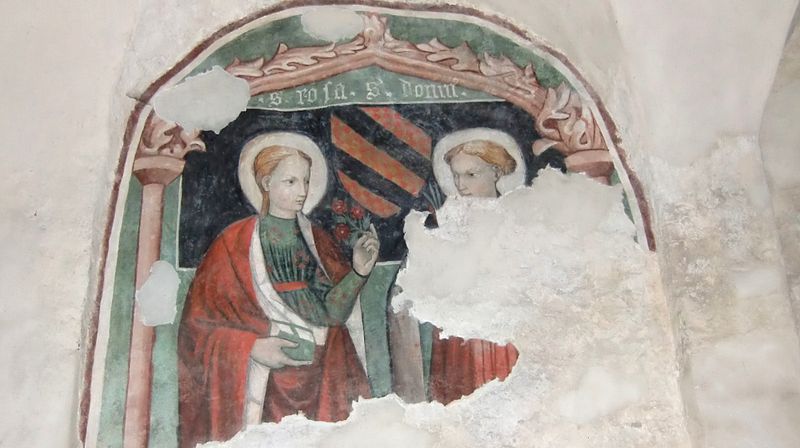
[Fresco depicting Saints. Rose & Donnino, 15th century, Duomo of Ivrea, Italy, source: Wikimedia Commons]
St. Rose of Viterbo (d. 1252) stands among the small number of medieval Catholic women who were allowed, or even encouraged to preach publically, an activity the Church otherwise tried to reserve entirely to its priests.  As is the case with many medieval saints, we know very little of her biography.  Her two vitae do give us some information, but they were intended more to make the case for her sainthood, than to give an account of who she was.  Not to mention that her second and more complete vita was written 200 years after her death.

Rose was born sometime around 1233 in the city of Viterbo.  As it had been 100 years earlier, this was a time of struggle for power between the Holy Roman Emperor, Frederick II and two Popes, first Gregory IX, then Innocent IV.*  Though Viterbo was technically part of the Papal States, it was under the control of Frederick’s supporters, known as Ghibellines.  The Pope’s supporters were called Guelfs.**  Street preachers were common and tensions between the two sides were high.

Rose was a pious child.  According to her second vita, she already wanted to join the Third Order of St. Francis at the age of ten.  Her first vita, by the way makes no mention of this.  She started speaking publically as a teenager, at first only to a few other women in the private homes.  Soon she began urging them out into public spaces, claiming the right and the ability to preach through visions and miracles.

Rose’s words made many city officials angry and around 1250, she and her parents were exiled.  In December of that year though, Rose prophesied that something important was about to happen.  She wasn’t wrong.  Frederick II died less than a week later and she and her parents returned to Viterbo.  At this point, she tried to join the Poor Clare monastery in the city, but was rejected.  Instead, she continued her preaching up until her death in 1252, before the age of twenty.  Less than a year later, her body was moved to the very convent that rejected her, which was then renamed in her honor.***

Rose preached publically and was allowed to do so because of her claim to prophecy and the fact that she took the Pope’s side.  One thing both of her vitae make clear though, Rose was a woman to be admired rather than imitated.


*Technically Celestine IV was Pope between these two, but he lasted less than a month.
**After Welf V, husband of Matilda of Tuscany.
***It was also renamed in her honor.  The people of Viterbo commemorate the moving of her body every year on September 3rd, the eve of her feast day.

Sources/Further Reading:
Pryds, Darleen. "Proclaiming Sanctity through Proscribed Acts: The Case of Rose of Viterbo." In Women Preachers and Prophets through Two Millennia of Christianity, edited by Beverly Mayne Kienzle  and Pamela J. Walker, 159-172. Berkeley: University of California Press, 1998.
St. Rose of Viterbo - Catholic Encyclopedia
0 Comments

Secular Canonesses

23/7/2015

0 Comments

 
Picture
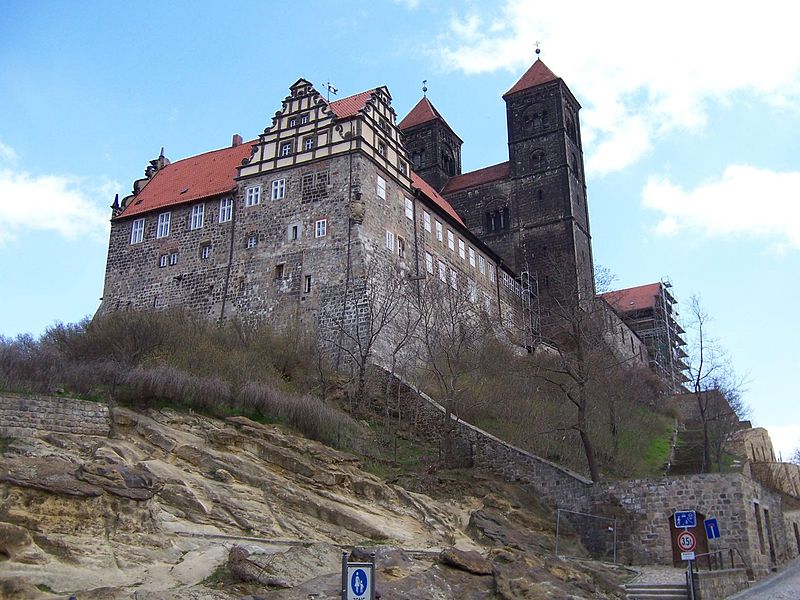
[The Church (St. Serviatus) and Monastery at Quedlinburg, photographed 2006 by Jungpionier, source: Wikimedia Commons]
In my reading about medieval religious women, I’ve frequently come across passing references to “canonesses.”  A lot of the time it gets used interchangeably with “nuns.”  Many people seem unsure as to whether the difference between the two is even important.  Even some medieval writers, purposefully or not, blurred the distinctions between the two groups.  There was a difference though, and by the fourteenth century it was one that houses of canonesses had to fight to defend.

The thing is, canonesses had some similarities with nuns.  Both groups lived in community under the authority of an abbess, devoting themselves to the religious life.  Unlike nuns though, canonesses were not strictly enclosed and did not focus primarily on contemplation.  They acted outside the cloister and were not bound to it, leaving to perform public liturgical functions like ringing the bells, taking part in synods* and participating in religious processions.  They lived in individual quarters around the cloister, maintained personal property, and many employed their own servants.  In many cases, it is hard to distinguish whether a particular group of women were canonesses or nuns.  Many sources use the same term for both, in some cases as part of an effort to get canonesses to act more like nuns and restrict their movements.

Canonesses can be divided into two groups: regular and secular.  Regular canonesses took permanent vows and lived strictly according to a Rule, usually that of St. Augustine.  Secular canonesses, with the exception of the abbess, were not so bound and could leave to get married if they wished.  Many communities of both sorts became centers of great learning, the best known being Quedlinburg and Gandersheim.

Male church officials were not so fond of the canonesses’ more free and less ascetic way of life and tried many times to restrict their movements, though there was only so much they could do.  Most canonesses came from wealthy, powerful families with an interest in maintaining their female relatives’ freedom and the political power that came with it.  They managed to defend their status up to the Reformation, at which point most communities of canonesses became Protestant and either disbanded or continued to exist as communities of single women.


*Church councils

Sources/Further Reading:
Makowski, Elizabeth. "A Pernicious Sort of Woman": Quasi-Religious Women and Canon Lawyers in the Later Middle Ages. Catholic University of America Press, 2005.
McNamara, Jo Ann. Sisters in Arms: Catholic Nuns Through Two Millennia. Cambridge, MA: Harvard University Press, 1996.
Canoness - Catholic Encyclopedai
Canons and Canonesses Regular - Catholic Encyclopedia
0 Comments
<<Previous

    My Blog

    Translation of the above: where I post the interesting things I find researching the Classical and Medieval periods in my free time.

    Currently Reading:
    -
    Medieval Monasticism by C. H. Lawrence

    Archives

    March 2016
    February 2016
    January 2016
    December 2015
    November 2015
    October 2015
    September 2015
    August 2015
    July 2015
    June 2015
    May 2015
    April 2015
    March 2015
    February 2015
    January 2015
    December 2014
    November 2014
    October 2014
    September 2014
    August 2014
    July 2014
    June 2014
    May 2014
    April 2014
    March 2014
    February 2014
    January 2014
    December 2013
    November 2013
    October 2013
    September 2013

    Categories

    All
    Architecture
    Biography
    Classical
    Law
    Marriage (legal And Otherwise)
    Medicine
    Medieval
    Misconceptions
    Monasticism
    Overview
    References
    Religion
    Review

    RSS Feed

Powered by Create your own unique website with customizable templates.