Emily Kittell-Queller
  • Home
  • About Me
  • Blog
  • Projects
  • Resume
  • Contact Me

Child Oblation

28/5/2015

0 Comments

 
Child oblation was the practice of promising one’s infant or young child to the monastic life and was almost exclusively practiced by the upper classes.  The reforming orders of the 12th and 13th centuries made a point of opposing the practice and requiring that postulants actually be of an age to make an informed decision before entering the monastic life.  What they were speaking out against was a practice that had been going on for centuries and, as they saw it caused some pretty major problems in monastic discipline.

This was generally not, as has been argued, a way of getting rid of excess or unwanted children.  The fact that many families sent nobody into the Church for generations while others committed “dynastic suicide” by sending all of their children as oblates or letting them join later.  Rather, the idea was that the parents were offering a gift to God and to the Church.  Making one’s child a monk or nun set them on a holier path than the secular life, it ensured there was someone praying for one’s soul, and it opened up the potential for much greater political power than a child of any parents less prestigious than the upper nobility could ever hope for.*  It also meant that the child in question would be raised in a secure place and position.**

Once such a promise was made, it was very hard to get out of.  When the oblate was drawn to the religious life, or at least unopposed to taking it up, things worked out relatively well.  It was when they had no interest in the monastic life that things got sticky.  Some communities might allow a young oblate to leave the community.  More often though, especially if the child had been sent to the Cluniacs, leaving was extremely difficult, if not impossible.***  As a result, many monasteries contained a certain number of people who didn’t want to be there and had no interest in asceticism.

Child oblation served a purpose and for some it worked well, but the benefits weren’t worth the problems both for and caused by those who weren’t so inclined to the monastic life.  A few Church councils tried to forbid the practice, but it didn’t begin to fall out of favor until the 12th century when it began its slow decline.


*Abbot Suger of St. Denis came from a simple knightly family and went on to become friend and advisor two kings.  Hildegard of Bingen and Guibert of Nogent came from similar families of the lesser nobility.
**Mostly.  Abbots and Abbesses tended to do better in the position if they hadn’t been raised exclusively in a monastery.
***Katharina von Bora, a later example, had to be smuggled out among fish barrels.

Sources/Further Reading:
Barber, Malcolm. The Two Cities: Medieval Europe 1050-1320. London: Routledge, 1993.
Bouchard, Constance Brittain.  Strong of Body, Brave & Noble: Chivalry & Society in Medieval France. Ithaca, NY: Cornell University Press, 1998.
Archambault, Paul J. A Monk's Confession: The Memoirs of Guibert of Nogent. University Park, PA: Pennsylvania State University Press, 1996.
Flanagan, Sabina. Hildegard of Bingen, 1098-1179: a Visionary Life. London: Routledge, 1989.
0 Comments

Artemisia II of Caria

25/5/2015

0 Comments

 
Picture
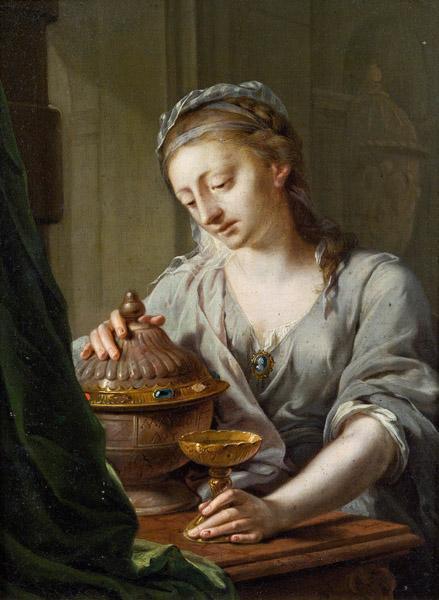
I was unable to find any contemporary images of her, but thanks to a 17th and 18th century fad for painting her about to drink her husband's ashes, we have several paintings like this one.
[Johann Heinrich Tischbein* the Elder, Artemisia trauert um Mausolos, before 1775, source: Wikimedia Commons]
Artemisia II of Caria (d.351 BCE) is sometime confused with Artemisia I of Caria.  But while the first Artemisia fought in the navy of the Persian king Xerxes, most notably at the Battle of Salamis, the second was responsible for the building of the famous Mausoleum at Halicarnassus.  She ruled only a little more than two years on her own, having spent the previous 24 at the side of her brother/husband, Mausolus of Caria, for whom she would build said Mausoleum.

We know little of Artemisia’s life before 353 BCE.  She was one of five children of the satrap Hecatomnus.  At some point she married her eldest brother Mausolus, who would eventually inherit their father’s throne.  In 353, Mausolus died and the throne passed not to his younger brother, but to his sister/wife, Artemisia, who acted as satrap in her own right.

At some point during her reign, the people of Rhodes decided to free themselves of foreign control, seeing Artemisia as not strong enough a ruler to prevent it since she was a woman.  They were wrong.  There’s some uncertainty as to whether she came up with the strategy of tricking the Rhodians into thinking they had won, but there is no denying that it worked.  They wound up sending all of their soldiers to attack and plunder Artemisia’s property, only to find that her army had taken control of Rhodes in their absence.

Picture
[Scale model reconstruction of the Mausoleum of Halicarnassus, Minaitürk park, Istanbul, photographed by Zee Prime, source: Wikimedia Commons]
Artemisia didn’t live much more than two years after her husband’s death.  The story goes that she missed him so much that would mix his ashes into her drink.  Whether or not the story is true, she was responsible for another memorial for her husband: the Mausoleum at Halicarnassus, on a site Artemisia had planned for her burial and his.  According to Pliny the Elder, though the building was unfinished at the time of her death, the sculptors and builders decided to stay and complete the work.  Two hundred years later, the monument Artemisia commissioned would be named one of the Seven Wonders of the World.


*I'm relatively certain (though not entirely since I haven't spoken or read German in a long while) that his last name means "table leg."

Sources/Further Reading:
Diodorus Siculus, Bibliotheca 16.36.2, 16.45.7 - Perseus
Demosthenes, "On the Liberty of the Rhodians" - Perseus
Vitruvius, De Architectura 2.8.14-15 - Perseus
Suda, "Artemisia" - Suda On Line
Bocaccio, Giovanni. Famous Women. Translated by Virginia Brown. Harvard University Press, 2003. [Parts of this may be found here.]
The Mausoleum of Halicarnassus - Livius.org
Artemisia II of Caria - Wikipedia
0 Comments

Grain Distribution at Rome

21/5/2015

5 Comments

 
“Bread and Circuses:” the two things that kept the Roman populace quiet and uninterested in politics, according to Juvenal at least.  The thing is, feeding the people of the City of Rome remained a problem for much of its history in the ancient period.  The surrounding farmland simply couldn’t produce enough grain even before it started being used primarily to cultivate luxuries rather than food staples.  Instead, they had to get grain from elsewhere.*  There was another problem though: given the cost of importing grain, a significant portion of the lower classes in the city couldn’t actually afford to buy it.


This was where the dole came in.  Starting in the late 3rd century BCE, politicians began distributing grain to the lower classes, mostly to men who could vote, in an effort to gain popularity and get elected.  A century and a half later, Gaius Gracchus instituted a measure which allowed people to buy grain at a lower price.  By this point, the availability of free or affordable grain to at least some of the populace of the City was so entrenched that to take it away might well have resulted in revolts.  Julius Caesar, among others, tried to lower the number of people who were eligible, but the numbers always went up again.  Eventually, the office of Prefect of Annona was set up to oversee the distribution.  Emperors and other wealthy people also set up programs to supplement the official grain dole.

The thing is, these things supported men and boys almost exclusively.  Women couldn’t vote or be soldiers and they were considered far less likely to rise in revolt if they couldn’t get food.  Girls, meanwhile, wouldn’t grow up to be soldiers.  Programs that supported children often gave less to girls than to boys and less to illegitimate children than legitimate ones.  A few funds were created specifically for girls, most notably the “puellae Faustinae,” in memory of Faustina the Elder and the “novae puellae Faustinae,” in memory of her daughter.  Most programs though, gave far more to men and boys than to women and girls, if they included them at all.


*And oh boy the politics of that one, not to mention the exploitation of other peoples.  But that’s a story for another day.

Sources/Further Reading:
Alföldy, Géza. The Social History of Rome. Translated by David Braund and Frank Pollock. Baltimore: Johns Hopkins University Press, 1988.
Pomeroy, Sarah. Goddesses, Whores, Wives, and Slaves: Women in Classical Antiquity. New York: Pantheon Books, 1995.
William Smith, Frumentariae Leges - Lacus Curtius
Society and Daily Life - The Romans
Grain Supply to the City of Rome - Wikipedia
5 Comments

Marie d'Oignies

18/5/2015

0 Comments

 
Marie of Oignies (1177-1213) is sometimes, wrongly, considered the founder of the beguine movement.  As one of the earliest beguines we have a vita for,* she is frequently used as an example, both of what one possible life path for an early beguine might look like and of the intense spirituality of the beguine mystic.  Though she was not necessarily a typical beguine, her values and decisions shaped what would become a movement.

She was born to a relatively wealthy family in the town of Nivelles, now in Belgium.  According to her biographer, Jacques of Vitry, her parents disapproved of her strong interest in religion and her rejection of their luxuries.  Her marriage at the age of fourteen, however, freed her of their influence and she quickly persuaded her husband that they should have a spiritual (i.e. celibate) marriage and seek the apostolic life.  The couple gave up their possessions and moved to Willambroux to work at a leper hospital.**

It is at this point that her husband disappears from the story.  Marie had begun to collect a community of women about herself, including a woman named Clementia, who seems to have acted as a companion and servant to her and who had followed her into the life of a beguine.  Around the year 1207 Marie, followed by her companions, moved to Oignies to become a recluse attached to the community Augustinian canons there.  It was here that she met Jacques of Vitry, who would become her spiritual advisor and who would later write her vita.

Marie lived an extremely ascetic life, eating and drinking little and physically injuring herself as an act of penance.  In her final years she was frequently overcome with religious ecstasies.  According to her biographer, she spent the last few days of her life singing a rather extraordinary song in which she not only glorified God, but gave explanations on several theological points.  Her life and Jacques of Vitry’s account of said life would eventually help gain ecclesiastical approval for the beguines.


*Which is, in fact, the only major source on her life.
**It is entirely possible they may have founded said hospital.

Sources/Further Reading:
Muessig, Carolyn. "Prophecy and Song: Teaching and Preaching by Medieval Women." In Women Preachers and Prophets through Two Millennia of Christianity, edited by Beverly Mayne Kienzle  and Pamela J. Walker, 146-158. Berkeley: University of California Press, 1998.
Holböck, Ferdinand. Married Saints and Blesseds Through the Centuries. San Francisco: Ignatius Press, 2002.
Simons, Walter. Cities of Ladies: Beguine Communities in the Medieval Low Countries, 1200-1565. Philadelphia: University of Pennsylvania Press, 2003.
The Blessed Marie of Oignies - The Monstrous Regiment of Women
Marie of Oignies - Wikipedia
0 Comments

Marriage: Sacrament or Sin?

14/5/2015

0 Comments

 
Though marriage has never technically been considered a sin in the Catholic Church, it has not always been considered particularly holy either.  Early Christian theologians’ ambivalence about, and even distaste for, marriage and its association with sexuality* would have a strong effect on medieval thought.  It was only in the mid 16th century that marriage was officially declared a sacrament, though it was widely held to be such for several centuries prior to that.

This is not to say that marriage was condemned outright by more than a few, but neither was it particularly praised.  It helped prevent sins like fornication, but there was little good about it in and of itself since it still bore the taint of sexuality.  Marriage for procreation was not a bad thing, but marital celibacy was better, and remaining celibate and unmarried was best.  As time went on, the religious view of marriage improved.  It still wasn’t regarded as particularly holy, but nor did theological writers see it as a step up from sin.

Significant change in attitudes towards marriage began to come about in the 12th century.  Greater attention to what people believed and brought made the question of marriage into a bone of contention.  Several heretical groups, most notably the Cathars, considered marriage an out and out sin.  Catholic writers, meanwhile, chose to defend marriage as something positive.  Writers like Gratian and Hildegard of Bingen listed the moral and personal benefits of marriage.  They viewed sexuality within marriage as a good thing, with Gratian even going so far as to say that consummation was what made a marriage a sacrament and therefore impossible to end.  Not everyone agreed with the sacramental idea of marriage, but the idea was gaining force. 

Within a century, argument on the subject was minimal, though the official declaration that marriage should be regarded as a sacrament wouldn’t come until the Council of Trent in the 16th century.  This, once again, may have had something to do with disagreement from other religious groups.  Reformation leaders like Luther and Calvin rejected the sacramental idea of marriage, viewing it rather as a product of the natural order, not something religious.  Over the course of centuries, marriage had gone from something one step up from sin, to sacred on the one hand and completely natural on the other.


*St. Paul’s oft quoted “It is better to marry than to burn” (1 Corinthians 7:9) comes to mind.  Not the most stunning endorsement of marriage.

Sources/Further Reading:
Brundage, James A. Law, Sex, and Christian Society in Medieval Europe. Chicago: University of Chicago Press, 1987.
"Canons on the Sacrament of Matrimony," Council of Trent - ETWN.com
Marriage Canons in The Decretum of Gratian - Catholic University of America
Sacrament of Marriage - Catholic Encyclopedia
0 Comments

Artemisia of Halicarnassus

11/5/2015

2 Comments

 
Picture
Eva Green played Artemisia in the second 300 movie.  I'm using this image for the sake of a friend of mine.  You know who you are.
[Eva Green as Artemisia, Patrick Whitaker & Keir Malem-Whitaker Malem, Archive of Movie Costumes, source: Flickr]
We know of Artemisia of Halicarnassus (late 5th century BCE), also known as Artemisia I of Caria, primarily through accounts of the second Persian invasion of Greece in which she fought on the side of the Persians.  She ruled as Queen over the cities of Halicarnassus, Cos, Nisyros, and Calyndos, all in the region of Caria in what is now southwestern Turkey and bowed to Xerxes I of Persia as her overlord.

We know little of her beyond her military activity.  She presumably took over as ruling queen when her husband died.  When Xerxes invaded Greece, Artemisia followed, bringing with her five ships and the soldiers and sailors to man them.  Herodotus tells us that of all Xerxes’ allies, she gave the best advice.  After the Persians took Athens, he asked his commanders whether he should fight the Greek fleet.  Artemisia was the only one to advise against it, telling him that the Greeks were far better fighters at sea than his own people.  The risk was not worth it when he had already accomplished so much.  He should fight, rather, on land, where the Greeks would not be able to stand against him.

Contrary to the hopes of her enemies, Xerxes praised Artemisia’s good advice rather than punishing her for it.  Even so, he didn’t listen to her and paid the price for it.  The Persians went on to lose the Battle of Salamis rather spectacularly.  The story goes that she survived the battle, avoided capture by the Greeks, and earned her king’s admiration by ramming an allied ship and sinking it.  The Greeks thought she was a Greek, while Xerxes thought she had sunk an enemy ship.  Artemisia, meanwhile avoided capture by the Greeks, who were out for her blood since she, a woman, had dared go against them militarily.

After the battle, Xerxes once again asked for her advice.  Should he stay in Greece and continue to fight or should he return to Persia and leave command in the hands of one of his generals?  She told him to leave, since success would then bring him glory, while failure would reflect only on the general he left behind.  Artemisia left as well, on an errand to escort Xerxes’ illegitimate sons to Ephesus.  What happened to her after that is unknown.  Presumably though, her son ruled after her.


Sources/Further Reading:
Artemisia in Herodotus - Diotima
Artemisia of Halicarnassus - Livius.org
Artemisia I of Caria - Ancient History Encyclopedia
Artemisia I of Caria - Wikipedia
2 Comments

Fourth Century Christian Holy Women

7/5/2015

0 Comments

 
The tradition of women’s monasticism can trace its roots back to two major points of origin: the female communities created as secondaries to early male monasteries (such as that of Pachomius) and the lives and works of fourth century holy women, sometimes known as the “Desert Mothers.”  It is the latter that I wish to talk about.  We know about all of these women because they were in some way connected to male writers of the time (e.g. Gregory of Nyssa, St. Jerome), often but not always by blood.  These were women who turned their homes into religious houses, who argued theology and education with each other and with their male relatives.

Most of the women we know of specifically came from a wealthier Roman background.  This isn’t really surprising considering the resources necessary for setting up a monastic community, or even for establishing oneself as a secluded ascetic.  Pilgrimage to holy sites, an important facet of devotion for many Christians in this time period regardless of gender, was yet another significant drain on personal resources.  It’s also worth pointing out that wealthier people were more likely to write and be written about.  With the notable exception of Mary of Egypt, most of these women were quite well educated.

Similarly, few of these women took the religious path alone. Paula and her daughter Eustochium and Macrina the Younger and her mother Emmelia were two sets of mother-daughter pairs who established their homes as monasteries for women. Melania the Younger adopted the monastic life together with her husband Pinianus.  They also acted as teachers and advisors for prominent male Christian writers.  Not only that, but it was hardly possible for a woman to go on a long pilgrimage alone.  In traveling to places like Jerusalem, they brought not only family members, but entire entourages, consisting mostly of household members who had opted for the monastic life themselves.

Sources/Further Reading:
Life of St. Macrina - Tertullian.org
McNamara, Jo Ann. "Muffled Voices: the Lives of Consecrated Women in the Fourth Century." In Distant Echoes: Medieval Religious Women Volume I, edited by John A. Nichols and Lillian Thomas Shank, 11-29.
Kalamazoo, MI: Cistercian Publications, 1984.

Simpson, Jane. "Women and Asceticism in the Fourth Century: A Question of Interpretation.  In Women in Early Christianity, edited by David M. Scholer. Taylor & Francis, 1993.  [Parts of this book are available on Google Books here]
0 Comments

Anna Dalassena

4/5/2015

0 Comments

 
Picture
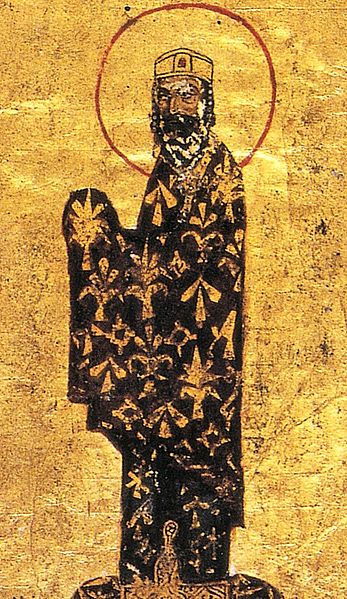
I can't find any images of her, so you get grumpyface Alexios I again.
[Alexios I, 11th century, Vatican Library, source: Wikimedia Commons]
Anna Dalassena (1025-c.1100), while never technically Empress, essentially ruled the Byzantine Empire alongside her son, Alexios I Komnenos, for the first 20 years or so of his reign.  She was an ambitious, intelligent woman, and it was through her maneuverings that her family was able to take the throne and hold it.  She governed skillfully while her son was away at war, keeping the Empire running and preventing a total economic crisis.

The daughter of Alexios Charon, Anna took her mother’s family name as it was the more prestigious.  She kept it for the same reason after she married John Komnenos at about the age of 20.  A revolt in 1057 made her brother-in-law Isaac Komnenos Emperor and gave both Anna and John positions of high authority.  Isaac, however, reigned only two years before retiring and Anna, much to her own dismay, was unable to convince John to take the throne.  It went instead to Constantine X Doukas.  Thus began Anna’s hatred of the Doukai family.

After Constantine’s death, Anna threw her support first behind his widow, Eudokia Makrembolitissa, then behind the new Empress, Maria of Alania.  It was this connection, through Anna and Maria’s friendship as well as through Maria’s adoption of Anna’s son Alexios, that allowed Anna and her middle two sons to overthrow Emperor Nikephoros Botaniates in 1081 and put Alexios on the throne.

Now, Anna knew the importance of making alliances and married most of her children into powerful families.  Even so, her dislike of the Doukai (based on her belief that they had taken the throne from her family) was well known.  She even tried to prevent the coronation of Alexios’ wife Irene Doukaina,* but only succeeded in delaying it a week.

She still managed to mostly exclude Irene from power, taking the governance of the Empire on herself while Alexios spent his time away at war.  Alexios trusted her completely and given her skill, he was right to.  It was she who managed to balance the budget and restore the treasury from its empty state, no mean feat.  It was only in the last years of her life that she was persuaded to retire.  Alexios spent far less time away at war and felt it would look bad if he continued to leave the governing of the Empire to his mother.  Given her granddaughter Anna Komnene’s silence about her last years, she may well have been involved in something questionable as well.**  Anna retired to a monastery in the late 1090s and died shortly thereafter.


*There was some speculation even at the time that she intended to have her son divorce Irene and marry Maria of Alania.
**Heresy, perhaps?

Sources/Further Reading:
Anna Komnene, Alexiad - Internet History Sourcebooks Project
Lydia Garland. "Anna Dalassena, Mother of Alexius I Comnenus (1081-1118) - De Imperatoribus Romanis
Anna Dalassene - Wikipedia
0 Comments

    My Blog

    Translation of the above: where I post the interesting things I find researching the Classical and Medieval periods in my free time.

    Currently Reading:
    -
    Medieval Monasticism by C. H. Lawrence

    Archives

    March 2016
    February 2016
    January 2016
    December 2015
    November 2015
    October 2015
    September 2015
    August 2015
    July 2015
    June 2015
    May 2015
    April 2015
    March 2015
    February 2015
    January 2015
    December 2014
    November 2014
    October 2014
    September 2014
    August 2014
    July 2014
    June 2014
    May 2014
    April 2014
    March 2014
    February 2014
    January 2014
    December 2013
    November 2013
    October 2013
    September 2013

    Categories

    All
    Architecture
    Biography
    Classical
    Law
    Marriage (legal And Otherwise)
    Medicine
    Medieval
    Misconceptions
    Monasticism
    Overview
    References
    Religion
    Review

    RSS Feed

Powered by Create your own unique website with customizable templates.