Emily Kittell-Queller
  • Home
  • About Me
  • Blog
  • Projects
  • Resume
  • Contact Me

Katharina von Bora

30/3/2015

0 Comments

 
Picture
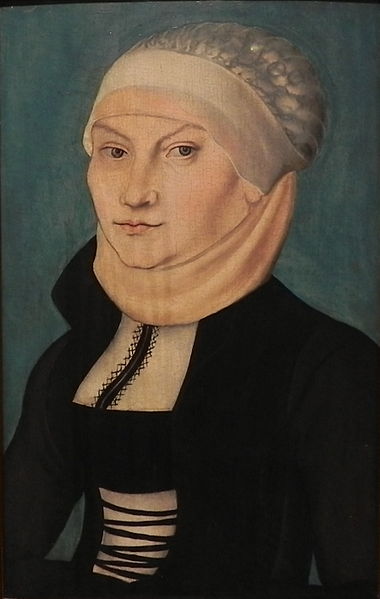
Not a meek little housewife.  Look at her eyes.
[Katharina von Bora, 1528, Lucas Cranach the Elder, Lower Saxony State Museum]
[Source: Wikimedia Commons]

When Katharina von Bora (1499-1552) was a small child, her parents, members of an impoverished noble family, sent her to a monastery to be raised and to eventually take vows as a nun.  After a time at a Benedictine convent, she moved to Marienthron, a Cistercian community that included two of her aunts.  She took vows there at age 16, perhaps at the urging of her parents and aunts, perhaps because it seemed like the logical next step.

But the cloistered life did not suit Katharina.  She fled the monastery for the city of Wittenberg at age 24, hiding in a wagon used for carrying fish along with 11 other nuns.  They came under the care of the reformer and protestant leader, Martin Luther.*  When their families would not take them back, Luther took it upon himself to arrange marriages or respectable employment for them.  It did not take long for the other 11 women to be settled into their new lives.  Katharina, on the other hand, took two years to reach a conclusion.  In the end, she told Luther that she would marry only him or his friend Nicholas von Amsdorf, neither of whom had been actively courting her.

The wedding of Katharina von Bora to Martin Luther did two important things:  it definitively answered the question of whether Lutherans should approve of clerical marriage and it put Katharina in the position of becoming the example for how Lutheran wives should behave.  The couple settled down in a former monastery and set the place up as a farm.  Luther devoted himself to his theology and teaching, while Katharina took up the management of their property, supporting the both of them financially.  She grew much of what they ate, bred and sold cattle, ran a brewery, set up a guest house for visiting students, and eventually established a hospital on the premises.**  Her husband admired her intellect and she apparently enjoyed debating theology, but showed no interest in scholarship.  She reportedly told him that she had had enough of studying Scripture as a nun; now she wanted to live it.

Martin Luther died in 1546, leaving Katharina as his heir.  She survived him by six years, dying of injuries from a cart accident while fleeing the plague.  So died the woman who through her own actions and interests created the model for the ideal Lutheran wife.


*Yes, that Martin Luther, the founder of Lutheranism.
**All skills it’s possible she may have learned in the monastery.

Sources/Further Reading:
Stjerna, Kirsi. "Herr Doktor Katharina von Borra."  In Women and the Reformation. Blackwell Publishing, 2011.
Katharina von Bora, die Lutherin - Lutherin.de [Website is in German]
Luther's wife: Katharina von Bora - LutherCountry
Katharina von Bora - Wikipedia
0 Comments

Funerals in Ancient Athens

27/3/2015

0 Comments

 
To the Ancient Greeks, leaving someone’s body unburied was unthinkable, inhuman.  The actual work related to funerals and mourning practices in Ancient Athens was primarily performed by women.  They were the ones who cared for and prepared the body, who were expected to mourn most visibly, and who were most likely to be polluted by the death.  While certain practices changed over time there was also a lot of continuity from the Archaic period through to the Hellenistic.*  Shifts in common practice came mostly as a result of changes in the Athenian government.

When someone died, their female relatives were responsible for washing, anointing, and clothing the body before laying it out in the house.  This was the prothesis, when friends and family could come to mourn and pay their respects.  Since the family, any water in the house, and anyone who came in was polluted by the death, a jar of fresh water, preferably seawater, was placed outside the door for people to wash in when they left.**  Female relatives sang songs of mourning around the body.  During the Archaic Period, all of this happened in the courtyard and often became a way for a family to show of their wealth.  All kinds of people came to pay their respects.  By the Classical Period, Athenian law restricted these displays, moving them inside to limiting the display of wealth and the presence of women.  The only women allowed to be present were close relatives or those over sixty.

Next came the ekphora, or bearing of the body to its grave outside the city.  In the Archaic Period, the body would often be accompanied by large numbers of people, often including unrelated women who acted as paid mourners.  The women were expected to mourn loudly and dramatically, while the men restrained themselves.  Legislation attributed to Solon curbed this display in the 6th century BCE, curbed this display, forbidding women who were more distantly related than the children of cousins and under the age of sixty from participating.  The burial itself usually happened just before dawn.

A period of mourning followed.  Small offerings might be brought to the grave.  The house had to be cleansed and certain family members, mostly the women, remained polluted by the death for a time before they could be purified.  The dead should be remembered, but especially by the Classical Period, the time for elaborate or very obvious mourning was over.


*And from what I’ve read, there is a fair amount of continuity through to Modern Greek funeral and mourning practices.  Unfortunately, I haven’t read enough on that yet to feel comfortable saying anything about it.
**This contamination was not physical, but was based on the idea that, like birth, the act of dying should be hidden from the gods and anyone who came in contact with it needed to be purified before approaching them.

Sources/Further Reading:
Lefkowitz, Mary R. and Maureen B. Fant, trans. Women’s Life in Greece and Rome: a Source Book in Translation. Baltimore, MD: Johns Hopkins University Press, 1992.  [Especially no. 77]
Pomeroy, Sarah B.  Goddesses, Whores, Wives, and Slaves. New York: Schocken, 1995.
Burial Customs, the Afterlife and the Pollution of Death in Ancient Greece - African Journals Online
Death, Burial, and the Afterlife in Ancient Greece - Met Museum
0 Comments

Allods and Allodial Land

25/3/2015

3 Comments

 
We hear a lot about fiefs and fief-holding and how these things organized medieval society in Western Europe, but such discussions often leave out the importance of allodial land.  This was land a person owned outright, with no responsibilities or taxes owed because of their possession of it.  It was relatively common at all levels of society in South-Central Europe, somewhat uncommon in Northern Europe, and unknown in England.

The term was originally Merovingian and referred to property that was inherited rather than purchased.  Over time though, as the ideas of lordship and vassalage became more common and more entangled with fief-holding, “allod” begand to refer to land and other property owned outright, whether inherited or purchased.*  A fief technically still belonged to the lord rather than the vassal, though it was the vassal who had control over it.

Though inheritance of fiefs became more and more common over time, it was not a given and the lord could entrust the position and the land to someone else if they wished to.  An allod, by contrast, belonged to and was controlled by the person who owned it.  Taxes on such property were lesser or nonexistent, and one could sell or donate it without asking permission from anyone.  Since an allod was simply property and not also a position, it could also be divided for inheritance purposes and/or left directly to a daughter without her having to marry someone who would then take the oath of fealty and become the lord’s vassal.

The ownership of allodial land was not limited to only the upper classes who could participate in the vassal-lord contract.  It was widespread among the lower classes as well and significant number of peasants owned the land they worked themselves.

Owning land in this way allowed for a lot more independence.  Holding land in fief could grant or maintain political connections, whereas allodial land granted resources, came with no strings attached, and had far fewer restrictions on inheritance.**  Matilda of Tuscany was able to wield the power she did because of her vast amount of allodial land.***  Peasant allodists owed no rent or service to anyone, leaving them with far more freedom and resources.  Allodial property added a layer of complexity to the lord-vassal system, granting a certain level of independence from social ties, but on its own, isolating the property owner from those same ties.


*Or captured.
**Especially since a fief did not necessarily go to the vassal’s heir, particularly in earlier centuries.
***Also, the Dutch House of Orange is so named because Orange was the only land William I owned in his own right rather than in fief to somebody else.

Sources/Further Reading:
Bouchard, Constance Brittain.  Strong of Body, Brave & Noble: Chivalry & Society in Medieval France. Ithaca, NY: Cornell University Press, 1998.
Hodder, Michael J. "Allod." In Dictionary of the Middle Ages v.1, edited by Joseph R. Strayer, 190. New York: Charles Scribner's Sons, 1982.
Stephenson, Carl and Bryce Lyon. Mediaeval History: Europe from the Second to the Sixteenth Century. New York: Harper & Row, 1962.
Allod - Wikipedia
3 Comments

Julia Maesa

23/3/2015

0 Comments

 
Picture
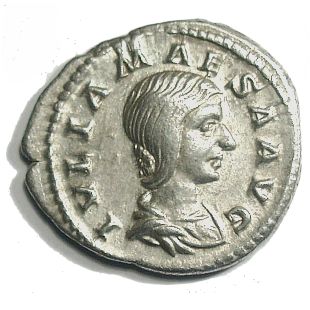
[Coin depicting Julia Maesa Augusta, early 3rd century CE, source: Wikimedia Commons]
Julia Maesa (c.165-c.226), elder sister of Julia Domna, never ruled as Roman Empress herself but instead held significant power behind the throne through her connections to various leaders.  She used her position as sister-in-law to Septemius Severus and the influence that gave her to set first one of her grandsons, Elagabalus, and then the other, Alexander Severus, on the throne.  It was she who led the plot to overthrow Macrinus and restore the Severan dynasty to power.

Maesa, like her sister, was probably of Arab descent.  The were born in Syria, daughters of the priest Bassanius.  Maesa married Syrian nobleman and military leader, Gaius Julius Avitus Alexianus and had two daughters, Julia Soaemias Bassania and Julia Avita Mamaea.  When her brother-in-law Septemius Severus became Emperor, Maesa took her daughters and moved to Rome with her sister.  Her husband served as Prefect and Tribune before being promoted to the Senate.

It was after the deaths of her nephew Caracalla and her sister Julia Domna that her actions became noteworthy in the eyes of the biographers.  A man named Macrinus took the throne for a year and forced the family to return to Syria, but allowed them to keep their money.  This proved a bad move on his part.  Maesa resolved to keep power within her family and continue the dynasty her sister and brother-in-law had started.  Together with her elder daughter, Julia Soaemias, she plotted to overthrow Macrinus and put her grandson Bassanius (later known as Elagabalus) on the throne, helped by the rumor that he was Caracalla’s illegitmate son.*  Elagabalus took the throne and his mother unofficially ruled alongside him.  Julia Maesa was proclaimed Augusta grandmother of Augustus.

This situation would not last long.  Elagabalus and his mother were unpopular and their actions made them moreso.  Maesa attempted to restrain her grandson, but when this proved impossible, cut her losses, and supported Alexander Severus, the son of her younger daughter, Julia Avita Mamea, instead.  It was not too long after he was proclaimed heir that Elagabalus and his mother were assassinated.  Maesa escaped this fate and put Alexander Severus on the throne.  She and her daughter ruled as co-regents for the young Emperor.  She died not long after, living to see the glory of her daughter and grandson’s rule, but not its bloody end.


*By contrast with Macrinus, who had no notable familial connections.

Sources/Further Reading:
Cassius Dio, Roman History books 76-80 - Lacus Curtius
"Elagabalus," Historia Augusta - Lacus Curtius
"Alexander Severus," Historia Augusta - Lacus Curtius
Benario, Herbert W. "Severan Julias" - De Imperatoribus Romanis
Julia Maesa - Wikipedia
0 Comments

Remarriage in Medieval Law

20/3/2015

2 Comments

 
Note: As usual, I must point out that law and practice are not the same thing.  They may influence each other, but what I have written here does not give a definitive description of how people actually behaved.

For more than a thousand years of its history, the question of remarriage remained a problematic one for the medieval Catholic Church.  The law had to find a balance between the religious ideal of indissoluble marriage and common practice that carried over from earlier centuries.

Early church leaders could do little in practice, though as a rule they strongly opposed second marriages for any reason.  Saints Paul, Augustine, and John Chrysostom all frowned on remarriage, but allowed it if it followed widowhood* rather than divorce, imposing penalties on those who did marry a second time.  They all agreed that a priest could not marry more than once.  Church councils affirmed the right to remarry after the death of a spouse and most did not forbid it after divorce.  They could hardly have done otherwise.  The practice was common enough, having previously been completely legal, that forbidding it would have no practical result.  This remained the case throughout most of the Early Middle Ages.  Remarriage after widowhood was allowed but discouraged.  Divorce with remarriage was equally discouraged, but common.  A person whose spouse disappeared had to wait a certain period of time before they remarried.** 

Reformers in the 11th and 12th centuries, however, promoted the idea that marriage was an unbreakable bond.  They opposed the remarriage of widow(er)s, but took an even stronger stance on divorce.  A marriage could only be ended by the death of a spouse.  Couples wishing to end their union could get either a separation (which meant they were still married) or an annulment (a declaration that marriage had never been valid in the first place***).  Only an annulment came with the right to remarry.  This was the ideal.  It did not yet have the force of practice.

By the 13th and 14th centuries there was little to no opposition to the remarriage of widow(er)s, though some Church leaders regarded second marriages as spiritually incomplete.  The opposition to divorce, however, had become a crackdown.  Cases among the lower classes, who in many places continued to engage in clandestine marriage, often only came to light when they came to court, but the middle and upper classes faced more scrutiny.  This would become a significant issue in the Reformation, with reformers and Protestants generally arguing in favor of remarriage after divorce, and Catholics opposing divorce on principle.  Nobody opposed the remarriage of widows.


*For simplicity’s sake, when I say “widowhood” I am referring to both men and women.  For most of this time period, the law made little (but not no) difference regarding gender when it came to the remarriage of people who had lost their spouses.
**Church leaders never did agree on how long that period should be.
***As a result of, for example, a defect in consent.

Sources/Further Reading:
Brundage, James A. Law, Sex, and Christian Society in Medieval Europe. Chicago: University of Chicago Press, 1987.
Marriage and Divorce - Consistory Database
Marriage Canons in The Decretum of Gratian - Catholic University of America
2 Comments

Marriages of Roman Freedwomen

18/3/2015

0 Comments

 
Culturally, the marriage of Roman freedwomen posed a problem.  Married women were supposed to be chaste.  Slave women were assumed to be anything but.  A freedwoman, who would generally be expected to marry because that was supposedly what women did, was stuck between the two.  Some of them wed out of obligation, others more freely.  As time went on, concerns about freedwomen’s status led to more restrictions on who freedwomen could or should marry.

Some women were freed by their owners for the purposes of marriage, in which case the grant of freedom created the obligation to marry.  If she refused, she would have been seen as ungrateful and undeserving of her freedom.  The status of wife did give her the option of divorce, but with her husband as her patron, that may have been difficult.  In the first century BCE the Julian Marriage Laws forbade men of senatorial status from marrying freedwomen.  Instead, the status of concubine  was considered more appropriate.*  By the second century, even middle class freeborn men who wished for a recognized relationship with a freedwoman, their own or of others, were generally encouraged to take them as concubines rather than marrying them.

Some freedwomen married coliberti, men who had been slaves of the same master with them.  Often these couples were already in a de facto marriage, known as contubernium.  It was not uncommon for a woman to be freed so that her relationship with her already freed partner could be made legal.  Freedwomen who married neither a colibertus nor their former owners usually married other freedmen or no one.  Some did marry freeborn men, but as time went on, such unions were discouraged more and more, though this was more likely to be ignored in the lower classes.  There were also women who became concubines of freeborn men not their former owners.**  Often these were women who had been freed by women.  The anxiety about a former slave woman’s sexuality carried over even if she became a concubine.


*If you’ve never read anything on Roman concubinage please go read something about it before making assumptions.  It’s probably not really what you think it is.
**Granted, considering that one jurist basically defined marriage as “it’s a marriage if they claim affectio maritalis  and can legally marry; it’s concubinage if they say it’s concubinage,” another’s words basically boil down to “assume marriage if she’s free, they’re living together, and she’s not a prostitute,” and a third bases it entirely on the relative statuses of the partners, defining whether a woman was a wife or a concubine could sometimes get a little sticky, from a legal standpoint at least.

Sources/Further Reading:
Lefkowitz, Mary R. and Maureen B. Fant, trans. Women’s Life in Greece and Rome: a Source Book in Translation. Baltimore, MD: Johns Hopkins University Press, 1992.
Perry, Matthew J. Gender, Manumission, and the Roman Freedwoman. New York: Cambridge University Press, 2014.
Pomeroy, Sarah B.  Goddesses, Whores, Wives, and Slaves. New York: Schocken, 1995.
Treggiari, Susan. Roman Freedmen During the Late Republic. Oxford University Press, 1969.
0 Comments

Matilda of Tuscany

16/3/2015

0 Comments

 
Picture
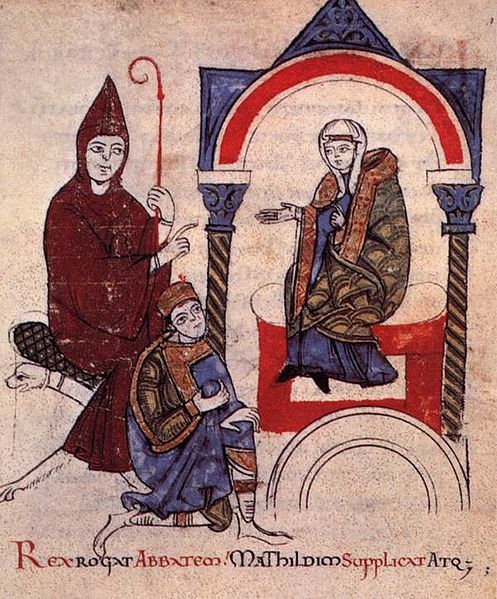
Yes, that is the Holy Roman Emperor on his knees begging a Countess to let him in.  The other guy is Abbot Hugh of Cluny.
[Miniature from the Vita Matildis, 1115, source: Wikimedia Commons]
Matilda, Countess of Tuscany and Duchess of Lorraine (1046-1115), also known as Matilda of Canossa, was one of the papacy’s most important supporters, politically and militarily, during the Investiture Controversy and subsequent moves for reform.  It was largely through her efforts that Henry was unable to maintain a foothold in Italy.

Her father, Boniface III of Tuscany died* when she was eight.  Her mother, Beatrice of Bar, married Godfrey the Bearded, Duke of Lorraine and betrothed Matilda to his son, Godfrey the Hunchback.  Godfrey and Beatrice saw to it that she was educated not just in governance, but also in military matters and fighting.  When the Duke died in 1069, the twenty-year-old Matilda and her mother ruled Tuscany together, while Matilda’s husband governed Lorraine.  The deaths of both her mother and her husband in 1076 left Matilda sole ruler of not only her Italian possessions, but also of the Duchy of Lorraine.

This was right around the height of the Investiture Controversy.  Matilda placed herself firmly on the side of the Pope and acted as one of his primary advisors.  When Henry sought out the Pope to receive forgiveness and have his excommunication lifted, it was at Matilda’s castle of Canossa that the reconciliation took place.  Matilda appears as one of the key witnesses to the events there.  When Henry went south to attack Rome, he had to go through Matilda’s lands first.  He defeated her and her forces, but she dealt him a more powerful blow: informing the German princes of his theft of the papal seal and encouraging their rebellion against him.**

After Gregory VII’s death in exile, Matilda took up the papal cause again, helped by a political marriage to Welf V.***  She led her armies against Henry once more and, though she was unable to drive him out of Italy entirely, she brought his influence there to almost nothing, capturing most of the towns loyal to him and humbling him at Canossa a second time, this time militarily.  In between fighting Henry, she founded a number of

Matilda died of gout in 1115 and was buried at Modena.  She left no heir, as her one child with Godfrey, Beatrice, did not survive infancy.  Her body was later moved to the Vatican, making her the first person who was neither a pope nor a saint to be buried there.


*Was murdered, actually.
**We actually have that letter of hers, along with quite a few others.  Go read it here if you have time.  It's really cool.
***He was 26 years younger than her.  She seems to have had no interest in him beyond the political support he brought and the marriage was never consummated.

Sources/Further Reading:
Barber, Malcolm. The Two Cities: Medieval Europe 1050-1320. London: Routledge, 1993.
Letters of Matilda of Tuscany - Epistolae
Matilda of Canossa - Catholic Encyclopedia
Matilda of Tuscany - Badass of the Week
Matilda of Tuscany - Wikipedia
0 Comments

Manumission of Roman Slave Women

13/3/2015

0 Comments

 
Manumission, or the freeing of slaves, was an integral part of Roman slavery.  It increased the number of citizens, structured relationships between people, and was believed to provide an incentive for certain groups of slaves to provide good service and remain loyal.  Women would be manumitted for a number of reasons, including as a reward for good service and loyalty, for producing children, or to be the wife or concubine of a former master or fellow freedperson. It is important to remember though, that no matter how common it was, the freeing of slaves happened only at the master or mistress’s will.

A slave who actually had contact with owner was significantly more likely to be freed for good service than one who didn’t.  Given that most urban households had more male slaves than female slaves working in important positions, option was not as available to women, though it was not uncommon, especially for personal attendants, wet-nurses, midwives, and physicians.  After manumission, there was an expectation of continued loyalty to one’s former owner, especially when a woman was freed for as a reward for good service.

Some women were freed for marriage or concubinage, or as a result of a sexual relationship with her owner that may have ended with her manumission.  The Julian Marriage Laws forbid marriage between a man of senatorial rank and a freedwoman, but other men were known to have married their former slaves.  By the 2nd century, however, this was publically discouraged and many held that if one wished an official relationship with one’s freedwoman, it should be one of concubinage.  Other women were freed in order to marry other freedmen, as a reward to both the man and the woman.*  Often in cases like this, the couple were already in a de facto marriage,** and the wife sometimes unofficially belonged to her husband (contubernalis) as a slave prior to her manumission.

A few writers held that one should free a slave who had four children, since she had produced more slaves for the household, though this was a less common attitude.  Some women managed to buy their own freedom, though less frequently than men since they were less likely to have access to funds, and when they did, they often had help from a third party, who they later had to repay.  How common the manumission of slaves was is uncertain, but it was central to the Roman conception of slavery.


*Often more for the man though.  Or at least, it was thought of that way, rewarding the man with his wife’s freedom.
**Known as contubernium.

Sources/Further Reading:
Perry, Matthew J. Gender, Manumission, and the Roman Freedwoman. New York: Cambridge University Press, 2014.
Pomeroy, Sarah B.  Goddesses, Whores, Wives, and Slaves. New York: Schocken, 1995.
Treggiari, Susan. Roman Freedmen During the Late Republic. Oxford University Press, 1969.
0 Comments

Women and Gregorian Reform

11/3/2015

0 Comments

 
The efforts of reformers to concentrate religious power in the hands of the Church and its authorities were to have a significant effect on the lives of women, particularly those in some way associated with the Church.  Pope Gregory VII and his successors proposed to clean up the sinful excesses of those sworn to the Church.  When it came to women they focused on their behaviour and status and their association with sexuality, especially nuns and priests’ wives.

This was a time when more and more monasteries were being founded, for both women and men.  The ideology surrounding these new women’s communities was changing though.  A concern with the protection and care of nuns dominated, resulting in an emphasis on enclosure and isolation from the outside world.  Rather than being partnered communities, the new double monasteries that were founded maintained that the monks or canons were there to ensure that the nuns could remain fully enclosed.  The religious care of nuns was becoming a burden.

This meant as well that there were fewer powerful abbesses like Hilda of Whitby or St. Leoba involving themselves in politics.  There were still a few, especially among those who vocally supported reform, most prominently Hildegard von Bingen.  It is worth noting though, that rather than relying on political power and family influence* as her predecessors had, Hildegard emphasized her visionary status.

The other group of women to get significant attention from the reformers were priests’ wives. Reformers focused, however, far more on the actions of priests in marrying rather than on their wives in marrying priests.  Here it was the priests’ agency and actions that were important.  Their wives were almost incidental except by their very existence and status.  Attempts to ban clerical marriage did not go over well.  Bishops who attempted to impose celibacy on their priests faced riots.  When the reformers officially banned clerical marriage, many local priests simply ignored the ban and lived as though they were married.

Gregorian reform drew a strong connection between women and sexuality.  Its aim was to keep both its nuns and its priests celibate, by isolating nuns more firmly from the outside world and by denying priests and their wives what had before been a legitimate relationship.  The reformers were not always successful, but they irrevocably changed the relationship between women and the institution of the Church.

*Not just male influence either.  Mothers and sisters in particular, but also nieces and cousins gave and received political help from their abbess and nun family members.

Sources/Further Reading:
Barber, Malcolm. The Two Cities: Medieval Europe 1050-1320. London: Routledge, 1993.
Nichols, John A. and Lillian Thomas Shank, eds., Distant Echoes: Medieval Religious Women, Volume One. Kalamazoo, MI: Cistercian Publications, 1984.
Weisner, Merry E. Women and Gender in Early Modern Europe. Cambridge: Cambridge University Press, 2000.
The Role of Benedictine Women before Gregorian Reform - Deborahvess.com
0 Comments

Berenice II

9/3/2015

0 Comments

 
Picture
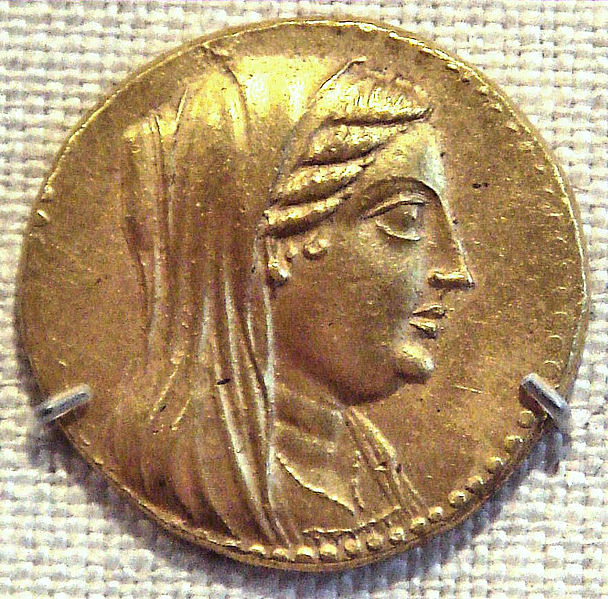
[Coin depicting Berenike II, 3rd century BCE, source: Wikimedia Commons]
Berenice II (c. 267-221 BCE), or Berenike II, princess of Cyrene, Hellenistic Queen of Egypt, and literary patron, comes across to us perhaps less through propaganda designed to show her husband’s right to rule than some of her contemporaries.  Even so, while we know many of the events of her life, her personality remains mostly obscured.

Her father was Magas of Cyrene, half-brother of Ptolemy II Philadelphos,* her mother Arsinoe/Apama.**  Her father betrothed her to Ptolemy III, possibly as part of a peace agreement with Ptolemy II, since Cyrene had belonged to Egypt during his father’s reign.  This, however, was not to be.  At least, not right away.

When her father died, Berenice’s mother betrothed and possibly married her in 249 BCE to Demetrius the Fair as his second wife.  Their relationship was not a happy one, especially considering Demetrius’ arrogance and the fact that he was his mother-in-law’s lover.  It ended abruptly when royal guards assassinated Demetrius in Arsinoe/Apama’s bedroom, possibly at Berenice’s instigation.

Three years later, Berenice fulfilled her father’s wishes and married Ptolemy III, becoming Queen and bringing Cyrene back into Egypt.  This marriage went much better for her.  The two of them ruled together harmoniously and had at least four children.***

Berenice herself took little part in the political part of ruling and focused her attention on religion and culture.  She spent much of her significant wealth on building and repairing temples and used her influence to bring favored priesthoods to political prominence.  She made an effort to collect a literary circle about herself, supporting poets in particular.  The best known of these is Callimachos, who wrote “Lock of Berenice,” which was later translated into Latin by Catullus, about her dedication of her hair to Aphrodite for Ptolemy’s safe return from war.  Sometime during her reign she entered both the Nemean Games and the Olympic Games.

Berenice died in 221 BCE, probably poisoned on the orders of her son Ptolemy VI.  Her husband had died a year earlier and her son feared her political support for his brother Magas in the dispute over the succession.  Ten years later, he had her deified.


*Through their mother, Berenice I of Egypt.
**Do these two names refer to the same person or did Magas marry twice?  No idea.
***Is it just me or has anyone else noticed that when they lack other evidence, historians tend to judge how happy a marriage was by how many children the couple had?

Sources/Further Reading:
Justin, Epitome of the Philippic History by Pompeius Trogus, Book 26 - Corpus Scriptorum Latinorum
Catullus 66 (Berenice's Lock) - Perseus
Polybius, Book 10, Book 15 - Lacus Curtius
E. R. Bevan "The House of Ptolemy," 1927 - Lacus Curtius
Berenice II - Egyptian Royal Genealogy
Clayman, Dee L. Berenice II and the Golden Age of Ptolemaic Egypt. New York: Oxford University Press, 2014.
Berenice II - Wikipedia
0 Comments
<<Previous

    My Blog

    Translation of the above: where I post the interesting things I find researching the Classical and Medieval periods in my free time.

    Currently Reading:
    -
    Medieval Monasticism by C. H. Lawrence

    Archives

    March 2016
    February 2016
    January 2016
    December 2015
    November 2015
    October 2015
    September 2015
    August 2015
    July 2015
    June 2015
    May 2015
    April 2015
    March 2015
    February 2015
    January 2015
    December 2014
    November 2014
    October 2014
    September 2014
    August 2014
    July 2014
    June 2014
    May 2014
    April 2014
    March 2014
    February 2014
    January 2014
    December 2013
    November 2013
    October 2013
    September 2013

    Categories

    All
    Architecture
    Biography
    Classical
    Law
    Marriage (legal And Otherwise)
    Medicine
    Medieval
    Misconceptions
    Monasticism
    Overview
    References
    Religion
    Review

    RSS Feed

Powered by Create your own unique website with customizable templates.