Emily Kittell-Queller
  • Home
  • About Me
  • Blog
  • Projects
  • Resume
  • Contact Me

Veneration of Catherine of Alexandria

31/12/2014

0 Comments

 
Note:  This post assumes you know Catherine's story.  Wikipedia and Catholic.org both have short summaries.
Picture
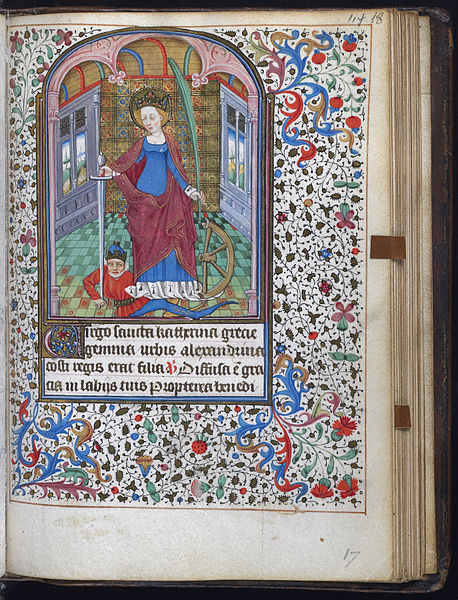
I'm pretty sure that thing in her left hand is a giant quill pen.
[Miniature of Catherine of Alexandria found in a French book of hours, 15th century]
[Walters Art Museum, source: Wikimedia Commons]

After the Virgin Mary and Mary Magdalene, St. Catherine of Alexandria was the most widely venerated female saint for most of the Middle Ages.*  A big part of this came from her status as a virgin martyr, but what is perhaps most notable about her is the fact that she was widely known for her intelligence, her preaching, and the fact that she supposedly converted over 250 people by actively talking and arguing them into it.**
Picture
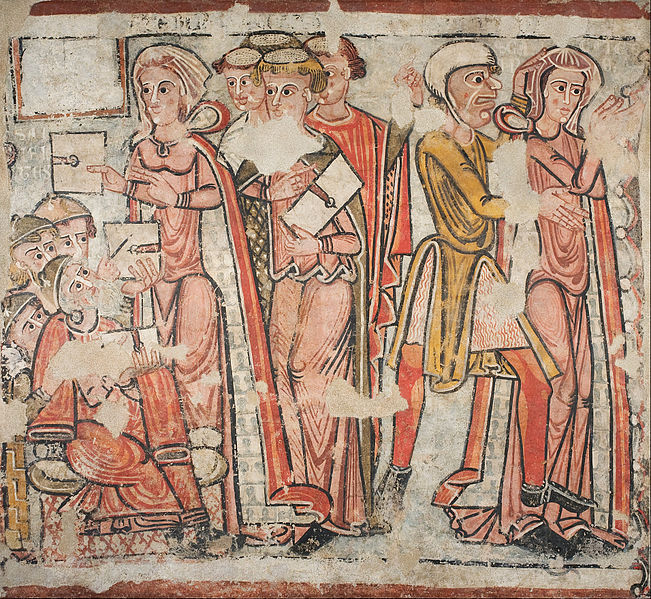
Catherine appears in this image twice: on the left, disputing with those sent to persuade her, and on the right, being placed under arrest.
[Dispute and Arrest of Catherine of Alexandria, 13th century, Museu Nacional d'Art de Catalunya]
[Source: Wikimedia Commons]

St. Catherine’s power as a saint was primarily seen through her reliability as an intercessor.***  In the 14th century, she was named one of the Fourteen Holy Helpers, saints whose help was considered particularly effective, especially against disease.****

Beyond this, however, she was also associated with intelligence and scholarship.  Many called upon her as an example and bestower of wisdom, especially, though not exclusively to women.  Scholars and teachers (particularly female ones) looked to her as the patron saint of learning.  It is likely for this and because of her preaching that she was so venerated by groups like the beguines.

The fact that she was known for preaching and converting so many people caused a lot of anxiety among certain churchmen, and unsurprisingly so.  Her example threatened the idea that women were not fit to interpret scripture and ran directly counter to St. Paul’s injunction that women should not speak in church and should be subordinate [1 Corinthians 14:34].  Some people, men and women alike, used Catherine’s example to support the idea that some women at least could and should preach.  Those who did so usually paired her with Mary Magdalene, another saint known in this time period for her preaching.
Picture
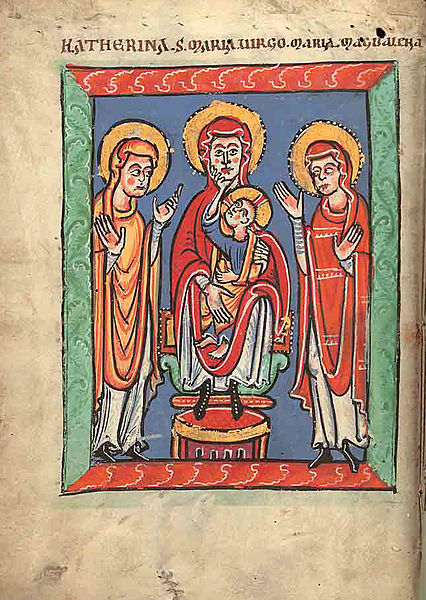
The baby Jesus must inspect his mother's face, regardless of what Catherine or Mary Magdalen have to say about it.
(Apologies for my silliness.)
[Miniature of Catherine of Alexandria, the Madonna and Child, and Mary Magdalen]
[Sermons of Innocent III, 13th century, Czech Republic, source: Wikimedia Commons]

The most common direct argument against such claims said that the preaching of women like Catherine and Mary was a temporary expedient in times when there were not enough men able to do so.  More commonly, her preaching was simply ignored unless someone brought it up, allowing it to fade into the background while her wisdom and help against disease came to the forefront.

*For all that she was most likely fictional.  She supposedly died in Rome in the early fourth century.  Her remains were lost, only to supposedly be found again 500 years later on Mount Sinai Egypt.  Add to that the fact that the very earliest mention we have of her comes from the 9th century, and the probability of her actually having existed becomes very small.  She may, however, have been partially based on Hypatia of Alexandria.


**As opposed to more passively converting them by the example of her piety.
***Really basic, probably oversimplified explanation: someone to pray to rather than asking God directly.  Help doesn’t technically come from the intercessor themselves.  If anyone from a Catholic background wants to go into more detail, please feel free.
****14th century, oh hi there black plague.

Sources/Further Reading:
Kienzle, Beverly Mayne and Pamela J. Walker, eds. Women Preachers and Prophets Through Two Millennia of Christianity. Berkeley, University of California Press, 1998.

Kleinberg, Aviad. Flesh Made Word: Saints’ Stories and the Western Imagination. Cambridge, MA: Belknap Press, 2008.Simons, Walter. Cities of Ladies: Beguine Communities in the Medieval Low Countries, 1200-1565. Philadelphia: University of Pennsylvania Press, 2003.
Jacobus de Voragine, "Life of St. Catherine of Alexandria" in The Golden Legend, translated by William Caxton - Christian Iconography
St. Catherine of Alexandria - Catholic Encyclopedia
Catherine of Alexandria - Wikipedia
0 Comments

Faustina Major

29/12/2014

0 Comments

 
Picture
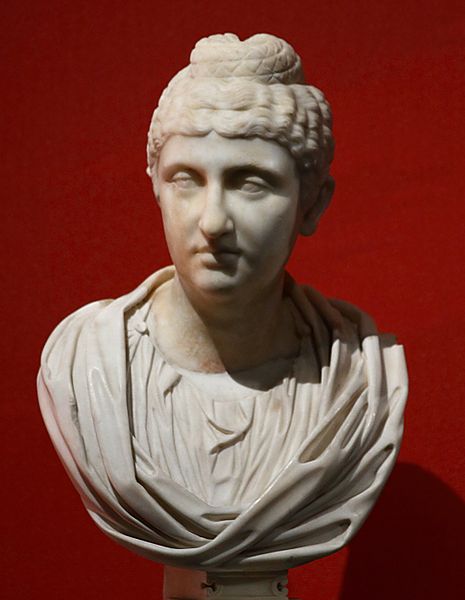
[Bust of Faustina Major, c.140, Musei Capitolini, source: Wikimedia Commons]
Empress Anna Galeria Faustina (c.100-140 CE), known as Faustina the Elder, died only two years into her husband’s reign.  Even so, she left a lasting mark on the Empire as the only deified empress whose cult remained general to the whole Empire* long after her death.  Her husband’s memorials to her, both symbolic and practical, kept the memory of her alive even after his own death.

Like other Roman Empresses from this period, Faustina already had close family ties to the imperial family before she married a man who would become emperor, in her case on her mother’s side.  Her father and brother were consuls.  Her mother was half-sister to Vibia Sabina and niece to Trajan.  Unlike her aunt, she didn’t marry to strengthen her husband’s claim to a place in the succession, though her marriage was almost certainly still political.  The match was a good one and the couple cared deeply for her.  Antoninus Pius seems to have been mostly (or entirely) monogamous to her.  At the very least, he took no official lovers.  The couple had four children together, three of whom died before Antoninus became Emperor in 138.

Picture
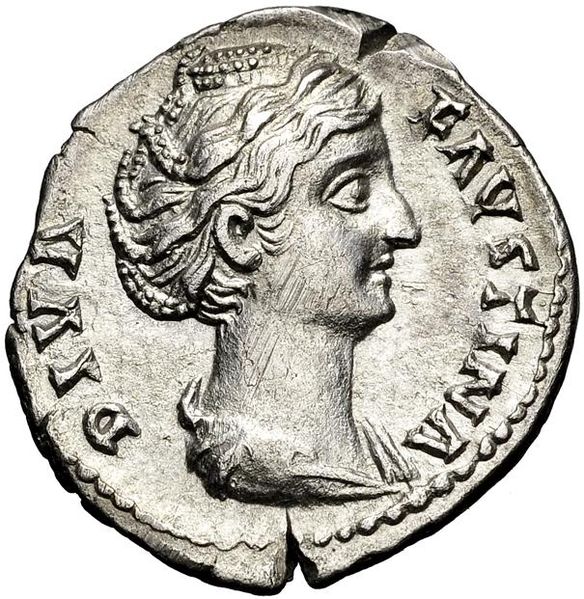
Images of her can be identified by her distinctive hairstyle, which was so much hers that nobody directly imitated it.  As Empress, her daughter may have specifically chosen another hairstyle to differentiate herself from her mother.
[Denarius depicting "DIVA FAUSTINA," 2nd century CE, source: Wikimedia Commons]
The Senate awarded Faustina the title of Augusta almost immediately after she became Empress.  On a private level, her interests lay in furthering the welfare of her family.  On a public level she devoted many of her resources to charities for the poor, especially for girls.  When she died only two years into her husband’s reign, Antoninus promptly founded a public assistance program (largely a grain dole) specifically for poor girls, calling it the Puellae Faustinianae in memory of his wife.**

This was not all he did, however.  Antoninus was determined to keep the memory of his wife alive.  He deified her almost immediately and had a temple built in the forum.***  He had several coins struck showing her as different goddesses.  Sculptures of her were brought out for public events for the rest of Antoninus’s reign.  Enough of these survived over the centuries, that her image became an ideal not merely for the rest of her husband’s reign, but for centuries afterwards.


*As opposed to becoming the provenance only of her priesthood and a few devoted followers.
**This is significant in large part because there were almost no such programs for women and girls, while there were several for men and boys.
***Once he died it was reconsecrated to both of them rather than just her.

Sources/Further Reading:
Life of Antoninus Pius, Historia Augusta - Lacus Curtius
Bergmann, Bettina. "The Moon and the Stars: Afterlife of a Roman Empress" - Academia. edu
Burns, Jasper. Great Women of Imperial Rome: Mothers and Wives of the Caesars. New York: Routledge, 2007. [Note: This book can be found on Google Books here.]
Faustina the Elder - Wikipedia
0 Comments

Cistercian Nuns

26/12/2014

0 Comments

 
In the years after its founding, the Cistercian Order expanded rapidly.  It welcomed with mostly open arms the men that flocked to its gates.  It was less welcoming to the women who wished to join in this reformation of monastic life.  Nuns presented a problem.  Many monks saw them as a burden, a drain on resources, and a temptation to sin.  Despite this resistance, Cistercian nuns found their own way.  Some communities officially made themselves part of the order.  Others followed Cistercian practices without that status.
Picture
Le Tart Abbey, the first monastery for Cistercian nuns was destroyed in the French Revolution, so have a picture of Las Huelgas at Burgos in Spain instead.
[West range and church of Las Huelgas, photographed 2011 by Zarateman]
[Source: Wikimedia Commons]

The first community of Cistercian nuns managed to gain the cooperation the then Abbot of Cîteaux Stephen Harding for the foundation of their monastery at Le Tart in 1125.  Others followed in large numbers, mostly in France, but also Spain, the Low Countries, and the British Isles as well.  The Order, however, was not interested in founding houses for women and only admitted female communities to the order under pressure.  It even banned the foundation of new houses of Cistercian nuns in 1228, but to no effect.  Those communities were refused affiliation continued to live according to the Cistercian Rule, but found themselves under the jurisdiction of local bishops rather than Citeaux.

The male leaders of the order had several concerns.  To be blunt, some of the higher-ups were terrified of women and believed that no man could spend more than a certain amount of time around a woman without having sex with her.*  They regarded the care of nuns’ souls as a temptation, a burden, and a distraction.**  They also questioned whether women, being the weaker sex, would be up to the austerities of Cistercian life.  Lastly, they were concerned about how well Cistercian nuns would be able to remain cloistered.

Even so, the numbers of Cistercian nuns continued to expand.  Their abbesses followed the Cistercian practice of meeting in a general chapter*** making visitations to their daughter houses until the Council of Trent strengthened the rules regarding nuns’ enclosure and put a stop to it.  When they had trouble finding priests for their communities, they turned to the Franciscans and Dominicans.****  In the 17th century Cistercian nuns were heavily involved in attempts to reform the Order and bring it back to a closer observance of its original rules, which eventually led to the formation of Cistercian Order of the Strict Observance, known as the Trappists.


*Regardless of her opinion or desires, of course.
**In their defense (sort of), these last two were actually commonly held views of female monasteries of any sort.
***Seemingly one separate from that of the male branch of the Order.
****Not that these orders were more welcoming to women.  It was, however, easier to find priests already sworn to the monastic life in an order of friars (who were all ordained) than in an order of monks (most of whom weren’t).

Sources/Further Reading:
Nichols, John A. and Lillian Thomas Shank, eds., Distant Echoes: Medieval Religious Women, Volume One. Kalamazoo, MI: Cistercian Publications, 1984.
Simons, Walter. Cities of Ladies: Beguine Communities in the Medieval Low Countries, 1200-1565. Philadelphia: University of Pennsylvania Press, 2003.
Bynum, Caroline Walker. Holy Feast and Holy Fast: The Religious Significance of Food to Medieval Women. Berkeley: University of California Press, 1987.
Cistercian Nuns - Wikipedia
0 Comments

Fortuna

24/12/2014

0 Comments

 
Picture
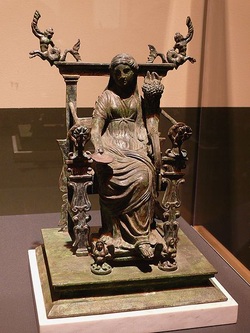
You almost can't see her cornucopia, but it's there in her left arm.
[Fortuna enthroned, statue found in Pompeii, source: Wikimedia Commons]

For the Romans, Fortuna, the goddess of chance events, was inextricably entwined with questions of morality.  The rites for her various aspects were not open to all, but rather were limited by the worshiper’s status and reputation.  She was a goddess whose public cult reinforced and controlled women’s behaviour, reinforcing the association of morality with high status and wealth and low status and poverty with immorality and unrestrained sexual behavior.

The dedication of a girl’s childhood clothing to Fortuna Virginalis and her subsequent donning of the matron’s stola marked her passage through puberty into adulthood.  The fact that this was assumed to be an abandonment of her virginity in respectable marriage* limited this to “respectable” women.  After this they passed into the patronage of Fortuna Primigenia of Praneste, responsible for mothers, childbirth, and the good luck of the Roman people.  The fortunes of the state was then held to rest on the morality of these women.

Other aspects, however, drew even stronger divisions between women.  The Romans paired her cult with that of Mater Matuta, celebrating not only good motherhood, but also the care of an aunt for her siblings’ children.  They limited the worship of these goddesses to respectable univirae, apparently excluding even respectable plebian women from some of their rites.**  To bring the point home, every year on the festival of Matrialia they brought in a slave woman only to forcibly expel her from the temple.

On the other hand, respectable women were expected to avoid the cult of Fortuna Virilis, associated with the sexual fortunes of women.  They honored her by crowding into men’s public baths on the day of her festival, April 1.  Whether men were barred from said baths for the day is unknown.  Respectable women, meanwhile, spent the day celebrating Venus Verticordia in honor of marital fidelity.

The restrictions on worship of the Goddess of Chance Events served to strongly associate good fortune for both the individual and the Roman state with good morals and respectability.  Her rites were celebrations of bounty, certainly, but only through those deserving.


*As signified by the putting on of a matron’s garments.  The status of matron assumed marriage or widowhood, though a woman did not necessarily need to be either to be a matron.
**According to Livy, Verginia, a patrician woman who had married a plebian, responded by setting up her own altar to Fortuna, dedicating it to plebian chastity.

Sources/Further Reading:
Plutarch, Moralia Roman Questions 16 - Lacus Curtius
Plutarch, Moralia 492D - Lacus Curtius
Livy, Ab Urbe Condita 2.40, 10.23 - Wikisource
Pomeroy, Sarah. Goddesses, Whores, Wives, and Slaves: Women in Classical Antiquity. New York: Pantheon Books, 1995.
Fortuna - Wikipedia
0 Comments

Eleanor of Aquitaine

22/12/2014

0 Comments

 
Picture
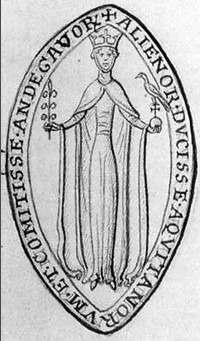
[Seal of Eleanor of Aquitaine while she was Queen of France, 12th century]
[Source: Wikimedia Commons]

Eleanor of Aquitaine (1122 or 1124 - 1204), Duchess of Aquitaine in her own right, and successively Queen of France and England, is one of the best-known medieval queens.  One could say, however, that the legend grew larger than the woman herself and much of who she was is lost or embellished in the retelling.*

Eleanor was the eldest daughter and heir of Duke William X of Aquitaine and Aenor of Châtellerault.**  Her father’s death in 1137 left her and her sister under the guardianship of King Louis VI of France, who promptly married her to his son Louis shortly before dying himself.

The fifteen years of their marriage were unhappy ones for Eleanor.  She did not get along with her mother-in-law Adelaide of Maurienne or with her husband’s courtiers.  Her experiences on the Second Crusade both broadened her mind and highlighted the strain in her marriage.  Eleanor finally got her divorce in 1152, when Louis arranged for his relatives to “inform him” that his marriage was consanguineous.***

Though the duchy of Aquitaine was rightfully Eleanor’s, Louis attempted to keep his title as duke for another two years, fighting with Eleanor and her new husband Henry of Anjou (soon to be King of England
and chosen as her husband by Eleanor herself),**** before giving it up in 1154.  Eleanor spent much of the next 13 years bearing children (six of whom survived to adulthood) and acting as Queen Regent of England while Henry was abroad.  She took over sole administration of Aquitaine in 1166.  It was in this time period that she started assisting her sons Henry and Richard in their rebellion against their father.  As a result, her husband Henry had her seized and held in confinement until 1183, when he gave her control of Aquitaine again but kept her guarded.

Henry’s death in 1189 freed her completely.  She ruled England while her son Richard was away on the Second Crusade and then continued to rule while he was imprisoned in Germany.  When her son John rebelled, she made peace between the brothers.  She remained involved in the affairs of the kingdom after Richard’s death and John’s ascension to the throne, trying (somewhat successfully) to keep him in line.  She died at the monastery of Fontevraud in 1204.  She was buried there with an effigy of her holding a book, probably commissioned by Eleanor herself before her death.


*The more lurid stories of “courts of love” and her adultery with her uncle, for example, are all later inventions
**Eleanor was named for her mother, but was called “alia Aenor,” the other Aenor, which later shifted to Alienor or Eleanor.  She is the first recorded person to have used this name.  In other words, one could say that every Eleanor in the world was named for her.
***There is plenty of evidence that both he and Eleanor already knew, up to and including special permission from Pope Eugenius to remain married despite being third cousins once-removed.  Consanguinity was merely a cover for the fact that Louis wanted to be rid of a wife who had given him no sons in 15 years, only two daughters.
****He wasn’t king, or even the official heir when she married him.  He was made heir by the Treaty of Winchester in 1153 and became king on the death of King Stephen in 1154.

Sources/Further Reading:
Wheeler, Bonnie and John C. Parsons. Eleanor of Aquitaine: Lord and Lady. Palgrave Macmillan, 2008.
Turner, Ralph V. Eleanor of Aquitaine: Queen of France, Queen of England. Yale University Press, 2009.
Eleanor of Aquitaine - Women in World History
Eleanor of Aquitaine - Wikipedia
0 Comments

Education of Spartan Girls

19/12/2014

0 Comments

 
Spartan citizens had a vested interest in raising their children in a particular way, to produce the best warriors and mothers of warriors.  Like the boys, Spartan girls probably received a public education, though unlike them, they most likely continued to live with their mothers. They needed to be physically strong to bear strong children, so much of what they learned focused on that. None of this, however, meant that what we consider athletic made up the whole of their education.  Spartan girls competed with each other to be the strongest and the fastest, but also the most musical and the most graceful, to be, in the end, the best Spartan women.

According to Xenophon, Spartan girls received much the same physical education as boys, participating in races and trials of strength.  Euripides adds wrestling to the list, while Plutarch, writing much later, includes throwing the discus and the javelin as well.  They did not, however, learn to fight as their brothers did.

Picture
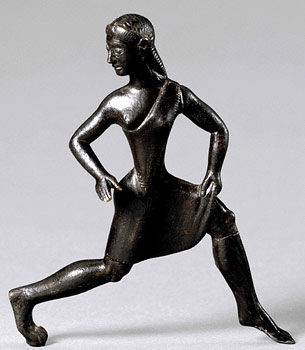
Many say this figure is running in a race, but Pomeroy suggests another possibility:  she is dancing.
[Statue from Prizren or Dodona, Spartan, c. 500 BCE, source: Wikimedia Commons]
Spartan girls also learned and competed in singing, dancing, and playing musical instruments took up much of their time.  The songs Alkman composed for girls’ choirs show the importance of doing well in these competitions.  Dancing, meanwhile, may have been one of the only things boys and girls learned together. They won prizes and status in singing and dancing competitions.  While modern readers may think of this as less athletic than running or wrestling, Spartans saw these as equally important and the dancing, at least, took as much strength and probably more agility than running or wrestling.

They did not neglect the things other Greek women learned either, though they spent much less time at it.  A Spartan woman was responsible for running at least one household, maybe even two or more.*  Whether girls learned this as part of their public education is unknown, but it was certainly important.  Nor did they neglect that quintessentially female task in ancient Greece: weaving.  Comparatively speaking, they spent almost no time at it but they needed to know it nonetheless.

Sparta was a society that raised its children to produce the best warriors possible.  To meet that need, they trained their girls not only in how to manage a household, but also in athletics, encouraging them to compete, so that they might be the best possible mothers and the best possible Spartan women.


*If she had children with another man, for example, she had some stake in his household as well.

Sources/Further Reading:
Xenophon, Constitution of the Lacedaimonians 1.4, 4.2 - Perseus
Euripides, Andromache 595-601 - Perseus
Plutarch, Life of Lycurgus 14.2 - Lacus Curtius
Kennell, Nigel M. The Gymnasium of Virtue: Education and Culture in Ancient Sparta. University of North Carolina Press, 1995.
Pomeroy, Sarah B. Spartan Women. New York: Oxford University Press, 2002.
Women in Ancient Sparta - Wikipedia
0 Comments

Cistercian Architecture

17/12/2014

1 Comment

 
One of the primary practical results of the Cistercian rejection of Benedictine, particularly Cluniac, ostentation was a change in architecture.  Since Cistercian monasteries were always founded by monks sent out from an already existing community, certain architectural choices spread and remained common to most or all of the Order’s monasteries.  The most obvious changes were in their ways of building and decorating their churches, but they made other alterations to the typical layout of a Benedictine monastery as well.

Picture
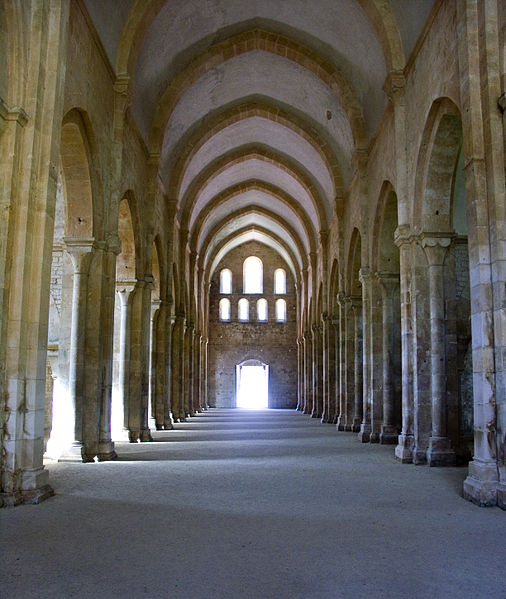
Since both Cîteaux and Clairvaux were distroyed in the French Revolution, Fontenay is our best example of Cistercian architecture we have.
[Interior of the church at Fontenay, facing west, built early 12th century, photographed by Jean-Christophe Benoist, source: Wikimedia Commons]
A Cistercian church, unlike the Cluniac “small piece of the Heavenly Jerusalem on earth,” was supposed to feel like a “workshop of prayer.”  Elaborate, colorful decorations were for lay people, who needed the glory of the Church and its stories displayed before them.  A monk or nun should need no such reminders.  As a result, Cistercian churches may seem at first glance dull, with a squared off presbytery* rather than a rounded apse and no decoration.  The beauty of such buildings was intended to be subtle, found more in the lines of their architecture rather than in painted walls and sculpted capitals.

Picture
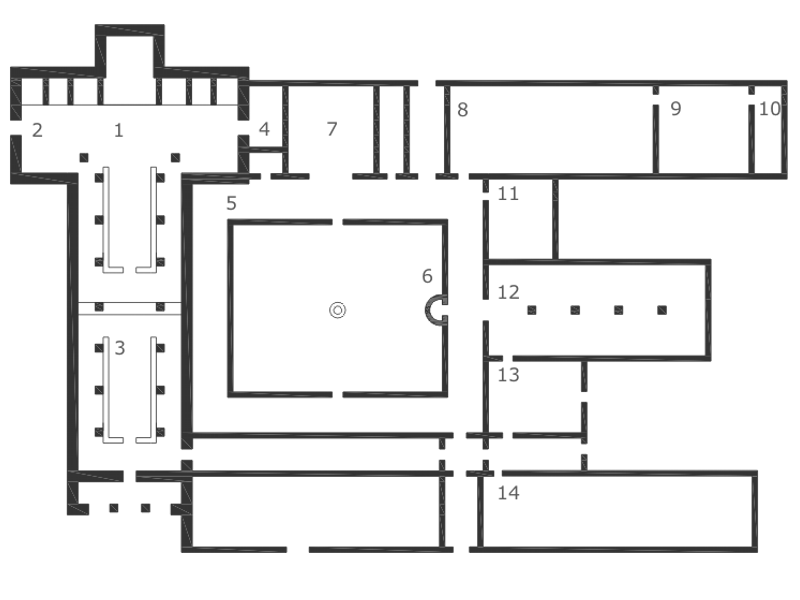
North is to the left in this image, not up.  As is pretty common with "typical" plans of things, very few actual monasteries, if any, don't deviate from this in some way.
[Ideal plan of a Cistercian monastery, Carla Christiana Carvalho, source: Wikimedia Commons]
The Cistercians made changes to other parts of the traditional Benedictine monastic layout as well.  They usually left their chapter houses open to the cloister walk,** presumably so that the lay brothers could stand out on the walk and participate in certain meetings, while the choir monks sat inside.  Their refectories, unlike those in most Benedictine monasteries, were turned perpendicular to the cloister rather than parallel.  This not only gave them extra space for a warming room on the south range, but it also meant that they could expand their eating space as little or as much as necessary to accommodate their numbers.

The chronicler Odericus Vitalis tells us that Cistercian monks built their monasteries with their own hands.  He almost certainly did not mean that they let unskilled monks build in stone.  Rather, they almost certainly put up preliminary wooden buildings themselves and assisted in the actual construction of the stone buildings, but the skilled labor would have been done by professional masons hired from outside.  The Order did have a few experts in building within its ranks, and with them acting as advisors alongside the abbot, Cistercian architecture maintained its simplistic, practical bent.


*The presbytery is the area around the altar and the space to the east of it (in a traditional church).  If the walls at the end are rounded rather than squared off, the resulting semi-circular space is known as an apse.  For an overview of spaces in a monastery, try here.
**Though hopefully in colder climates the cloister walk was enclosed from the garth (the open space in the middle).  Asceticism does not mean freezing to death.

Sources/Further Reading:
Cook, William R. and Ronald B. Herzman. The Medieval Worldview: an Introduction. New York: Oxford University Press, 2004.
Stalley, Roger. Early Medieval Architecture. Oxford: Oxford University Press, 1999.
Cistercian Architecture - Wikipedia
1 Comment

Pompeia Plotina

15/12/2014

0 Comments

 
Picture
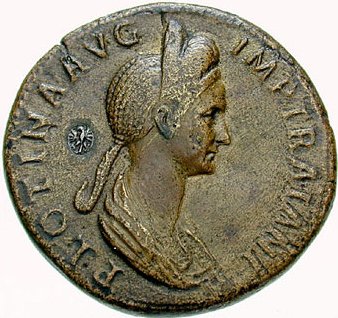
I'm curious about her hair.
[Roman coin depicting Pompeia Plotina and naming her Augusta, source: Wikimedia Commons]
Empress Pompeia Plotina (died c.122 CE), like Livia Drusilla 100 years before her, was presented as a model wife and the ideal for an Empress.  She showed herself to Rome as a modest, hardworking, obedient wife.  She did not, however, stay out of politics.  She had her own views regarding what was good for Rome and did not hesitate to push for her own causes.

Born the daughter of Lucius Pompeius, Plotina was probably raised in or near Nemasus (modern Nimes, France).  She married a general named Trajan and accompanied him to Cologne in 88 CE when he was sent to end a revolt in the area.  In 98, Trajan succeeded Nerva as Emperor and the couple moved to Rome.  In the following years, Plotina cultivated her reputation as an ideal wife.  She ran the Imperial household, wove, and presented herself as modest* and entirely obedient to her husband before the Roman public.  When Trajan tried to award her the title of Augusta in 100 CE, she refused it, only agreeing to accept it five years later.

None of this meant, however, that Plotina was uninterested or uninvolved in the running of the Empire anymore than the image of obedience meant she could not act on her own.  She had influence as the Emperor’s wife and she knew how to use her reputation and his to get what she wanted.  She was particularly interested in the welfare of the Roman people, pushing for fairer taxation and public aid for the poor, especially orphans and widows.  She was also particularly devoted to the Epicurean school of philosophy, seeking the help of Hadrian, Trajan’s successor, on their behalf.

Plotina was quite fond of Hadrian.  It was she who arranged his marriage to Vibia Sabina, strengthening his claim to imperial power.  When Trajan died, she was the one who signed his will, formally adopting Hadrian as his heir** and making him Emperor.  In the last years of her life he apparently never failed to give her what she wished for, though according to him she never asked for anything unreasonable.  When she died in the early 120s, he had her deified and built a temple for her in the place of her birth.


*The story goes that on entering the imperial palace for the first time she said she hoped she would leave it as the same woman she was when she entered.
**The couple had no children.

Sources/Further Reading:
Cassius Dio, Roman History 68.5, 69.1, 69.10 - Lacus Curtius
Letter from Pompeia Plotina to her adoptive son Hadrian, found in Lewis, Naphtali and Meyer Reinhold. Roman Civilization. Columbia University Press, 1989.  [Note: Text of the letter may be found here on Google Books]
Lightman, Marjorie and Benjamin Lightman. A to Z of Ancient Greek and Roman Women. New York: Infobase Publishing, 2008. [Note: May be found on Google Books here.]
Shelton, Jo-Ann. The Women of Pliny's Letters. New York: Routledge, 2013. [Note: May be found on Google Books here.]
The Ideal Epicurean Woman? - New Epicurean
Pompeia Plotina - Wikipedia
0 Comments

The Cistercians

12/12/2014

0 Comments

 
In 1098, Abbot Robert of Molesme left the monastery he led there, and founded a new community in a marshland south of Dijon, known as Cîteaux.  A former Cluniac monk, he found their way of life too extravagant and too far from the austerity and simplicity of the Benedictine Rule.  Though he was soon forced to return to Molesme, the monastery in the marsh continued on and eventually grew into the most famous of the monastic reforming Orders of the 12th century.

Picture
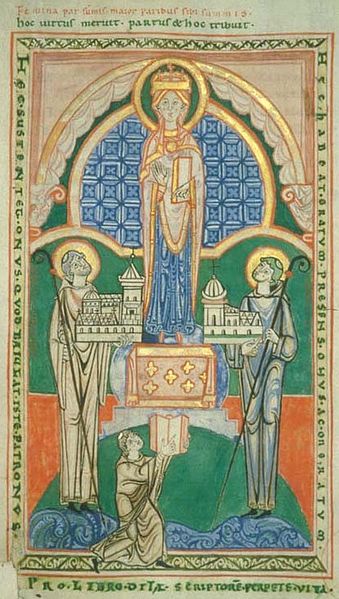
I find the whole holding churches thing fascinating, but not fascinating enough to study it right now.
[Stephen Harding (right) and the Abbot of St. Vaast in Arras (left) present their churches to Mary]
[c. 1125, source: Wikimedia Commons]

It was under its second and third abbots that Cîteaux rose to prominence.  Under Alberic, the community gained official recognition and began wearing their distinctive white habit.  The third abbot, Stephen Harding, expanded the order.  He laid out its central Constitution, codifying their ideals.  He emphasized in particular the importance of manual labor,* the refusal to admit children, and the rejection of the extravagance of Cluny.  Stephen also gave over the west wing of the monastery to the conversi (lay brothers) who worked the community’s farms.**

In 1111, Stephen sent out a group of monks to found the first Cistercian daughter house: La Ferté.  Three more daughter houses (Pontigny, Morimond, and Clairvaux) followed in the next two years.  Under the guidance of Cîteaux, these four houses became the core of the new order and any new houses were to answer to one of them.  A system of visitation was set up, with the abbot of each monastery responsible for overseeing its daughter houses.

Picture
Oh St. Bernard.  I may sometimes disagree with you and sometimes think you were something of an intolerant ass, but damn you had charisma.
[Bernard of Clairvaux in an Initial B, 13th century, source: Wikimedia Commons]
The most famous member of the Cistercian Order and the one person most responsible for its rapid expansion was St. Bernard, founder of Clairvaux.  A charismatic and highly public figure, he had his fingers in many pies.  He advised people from all classes of society, oversaw or inspired the foundation of more than 200 new Cistercian monasteries, and publicly supported the expansion of other new forms of monasticism.***

Eventually, however, the Cistercians ran into many of the same problems faced by Cluny.  Despite the desire to retreat from the world, the Order’s popularity and success at cultivating previously unusable land dragged it back into contact with the secular world.  The Order had grown too large to manage effectively, and by the 13th century, the mendicant orders (Franciscans and Dominicans) had eclipsed it in popularity.  It remains, however, a powerful and respected Order to this day, both in its original observance and in the Trappist Order, reformed in the 17th century.


*Many monasteries at this time merely paid lip service to this ideal, which became central to the Cistercian Order.
**Thus taking Cîteaux out of the systems of manorialism and fief holding.
***Two examples of this would be the Templars and the Beguines.

Sources/Further Reading:
Barber, Malcolm. The Two Cities: Medieval Europe 1050-1320. London: Routledge, 1993.
Cook, William R. and Ronald B. Herzman. The Medieval Worldview: an Introduction. New York: Oxford University Press, 2004.

Hill, Bennett D. "Cistercian Order." In Dictionary of the Middle Ages v.3, edited by Joseph R. Strayer, 403-406. New York: Charles Scribner's Sons, 1983.
The Cistercians - Order of St. Benedict
Order of Cistercians of the Strict Observance - O.S.C.O.
Cistercians - Wikipedia
0 Comments

The Wandering Womb

10/12/2014

0 Comments

 
Note: Warning for cissexism and discussions of pregnancy and menstruation.
When it came to the cause of “women’s illnesses” in Ancient Greece and Ancient Egypt, most physicians laid the blame on their reproductive organs.*  More specifically, they believed that the uterus could move around the body, overcrowding the organs and causing suffocation, mood alterations, and other, potentially more serious ailments.

According to Plato’s Timaeus, people’s reproductive organs had minds of their own and since the uterus was not anchored down, it moved all over the body when it became agitated.  Aretaeus of Cappodacia took it further and explicitly compared the uterus to an “animal within an animal.”  Texts like the Hippocratic Corpus, the most commonly cited text on this belief, doesn’t state things nearly so strongly, suggesting that most Hippocratics believed its movements were confined to the torso, possibly only the lower section.  They also believed that this could cause the vagina to close off, preventing the woman from menstruating.

One reason for this was the related belief that the uterus had no particular place within the body.  After all, the penis was anchored externally and the male body was obviously the default.  Ancient physicians did, however, have the evidence of uterine prolapse,** having seen it in animals.  They then theorized that if the uterus could move downwards, it could also go the opposite direction.

There were two main theories.  One stated that the uterus sought moisture.  So if a woman had not had intercourse or been pregnant in too long, the uterus dried out and moved towards moister organs.  The other theory, most notably found in Hippocratic texts and the Ebers Papyrus was that the uterus was attracted to sweet smells and repelled by foul ones.  Thus, treatments tended to involve having a woman sit over something sweet smelling and having her inhale something nasty-smelling through her nose, with the recommendation that she get some guy to get her pregnant soon.

Almost anything that was physically wrong with a woman, any pain she experienced, any mood or reaction deemed “unusual” could be blamed on her uterus being out of place.  Not all ancient physicians agreed on this theory.  Soranus and Galen both opposed it, arguing that the uterus remained stationary.  Despite this, however, the idea of the wandering womb remained a popular one in the medical field until the early modern period.  It has since fallen out of favor, but it is impossible not to see traces of it in our attitudes today.


*Not too different from today, if you think about it.
**That is, when the uterus slips down into the vagina.

Sources/Further Reading:
Plato, Timaeus 90e-91d - Perseus
Hippocrates, Places in Human Anatomy 47 - Diotima
Aretaeus of Cappadocia, On the Causes and Symptoms of Acute Diseases 2.11 - Perseus
The Ebers Papyrus - University of Chicago
Hanson, Ann Ellis. "Continuity and Change: Three Case Studies in Hippocratic Gynecological Therapy and Theory." In Women's History and Ancient History, edited by Sarah B. Pomeroy, 73-110. Chapel Hill, NC: University of North Carolina Press, 1991.
Dean-Jones, Lesley. "The Cultural Construct of the Female Body in Classical Greek Science." In Women's History and Ancient History, edited by Sarah B. Pomeroy, 111-137. Chapel Hill, NC: University of North Carolina Press, 1991.
0 Comments
<<Previous

    My Blog

    Translation of the above: where I post the interesting things I find researching the Classical and Medieval periods in my free time.

    Currently Reading:
    -
    Medieval Monasticism by C. H. Lawrence

    Archives

    March 2016
    February 2016
    January 2016
    December 2015
    November 2015
    October 2015
    September 2015
    August 2015
    July 2015
    June 2015
    May 2015
    April 2015
    March 2015
    February 2015
    January 2015
    December 2014
    November 2014
    October 2014
    September 2014
    August 2014
    July 2014
    June 2014
    May 2014
    April 2014
    March 2014
    February 2014
    January 2014
    December 2013
    November 2013
    October 2013
    September 2013

    Categories

    All
    Architecture
    Biography
    Classical
    Law
    Marriage (legal And Otherwise)
    Medicine
    Medieval
    Misconceptions
    Monasticism
    Overview
    References
    Religion
    Review

    RSS Feed

Powered by Create your own unique website with customizable templates.