Emily Kittell-Queller
  • Home
  • About Me
  • Blog
  • Projects
  • Resume
  • Contact Me

Husband-Doubling in Ancient Sparta

30/7/2014

0 Comments

 
On the other hand, in case a man did not want to cohabit with his wife and nevertheless desired children of whom he could be proud, he made it lawful for him to choose a woman who was the mother of a fine family and of high birth, and if he obtained her husband's consent, to make her the mother of his children.
Xenophon, Constitution of the Lacedaimonians 1.8
In Ancient Sparta the important thing about families was that they produced strong Spartan children.  Where in ancient Athens, the stability of the state was felt* to rest on the stability of the oikos and thus on the wife’s chastity, it seems that for Spartans, strong citizen children were far more important than the exact marital status of their parents.

More specifically, Xenophon tells us of a practice known as “husband-doubling.”**  By this arrangement, an older husband and a much younger wife could select a younger man to father children for them.  Similarly, a man who wanted children could make an arrangement with a married woman to have children with her, provided her husband agreed.

There were several benefits for the individuals involved.  There was the potential for strong sons, which brought prestige to all parents involved.  It also, as Xenophon himself points out, gave the woman involved access to and power over another oikos besides that of her husband.  In a situation where paternity might be uncertain, both the woman and her children reaped the benefits of having two men contribute to their welfare.  Even where paternity was clear, it gave the children siblings on whom they might rely, but with whom they would not fight over the inheritance.

It is important to remember that the entire purpose of this was eugenics.  The Spartans wanted the best, healthiest children they could get and were absolutely willing to control reproduction to get them.  While certain people were encouraged to have children in a husband-doubling arrangement, others were doubtlessly discouraged from the same, or even encouraged to avoid reproducing with their spouse and let someone else procreate instead.

What other effects these arrangements might have had on Spartan society are unknown.  Certainly it is claimed that the Spartans were bigger and stronger than other Greeks.  Potential confusion over paternity and the availability of extra people to act as parents may have led to wider definitions of “mother” and “father.”  They may also have drawn mythological parallels.  The stories of both Helen and Leda lend themselves to such interpretation, but as no Spartan versions of these myths survive, we will likely never know.


*At least by the people in any position to influence politics or write something we still have 2.5 millennia later.
**It used to be called “wife-sharing” by scholars who took Xenophon’s lack of acknowledgement of women’s desires as a sign that only men had the right to make such decisions and ignored the evidence that Spartan women were known for speaking their minds.  Such scholarship also tends to omit what Xenophon says about the benefits women gained from such arrangements.  Pomeroy suggests “husband-doubling” as a more accurate term, especially considering that Spartan households consisted mostly of women, as the men lived most of their lives with their army groups.  This combined with Spartan women’s outspokenness suggests that women most likely had a lot of decision-making power in situations like this.

Sources/Further Reading:
Xenophon, Constitution of the Lacedaimonians 1.5-10 - Perseus
Pomeroy, Sarah B. Spartan Women. New York: Oxford University Press, 2002.
0 Comments

Matilda of Boulogne

28/7/2014

0 Comments

 
Note: To avoid confusion and reduce the clunkiness of constantly using full titles, I am going to refer to Matilda of Boulogne as simply “Matilda” or “the Queen.”  Matilda of England will be called “Matilda of England” or “the Empress.”*
Picture
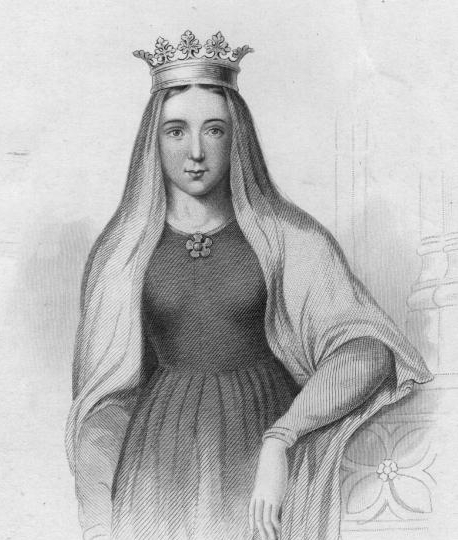
Lacking a contemporary image of her, have a more recent one from Wikipedia.
[Matilda of Boulogne, source: Wikimedia Commons]
Much is made of how Matilda of England and Stephen of Blois (respectively daughter and nephew of Henry I of England) fought over the English throne and how Stephen kept it from her. ** Most accounts of the story, however, leave out one of the most important characters: Stephen’s wife, Matilda, Countess of Boulogne (1105-1152).

Matilda was the only child of Eustace of Boulogne and Mary of Scotland.***  In 1125 she became Countess of Boulogne in her own right and in the same year married Stephen of Blois.  Stephen would rely heavily not only on her inheritance (not only for financial stability, but also because she held several strategic ports in Flanders), but also on her gifts for political and military strategy.

Stephen seized the English throne in 1135.  During the subsequent years, Matilda involved herself in politics and diplomacy.  She appears as witness to many of his charters and maintained her own courts to deal with the affairs of the royal lands and, more specifically, her own holdings.  She settled her husband’s feud with King David of Scotland and married her son Eustace to Constance of France, strengthening the alliance between the two powers.  She even attempted to set up a diplomatic meeting between her husband and his cousin Matilda of England in 1140, three years after the fighting started, but her plans fell through.

She also showed herself a capable military leader.  When Stephen found himself facing three separate revolts, he chose her to besiege Dover and take it back from the rebels.  This is one of the only known cases in Western Europe of a woman directing a siege.  In 1141 the Empress captured first Stephen and then the city of London.  Matilda quickly negotiated for aid from her allies and drove her cousin out of London four days after she entered the city.  Getting Stephen back took a bit longer, but within the year she was able to negotiate a hostage trade.  During his absence, it was she who led both his government and his military.

In her later years, Matilda remained involved in the government of her husband’s kingdom and in caring for her own lands, but left much of the official governance to Stephen.  She died in 1152, two years before Stephen, and was buried at Faversham Abbey.


*Though she wasn’t Holy Roman Empress during the time of this civil war, she had held that title for 11 years and is sometimes known as Empress Matilda.
**In (very) brief: Henry I of England made his only child Matilda his heir.  When Henry died, however, her cousin Stephen of Blois managed to get himself crowned and take over the country before she could.  A civil war ensued (1135-1154) during which Stephen mostly managed to retain control of the country in his own hands.  For a slightly longer summary see here.
***It is through Mary of Scotland and her sister Matilda of Scotland that Matilda of Boulogne and Matilda of England were first cousins.

Sources/Further Reading:

Tanner, Heather J. "Queenship: Office, Custom, or Ad Hoc? The Case of Queen Matilda III of England (1135-1152)."  In Eleanor of Aquitaine: Lord and Lady, edited by Bonnie Wheeler and John Carmi Parsons, 133-158. New York: Palgrave Macmillan, 2003.

Matilda of Boulogne - Epistolae
Matilda of Boulogne - Oxford Dictionary of National Biography
Matilda of Boulogne - Wikipedia
0 Comments

Short Hiatus

20/7/2014

0 Comments

 
Since I'm going to be moving in the next couple of days, I'm putting this blog on hiatus for a week while I get everything dealt with.  See you in a week!
0 Comments

Married High Priestesses: the Flaminica Dialis and Regina Sacrorum

18/7/2014

0 Comments

 
Picture
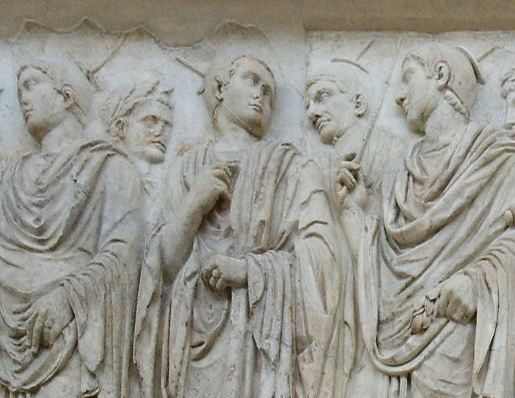
Four of these guys are flamines, as shown by the distinctive cap they wear  Three of them are supposedly flamines maiores (priests of Jupiter, Mars, and Qurinal).
[West side of the Ara Pacis, 9 BCE, source: Wikimedia Commons]
When I talked about manus marriage, I mentioned that certain priests had to be married by confarreatio, a ritual sacrifice to Jupiter.  Two of these were the Flamen Dialis (high priest of Jupiter) and the Rex Sacrorum (king of the sacred rites).  In part, this may have been because their respective wives, the Flaminica Dialis and the Regina Sacrorum had their own religious responsibilities and were priestesses themselves.  Though we have very little information on these women, what information we do have suggests that each of these priestly positions was incomplete without both spouses.

The Flaminica Dialis, and presumably the Regina Sacrorum as well, primarily assisted her husband with the rituals he performed.  Plutarch suggests that this assistance was essential, but the way he says it also implies that it was so commonplace that most would not comment on it, while Aulus Gellius tells us simply that “The ceremonies of the Flaminica Dialis are about the same [as those of her husband].”  In addition to this, however, they had their own responsibilities.  Each nundina (market day), the Flaminica Dialis sacrificed a ram to Jupiter.  On the Kalends of every month, the Regina Sacrorum sacrificed a sow or female lamb to Juno.  They also participated in larger religious rituals and observances as well, for example the Argei, for which the Flaminica Dialis was supposed to wear her hair uncombed and unarranged.  Presumably they had other responsibilities as well, but the sources don’t tell us what they might have been.

These women also shared many of the restrictions imposed on their husbands and had their own distinctive clothing and hairstyles reflecting their positions.  Aulus Gellius gives an extensive list of what the Flamen and Flaminica Dialis could not do, adding that the Flaminica could not go up a staircase of more than three steps, presumably so as not to expose too much of her legs.  Perhaps the strongest indicator of how important these priestesses were is the fact that the death of either husband or wife meant that the other had to step down.  Remarriage and divorce were forbidden.  The loss of one spouse made the other incomplete, and therefore unfit for this high office.

Sources/Further Reading:
Aulus Gellius, Attic Nights X.15 - Lacus Curtius
Macrobius, Saturnalia I.15-16 - Lacus Curtius (text in Latin)
Plutarch, Moralia, Roman Questions 50 - Lacus Curtius
Maurus Severus Honoratus, Commentary on the Aeneid IV.374 - Perseus
Flamen Dialis - Wikipedia
Rex Sacrorum - Wikipedia
0 Comments

Hildegard and Richardis

16/7/2014

1 Comment

 
The second conflict in Hildegard’s life was much more personal and immediate than her ongoing disputes with the Abbots of Disibodenberg, for it concerned Richardis von Stade, Hildegard’s assistant in writing Scivias and her favourite nun.  Richardis was the daughter and sister of the Marchioness von Stade and the Archbishop of Bremen, powerful nobles who had helped Hildegard in her fight to move to Rupertsberg.

In 1151, Richardis was elected abbess of the monastery of Bassum,* far from Rupertsberg.  Hildegard wrote to the Marchioness von Stade, attempting to use their common motherly feelings for the nun to persuade her to prevent the appointment.  This letter is particularly notable because it is one of the only ones in which Hildegard spoke almost entirely as herself rather than blending her voice with the prophetic Living Light,** making this possibly the most personal of her letters.

She took up strong prophetic language once more in her letters to the Archbishop of Mainz (her own superior within the Church), the Archbishop of Bremen, and possibly her now lost letter to Pope Eugenius concerning the affair.  She argued that the election had “no weight in God’s eyes,” and implied that those involved were guilty of simony.***  In this case she may not have meant that literally, intending rather to say that any election against the will of God (as she believed this one to be) could be equated with the buying of Church offices.

All of this, however, was not enough to keep Richardis with her.  Both the pope and her own archbishop refused to take Hildegard’s side in the matter, and Richardis took up her duties in 1152.  Hildegard wrote one letter to her favourite nun, showing her grief that they had been parted.  Not long afterwards, she received a letter from the Archbishop of Bremen telling of his sister’s death.  Hildegard’s reply to him showed no more anger, only grief, consolation, and vindication.  She had been proved right.  The election was against God’s will.  But Richardis was gone.


*Richardis’ niece Adelheid was also elected abbess of another monastery at the same time.  Despite the fact that Richardis was of age and Adelheid was not (and may still have been a novice at the time), it was Richardis for whom Hildegard fought.
**As many scholars have noted, Hildegard used three voices in her visionary letters: 1) the voice of the Living Light, 2) her own voice as Hildegard of Rupertsberg, and 3) a blend of the two.  She seems to have purposefully confused the issue on several occasions, leaving in doubt just who was speaking.
***The buying of Church offices.  A grave sin, and a serious accusation.

Relevant Letters (see below for possible link):
323 - to the Marchioness von Stade
18 – from the Archbishop of Mainz (demand that Hildegard surrender Richardis)
18r – to the Archbishop of Mainz (Hildegard’s reply)
4 – from Pope Eugenius (reply to a now lost letter from Hildegard)
12 – to the Archbishop of Bremen (Hildegard’s request that he intervene on her behalf)
64 – to Abbess Richardis
13 – from the Archbishop of Bremen (on Richardis’ death)
13r – to the Archbishop of Bremen (Hildegard’s reply)

Sources/Further Reading:

Baird, Joseph L. and Radd K. Ehrman, trans. The Letters of Hildegard of Bingen. New York: Oxford University Press, 1994, 1998, 2004. [Note: parts of these can be read on Google Books here, here, and here.]

Flanagan, Sabina. Hildegard of Bingen, 1098-1179: a Visionary Life. London: Routledge, 1989.  [Note: Some excerpts from this book can be found here.]
1 Comment

Valeria Messalina

14/7/2014

0 Comments

 
Picture
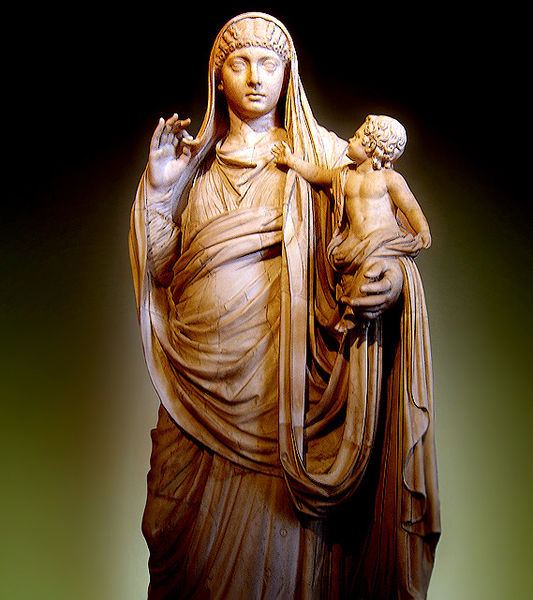
[Messalina with Brittanicus, 1st century CE, source: Wikimedia Commons]
Valeria Messalina (17/20 -48 CE), Agrippina the Younger’s predecessor as Empress and Cluaudius’s wife, was no less notorious according to historians of the time.  They accuse her not only of extreme sexual promiscuity, but also of manipulating her husband into numerous murders and other cruel acts.  As usual for women of the later Julio-Claudian line, it is impossible to tell just how much of what the historians tell us is exaggeration.

We know nothing about her life prior to her marriage.  She married Claudius in 38 CE, three years before he became Emperor.  The couple had two children, the future Empress Claudia Octavia and Brittanicus,* the heir presumptive, born less than a month into Claudius’ reign.

Messalina quickly made herself a major player in imperial politics.  Many courted her favour and tried to make use of her influence.  Both Cassius Dio and Suetonius accuse her of colluding with at least one of the Emperor’s freedmen to have him put to death several of their political enemies, or in some cases, people who simply managed to annoy them.

Rumors of her voracious sexual appetite abound in the histories, though it is worth noting that most of them come from after her death.  Several of the men she supposedly conspired to have executed were those who had supposedly refused her.  Other men came willingly into her bed or had to be tricked.

Such stories, however, served a political purpose.  For the supporters of Nero, who became the Emperor’s stepson when Claudius married Agrippina the Younger after Messalina’s death, they called into question not only whether Brittanicus was actually a legitimate heir to the Empire, but also whether or not he was a stable enough person to rule, given who his mother was.  For the later historians from whom we hear them (political enemies of the people they wrote about), they serve to further highlight the depravity of the later Julio-Claudians.

In 48 CE, Messalina publically married Gaius Silius,** though whether this was because she was slave to her passions and madly in love with him or because she felt Silius would be a stronger political support to her son than the aging Claudius and plotted against her husband remains unknown.  She was executed shortly after Claudius discovered what had happened.


*He was originally named Claudius Germanicus, but was given the name Brittanicus after his father’s conquest of Britain.  It is by this name that he is best known.
**I don’t know about you, but I find his name… silly.

Sources/Further Reading:
Tacitus, Annals, 11.2, 12; 11.26-38 - Lacus Curtius
Suetonius, Life of Claudius (sections 17, 26, 27, 29, 36, 37, 29) - Lacus Curtius
Cassius Dio, Roman History, 60.8, 60.12-18, 60.22, 60.27-28, 60.29-34 - Lacus Curtius
Valeria Messalina - De Imperatoribus Romanis
Messalina - Wikipedia
0 Comments

Hildegard and the Abbots of Disibodenberg

11/7/2014

0 Comments

 
Now, listen and learn so that in the inwardness of your soul you will be ashamed. Sometimes you are like a bear which growls under its breath; but sometimes like an ass, not prudent in your duties, but, rather, worn down. Indeed, in some matters you are altogether useless, so that, in your impiety, you do not even put the malice of the bear into practice. You are also like certain kinds of birds, which do not fly on the heights and yet do not hug the earth, neither excelling nor being subject to harm.
-Hildegard von Bingen to Abbot Helengerus of Disibodenberg

Hildegard von Bingen, visionary, abbess,* and saint, found herself in direct conflict with her superiors three times in.  Two of them occurred over finite periods of time, but the third, her disputes with her abbot and the monks of Disibodenberg remained ongoing.

This grew out of the fact that her community was not an independent foundation, but rather grew out of an anchoress’s cell attached to a male monastery.  As young women attached themselves to Hildegard’s mentor Jutta, an actual community of nuns was formed.  While the relations between the two communities remained peaceful at first and Abbot Kuno supported Hildegard’s visionary work, conflicts soon arose.
Picture
[The ruins of Disibodenberg, photographed by saharadesertfox, source: Wikimedia Commons]
The first notable break was Hildegard’s decision to build a new monastery at Rupertsberg near the town of Bingen and move her nuns there.  Abbot Kuno of Disibodenberg, her direct superior, attempted to deny her permission to do this.   There were several reasons for his opposition.  By this point Hildegard was only a year or two away from completing her first visionary work Scivias and was already moderately well known as a holy woman.  Her reputation attracted both pilgrims and prospective monks and nuns to Disibodenberg, all of whom provided a source of money for the monastery.**  Additionally, while the nuns would still nominally be subordinate to Disibodenberg’s abbot, in practice Kuno would lose direct control of them.  Nevertheless, Hildegard eventually convinced him that it was the will of God and she and her nuns moved to Rupertsberg in 1150.***

Conflict continued after the move, this time focusing on the dowries the nuns had brought with them.  Hildegard’s attempt to gain control of this income and her success in 1154/1155 soured relations further.  The dislike between Hildegard and Helengerus, Kuno’s replacement as abbot, appears to have been mutual.  At the very least she had a low opinion of his spiritual character (see above).

The situation did not get any better in 1173 when Volmar, Hildegard’s confidant and father confessor to her nuns.  The monks of Disibodenberg were required to provide the nuns with replacement for him, an obligation Helengerus resented and did his best to avoid carrying out.

This particular conflict did not so much end as trail off.  And one can’t really say the monks’ fears were unjustified.  She is now known as St. Hildegard von Bingen, and rarely do people ever mention Disibodenberg in connection with her.


*Well, sort of.  She never formally held that title, since for her community that position was already held by Abbot of Disibodenberg.
**There may also have been a sense of betrayal among the monks of Disibodenberg, since she had been raised in their monastery and was now abandoning them, taking the income and prestige she brought them with her.
***They received significant financial and political support in this from the mother and brother of one of her nuns, the Marchioness von Stade and the Archbishop of Bremen, as well as the Archbishop of Mainz, in whose archdiocese Disibodenberg lay.  These were powerful figures and their support for Hildegard in this dispute was significant not only because it helped her win her point against Kuno, but also because she would find herself opposing them in the second major conflict of her life.

Sources/Further Reading:
Baird, Joseph L. and Radd K. Ehrman, trans. The Letters of Hildegard of Bingen. New York: Oxford University Press, 1994, 1998, 2004.
Flanagan, Sabina. Hildegard of Bingen, 1098-1179: a Visionary Life. London: Routledge, 1989.  [Note: Some excerpts from this book can be found here.]
0 Comments

Heiresses in Ancient Greece

9/7/2014

2 Comments

 
A woman known as an epikleros in Athens (patrouchos and patroiokos were the words used in Sparta and Gortyn) was the daughter of a deceased man with no living sons to inherit his property.  In a society as patriarchal and as concerned with the passing on of property as some of the Greek city states, the question of what to do with an heiress was a pressing one.  Since the property had to remain within the family, the solution the law prescribed was to marry her off to her father’s nearest male relative.

The laws in Athens concerning the epikleros* were the strictest.  The woman in question usually had no choice in the matter.  The first person with the right to marry her and control her father’s property was her father’s oldest living brother.  If there were none, the right and duty (since it was thought of as a duty) passed to sons of brothers.  A difference in ages was no impediment, provided the couple could procreate.  If for some reason the prospective groom did not wish to marry her (if, for example, she had inherited nothing more than debts), he had to give her a dowry suitable to her rank.  Should he refuse, the archon (or the polemarch) could compel him to do so.**

Things were rather different in Sparta and Gortyn since women in both places could own property themselves.  In Sparta, the law regarding the patrouchos seems to have only applied to unmarried, unbetrothed women.  For those to whom it did apply, the pressure to produce an heir to carry on the property was intense.***

The Gortyn Law Code gave women (and their kin) even more freedom.  The succession of who the patroiokos was to marry remained the same, but she had more choice in the matter.  If she was too young to marry, she got the house and half the income.  If she didn’t want to marry the prospective bridegroom, she could pay him off, which then freed her to marry whoever she wanted from the clan.  If he didn’t want to marry her, she went to the next in line.  If none of them agreed, she could wed whom she wished.


*The term means “upon the property.”
** In cases like this where the woman in question was considered undesirable, this might be the only thing she had to fall back on to avoid complete poverty.
*** Herodotus tells us that Leonidas specifically selected men with sons for Thermopylae so as to avoid this law coming into effect for anyone’s daughters.

Sources/Further Reading:
Pomeroy, Sarah B.  Goddesses, Whores, Wives, and Slaves. New York: Schocken, 1995.
Pomeroy, Sarah B. Spartan Women. New York: Oxford University Press, 2002.
Epikleros - Wikipedia
2 Comments

Æthelflæd, Lady of the Mercians

7/7/2014

0 Comments

 
Picture
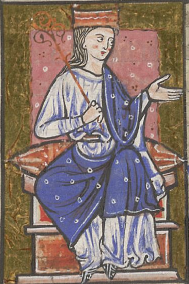
[Image of Æthelflæd, Cartulary of Abingdon Abbey, 1220, source: Wikimedia Commons]
Æthelflæd (d. 918 CE), eldest child of Alfred the Great,* was raised during the height of the Viking invasions of England.  Some have argued that this was why she attained the power she did, but it is clear that her intelligence and decisiveness were what allowed her to create a situation she could take advantage of.

She married Æthelred, Lord of Mercia, and ruled at his side until his death in 911.  During this time she played an active role in Mercia’s defense against the Vikings, forcing them into a temporary peace.  This, however, was nothing on her actions after her husband’s death when she was proclaimed “Lady of the Mercians” and sole ruler of Mercia.

Over the course of the next four years Æthelflæd built and very successfully defended a series of fortifications in the north against the incursions of the Vikings.  She also reconquered Leicester and Derby and in 917 led an army into Wales to avenge the murder of a Mercian abbot, subduing the local prince and returning victorious to Mercia.

Her achievements were not only military in nature, but political as well.  Her alliance with her brother Edward the Elder was what allowed him to accomplish much of what he did during his reign and vice versa.  She forged alliances with peoples of all sorts, from the king of Alba (Scotland) to a few of the Viking leaders.  In 918, the people of York promised to pledge her their loyalty, probably in return for military support, but she died just weeks before the promise could be carried out.

Two factions sprang up among the Mercians after Æthelflæd’s death, one in support of her brother Edward the Elder and his son Æthelstan (who had been brought up in his aunt’s court and therefore had the opportunity to make political connections) and one in support of her daughter Ælfwyn on the basis of her birth, her mother’s career, and quite probably her own training.  It was Ælfwyn who took control of Mercia after her mother’s death.  Six months into her rule, however, her uncle Edward forced her out of power and took his niece’s lands for himself.


*If you ever have trouble remembering his name, just think Alfred the Cake.  It comes from the book 1066 And All That and I’ve found it’s just ridiculous enough to stick.

Sources/Further Reading:

Stafford, Pauline. Queens, Concubines, and Dowagers: the King’s Wife in the Early Middle Ages. Athens, Georgia: University of Georgia Press, 1983.
Asser's LIfe of Alfred (Translated by Albert Cook) - Archive.org (see section 75)

Æthelflæd - Wikipedia

Charters - Anglo-Saxons.net
S 221
S 223
S 224
S 225
S 1280
0 Comments

Women's Textile Work in Ancient Rome

4/7/2014

1 Comment

 
Picture
It kinda looks like a cookie or a doughnut, doesn't it?
[Roman spindle whorl, source: Wikimedia Commons]

As in Ancient Greece, the production of textiles was primarily the responsibility of women.  It was not necessarily the primary task most women performed, or even the only one viewed as productive, but the ideal woman of worked in wool and did it well.

In many cases, saying a woman worked in wool was a way of implying her virtue. The historian Livy did exactly this with Lucretia.*  Similarly, no matter what else one said about a deceased woman, mentioning that she worked in wool was standard praise.  This held for women slave and free, rich and poor. 
Picture
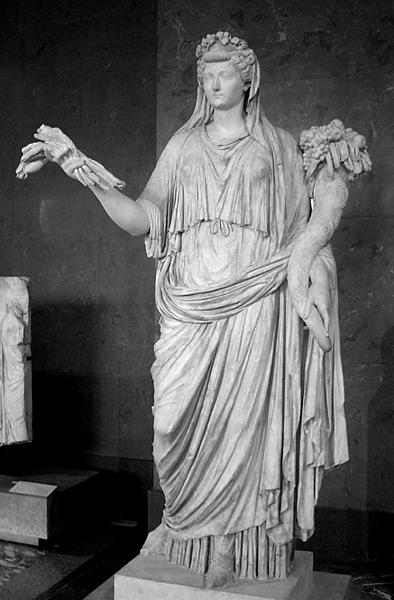
[Livia as Ops, 1st century CE, source: Wikimedia Commons]
Up until the late Republic, women’s textile work was economically necessary and most women spent at least part of the time doing wool-work and supervising any slave women they might have in the same tasks.  By the early Empire, however, this was no longer the case for upper-class women and they could, should they choose, leave such things to the slaves.  Those richer women who wished to show their respect for the traditions of the past, a very political choice, generally spent at least part of the day engaged in textile work.  Livia Drusilla, wife of Augustus, was one such and made sure to be quite ostentatious about it, driving home the idea that the Emperor and his family represented stability and virtue.
Picture
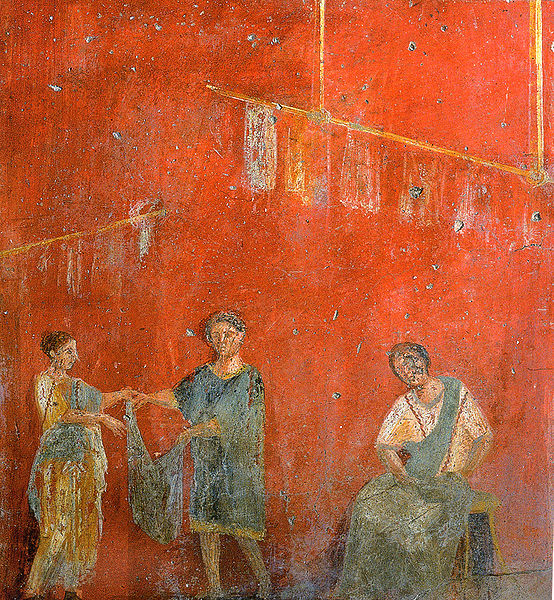
Roman women hanging clothes to dry in a dye-shop.
[Fresco found in Pompeii, Museo Nazionale di Napoli, source: Wikimedia Commons]
Most slave women and women of the lower classes generally spent at least part of each day doing textile work.**  Manumission records show that a significant portion of freedwomen were wool workers.  Many free women (freeborn and freed) worked only in the home, but some participated in the small-scale textile industry.  Household weaving was considered important enough for the law to involve itself in the ownership of the cloth.***  In terms of the industry, spinning was done by women alone, while weaving and fulling**** were tasks open to women and men alike.

Textile work, while definitely important, was not as central to women’s work and identity in Rome as in most of Greece.  It held very strong connotations of women’s virtue and the stability of the past, but ideal held more force here than necessity.


*For those unfamiliar with the story, try here.  (tw: rape)
**Among the possible exceptions to this (aside from prostitutes and barmaids and the like) were midwives.  At the very least Soranus argued that the best midwives avoided wool-work because it made the hands hard.
***No matter who did the work, the cloth belonged to the owner of the wool.
****Fulling is the process of cleaning and thickening cloth.

Sources/Further Reading:

Primary Sources
Lefkowitz, Mary R. and Maureen B. Fant, trans. Women’s Life in Greece and Rome: a Source Book in Translation. Baltimore, MD: Johns Hopkins University Press, 1992.
Claudia, 2nd century BCE, CIL VI.15346 - Diotima
Anymone, housewife, 1st century BCE, ILS 8402 - Found in Lefkowitz & Fant (no. 41), no link available
Menophila, 1st century BCE, Peek 1881 - Diotima
Murdia, 1st century BCE, CIL VI.10230 - Diotima
Allia Potestas, late 3rd-4th century CE, CIL VI.37965 - Diotima
Funeral Eulogy, 1st century BCE, ILS 8393 - Diotima
Juvenal, Satire 6, late 1st-2nd century CE - Diotima
Musonius Rufus 3, 4, 13a, 1st century CE - Diotima
Livy, History of Rome 1.57.6-1.58 (The Rape of Lucretia), late 1st century CE - Diotima
Soranus, Gynaecology 1.3-4, 2nd century CE - Diotima

Secondary Sources
Pomeroy, Sarah B.  Goddesses, Whores, Wives, and Slaves. New York: Schocken, 1995.
Clothing in Ancient Rome - Wikipedia
1 Comment
<<Previous

    My Blog

    Translation of the above: where I post the interesting things I find researching the Classical and Medieval periods in my free time.

    Currently Reading:
    -
    Medieval Monasticism by C. H. Lawrence

    Archives

    March 2016
    February 2016
    January 2016
    December 2015
    November 2015
    October 2015
    September 2015
    August 2015
    July 2015
    June 2015
    May 2015
    April 2015
    March 2015
    February 2015
    January 2015
    December 2014
    November 2014
    October 2014
    September 2014
    August 2014
    July 2014
    June 2014
    May 2014
    April 2014
    March 2014
    February 2014
    January 2014
    December 2013
    November 2013
    October 2013
    September 2013

    Categories

    All
    Architecture
    Biography
    Classical
    Law
    Marriage (legal And Otherwise)
    Medicine
    Medieval
    Misconceptions
    Monasticism
    Overview
    References
    Religion
    Review

    RSS Feed

Powered by Create your own unique website with customizable templates.