Emily Kittell-Queller
  • Home
  • About Me
  • Blog
  • Projects
  • Resume
  • Contact Me

Fulvia

28/3/2016

0 Comments

 
Picture
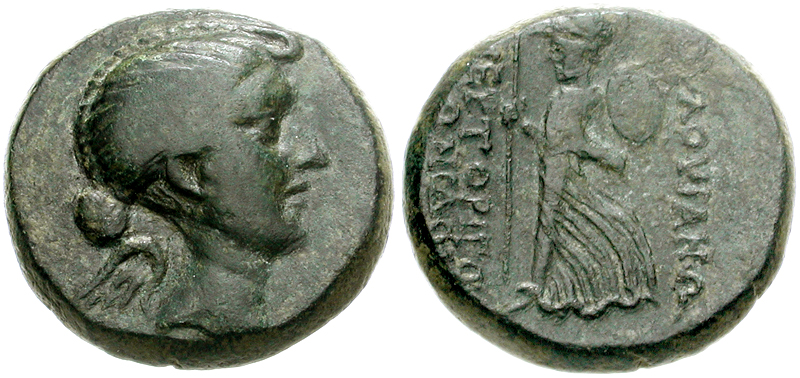
[Coin depicting Fulvia as Nike, 1st century BCE, source: Wikimedia Commons]
Fulvia (d. 40 BCE) is best known as the extremely politically active wife of Marc Antony. She is known for going beyond the limitations imposed on her because she was a woman and stirring up conflict between those around her.  The problem, of course, with his image of her is that we have no idea how much of it was true and how much was purely propaganda.  She was a convenient target, both for those who wanted to tear down her husband and later for Octavian and Antony when they reconciled after her death and blamed their entire conflict on her.
 
Fulvia was the daughter of Marcus Fulvius Bambalio and Sempronia.  She married Publius Clodius Pulcher around 62 BCE and had two children by him, a son and a daughter.  Unlike many Roman wives of the time, she may have accompanied him on most of his travels.  The first we know of her in the historical record comes with her husband’s death in 52 BCE, when she publically mourned over his body, causing a riot due to his popularity.  Her second marriage was to Gaius Scribonius Curio.  He died not three years later, while fighting for Julius Caesar in Africa.
 
Her third marriage is the most famous, to Marc Antony.  This is where claims about her political activity and her dominating personality mostly come from.  She was certainly politically active, accompanying Antony to the military camps at times and at other times staying in Rome to drum up political support for her husband and herself.  As for her personality, Plutarch claims that she dominated her husband as “she wished to rule a ruler and command a commander.”  How much of this is true is uncertain.  Some of it certainly was, but how much?  It certainly made her a convenient target for both Octavian and her husband after the Perusine War.  Since she fled to Greece and died there shortly after said war, she couldn’t argue when the pair of them blamed the entire mess on her.  Her son by Antony, Iulius Antonius, would be raised by Octavian’s sister, Octavia Minor.

Sources/Further Reading:
Plutarch, Life of Antony - Lacus Curtius
Delia, Diana. "Fulvia Reconsidered." In Women's History & Ancient History, edited by Sarah B. Pomeroy, 197-217. Chapel Hill: University of North Carolina Press, 1991.

0 Comments

Parents and Children in Classical Athens

24/3/2016

0 Comments

 
There is some evidence that Athenians considered the birth of the first child as the point when a marriage was secured.  Before that, the connection between husband and wife was uncertain (not least because girls first married around 14 and men around 30), but a child was held in common between them* and so bound them together.  Having children was considered the entire point of marriage.  But with the age differences between them and the highly gendered expectations laid on them, what children meant to a father and to a mother, what each of their relationships were with the child, differed greatly.
 
Mothers were, perhaps unsurprisingly, expected to be the more nurturing parent.  It was mostly unquestioned that a mother loved her children deeply and would do anything for them.  She would almost certainly be closer in age to her children than her husband was, which might even lead to her being closer to them emotionally than she was to her spouse.  Certainly a mother being more likely to take her son’s side in a quarrel with his father was a common rhetorical trope.  The age difference also meant that she was far more likely to end up a single parent than she was, though she would never end up legally in charge of them.
 
The relationships between fathers and their children were generally not expected to be so close and probably weren’t in practice.  Tension between fathers and their adult sons who hadn’t yet received an inheritance yet certainly seem to have not been uncommon.  But fathers were still expected to care deeply for their offspring.  To say in court that a man did not love his children was a serious strike against him. 
 
 
*Not legally certainly, but emotionally.

Sources/Further Reading:
Golden, Mark. Children and Childhood in Classical Athens. 2nd Edition. Baltimore, MD: Johns Hopkins University Press, 1990, 2015.
0 Comments

Servilia Caepionis

7/3/2016

1 Comment

 
Servilia Caepionis (1st century BCE) maintained ties to and influence over several important men in the Late Roman Republic.  She was the mother of Brutus, Julius Caesar’s lover, Cato the Younger’s half-sister, and mother-in-law to Cassius.  Though she helped Brutus and Cassius after Caesar’s assassination and represented their interests in Rome while they were away, she escaped persecution and lived to a ripe old age.
 
Servilia was the daughter of Livia Drusa and Quintus Servilius Caepio.  Her parents divorced when she was quite young and her mother remarried Marcus Porcius Cato, giving Servilia a younger half-brother, Cato the Younger.  After her mother and stepfather died, she was raised by her maternal uncle, Marcus Livius Drusus.  She married at a young age and in 85 BCE gave birth to a son, Marcus Junius Brutus, who was given the same name as his father.  Her husband was killed by Pompey in 77 BCE.
 
Shortly thereafter, she remarried, to Decimus Junius Silanus, and had three daughters and a son by him.  It was also around this time that Servilia’s affair with Caesar began.  It would last longer than any of his other relationships and seems to have been more passionate as well.  She matched him in education, intelligence, and ambition and so held his attention, as he held hers in the same way.  It was not a well kept secret.
 
In 63 BCE, during a debate in the Senate about the Catiline conspirators, Caesar was handed a note.  Cato the Younger, Servilia’s half-brother, accused Caesar of siding with the conspirators and demanded to read the letter aloud.  It was a love-letter from Servilia.
 
When civil war broke out, Servilia’s son Brutus sided against Caesar, who wound up ordering that the young man not be harmed, possibly out of affection for both Servilia and her son.  Servilia and Brutus would soon be at odds themselves though.  She opposed his marriage to his cousin, Porcia Catonis and may have resented the younger woman.
 
Even so, both women were present at the meeting of the conspirators after Caesar’s assassination and, much to Cicero’s disgust, her voice was listened to.  When the conspirators fled, she represented their interests in Rome.  She would outlive all of them.  After her husband’s death, she retired into the care of Cicero’s friend Atticus and eventually died of old age.

Sources/Further Reading:
Cornelius Nepos, Atticus - Epicurus.net
Suetonius, "Julius Caesar," Lives of the Caesars - Lacus Curtius
Plutarch, "Cato Minor," Parallel Lives - Lacus Curtius
Plutarch, "Brutus," Parallel Lives - Lacus Curtius
Salisbury, Joyce E. "Servilia." In Encyclopedia of Women in the Ancient World, 319. Santa Barbara, CA: ABC-CLIO, Inc., 2001.
Goldsworthy, Adrian. Caesar: Life of a Colossus. Yale University Press, 2006.
James, Sharon L. and Sheila Dillon. A Companion to Women in the Ancient World. Malden, MA: Blackwell Publishing, 2012.
Bauman, Richard. Women and Politics in Ancient Rome. London, Routledge, 1992.
1 Comment

Adoption as Roman Political Strategy

3/3/2016

0 Comments

 
Nearly all of what we know about formal adoption in Ancient Rome has to do with the upper classes.  For them it was political strategy.  It was a way for a man* to formally and legally restructure his family and appoint his heirs according to his own wishes.  Both adoptio and adrogatio were commonly used, though testamentary adoption was an option as well.
 
Because of the way we think about adoption now, probably the first thing that springs to mind is a man without an heir who then adopts one.  This did happen, but men who already had sons adopted more just as frequently, strengthening their chances of having descendants.  Sometimes this was a way of legitimizing an illegitimate son, but that was less common.  Usually they took legitimate sons of their own social class instead.
 
It was also unusual but not unheard of for a man to adopt a woman as his heir, as in the case of Curtilius Mancia, who hated his son-in-law and so adopted his granddaughter instead.  Adoption allowed men to be highly selective about who became their heirs, but it also meant they weren’t just dependent on their offspring for security.  When the Leges Iuliae came into effect, some childless men adopted others to take advantage of the benefits of having children and then emancipated them shortly thereafter.
 
There were benefits to the person being adopted as well, beyond just the chance at inheriting their stuff.  Since adoption didn’t prevent him from inheriting from their birth parents, a young man adopted by another man of wealth could then inherit from two fathers instead of one.  He might also gain the status of his new father.  This led to several men of senatorial rank having themselves adopted by plebeians so they were eligible to become the Tribune of the Plebs.  For Romans of the upper classes at least, adoption could be more of political strategy than anything else.
 
 
*Most forms of adoption weren’t open to women, and the wife of someone’s adoptive father was not considered to be one’s adoptive mother.

Sources/Further Reading:
Corbier, Mireille. "Divorce and Adoption as Roman Familial Strategies." In Marriage, Divorce, and Children in Ancient Rome, edited by Beryl Rawson, 47-78. Oxford: Oxford University Press, 1991.
Adoptio - Lacus Curtius
Lindsay, Hugh. Adoption in the Roman World. Cambridge: Cambridge University Press, 2009.
Frier, Bruce. Review of Lindsay, Adoption in the Roman World - Bryn Mawr
0 Comments

Ada of Caria

22/2/2016

0 Comments

 
Picture
The theater of Alinda, Ada's stronghold.
[Theater of Alinda, Ancient Carian City, Turkey, photographed by Ana al'ain, 2009, source: Wikimedia Commons]
Ada of Caria (died c. 326 BCE) ruled Caria first alongside her brother-husband Idrieus, then as a rival claimant to her youngest brother Pixodaurus, and finally on her own and seemingly unopposed as client-king to Alexander the Great.  She was not the first woman to rule Caria alone and in her own right, as Artemisia I and her own sister Artemisia II had done so before her.  She was also the first local ruler in Asia Minor to remain in power instead of being replaced after Alexander came through with his army.
 
Ada was the younger of the two daughters of Hecatomnus of Caria.  At some point she married the middle of her three brothers, Idrieus.  When their father died, her elder brother and sister Mausolus and Artemisia took the throne.  Following Mausolus’ death, Artemisia ruled alone.  On Artemisia’s death, Idrieus and Ada succeeded her, ruling together for seven years from 351 to 344.  Though Caria was a satrapy or client state* to the Persian Empire, Idrieus and Ada seem not to have been on terribly good terms with the Persians, preferring to maintain close ties with Greece.
 
Ada should have become the sole ruler when Idrieus died in 344, but her youngest brother Pixodaurus had other plans.  He seized power and drove her out of Halicarnassus, Caria’s main city.  Ada kept control of Alinda and the surrounding areas and contested her brother’s right to the throne but Pixodaurus had the support of the Persians and she was unable to take power back from him on her own, for all her popularity with the Carian people.
 
Ada saw her chance in 334 when Alexander the Great brought his army through Caria.  She allied herself with him and adopted him as her son.  He, in turn, besieged Halicarnassus for her and took the city back.  When he moved on, he left her in charge of the last of the fighting, specifically the siege of the acropolis and made her Queen, not just satrap, of Caria.  This was a first for Alexander.  All of the other rulers he had put in power were Greek, and therefore foreigners.  By adopting him, she gained his help, while he gained control of Caria as the legitimate heir of its queen.  Ada died eight years later, ruler of Caria in her own right.
 
 
*Which it was is rather unclear.

Sources/Further Reading:
Strabo, Geography 14.2.17 - Perseus
Sears, Mathew. "Alexander and Ada Reconsidered" - Academia.edu
Ada - Livius.org
0 Comments

Adoptio and Adrogatio

18/2/2016

1 Comment

 
In Ancient Roman law, the basic purpose of adoption was to create a legal relationship of father and son between two people, often for the purpose of providing the father with an heir.  It recognized two types of legal adoption: adoptio and adrogatio, respectively the adoption of someone still in patria potestas and the adoption of someone already sui iuris.  If we define adoption as the acquisition or designation of an heir who was not one’s biological child we can add a third type: what is now known as “testamentary adoption.”  Adoptio and adrogatio were limited to men as adopters.*  Only testamentary adoption was available to women as well.  An adoptee could be any free person, but were usually adult men.
 
Adoptio was legally the simplest of the three, the passing of someone in patria potestas from the power of one person to that of another.**  Adrogatio meanwhile, was far more complicated.  This involved the adoption, and therefore return to being under patria potestas, of a man*** who was already sui iuris and therefore legally under no one’s power.   But the caput (status/rights) of a Roman citizen could not be negatively affected except with the involvement of a court.  In other words, adoption by adrogatio couldn’t happen without both the potential adopter and the adoptee presenting a satisfactory case and having it voted on, with the possibility of conditions being imposed.  Originally this could only happen in the city of Rome.  As time went on, restrictions were loosened; people didn’t have to go to Rome and one only had to go before the pontifices.  Some may have found their way around the restrictions entirely.
 
What is now called “testamentary adoption” was its own special case.  A person could name someone else in their will as their heir on the condition that the inheritor took the dead person’s name.  This condition though, could be avoided, especially when the person making the will was an enemy of the state.  Whether or not it made the new heir part of a different family was unclear and could be legally challenged.  This was the only form of adoption open to women as adopters and was a way a woman could pass on her name and bring someone into her family.


*The wife of an adoptive father was not legally the new son’s mother.
**I’ll get more into the technicalities of this when I talk about adoption as a familial and political strategy.
***Women couldn’t be adopted by adrogatio.

Sources/Further Reading:
Corbier, Mireille. "Divorce and Adoption as Roman Familial Strategies." In Marriage, Divorce, and Children in Ancient Rome, edited by Beryl Rawson, 47-78. Oxford: Oxford University Press, 1991.
Adoptio - Lacus Curtius
Lindsay, Hugh. Adoption in the Roman World. Cambridge: Cambridge University Press, 2009.
Frier, Bruce. Review of Lindsay, Adoption in the Roman World - Bryn Mawr
1 Comment

Cleopatra IV of Egypt

8/2/2016

1 Comment

 
Note: As usual, to reduce confusion and make things flow better, “Cleopatra” here refers to Cleopatra IV.  All others will be given further identification.


Cleopatra IV (d. 112 BCE), like her sisters Tryphaena and Cleopatra Selene I, ended up being more heavily involved in Seleukid politics and wars than in affairs in Egypt, where she was born.  Though some make her out to be merely the victim of others’ plots, she acted on her own as well, helping on one occasion to turn the tide for her last husband, Antiochos IX Cyzicenus.
 
Cleopatra was the child of Cleopatra III and Ptolemy VIII, probably the middle of their three daughters who survived to adulthood.  She grew up on Cyprus, well away from the civil war between her parents and stepmother/aunt/grandmother, Cleopatra II.  She first married the elder of her two brothers, the future Ptolemy IX, and had at least one son sometime before their father died.  With Ptolemy VIII’s death, Cleopatra III would have preferred to make her younger son king, but when forced to choose the elder, she made him divorce Cleopatra and marry Cleopatra Selene instead.
 
Cleopatra herself was still on Cyprus when she found out she had been divorced and deprived of a throne.  She assembled an army, mostly persuading the men of the Seleukid king Antiochos VIII Grypus, her sister Tryphaena’s husband, to follow her instead.  Rather than march on Egypt though, she took them to Antiochos IX Cyzicenus, Grypus’s younger brother and rival and offered him both the army and her hand in marriage.  He agreed and the two were married.
 
With the army Cleopatra brought him, Cyzicenus finaly had enough men to rebel against his brother, starting a civil war.  Tryphaena, however, took her sister and sister-in-law’s actions as a very badly and accused Cleopatra of invading the country out of rivalry and envy and of bringing in a foreign army to deal with a dispute between brothers.  When Cleopatra was trapped in Antioch and too refuge in a temple, Tryphaena had her dragged out and killed.  Tryphaena herself would not live even a year beyond that.  Cyzicenus captured her and had her executed in revenge for his wife’s murder.

Sources/Further Reading:
Justin, Epitome of the Philippic HIstory 39.3 - Attalus.org
Cleopatra IV - Egyptian Royal Genealogy
Cleopatra IV - Livius.org
1 Comment

Living Spaces in Pompeii and Herculaneum

5/2/2016

0 Comments

 
The people of Pompeii generally lived in one of two types of buildings: houses and insulae.  The former tended to be organized along some variation of the atrium-tablinum-hortus/peristyle layout, while the latter has been characterized essentially as an apartment block.  The thing is, neither of these, but especially houses, were necessarily limited to just the family in terms of who could or did live there.
 
It’s very difficult, nearly impossible even, to find evidence of these sorts of arrangements in apartments, but it’s a little easier to figure out with houses.  It seems to have been not uncommon for house owners to rent out a room or rooms on the upper floor as living spaces, most likely to freedpersons and clients.  Being on the upper floor more easily separated the rented space from family space.  If the rooms were at the very front of the house, an external staircase could even be added to allow easy access from the street.  People living in rooms further back in the house, on the other hand, would have to go into the house and through the atrium.
 
Staircases in Pompeii mostly didn’t survive, though a few did in Herculaneum.  In Pompeii many upper floors didn’t survive either, making it harder for archaeologists to determine which rooms might have been rented out.  The easiest way to find such spaces, especially at Herculaneum, is to look for a separate hearth.  Rooms that are structurally part of the house but only open onto the street and not the house might be separate living spaces, but if they’re on the ground floor they might also just be a shop.  Or both.  Another possible, though less definitive indicator are the secondary reception rooms Wallace-Hadrill finds in his study of Pompeiian houses.
 
As Wallace-Hadrill argues, houses were not necessarily just “family” homes.  They could, and sometimes did, hold multiple, unrelated households in secondary spaces.

Sources/Further Reading:
Wallace-Hadrill, Andrew. "Houses and Households: Sampling Pompeii and Herculaneum." In Marriage, Divorce, and Children in Ancient Rome, edited by Beryl Rawson, 191-227. Oxford: Oxford University Press, 1991.
0 Comments

Tryphaena

28/12/2015

2 Comments

 
Tryphaena (d.111 BCE) was a Ptolemaic princess who like her ancestor Berenike Phernophoros and her sisters Cleopatra Selene I and Cleopatra IV, she was more heavily involved in the politics of the Seleukid Empire than in the goings on in Egypt.  She was an active queen, who seems to have been comfortable acting independently of her husband on several occasions.
 
Tryphaena was the daughter of Cleopatra III and Ptolemy VIII Physcon.  She was born during their reign with Cleopatra II and married Antiochos VIII Grypus at around the same time the three of them reconciled in 124.  The Seleukids had been dealing with their own internal strife with several different men claiming the throne.  Tryphaena’s marriage brought Egyptian political support and troops in to support her new husband Grypus.  Her resources swung things in his favor and soon he was king, with her as queen.  The couple went on to have probably five sons and one daughter.
 
In 115, things changed.  Her sister, Cleopatra IV, was divorced from her husband, Ptolemy IX Soter, on the orders of their mother.  Rather than pursue queenship in Egypt once more, she raised an army and offered her own hand in marriage to Antiochos IX Cyzicenus, Grypus’ half-brother, cousin, and rival for the throne.  Tryhpaena was furious.  She accused her sister of bringing a foreign army into a dispute between brothers and of marrying outside of Egypt without their mother’s permission.  Three years later, she saw her chance.  When Cleopatra took refuge in a temple, Tryphaena ordered her executed there, despite people’s warnings about angering the gods by such an act.
 
Tryphaena herself would not live long after this.  Her brother-in-law captured her less than a year later and had her executed.  Her sister Selene eventually married Grypus herself.

Sources/Further Reading:
Justin, Epitome of the Philippic History of Pompeius Trogus 39.2-3 - Forumromanum.org
Flavius Josephus, Antiquities of the Jews 13.13.4 - Perseus
Tryphaena - Egyptian Royal Genealogy
Tryphaena - Livius.org
2 Comments

Children of Roman Freedwomen

24/12/2015

0 Comments

 
The children of Roman freedwomen existed in an odd position, both legally and socially.  Their mother’s legal status throughout her pregnancy and at the time of childbirth determined their status as freeborn or slave.  It also governed whether they legally and socially belonged to her or her (former) owners, a question that on at least one occasion prompted a lawsuit.  Lastly, only her freeborn children counted towards the four children necessary for her freedom from guardianship under the Julian Marriage Laws.
 
Children born outside of a Roman marriage followed the status of their mother.  So the child of as slave was a slave, but if she was freed before its birth, her child would be freeborn and had all the associated benefits.  This did not necessarily include citizenship though.  A freedperson automatically got citizenship if they were freed formally.  Informal manumission, however, meant that the woman any children she had would be Junian Latins, not Roman citizens, with some of the same rights, but without other significant ones.  Marriage was limited to citizens, as was the right to make a will.  And since only children born from a marriage were legitimate and illegitimate children followed their mother’s status, any children a woman who was informally freed would be Junian Latins as she was.  There were ways to gain citizenship, but it was an involved process and if the woman died before completing it, her property went not to her offspring, but to her patrons.
 
If, however, the woman was formally freed, whether in front of a magistrate or through someone’s will, she gained citizenship.  In that case, if she married, any children she had after that would also be citizens and would be under the potestas of her husband.  If she didn’t marry, any children she had would still be citizens, but they would be sui iuris, free from potestas but not necessarily guardianship, from birth.

Sources/Further Reading:
Gardner, Jane F. “Legal Stumbling-Blocks for Lower-Class Families in Rome.” In The Roman Family in Italy: Status, Sentiment, Space, edited by Beryl Rawson and Paul Weaver, 35-54. Oxford: Oxford University Press, 1999.
Pomeroy, Sarah B.  Goddesses, Whores, Wives, and Slaves. New York: Schocken, 1995.
Rawson, 7-30. Oxford: Oxford University Press, 1991.
Weaver, P. R. C. “Children of Freedmen (and Freedwomen).” In Marriage, Divorce and Children in Ancient Rome, edited by Beryl Rawson, 166-190. Oxford: Oxford University Press, 1991.
0 Comments
<<Previous

    My Blog

    Translation of the above: where I post the interesting things I find researching the Classical and Medieval periods in my free time.

    Currently Reading:
    -
    Medieval Monasticism by C. H. Lawrence

    Archives

    March 2016
    February 2016
    January 2016
    December 2015
    November 2015
    October 2015
    September 2015
    August 2015
    July 2015
    June 2015
    May 2015
    April 2015
    March 2015
    February 2015
    January 2015
    December 2014
    November 2014
    October 2014
    September 2014
    August 2014
    July 2014
    June 2014
    May 2014
    April 2014
    March 2014
    February 2014
    January 2014
    December 2013
    November 2013
    October 2013
    September 2013

    Categories

    All
    Architecture
    Biography
    Classical
    Law
    Marriage (legal And Otherwise)
    Medicine
    Medieval
    Misconceptions
    Monasticism
    Overview
    References
    Religion
    Review

    RSS Feed

Powered by Create your own unique website with customizable templates.
