Emily Kittell-Queller
  • Home
  • About Me
  • Blog
  • Projects
  • Resume
  • Contact Me

The Rise of Primogeniture

3/12/2015

0 Comments

 
Primogeniture, where the eldest son inherits all (or nearly all) of the family property, especially land, was not universal throughout the Middle Ages.  By the eleventh century it had become fairly common, especially among the upper classes, but it was still nowhere near universal.  Even where it was the rule, people sometimes found ways around it.  It certainly had benefits for the family as a whole, but it also created a number of problems, both for individuals and for society.
 
In the Early Middle Ages, even noble titles didn’t necessarily follow the male line by primogeniture.  At first they weren’t even inheritable.  Instead, the king decided who would get the title and the associated land on the previous person’s death.  Eventually though, it just became easier to give it to one of the person’s heirs.  Over time, “heir” became codified as “eldest son or next male relative”
 
Before primogeniture became the rule (and in places where it never took hold), the inheritance was generally divided up between siblings, usually but not always equally.  The benefit of this system was that parents could make sure each of their offspring had a share and therefore a way to support themselves, daughters included, though sometimes they received less.  The problem, of course, was that it meant family land got broken down into smaller and smaller pieces over time, reducing the resources any one individual could draw on.
 
Primogeniture meant that family land and other wealth stayed mostly in one piece, keeping the inheritance largely intact for each successive generation.  This system, though, had its own problems.  For one thing, it meant that unless all of their brothers died,* daughters inherited nothing more than their dowries, which usually weren’t under their control.  Younger sons had no hope of an inheritance either unless their older brothers died or they married an heiress.  It also meant that if a man failed to produce a son or something happened to all of his sons, the property might well pass right out of the family’s hands, going with his daughter to a new family.
 
 
*Or were otherwise made unable to inherit.  Monks, for example, renounced any claim on the family property.

Sources/Further Reading:
Gies, Frances and Joseph Gies. Marriage and Family i the Middle Ages. New York: Harper & Row, 1987.
Erler, Mary and Maryanne Kowaleski, eds. Women and Power in the Middle Ages. Athens, GA: University of Georgia Press, 1988.
Winks, Robin W. and Teofilo F Ruiz. Medieval Europe and the World. Oxford: Oxford University Press, 2005.
0 Comments

Allods and Allodial Land

25/3/2015

3 Comments

 
We hear a lot about fiefs and fief-holding and how these things organized medieval society in Western Europe, but such discussions often leave out the importance of allodial land.  This was land a person owned outright, with no responsibilities or taxes owed because of their possession of it.  It was relatively common at all levels of society in South-Central Europe, somewhat uncommon in Northern Europe, and unknown in England.

The term was originally Merovingian and referred to property that was inherited rather than purchased.  Over time though, as the ideas of lordship and vassalage became more common and more entangled with fief-holding, “allod” begand to refer to land and other property owned outright, whether inherited or purchased.*  A fief technically still belonged to the lord rather than the vassal, though it was the vassal who had control over it.

Though inheritance of fiefs became more and more common over time, it was not a given and the lord could entrust the position and the land to someone else if they wished to.  An allod, by contrast, belonged to and was controlled by the person who owned it.  Taxes on such property were lesser or nonexistent, and one could sell or donate it without asking permission from anyone.  Since an allod was simply property and not also a position, it could also be divided for inheritance purposes and/or left directly to a daughter without her having to marry someone who would then take the oath of fealty and become the lord’s vassal.

The ownership of allodial land was not limited to only the upper classes who could participate in the vassal-lord contract.  It was widespread among the lower classes as well and significant number of peasants owned the land they worked themselves.

Owning land in this way allowed for a lot more independence.  Holding land in fief could grant or maintain political connections, whereas allodial land granted resources, came with no strings attached, and had far fewer restrictions on inheritance.**  Matilda of Tuscany was able to wield the power she did because of her vast amount of allodial land.***  Peasant allodists owed no rent or service to anyone, leaving them with far more freedom and resources.  Allodial property added a layer of complexity to the lord-vassal system, granting a certain level of independence from social ties, but on its own, isolating the property owner from those same ties.


*Or captured.
**Especially since a fief did not necessarily go to the vassal’s heir, particularly in earlier centuries.
***Also, the Dutch House of Orange is so named because Orange was the only land William I owned in his own right rather than in fief to somebody else.

Sources/Further Reading:
Bouchard, Constance Brittain.  Strong of Body, Brave & Noble: Chivalry & Society in Medieval France. Ithaca, NY: Cornell University Press, 1998.
Hodder, Michael J. "Allod." In Dictionary of the Middle Ages v.1, edited by Joseph R. Strayer, 190. New York: Charles Scribner's Sons, 1982.
Stephenson, Carl and Bryce Lyon. Mediaeval History: Europe from the Second to the Sixteenth Century. New York: Harper & Row, 1962.
Allod - Wikipedia
3 Comments

Medieval Thought on a Spherical Earth

25/6/2014

0 Comments

 
This is Part 2 of 2.  Part 1 is here.

As I showed last Friday, the Ancient Greeks, Romans, and Egyptians knew and accepted as a matter of course that the Earth was spherical.  This knowledge was not lost and continued to be accepted as fact throughout the medieval period.
Picture
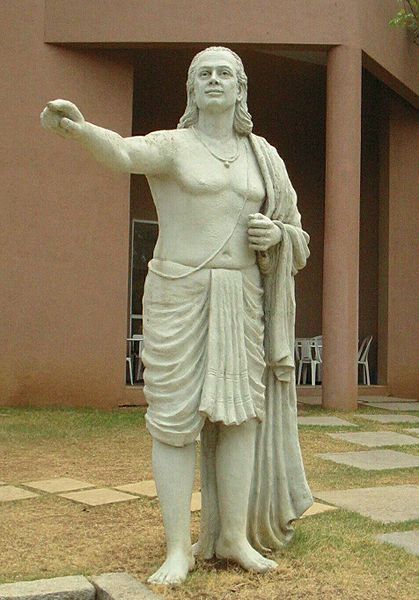
The astronomer Aryabhata
[Modern sculpture of Aryabhata on the grounds of IUCAA Pune, source: Wikimedia Commons]
In the early 6th century, the Indian astronomer Aryabhata* wrote the Aryabhatya in which he made his own calculation of the Earth’s circumference more accurately than Eratosthenes.  His work was read, translated, and commentated upon numerous times throughout the centuries.

The Venerable Bede is one of the earliest medieval Europeans we know of to make reference to the Earth as a sphere in the early 8th century.  He used this in The Reckoning of Time to explain the unequal length of days as the seasons changed.  This work was particularly widely copied and read due to Carolingian requirements for priests and was generally accepted without further proofs.  Additionally, the circulation of a few ancient works such as Plato’s Timaeus meant that medieval Europeans knew quite well that the Earth was round.
Picture
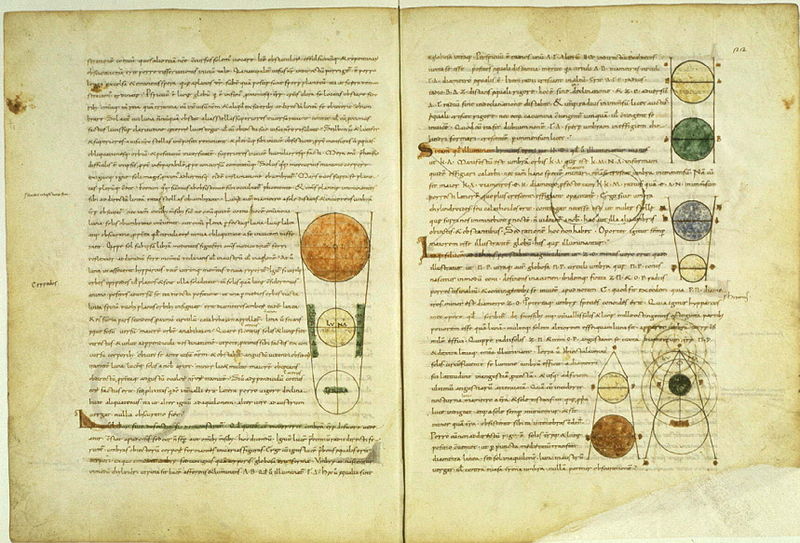
Plato's Timaeus, the only one of his dialogues available in Latin during much of the Middle Ages says that the Creator "made the world in the form of a globe, round as from a lathe, having its extremes in every direction equidistant from the centre, the most perfect and the most like itself of all figures"
[Pages from a Latin copy of Plato's Timaeus, early 10th century, source: Wikimedia Commons]
Islamic scholars still had copies of many works lost to Christian Europe, the most important of which were the works of Aristotle and Ptolemy.  Medieval Muslim rulers and scholars put a lot of energy into calculating the circumference and curvature of the planet** as they needed to be able to calculate the direction of Mecca from any given point on Earth.
Picture
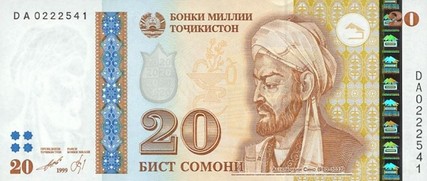
The Persian scholar Ibn Sina, known as Avicenna in Europe.
[Image of Ibn Sina on a modern Tajikistani banknote, source: Wikimedia Commons]
In the 12th and 13th centuries, Islamic scholars such as Ibn Sina and Ibn Rushd*** translated and wrote extensively on the works of Aristotle, Plato, and other ancient authors.  Ibn Rushd in particular concerned himself with the difference between Ptolemy’s geocentric model of the universe and Aristotle’s theories on the movements of the elements.

These works came to the universities of Christian Europe through Al-Andalus.  Western Europeans already knew the Earth was round, but these ancient texts and the commentaries on them and produced both a new interest in the topic.  Thomas Aquinas on several occasions used this fact as an example of something already known, which Roger Bacon and others speculated whether or not the equator was too hot to be crossed.****
Picture
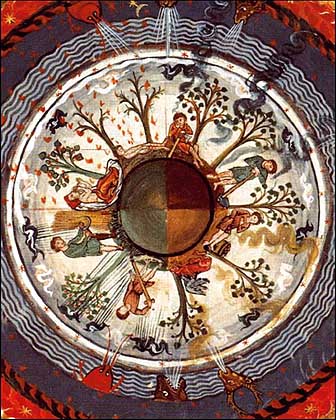
Hildegard von Bingen included this image in her third visionary work Liber Divinorum Operum (Book of Divine Works).  I don't think it gets clearer than that.
[Image from the Liber Divinorum Operum, HIldegard von Bingen, 12th century]
[Source: Wikimedia Commons]

These works came to the universities of Christian Europe through Al-Andalus.  Western Europeans already knew the Earth was round, but these ancient texts and the commentaries on them and produced both a new interest in the topic.  Thomas Aquinas on several occasions used this fact as an example of something already known, which Roger Bacon and others speculated whether or not the equator was too hot to be crossed.****

The spherical nature of the Earth was not up for debate in this time period.  People knew it already.  The question of whether the Earth went around the Sun or vice versa, on the other hand was the subject of significant debate, but that is a topic for another time.


*He should technically belong in the Ancient post rather than the Medieval one but I accidentally left him out.  So he gets his own paragraph here.
**Names of interest here include Al-Ma’mun (a 9th century Caliph who hired several astronomers and geographers to calculate the distance between to cities as well as the curvature and the circumference of the Earth), Al-Farghani (one of the astronomers hired by Al-Ma’mun), and Abu Rayhan Biruni (an 11th century scholar who developed a more accurate way of calculating the Earth’s circumference).
***Known in Europe as Avicenna and Averroes respectively.  Ibn Rushd was so famous in Western Europe as a translator of and commentator on Aristotle that many works refer to him simply as “the Commentator.”
****Christopher Columbus proved that it could.  He did not prove that the Earth was round because 1) he and everybody else already knew that and 2) that’s not what he was arguing.  He used Al-Farghani’s calculation of the Earth’s circumference in Arabic miles and treated it as though it were in Roman miles to prove (wrongly) that the Earth was much smaller than people said it was.

Sources/Further Reading:
The Aryabhatiya (Translated by Walter Eugene Clark) - Wilbour-Hall (Note: not searchable, unfortunately)
Aryabhata - Wikipedia
Claudius Ptolemy, Almagest - Central Connecticut State University
Bede the Venerable, De Temporum Ratione - Chronologie und Kalender (Note: This is in Latin.  I was unable to find an English translation online.)
The Reckoning of Time - Wikipedia
Bede the Venerable - Wikipedia
Plato, Timaeus - MIT.edu (Search "globe" for the reference.)
Timaeus (dialogue) - Wikipedia

Aristotle, De caelo Part 2 - MIT.edu (Search "spherical" and you'll find the reference.)
Aristotle, Meteorology Part 1 - MIT.edu
Aristotle, Meteorology Part 2 - MIT.edu
Al-Ma'mun - Wikipedia
Al-Farghani - Wikipedia
Abu Rayhan Biruni - Wikipedia
Biruni's Measurement of the Earth - Geogebra
Ibn Sina - Wikipedia
Ibn Rushd - Wikipedia
Averroes - Islamic Philosophy Online (This is a collection of works by Ibn Rushd, mostly in Arabic and English.)
Hildegard of Bingen - Wikipedia
Johannes de Sacrobosco - Wikipedia
Thomas Aquinas, Summa Theologica, Question 1, Article 1 - Christian Classics Ethereal Library
Thomas Aquinas, Summa Theologica, Question 54, Article 2 - Christian Classics Ethereal Library
Thomas Aquinas - Wikipedia
Roger Bacon - Wikipedia
Spherical Earth - Wikipedia
0 Comments

Ancient Thought on a Spherical Earth

20/6/2014

0 Comments

 
I’ve noticed several people lately talking about the myth that people believed the Earth was flat all the way until the late 15th century.  So I thought I’d write up my own history of thought on the topic.  This will be Part 1 of 2, covering the ancient Greek and Roman world.  Part 2 will cover the medieval world (and not just Europe) next Wednesday. (Edit: Part 2 is here.)
Picture
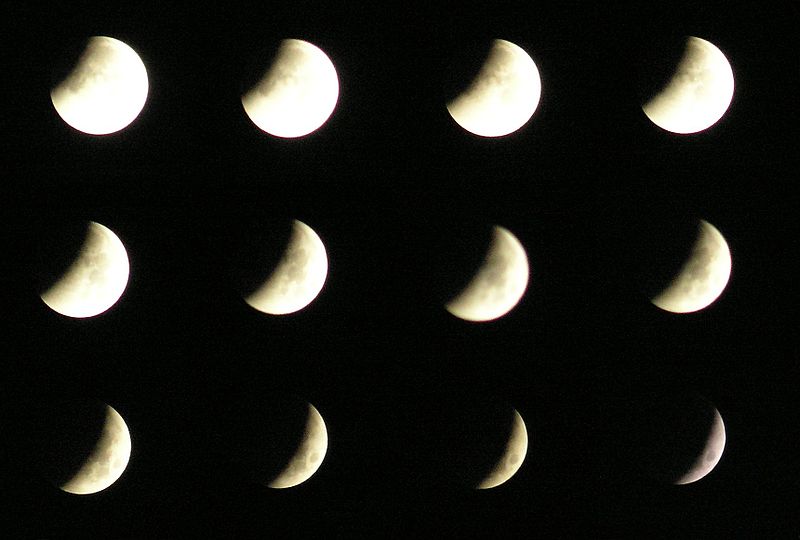
The most common evidence used to prove the Earth's spherical shape was the fact that it casts a round shadow on the Moon during a lunar eclipse.
[Lunar Eclipse in Estonia, October 28, 2004, photographed by Epukas]
[Source: Wikimedia Commons]

The earliest evidence we have comes from Greek sources.*  Different philosophers attribute the original idea to different people, the best known being Pythagoras.  None of the evidence is reliable but whoever it was, the idea gained enough widespread acceptance that by the 5th century BCE that Plato was able have his characters in Phaedo discuss the idea without much argument.  Aristotle used the theory to divide the planet into five climatic zones: one very hot at the equator, two temperate regions, and two very cold near the poles.

The idea spread throughout the Hellenistic world and in the 3rd century CE, Eratosthenes of Cyrene (now Libya) made an attempt to calculate the circumference of the Earth.  Depending on whether he used the Egyptian or Attic stade as a unit of measure (he doesn’t say), he was only off by 2%-17% and any error can be attributed to him having the wrong numbers.**
Picture
Strabo used a line from Homer's Odyssey and the fact that the Earth's roundness hides the bottom of a ship on the horizon to prove that Homer knew the Earth was a sphere.
[Ship at horizon, March 2006, photographed by Anton, source: Wikimedia Commons]
Three astronomers, Philolaos, Aristarchos of Samos, and Seleukos of Seleukia, suggested that the earth was not a fixed point around which other bodies orbited.  Both Aristarchos and Seleukos disagreed with Philolaos’ suggestion that both Earth and Sun orbited some central fire and argued that the Earth orbited the Sun.  All three of them were often ignored in favor of the model with the Earth at the center most popularized by the works of Claudius Ptolemy in the 2nd century CE.

The idea of a spherical Earth was so commonly accepted within the Roman Empire that both Cicero and Pliny the Elder refer to it as fact quite offhandedly.  By this point no one that we now know of in Roman or Hellenistic lands or the societies that came out of them was arguing that the Earth was flat.


*This doesn’t mean that the Greeks were the first or only people to figure this out.  This is not only a problem of what evidence has survived, but also what documents people have studied and circulated.
**I never learned this in history class in school.  No, I heard of it in one of my upper level math classes.  For shame.

Sources/Further Reading:
Plato, Phaedo 108-109 - Perseus
Aristotle, De caelo Part 2 - MIT.edu (Search "spherical" and you'll find the reference.)
Aristotle, Meteorology Part 1 - MIT.edu
Aristotle, Meteorology Part 2 - MIT.edu
Eratosthenes - Wikipedia
Philolaus - Wikipedia
Aristarchos of Samos - Wikipedia
Seleukos of Seleukia - Wikipedia
Cicero, Somnium Scipionis - Tertullian.org (The exact reference starts in paragraph 8)
Pliny the Elder, Natural History 2.2 - Perseus
Claudius Ptolemy, Almagest - Central Connecticut State University
Spherical Earth - Wikipedia
0 Comments

Priests' Wives and Concubines in Medieval Europe

30/5/2014

2 Comments

 
Up until the Reformation, the sight of a parish priest and his family was a quite usual one in Catholic Western Europe.*  I’m not talking about the family he was born into either.  I’m talking about his wife (or concubine, depending on the century) and his kids.  For centuries the Church tried to impose celibacy on all of its clerics, but for a long time it only succeeded in making them angry.**

Up until the First and Second Lateran Councils (early 12th century), it was perfectly legal within the Church for a priest to get married.  Many of them did just that.  Indeed, many parishes, especially those in rural areas, preferred that their priest have a wife.  A married man was considered more stable than an unmarried one, an idea that applied to priests as well as laymen.  In many places the priest’s wife held a certain amount of prestige and responsibility by virtue of being married to him.  Many sons of priests went on to be priests themselves.  People had so much invested in this system that many bishops who tried to tell their priests to give up their wives found themselves fleeing an angry mob.

Given all of that, it’s pretty unsurprising that the 12th century ban on clerical marriage didn’t have much practical effect.  In most places all that really happened was that priests continued to live with women as though they were married.  While this was technically concubinage and fornication, most priests and their parishes ignored what the higher-ups had to say and continued to do things the way they had previously.  Though they weren’t technically married, many of these concubines held much of the same status in the villages as a priest’s wife would.

The ban proved mostly ineffective, especially at first.  When their superiors cracked down on them, priests simply tried to be more discrete.  It was only during the Reformation, when the Church started educating its clerics much more systematically that the idea of the priest’s wife or concubine (his wife in all but law) as an integral part of the parish died out.


*Or really anywhere Christianity was prominent.  Neither the Eastern Orthodox nor the Coptic Churches have ever prohibited their priests from marrying.  A priest may not marry after his ordination, but being already married is no impediment.  Indeed, many Byzantine convents preferred that their priests and father confessors be married.
**The irony here is that the Church didn’t succeed in stopping most of its priests etc. from having sex or getting married until after the Protestants split off and decided that clerical celibacy was a stupid and unworkable idea.

Sources/Further Reading:

Brundage, James A. Law, Sex, and Christian Society in Medieval Europe
. Chicago: University of Chicago Press, 1987.

Parish, Helen L. Clerical Celibacy in the West, c. 1100-1700. Burlington, VT: Ashgate Publishing, 2010.

Armstrong-Partida, Michelle. "Priestly Marriage: the Tradition of Clerical Concubinage in the Spanish Church." Viator 40.2 (2009): 221-253.  (Also found here.)

Clerical Marriage - Wikipedia
Clerical Celibacy - Wikipedia
2 Comments

Lay Abbots and Abbesses

21/5/2014

0 Comments

 
Usually the head of a Catholic monastery, known as the abbot or abbess, is a member of that community, having taken the same vows and living under the same rule.  This has not always been the case.  From approximately the 8th to the early 12th centuries in Western Europe it was not uncommon for the abbot or abbess to be a lay person, often one with little to no real connection to the community.

This was particularly common in the Frankish kingdoms, though it happened elsewhere too.  Some important personage, usually but not always the king, would give a monastery to a friend, a wife, or a person they wished to reward.  Charles Martel, Mayor of the Palace to the Merovingian kings and grandfather of Charlemagne, was supposedly the first to do this.  Many subsequent kings continued this practice even while supporting the very reformers who called for an end to it.*

Queens and king’s daughters were common recipients of such honors, as were princess’s husbands.  Charlemagne made his friend Angilbert, who was also his daughter Bertha’s lover, abbot of St. Riquier.  After his death, the post of abbot was given to other laymen.  Gisla, daughter of Lothar II received charge of monasteries of Nivelles and Fosses (a male monastery).**  Richardis, wife of Charles the Fat, was variously the lay abbess of monasteries at Säckingen, Zurich, and possibly Andlau.

The Church as an institution was, unsurprisingly, not happy with this way of doing things.  The general claim was that lay abbots and abbesses led their monasteries into decay and degeneracy.  Given both the general lack of any close relationship between the lay abbot/abbess and the community and the usual lack of interest in monastic life on the part of said lay abbot/abbess, this is unsurprising.  (It is worth pointing out, however, that both Richardis and Agilbert (discussed above) are now considered saints.)  Several synods and church councils over the centuries condemned the practice, but it wasn’t until the Investiture Controversy*** came to a head in the 11th and early 12th centuries that the practice was ended and only people who had taken vows were allowed to become abbots and abbesses.


*The Rule of St. Benedict, for example, states explicitly that the abbot of a monastery should be elected by the members of the community.  It gives no option for appointment by an outsider.  Charlemagne had no qualms appointing people as lay abbots and abbesses while working to spread the use of this particular Rule.
**As far as I can tell, it was highly unusual for a woman to be given a male monastery or vice versa, but it apparently happened at least this once.
***Way oversimplified, this was a “No, me!” fight between secular rulers and the Church over who got to appoint the bishops.

Sources/Further Reading:
The Rule of St. Benedict, Chapter 68 (part 2) - Order of St. Benedic

Jo Ann McNamara. Sisters in Arms: Catholic Nuns through Two Millennia. Harvard University Press, 1998.
Lay Abbot - Catholic Encyclopedia
Lay Abbot - Wikipedia
Richardis - Wikipedia
Angilbert - Wikipedia

0 Comments

Hetairai

7/3/2014

0 Comments

 
Hetairai were the courtesans of the ancient Greek world.  They were known for their beauty, intelligence, and wit as well as being some of the only women in most Greek city-states to be highly educated.  Of course, their ability to function outside the rules circumscribing the lives of respectable women* came at a cost: the commodification of their sexuality.  In Athens, women were either respectable wives and daughters or they were considered prostitutes of one sort or another.

That said, it’s important to note that they were considered a distinct group, separate from prostitutes.  The expectations were different.  These were women who were expected to be well educated enough to actively participate in the discussions at symposia and sometimes to advise their lovers.  Indeed, Aspasia was claimed to have heavily influenced Socrates.**  At the very least, she is known to have guided Pericles well.  Many of them were also well versed in the arts of music and dance.  They tended to have a fair amount of money in their own right and generally had independent control of it.  Many sources claim that they were shrewd, grasping, and greedy.  I suspect such authors would have used similar, much more complimentary words had they been talking about men.
Picture
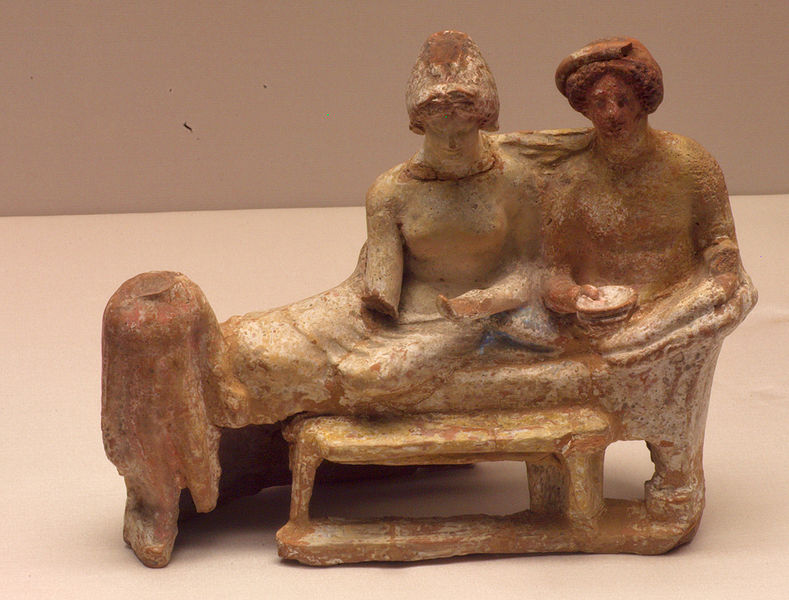
Are those two wearing some really weird hats or is that just their hair?
[Teracotta group of hetaera and young man at a symposium, 4th century BCE]
[photographed by MatthiasKabel, source: Wikimedia Commons]

The usage of the word “hetaira” is, however, a bit complicated.  The root of the word, “hetair-,“ means simply “companion.”  Scholars frequently assume the word only had sexual connotations in its simplest feminine form.  The masculine form, “hetairos,” is said to mean “close friend” and to have no sexual connotation.  While that may have been the general rule, it seems unlikely to me that the masculine form was never sexual.  It’s also worth noting that use of the feminine form of the word did not necessarily imply sexuality.  Both Sappho 124/29 and an Athenian funerary inscription refer to one woman as “hetaira” to another and in the former at least, the implication is not sexual.  Regardless of the usage of the word, however, calling these women “companions” extended to these women some implication of equality with men while simultaneously leaving them at risk because they weren’t “respectable.”


*Read: women considered fit to be wives by Greek (mostly Athenian, since the overwhelming majority of our sources come from there) standards.
**Whether or not this was merely satire is uncertain.  However, even if it was satire, it’s important to note that after a certain point, people took the claim seriously. 

Sources/Further Reading:
Lefkowitz, Mary R. and Maureen B. Fant. Women's Life in Greece and Rome. Baltimore, MD: Johns Hopkins University Press, 1992.
Roberts, Nickie. Whores in History: Prostitution in Western Society. London: Harper Collins, 1992.
Hetaira - Wikipedia
0 Comments

Monasteries & Construction

14/2/2014

0 Comments

 
Or: Quiet Contemplation? What quiet contemplation?

Note: I’ll be using “religious” as a gender-neutral noun to refer to monks and nuns.  It’s less clunky than “monastics.”

The general perception of a medieval monastery is one of quiet, of contemplation, and of peace.  Seclusion from the chaotic outside world certainly was part of the ideal.  The thing is, that wasn’t always entirely practical.  Leaving aside the slightly more frequent issues of visitors and the Abbot or Abbess’s duty to represent the monastery to the outside world* as well as the bits of daily life that caused their own disruptions, there was also the more fundamental need to construct, maintain, and renovate the actual buildings of the monastery.

The usual order of things for monasteries was to collect a community first and only then build the place.  In the meantime, the community lived in temporary wooden structures and moved into the stone buildings as they were completed.  In many cases it seems likely they went about their lives as structured by their Rule, as the construction work went on nearby.  For their first several years (Hildegard von Bingen’s monastery at Rupertsberg, for example, seems to have taken at least 3 years to build), a community of religious lived their lives next to a construction site, sometimes almost within it.
Picture
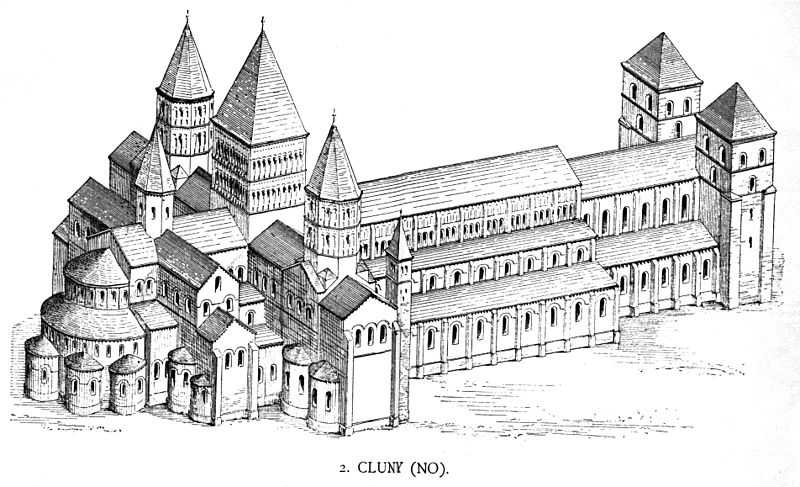
Can you imagine trying to sing the hours while that was being built?
[Reconstruction of what Cluny III might have looked like, Georg Dehio & Gustav von Bezold]
[Kirchliche Baukunzt des Abendlandes, 1887, source: Wikimedia Commons]

It wasn’t just at the beginning though.  Even stone buildings need maintenance every not-so-often, especially if people are living in them.  Some monasteries grew big enough that they needed to rebuild just so they could fit everybody in the church and the dormitories.  Some abbots and abbesses felt that their duty was to make the buildings of their monastery, especially the church, bigger and more beautiful than they had been before.  Some abbots and some monasteries had a reputation for being builders.  Angilbert, abbot of St. Riquier was one such, while the abbots of Cluny demolished and rebuilt their church twice over the course of around 200 years.  Meanwhile, the religious who had vowed themselves to these monasteries continued to live there, even as buildings went up around them.

*Two of the biggest reasons for this were the need to solicit donations to ensure the economic wellbeing of the monastery and the need to be involved in politics, both secular and ecclesiastical, for the aforementioned economic reasons as well as to advance or maintain the other interests of the monastery.

Sources/Further Reading:
Lawrence, C. H. Medieval Monasticism. London: Longman, 1984.
Stalley, Roger. Early Medieval Architecture. Oxford: Oxford University Press, 1999.
Building a Monastery the Medieval Way - Brush off the Dust!  History Now!
0 Comments

The Pythia

12/2/2014

0 Comments

 
Picture
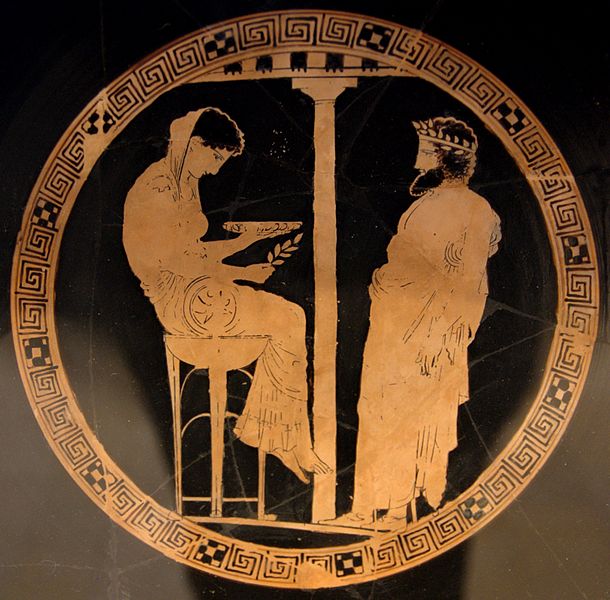
[Themis as the Oracle answers Aegeus. Attic red-figure kylix, 440–430 BC. From Vulci.]
[Source: Wikimedia Commons]

The Oracle at Delphi, known as the Pythia, is probably the most famous and respected oracle in the Ancient Greek world.*  People came from all over Greece, the surrounding lands, and later from Rome, Egypt, and even farther away to ask the advice of the Oracle on the seventh day of each of the nine warm months of the year.  Apollo was said to abandon Delphi in the cold months.**

The people who came to the Pythia were not asking for nebulous predictions of the future. They generally had specific questions about what they should or should not do.  Should we set up a settlement in a particular place?  Should I make war on this or that group of people?  These were some of the most common sorts of questions.
Picture
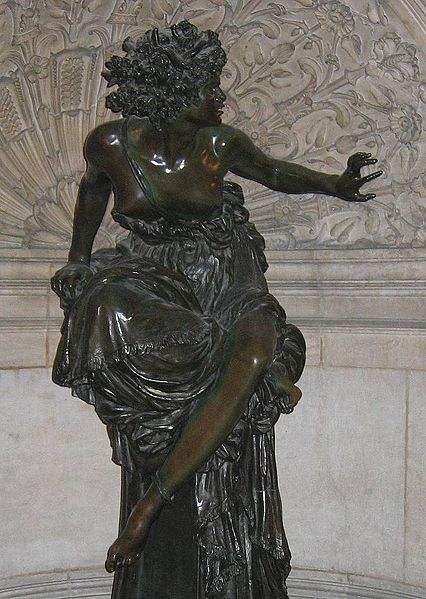
[Pythia, 1870,  Marcello (actually Adèle d'Affry, Duchess of Castiglione-Colonna]
[Source: Wikimedia Commons]

Two things about the Pythia remain unclear: who could be the Oracle and whether hallucinogenic fumes rising from a crack in the floor were the cause of her trances.  Some scholars claim that the Pythia was originally always a virgin priestess but that later the decision was made to only have older, married women.  Others argue that a priestess of any age and marital status could become the Pythia.  What we do know for sure is that social rank did not play much if any role in selecting the new Oracle and when a woman took on the position, she left behind all familial ties.

The other debate is more hotly contested.  The original excavations led to the widely accepted idea that the prophecies could have no connection to hallucinogenic gasses because there was no source for them.  This was proven wrong when geologists discovered two different faults that intersect under the ruins of the Temple of Apollo at Delphi.  These could easily have released ethylene, which has been known to cause trance states, up into the Temple.  Ethylene, however, does not cause one to speak in gibberish, nor do the ancient sources give any support for this theory.  The Pythia spoke in her own voice.


*It wasn’t, however, the only one.  Other important Greek oracles include the shrine to Dione (who is also identified with Rhea and Gaia) and Zeus at Dodona, the shrine to Trophonius at Lebadaea in Boeotia, and several others at various shrines to Apollo.
**It makes one wonder how many people drew a connection or parallel with Demeter here.

Sources/Further Reading:
The Pythia - Priestess of Ancient Delphi - Ancient History Encyclopedia
Pythia - Wikipedia
List of oracular statements from Delphi - Wikipedia
The Oracle of Delphi--Was She Really Stoned? - Biblical Archaeology Society
Delphic Oracle's Lips May Have Been Loosened by Gas Vapors - National Geographic
0 Comments

Some Things Worth Knowing about Parchment

5/2/2014

0 Comments

 
First off, some definitions:
-Parchment is made from calfskin, sheepskin, or goatskin.  The skin would be flayed, soaked (to most of the hair etc.), and then stretched and scraped.
-Vellum is parchment that is specifically made from calfskin.
-A quire is a measurement of paper (or in this case parchment) quantity.  In the Middle Ages it usually consisted of 4 folded sheets of parchment, resulting in 8 leaves (16 sides).
-A codex a collection of quires bound together in the form we are now used to for books.  Historically speaking, the word “book” (or rather, its Latin/Greek/what-have-you translation) covered groups of scrolls as well as codices.
-A palimpsest is parchment that has been scraped clean of whatever was previously written on it so it could be reused.

Second, a brief history:
Parchment was first developed in either the mid 3rd or early 2nd century BCE in the Greek city of Pergamon as a substitute for papyrus, though the history of writing on animal skins goes back much further.  It was widely used in Ancient Greece and Rome, but not so much as its heyday in the Middle Ages in Europe, when papyrus wasn’t an option.  Many early Islamic texts were also written on parchment.  Paper became available in Europe in the 1200’s and by the late 1400s was more widely used.  Parchment is still used today by some traditional Jewish communities as the only acceptable medium for religious texts.

Finally, a few more interesting facts:
-Parchment was expensive.  This is why palimpsests became a thing.  This is also why people took great care not to waste it.
-A medieval scribe wouldn’t just discard a piece of parchment that had a hole, or a ragged edge.  They might not use it for anything of especial value, but it would be used for something.  Sometimes holes became part of the artistry of the work.  See, for example here and here.**
-Errors could be fixed.  Often a scribe could scrape the mistake off and redo that bit.  Or, if they had skipped a word or letter, they would just squeeze it in there anyway.
-Parchment is sensitive to changes in humidity and warps easily.  This is why medieval codices were so often bound very tightly with wood covers and metal clasps.

*You know, I’ve been wondering if herding sheep would be a valid career choice for a Hogwarts graduate.  You really have to wonder where they’re getting all of that parchment.  I mean, they could probably produce some of it magically, but I assume you have to start somewhere.  I like the idea of herds of magical sheep or some equivalent.
**Or just go read the parchment tag over there.  He has some really cool stuff.

Further Reading:
Parchment - Wikipedia
Vellum - Wikipedia
Palimpsest - Wikipedia
Specifically Jewish Terminology: Gevil, Klaf, and Duchsustus

0 Comments
<<Previous

    My Blog

    Translation of the above: where I post the interesting things I find researching the Classical and Medieval periods in my free time.

    Currently Reading:
    -
    Medieval Monasticism by C. H. Lawrence

    Archives

    March 2016
    February 2016
    January 2016
    December 2015
    November 2015
    October 2015
    September 2015
    August 2015
    July 2015
    June 2015
    May 2015
    April 2015
    March 2015
    February 2015
    January 2015
    December 2014
    November 2014
    October 2014
    September 2014
    August 2014
    July 2014
    June 2014
    May 2014
    April 2014
    March 2014
    February 2014
    January 2014
    December 2013
    November 2013
    October 2013
    September 2013

    Categories

    All
    Architecture
    Biography
    Classical
    Law
    Marriage (legal And Otherwise)
    Medicine
    Medieval
    Misconceptions
    Monasticism
    Overview
    References
    Religion
    Review

    RSS Feed

Powered by Create your own unique website with customizable templates.