Emily Kittell-Queller
  • Home
  • About Me
  • Blog
  • Projects
  • Resume
  • Contact Me

Hildegard's Preaching against the Cathars

30/4/2015

0 Comments

 
One of the more remarkable things about Hildegard of Bingen is the fact that the Church hierarchy actually allowed, even asked, her to preach, a big deal considering that this went against some pretty significant prohibitions.  A big part of why she was allowed to do this had to do with the Cathars, an extremely popular heresy at the time.  Most of what she said on her four preaching tours had to do, directly or indirectly, with countering them.  Hildegard was a well-respected and engaging figure whose authority came from her gift of prophecy, said to come directly from God.  She was also extremely orthodox and unafraid of publically reprimanding authority figures.*

A major part of why Catharism was such a threat had to do with the perceived laxity of Catholic priests and bishops.  While many priests married and bishops concerned themselves with wealth and politics, the Cathar bonhommes and bonnefemmes** were seen to live more restrained, holy lives.  It’s no real wonder, then, that a lot of Hildegard’s preaching was directed at the clergy.  She cited their corruption as the reason heresy flourished and exhorted them to study the Scriptures and actually learn and teach properly rather than being distracted by earthly pleasures.

She was not, however, entirely against earthly things, in part because that would have been to agree with the Cathars, who felt that the material world was entirely a creation of evil.  No, Hildegard embraced material things as part of God’s creation and therefore good.  Her understanding of marriage and marital sex as good things*** also contrasted strongly with Cathar views and was at least partly political.

Hildegard of Bingen was a significant figure in Catholic opposition to the Cathars.  She strongly supported the papacy in its efforts at reform, using her standing as a prophetic figure to both reinforce the importance of the Church sacraments and the material word looked down on by the Cathars and to chastise the clergy, bringing them more in line with the Gregorian reform.  Her holy position combined with her orthodoxy brought her out of her monastery to preach to the wider world against all common wisdom on women and preaching.


*She once wrote to Frederick Barbarossa that he was behaving “like a little boy or some madman” (letter 313) and told Abbot Helengerus, her direct superior, that “in some matters you are altogether useless” (letter 76r).
**The commonly used term perfecti was one imposed by outsiders and used to mock them.
***When many of her predecessors had claimed married couples should do their best only to have sex for the purposes of having children.

Sources/Further Reading:
Flanagan, Sabina. Hildegard of Bingen, 1098-1179: a Visionary Life. London: Routledge, 1989.
Baird, Joseph L. and Radd K. Ehrman, trans. The Letters of Hildegard of Bingen. New York: Oxford University Press, 1994, 1998, 2004.
Newman, Barbara, ed. Voice of the Living Light: Hildegard of Bingen and Her World. Berkeley: University of California Press, 1998.
0 Comments

April 27th, 2015

27/4/2015

0 Comments

 
Picture
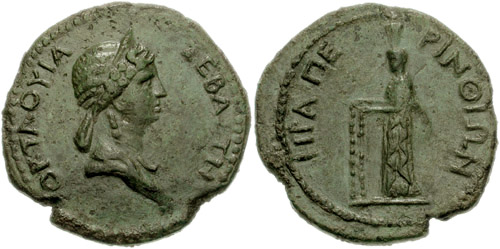
[Coin depicting Claudia Octavia on one side and Hera on the other, 1st century CE, Classical Numismatic Group, source: Wikimedia Commons]
Claudia Octavia (39 or 40 – 62 CE), named for Octavia the Younger, cuts a rather tragic figure.  She stands in contrast with her mother-in-law Agrippina the Younger, having been largely innocent of the intrigues of the Julio-Claudians, at least according to the historians who tell of her life.*  Daughter of Claudius, sister to Britannicus, wife and stepsister to Nero, and daughter-in-law to Agrippina-the-Younger, she is painted as the virtuous victim of their schemes.

The second eldest child of Claudius and his first with Valeria Messalina, Octavia was probably no stranger to the intrigues of the imperial court even at a young age.  When she was ten she saw her mother executed, officially for conspiring against her father.  A year later, Claudius married his niece, Agrippina.  The new Empress soon broke off Octavia’s childhood betrothal to Lucius Junius Silanus, and persuaded her husband to betroth her to her own son Nero instead.  Octavia was married at 13.

Her relationship with her husband and mother-in-law was not good.  Nero decided he hated her, and took up first with Claudia Acte** and then with Poppaea Sabina.  Agrippina, meanwhile, saw her as a dangerous rival, politically and personally.  Octavia’s marriage to Nero had strengthened his claim on the Empire, but it also made her a threat to Agrippina, especially after Claudius died.  Her reputation as a virtuous and chaste wife (by contrast with Nero and Agrippina’s antics) and the fact that the popular Britannicus had been her brother, only strengthened her position, especially in the eyes of the Roman people.

It did her little good though.  Nero had his mother killed in 59 CE.  Three years later, he finally felt secure enough in his power to divorce Octavia on the grounds that she was barren and marry Poppaea.  That, however, was not enough for him.  Octavia was still beloved of the Roman people and had powerful political supporters.  He accused her of adultery and had her banished to an island, then executed.  She was only about 22 years old.


*It’s worth noting that most of the evidence we have comes from Nero’s political enemies.  A historian more sympathetic to Nero and Agrippina may well have painted a different picture of Octavia.
**She may have been Claudia Octavia’s freedwoman.

Sources/Further Reading:
Tacitus, Annals 11-14 - Lacus Curtius
Suetonius, "Claudius," Lives of the Caesars - Lacus Curtius
Suetonius, "Nero," Lives of the Casesars - Lacus Curtius
Hurley, Donna, "(Claudia) Octavia, Wife of Nero" - De Imperatoribus Romanis
Claudia Octavia - Wikipedia
0 Comments

Education of Roman Women

23/4/2015

0 Comments

 
Upper class Roman girls in the Republic and Early Empire received an education that covered not only practical things, but also poetry and intellectual pursuits.  They not only had to be able to run a household, but also keep up in conversation with other members of their class, both men and women.  For a woman to be well educated was a sign of her status and that of her family.  A few even argued that girls should be educated in philosophy as their brothers were.

These young women generally got enough of an education in poetry, literature, and basic philosophy to participate in the intellectual life of their class.  Most studied with private tutors and generally did not leave the house to learn from philosophers as their brothers did.  Not only were they generally getting married at the age young men went out to study, but it would also not do for them to be more learned than their husbands.  Instead, a wife should be happy to learn from her husband and follow his interests.  Some, however, felt that girls should study philosophy more seriously as their brothers did, since that was the path to virtue and would teach them how to be good wives.

When a woman exhibited particular intelligence, it was generally attributed to the influence of her father or a father-like figure.*  Cornelia Africana’s extraordinary intelligence and virtue were said to come from her father’s teaching.  Hortensia is said to have learned oratory from her father.  Sulpicia was encouraged by her uncle** and the circle of poets he gathered about himself.

For a woman from a wealthy family to be educated in poetry and basic philosophy was a point of virtue and a marker of status at the height of Rome’s power.  She should not, however, overshadow the men in her life.


*Just as particular virtue in a man was often attributed to the influence of his mother.
**Her father died when she was young, leaving her to be raised by her uncle, Messalla Corvinus.

Sources/Further Reading:
Musonius Rufus 3, 4, 13a - Diotima
Plutarch, Life of Gaius Gracchus 19.1-3 - Diotima
Plutarch, Life of Tiberius Gracchus 1.2-2 - Diotima
Quintillian, Institutes of Oratory 1.1.6 - Diotima
Pliny the Younger, Letters, 4.19 - VRoma
Pomeroy, Sarah. Goddesses, Whores, Wives, and Slaves: Women in Classical Antiquity. New York: Pantheon Books, 1995.
0 Comments

Hilda of Whitby

20/4/2015

0 Comments

 
Picture
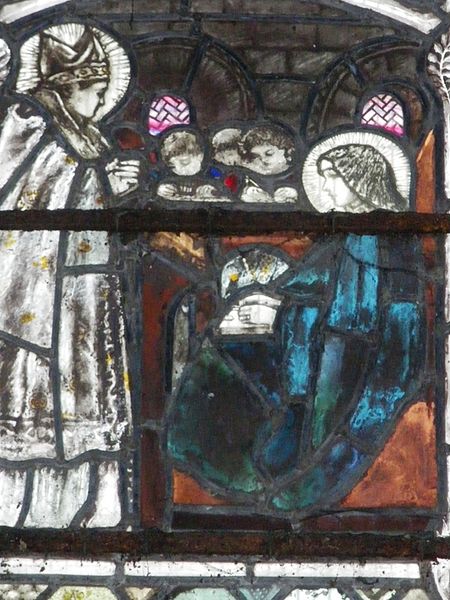
Hild is visited by Bishop Aidan.
[Glass windows in Gloucester Cathedral, Christopher Whall, early 20th century, source: Wikimedia Commons]
St. Hilda of Whitby (614-680 CE), also known as Hild of Streaneschalch,* lived in turbulent times.  Christianity was rapidly becoming the dominant religion in England.  Those who followed Celtic Christianity clashed with those who had learned from Roman missionaries.  As abbess and cousin to kings, and therefore a powerful political player, Hild found herself at the center of this dispute, which was resolved at the Synod of Whitby, held at the monastery she ruled.

Hild was the grand-niece of King Edwin of Northumbria.  She grew up in his court and was baptized in 627 along with the rest of his household.  We don’t know the events of her life between Edwin’s death six years later and her decision at age 33 (in 648) to join her sister in a monastery in Gaul.  Just as she was about to leave though, she got a message from Bishop Aidan of Lindisfarne, asking her to become a nun in Northumbria instead.  She agreed and spent a year as an ordinary nun before being made abbess of Hartlepool.

Now, after Edwin’s death, Celtic Christianity came to dominate English practice.  Hild herself followed the Celtic rite, and when she founded a double monastery at Streaneschalch, now known as Whitby, she followed the Irish form of monasticism.  The religious probably lived in groups of two or three in small huts, men on one side, women on the other, with the church in the middle.  Word of Hild’s monastery and its sanctity spread. Hild herself became known for her energy, judgment, wisdom, and able teaching of others.  Five of her monks went on to become bishops.  She is also credited with encouraging the poet Caedmon, then a stable-boy at the monastery, in his art.

Picture
Legend states that Hild had the power to turn snakes to stone, as evidenced by the number of "snakestones" near where she lived.  We now know these to be ammonites.
[Arch depicting ammonites as reference to St. Hild, Church of St. Hilda, Ellerburn, England, source: Wikimedia Commons]
Roman Christianity became more widespread over these years and the debate came to center around the dating of Easter.**  Eventually Church leaders called a synod (or meeting of Church authorities) in 664 at Hild’s monastery.  As I said above, Hild followed Celtic traditions and spoke in their favor, but when the synod decided in favor of the Roman dating, she not only obeyed the ruling but used her influence to encourage others to do so as well. 

Hild spent the last seven years of her life fighting off illness.  She stayed devoted to her work and her monastery though and continued on as she had before.  She died on 17 November 680.


*This was the name she and those around her used.
**This had a lot to do with royal marriages where one spouse followed the Celtic form and the other the Roman.  Since the two traditions calculated the date of Easter differently, one spouse might well be celebrating while the other was still observing Lent.  It caused some problems.

Sources/Further Reading:
Bede the Venerable, "Of the life and death of the Abbess Hilda," Ecclesiastical History of the English Book IV, Chapter XXXIII - Christian Classics Ethereal Library
Bede the Venerable, Ecclesiastical History of the English, Book III, Chapter XXIV - Internet History Sourcebooks Project
Kracher, Alfred. "Ammonites, Legends, and Politics: the Snakestones of HIlda of Whitby." European Journal of Science and Theology 8.4 (2012): 51-66. [Found here on Academia.edu]
Hild of Streonshalh - Women Philosophers
Hilda of Whitby - Women Philosophers
Hilda of Whitby - Wikipedia
0 Comments

Cistercian Patronage

16/4/2015

0 Comments

 
Note: I'm changing my posting schedule a bit due to things going on in my life.  I'll only be posting twice a week instead of three times.  Biographies will still be Mondays, and I'll put up other things on Thursdays.
The 11th and 12th centuries were a time of rising interest in religion in Europe.  Gregory VII’s attempts at reform had prompted others to attempt to make their own changes, or in many cases, found their own monastic communities,* with the Cistercian Order rising to become one of the most prominent and widespread.  And it was under their protection and encouragement that several other communities, reforms, and individuals flourished.  I can’t hope to list them all here, but perhaps I might give a few examples.

Hildegard of Bingen wrote to Bernard of Clairvaux in 1146 or 1147, asking for advice.  She had been having visions her whole life and finally, at age 49, felt the need to speak out about them.  But doing so without the approval of some higher authority was not an option.  Bernard’s reply to her was short, but encouraging, urging her to “recognize this gift as grace and respond eagerly to it with all humility and devotion”.

A century or so later, it was quite common to find Cistercian houses taking beguine communities under their protection.  The beguines got political protection, spiritual guidance, and validation in the outside world based on the fact that the Cistercians, who were known for their holiness as an order, were seeing to their orthodoxy.  The Cistercians, meanwhile, gained both access to sense of spirituality from outside their monasteries and the prestige of guiding another holy group of people.

The prestige connected with the Cistercians was no small thing.  Accounts of the founding of the Gilbertine Order** make much of the rather minor role Bernard of Clairvaux and the Cistercians played.  For smaller and newer groups, association with the Cistercians gave them both credibility and some protection against accusations of heresy.  The Cistercian Order as a whole, was not generally so enthusiastic, though they seem to have preferred encouraging and protecting other sorts of monasticism and religious life over admitting more women’s houses to their Order.  There was, after all some benefit.  They gained prestige and a reputation for encouraging good spiritual practices among both the religious and the laity.  It was a situation that worked out relatively well on both sides.


*There were actually so many religious orders being founded at this time that the Fourth Lateran Council had to ban the formation of new ones in 1215.
**The only monastic order originating in England, its communities were all double monasteries.

Sources/Further Reading:
Cook, William R. and Ronald B. Herzman. The Medieval Worldview: an Introduction. New York: Oxford University Press, 2004.
Baird, Joseph L. and Radd K. Ehrman, trans. The Letters of Hildegard of Bingen, Volume I. New York: Oxford University Press, 1994, 1998, 2004. [Most specifically, Letters 1 and 1r.]
Flanagan, Sabina. Hildegard of Bingen: a Visionary Life. 1989.
Simons, Walter. Cities of Ladies: Beguine Communities in the Medieval Low Countries, 1200-1565. Philadelphia: University of Pennsylvania Press, 2003.
Nichols, John A. and Lillian Thomas Shank, eds., Distant Echoes: Medieval Religious Women, Volume One. Kalamazoo, MI: Cistercian Publications, 1984.
0 Comments

Sosipatra

13/4/2015

0 Comments

 
Sosipatra (4th century CE) is one of those women who we’re not really sure if she existed or not. The problem is, beyond a few refutations, we only really have one source on her life, Eunapius’ Lives of the Philosophers, and to be frank, his version reads more like a fairytale than anything else.  She exists within his work more to serve a purpose than to act as a person in her own right.  We do, however, have her reputation.  She was widely known both for her skill at theurgy and for her Neo-Platonist philosophy and teachings, so much so that St. Augustine himself felt the need to account for her.

According to Eunapius, Sosipatra was given over to two elderly teachers at the age of five.  The two men came to her father’s estate and produced an extraordinary harvest.  They promised much greater things if both Sosipatra, already a beautiful child who brought blessings on everything around her, and the estate were given into their care for five years.

On her father’s return, he found his daughter had grown into a highly educated, beautiful girl with psychic and clairvoyant abilities.  She proved her learning to him by recounting to him every step of his journey.  The two men soon left,* leaving Sosipatra to continue her education on her own.  Her father let her live as she wanted and eventually she decided she wished to marry.  She chose Eustathius of Cappadocia, a brilliant philosopher in his own right, as the man worthy to be her husband, telling him that she would bear him three sons and that a high place awaited him after his death in five years but that a higher place would be hers.

Sosipatra’s words came true.  She had three sons by Eustathius before he died five years into their marriage.  After that she moved herself and her family to Pergamon and supported herself there by teaching.  This was also where the famous philosopher Aedesius lived and students would go from his lectures to hers, learning from both of them.  One of these students cleared up the small matter of a love spell at her request.**  Eunapius gives no account of her death, leaving us with the information that only one of her sons followed in her footsteps.


*Eunapius claims that they were gods in human form.
**What is it with 4th century scholarly women and their students falling in love with them?

Sources/Further Reading:
Eunapius, Lives of the Philosophers 401-418, 4th century CE - Tertullian.org
Johnston, Sarah Iles. "Sosipatra and the Theurgic Life" - Academia.edu
Sosipatra of Ephesus - Women Philosophers
Sosipatra of Pergamum - Suppressed Histories
Soispatra - Wikipedia
0 Comments

Hiatus

6/4/2015

0 Comments

 
Taking a hiatus.  See you in a week!
0 Comments

Vaulting in Medieval Architecture

3/4/2015

1 Comment

 
It’s pretty well documented that I like flying buttresses.  But you know what other architectural form is super cool?  Vaulting.  Vaulting is awesome and freaking gorgeous.

Picture
Picture
Picture
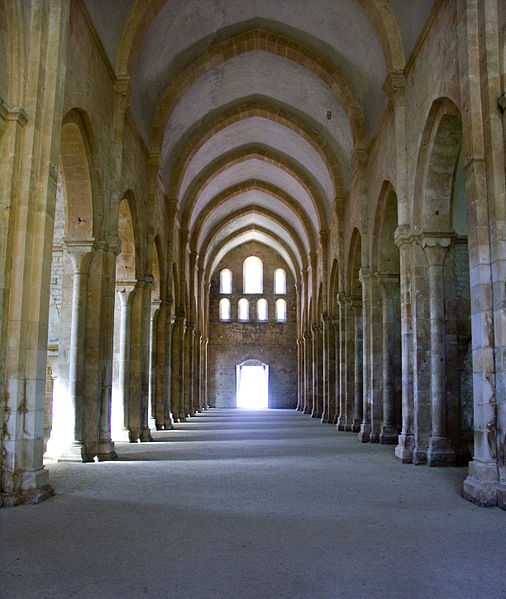
As you may already be able to tell, I have a preference for ribbed vaults, but I'll admit to stopping and staring at just about any sort of vaulting.
[
Interior of the church at Fontenay, facing west, built early 12th century, photographed by Jean-Christophe Benoist, source: Wikimedia Commons]
[Nave of Notre Dame de L'Épine in L'Épine, France, 15th century, photographed 2011 by Mattana, source: Wikimedia Commons]
[Liebfrauenkirche in Mühlacker, Germany, 15th century, photographed 2006 by SteveK, source: Wikimedia Commons]

What vaulting does is it takes the weight of a stone ceiling* and angles the downward force sideways a bit, letting walls, pillars, and buttresses transfer it to the ground at the edges of a space instead of in the middle of it.  Most early medieval buildings had wooden roofs, so they had no need for vaulting.  The problem with wood, of course, is that it burns easily, where stone doesn’t.  Stone ceilings, however, were not really possible without the use of vaulting.**  There were other reasons than practicality.  For one thing, vaulting is pretty.  One 12th century work said it improved the “composition of the work.”  In other words, it looked really nice.  It’s also possible vaulting helped the acoustics of a space, an important factor in churches used by monastic communities.

Picture
Picture
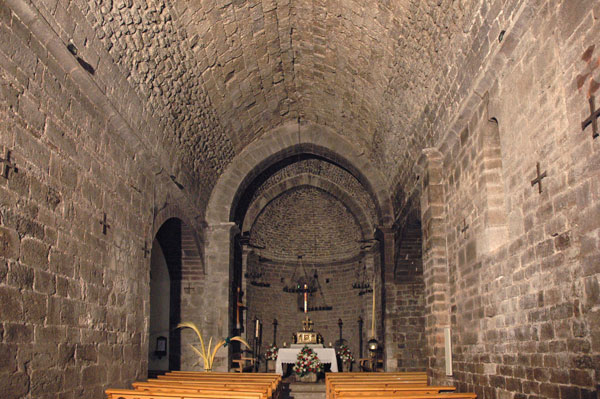
Barrel vaults: A drawing, a stone church in Spain, and the wooden ceiling of a Begijnhof chapel in Belgium.  Barrel vaults can either be pointed or rounded.  (For an example of a pointed barrel vault, see the very first picture in this post, the Abbey Church of Fontenay.)
[View of a barrel vault showing forces, Mcginnly, source: Wikimedia Commons]
[Sant Esteve de Llanars, Spain, built 12th century, photographed 2011 by Baldiri, source: Wikimedia Commons]

Picture
Picture
It says something about me that my first thought when I see the phrase "groin vault" my first thought besides "Vaulting! :D" isn't "Ehehehe" but "That looks like the 'g' should be capitalized and there should be an accent on the 'o'."  Like so: Gróin.
[Groin vault, 2005, drawn by Yosemite, source: Wikimedia Commons]
[Aisle of the Abbey Church at Mozac, Germany, built 12th century, photographed by Jochen Jahnke, source: Wikimedia Commons]

Medieval builders used three major types of vaulting: barrel, groin, and ribbed.  A barrel vault is essentially an arch that’s been extended to look like a tunnel.  The Sumerians, Egyptians, Assyrians, and Romans all used this sort of vault, especially below ground.  Even medieval European builders were slow to start using it above ground since it needs continuous walls and significant buttressing to hold it up.  Groin vaults are made by putting two barrel vaults at right angles to each other.  The benefit of using groin vaults was that they focused the weight on the four corners of the vault, meaning that they could be supported with pillars instead of continuous walls.  These were also used by the Ancient Romans but fell out of favor until the 11th century.

Picture
Probably the most common and popular sort of ribbed vaulting, though I think this is a particularly nice example.
[Church of the Monasterio de Santa María de Veruela, Vera de Moncayo, Spain, built 12th century, photographed 2007 by Zarateman, source: Wikimedia Commons]
Ribbed vaults add stone ribs for extra support.  These are usually groin vaults, but ribbed barrel vaults also exist.  There is some debate about the origin of ribbed vaulting, particularly as to whether it was first used for extra support or because it looks pretty.***  The earliest examples of ribbed vaults date to the early 12th century.  Fan vaults and other shapes were also used, but were less common.

Picture
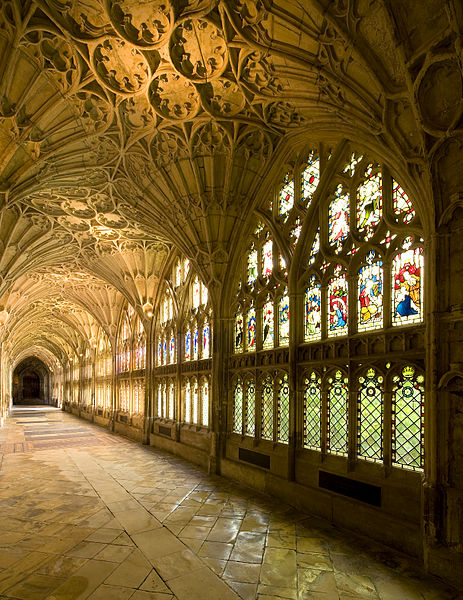
Fan vaulting is almost exclusively found in Britain.  This is actually some of the oldest in existence.  Fans of the Harry Potter movies may recognize it.
[Cloister walk of Gloucester Cathedral, built 14th century, photographed by Saffron Blaze, source: Wikimedia Commons]
Picture
Did I include this picture solely because I think it's a gorgeous example of a star vault that needs to be shared?  Yes, yes I did.
[St. Olav's church in Tallinn, Estonia, built 15th century (church built 12th century), photographed 2006 by -jkb-, source: Wikimedia Commons]

*And think how heavy that’s got to be.
**Vaulting can also be done in wood.  Stone is just more likely to make it necessary.
***So pretty.

Image I didn't get to use: Ceiling of the Sint-Agnes begijnhof church in Sint-Truiden, Belgium (example of a wooden barrel vault)

Sources/Further Reading:
Stalley, Roger. Early Medieval Architecture. Oxford: Oxford University Press, 1999.
Stephenson, Carl. Mediaeval HIstory: Europe from the Second to the Sixteenth Century. New York: Harper & Row, 1962.
Vault (architecture) - Wikipedia
Barrel vault - Wikipedia
Groin vault - Wikipedia
Rib vault - Wikipedia
Fan vault - Wikipedia
1 Comment

Women's Property in Ancient Rome

2/4/2015

0 Comments

 
Plutarch shows us a Roman ideal, that of married people holding everything in common.  In practice things were a lot more complicated, and varied widely by place.  Here I will only be talking about Roman Italy.  Both law and culture made distinctions between women and men in terms of rights relating to inheritance, making wills, and protection of property.  Maintaining people’s rights to their property, especially when those people were wealthy, was a matter of concern, but it also worried politicians when women held too much wealth and therefore power.

There was never any question of whether or not a daughter could inherit, but she should never get more than her brother(s).  Unlike the Greeks, the Romans never had the concept of an epikleros.  If a woman had no brothers on her father’s death, she* simply inherited everything if one of her father died intestate** or made a will in her favor.  What type of marriage she had also determined who she inherited from in cases of intestacy, based on whose potestas she came under.

For most of Roman history, until the reign of Hadrian, a woman could not make a will without first contracting a coemptio.   Similarly, if a woman died intestate, her nearest male relative got her property.  In 178 CE the law changed, giving everything to her freeborn children.***  This law also allowed her to inherit from her children who died intestate.  Illegitimate children could receive a share of their mother’s property, but not their father’s.  Other laws restricted women’s inheritance rights.  Both the Oppian (215 BCE) and Voconian (169 BCE) laws restricted the amount women could inherit.  Lawmakers were anxious about the amount of wealth concentrated in female hands since so many men had died in battle.

For all that the ideal was that property spouses brought to a marriage would be held in common, there were some protections on wife’s wealth.  Goods made from materials owned by the wife or another belonged to her, no matter who made them or if they were intended for her husband and vice versa.  A man who took his wife’s property in anticipation of divorce was liable for removal of property.  From 206 CE onwards, the seizure of a wife’s wealth as surety for her husband’s debt was considered violence.


*And her sisters (and her cousins and her aunts.  Okay no.  I'd apologize but it was right there.)
**Without having made a will
***Slaves and freedpersons were held not to have mothers and therefore could not inherit from them.

-Plutarch, Moralia, 2nd century CE
Indeed what the Roman lawgiver had in mind, when he prohibited an exchange of gifts between man and wife was not to deprive them of anything, but to make them feel that everything belonged to both of them together.
Sources/Further Reading:
Plutarch, Moralia 138a-146a, 2nd century BCE - Diotima (Lefkowitz & Fant)
The Laws of the KIngs, Rome 8th/7th century BCE - Diotima (Lefkowitz & Fant)
The Twelve Tables - Diotima (Lefkowitz & Fant)
Paul, Opinions 4.10 - found in Lefkowitz & Fant, not available online
Justinian, Codex 9.12.1 -
found in Lefkowitz & Fant, not available online
Ulpian, Rules 7.2 -
found in Lefkowitz & Fant, not available online
Lefkowitz, Mary R. and Maureen B. Fant. Women's Life in Greece and Rome: A source book in translation. Baltimore, MD: Johns Hopkins University Press, 1992.
Pomeroy, Sarah B.  Goddesses, Whores, Wives, and Slaves. New York: Schocken, 1995.
0 Comments

    My Blog

    Translation of the above: where I post the interesting things I find researching the Classical and Medieval periods in my free time.

    Currently Reading:
    -
    Medieval Monasticism by C. H. Lawrence

    Archives

    March 2016
    February 2016
    January 2016
    December 2015
    November 2015
    October 2015
    September 2015
    August 2015
    July 2015
    June 2015
    May 2015
    April 2015
    March 2015
    February 2015
    January 2015
    December 2014
    November 2014
    October 2014
    September 2014
    August 2014
    July 2014
    June 2014
    May 2014
    April 2014
    March 2014
    February 2014
    January 2014
    December 2013
    November 2013
    October 2013
    September 2013

    Categories

    All
    Architecture
    Biography
    Classical
    Law
    Marriage (legal And Otherwise)
    Medicine
    Medieval
    Misconceptions
    Monasticism
    Overview
    References
    Religion
    Review

    RSS Feed

Powered by Create your own unique website with customizable templates.