Emily Kittell-Queller
  • Home
  • About Me
  • Blog
  • Projects
  • Resume
  • Contact Me

Greek Women in Egypt in the Hellenistic Period

31/7/2015

3 Comments

 
During the three centuries of Ptolemaic rule (approximately 323 BCE – 30 CE) the legal status and capabilities of ordinary Greek women changed, allowing them some of the rights and responsibilities had by Egyptian women.  Though most Greek city-states were not so restrictive as Athens, all except Sparta required that women have a kyrios and limited the amount of property they could own or dispose of.

Basically, there two sets of laws were enforced under Ptolemaic rule, one Greek, one Egyptian.  Under Greek law, a woman required kyrios.  She could own and manage property, but could not make major transactions without his consent.  She could, however, petition the government without his involvement if necessary.  Egyptian law was not so restrictive.  Women did not need a guardian and could make property transactions on their own.  They were, however, expected to consider their own interests less important than those of a husband.

The thing is, these laws did not apply separately to each respective group.  Over time, less in the earlier period, more later, Greek women began to take on more of the Egyptian model.  They began disposing of common marital property and managing businesses when their husbands were traveling, only asking permission for transactions after the fact.*  Sonless, widowed mothers gave their daughters in marriage.  In short, Greek women began taking on aspects of Egyptian law and custom that granted them a little more freedom.

Part of this came out of the contact between two sets of laws and the fact that, within certain limitations, many Greek women were able to take advantage of some of the freedoms granted under Egyptian law in their own lives.  This was helped along by the reality that they no longer had a polis to protect and regulate their lives.  Without those safeguards, Greek women had to have more economic and legal freedoms, if only to protect themselves and their family’s property.


*Though it is important to note that they still asked for transactions to be approved, just afterwards instead of before.

Sources/Further Reading:
Pomeroy, Sarah. Goddesses, Whores, Wives, and Slaves: Women in Classical Antiquity. New York: Pantheon Books, 1995.
Johansson, Nathalie. "Women in Egypt - how the status of women in Egypt changed during the Ptolemaic Period."  Dissertation.  2010. Academia.edu [Link is here]
Pomeroy, Sarah. Women in Hellenistic Egypt: From Alexander to Cleopatra. Detroit: Wayne State University Press, 1990.

3 Comments

St. Rose of Viterbo

27/7/2015

0 Comments

 
Picture
[Fresco depicting Saints. Rose & Donnino, 15th century, Duomo of Ivrea, Italy, source: Wikimedia Commons]
St. Rose of Viterbo (d. 1252) stands among the small number of medieval Catholic women who were allowed, or even encouraged to preach publically, an activity the Church otherwise tried to reserve entirely to its priests.  As is the case with many medieval saints, we know very little of her biography.  Her two vitae do give us some information, but they were intended more to make the case for her sainthood, than to give an account of who she was.  Not to mention that her second and more complete vita was written 200 years after her death.

Rose was born sometime around 1233 in the city of Viterbo.  As it had been 100 years earlier, this was a time of struggle for power between the Holy Roman Emperor, Frederick II and two Popes, first Gregory IX, then Innocent IV.*  Though Viterbo was technically part of the Papal States, it was under the control of Frederick’s supporters, known as Ghibellines.  The Pope’s supporters were called Guelfs.**  Street preachers were common and tensions between the two sides were high.

Rose was a pious child.  According to her second vita, she already wanted to join the Third Order of St. Francis at the age of ten.  Her first vita, by the way makes no mention of this.  She started speaking publically as a teenager, at first only to a few other women in the private homes.  Soon she began urging them out into public spaces, claiming the right and the ability to preach through visions and miracles.

Rose’s words made many city officials angry and around 1250, she and her parents were exiled.  In December of that year though, Rose prophesied that something important was about to happen.  She wasn’t wrong.  Frederick II died less than a week later and she and her parents returned to Viterbo.  At this point, she tried to join the Poor Clare monastery in the city, but was rejected.  Instead, she continued her preaching up until her death in 1252, before the age of twenty.  Less than a year later, her body was moved to the very convent that rejected her, which was then renamed in her honor.***

Rose preached publically and was allowed to do so because of her claim to prophecy and the fact that she took the Pope’s side.  One thing both of her vitae make clear though, Rose was a woman to be admired rather than imitated.


*Technically Celestine IV was Pope between these two, but he lasted less than a month.
**After Welf V, husband of Matilda of Tuscany.
***It was also renamed in her honor.  The people of Viterbo commemorate the moving of her body every year on September 3rd, the eve of her feast day.

Sources/Further Reading:
Pryds, Darleen. "Proclaiming Sanctity through Proscribed Acts: The Case of Rose of Viterbo." In Women Preachers and Prophets through Two Millennia of Christianity, edited by Beverly Mayne Kienzle  and Pamela J. Walker, 159-172. Berkeley: University of California Press, 1998.
St. Rose of Viterbo - Catholic Encyclopedia
0 Comments

Secular Canonesses

23/7/2015

0 Comments

 
Picture
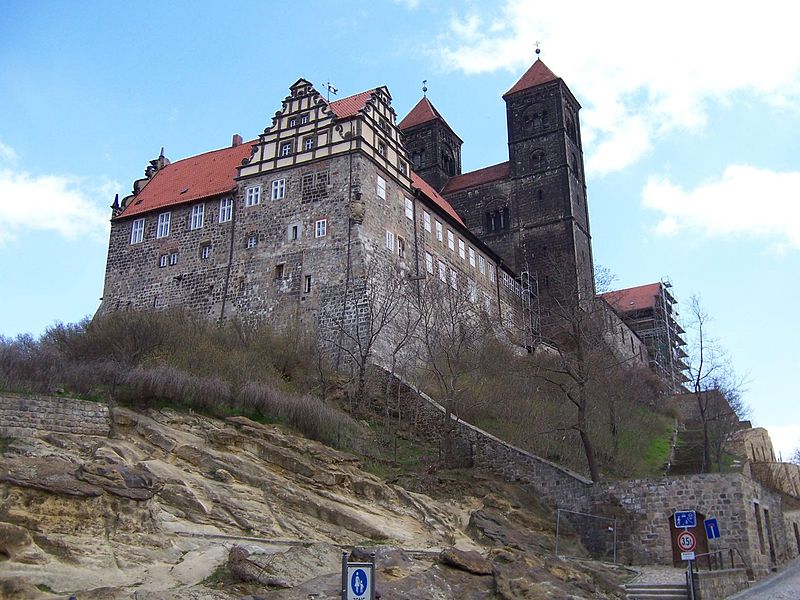
[The Church (St. Serviatus) and Monastery at Quedlinburg, photographed 2006 by Jungpionier, source: Wikimedia Commons]
In my reading about medieval religious women, I’ve frequently come across passing references to “canonesses.”  A lot of the time it gets used interchangeably with “nuns.”  Many people seem unsure as to whether the difference between the two is even important.  Even some medieval writers, purposefully or not, blurred the distinctions between the two groups.  There was a difference though, and by the fourteenth century it was one that houses of canonesses had to fight to defend.

The thing is, canonesses had some similarities with nuns.  Both groups lived in community under the authority of an abbess, devoting themselves to the religious life.  Unlike nuns though, canonesses were not strictly enclosed and did not focus primarily on contemplation.  They acted outside the cloister and were not bound to it, leaving to perform public liturgical functions like ringing the bells, taking part in synods* and participating in religious processions.  They lived in individual quarters around the cloister, maintained personal property, and many employed their own servants.  In many cases, it is hard to distinguish whether a particular group of women were canonesses or nuns.  Many sources use the same term for both, in some cases as part of an effort to get canonesses to act more like nuns and restrict their movements.

Canonesses can be divided into two groups: regular and secular.  Regular canonesses took permanent vows and lived strictly according to a Rule, usually that of St. Augustine.  Secular canonesses, with the exception of the abbess, were not so bound and could leave to get married if they wished.  Many communities of both sorts became centers of great learning, the best known being Quedlinburg and Gandersheim.

Male church officials were not so fond of the canonesses’ more free and less ascetic way of life and tried many times to restrict their movements, though there was only so much they could do.  Most canonesses came from wealthy, powerful families with an interest in maintaining their female relatives’ freedom and the political power that came with it.  They managed to defend their status up to the Reformation, at which point most communities of canonesses became Protestant and either disbanded or continued to exist as communities of single women.


*Church councils

Sources/Further Reading:
Makowski, Elizabeth. "A Pernicious Sort of Woman": Quasi-Religious Women and Canon Lawyers in the Later Middle Ages. Catholic University of America Press, 2005.
McNamara, Jo Ann. Sisters in Arms: Catholic Nuns Through Two Millennia. Cambridge, MA: Harvard University Press, 1996.
Canoness - Catholic Encyclopedai
Canons and Canonesses Regular - Catholic Encyclopedia
0 Comments

Arsinoë I

20/7/2015

0 Comments

 
Picture
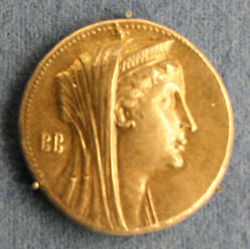
Something I was not expecting to be able to do: find any image at all of Arsinoë I.  Color me surprised and pleased.
[coin depicting Arsinoë, commissioned by her son Ptolemy III, 3rd century BCE, Kestner Museum, Hanover, source: Wikimedia Commons]
The life of Arsinoë I (early 3rd century BCE), first wife of Ptolemy II Philadelphos, remains relatively obscure, overshadowed by that of Arsinoë II, Ptolemy’s sister and second wife.  As the daughter of Ptolemy’s friend and ally Lysimachos and as the only woman known to have born Ptolemy children, her status likely remained relatively high until her father’s death and her own exile, though whether those two things were connected we have no way of knowing.

Arsinoë was the daughter of Lysimachos (formerly one of Alexander the Great’s bodyguards) and one of his wives, probably either Nicaea or Amastris.*  It’s possible, even likely, that she knew Arsinoë II during her youth, considering her future sister-in-law married Lysimachos as his third wife when Arsinoë was a young child.

She married Ptolemy II sometime between 285 and 281 BCE, after he began co-ruling with his father but before her own father’s death.  The couple had three children together, Ptolemy III, Lysimachos, and Berenike Phernophoros.  This, however, would not save her from repudiation and exile.  Her father’s death in 281 left her vulnerable, though not completely without allies.

At some point, Ptolemy II accused Arsinoë of plotting against him and had her exiled to Coptos, a place still within Egypt.  Precisely when this happened or whether she actually was planning to move against her husband is uncertain.  Certainly it was after her father’s death deprived her of her worth as part of a marriage alliance, though how long afterwards is impossible to say.  Many automatically assume this happened before Ptolemy’s marriage to his sister, Arsinoë II, but there isn’t really any direct evidence either way.  We also have no way of knowing if Arsinoë II had anything to do with Arsinoë I’s fall from power.  It’s possible, certainly, but it’s also possible she wasn’t involved at all.

What we do know is this: at some point Arsinoë I was accused of treason.  Two of her prominent supporters were executed and she herself was sentenced to exile within Egypt.  She was not sent out of the country or killed and her children were legally adopted as the children of Arsinoë II, though whether this was before or after Arsinoë II’s death is unknown.  As for the woman herself, the historical record says no more on Arsinoë I.


*It’s technically possible but unlikely that Arsinoë II could have been her mother.

Sources/Further Reading:
Donnelly Carney, Elizabeth. Arsinoë of Egypt and Macedon. New York: Oxford University Press, 2013.
Arsinoe I - Egyptian Royal Genealogy
Arsinoe I - Livius.org
0 Comments

Polygamy in the Hellenistic Dynasties

16/7/2015

0 Comments

 
Many Hellenistic queens are known for their plotting and scheming on behalf of their sons.  It was often at least partially through a mother’s efforts that her son took his father’s place on the throne.  Hellenistic queens were often close to their sons, less so to their husbands.  A major reason for all of this was the fact that many Hellenistic kings practiced polygamy and married multiple wives.

This was probably a holdover from Macedonian practice and seems to have been a relatively fluid system.  Most kings didn’t designate a primary wife and neither wife nor son’s prominence was certain.  A favored wife could find her power given to another.  A son who was named heir presumptive could see that position taken from him by his father and bestowed on another.  Half-brothers scrambled to prove each other illegitimate.  Infighting was semi-constant and power never secure.

Why would a king risk that sort of instability?  For several reasons.  Having multiple wives allowed for the possibility of multiple marriage alliances with both local families and foreign powers.  It also meant that if one wife didn’t produce any male heirs, another might.  The potential for infighting was preferable to the lack of an heir.

What about the women themselves?  Marriage alliances could benefit a wife almost as much as they did her husband, especially if her family was physically nearby.  If she had a son, she could rise to become the king’s most important wife and then maybe even the next king’s mother, both positions of significant power.  Even if a wife had no sons, she could ally herself with one who did and obtain power and prestige that way.

Some examples are pretty clear-cut.  Phillip II had seven wives, the most famous of whom, Olympias, was the mother of Alexander the Great and a fierce political player herself.  Ptolemy VIII married both his sister Cleopatra II and his niece Cleopatra III.  The marriages of Antiochos II first to Laodike I, then to Berenike, follow more in terms of serial monogamy, but his return to Laodike might share continuity with his predecessors’ practice.

Sources/Further Reading:
Pomeroy, Sarah. Goddesses, Whores, Wives, and Slaves: Women in Classical Antiquity. New York: Pantheon Books, 1995.
Shipley, Graham. The Greek World after Alexander 323-30 B.C. New York: Routledge, 2000.
Carney, Elizabeth Donnelly. Women and Monarchy in Macedonia. University of Oklahoma Press, 2000. [Can be found on Google Books here.]
Review of Ogden, Polygamy, Prostitutes, and Death: the Hellenistic Dynasties - Bryn Mawr Classical Review
0 Comments

Hrotsvit of Gandersheim

13/7/2015

0 Comments

 
Picture
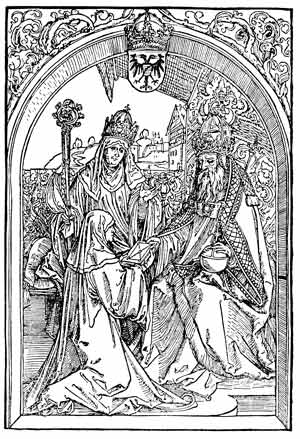
Those are some fancy hats there.
[Hrostvit presents her work to Otto the Great, woodcut, Albrecht Dürer, early 16th century, source: Wikimedia Commons]
Hrotsvit of Gandersheim (mid to late 10th century), canoness at the monastery of Gandersheim, has the distinction of being one of the very few Early Medieval female writers whose work survives.  She wrote on both secular and religious topics, drawing from both Roman authors and the works of Church Fathers.  The three books in which she collected her writings contain saints’ vitae, plays, poetry, and two histories.  Her works continued to be studied both for their style and their content for several centuries after her death.

We know very little of her life beyond her writings.  We can say with certainty though that she was of Saxon ancestry came from the nobility.  In her works she speaks of her Saxon heritage with pride.  Her membership in the community at Gandersheim, meanwhile, shows that she must have been a member of the German nobility, since only the daughters of this social class could take the veil there, where the abbesses were princesses in their own right.

Gandersheim had, by the time Hrotsvit arrived there, become a famous cultural center and place of learning.  It was here that she studied under her abbess, Geberga II, and a fellow canoness named Rikkardis, both of whom were known for their intelligence.  She read not only the theological writings of her predecessors, but also Roman writers like Vergil, Horace, Ovid, and Terence, becoming so familiar with Terence that she wrote many of her works in his style.  Some people felt that in doing so she performed a correction, taking the playwright’s style and using it for an appropriate purpose, religion, rather than for comedy.

Like most other medieval female writers, she prefaced her work with protestations of being only a poor little (ignorant) woman and nobody special.  It has been argued though that, as it was for other medieval writers, especially women, this attitude was only a front put up because she knew it was expected of her.  Her plays are peopled with women who, using only their words and their intellect, defeat men at the highest levels of society.  She may have claimed to be a poor ignorant woman, while in reality she was, and saw herself, as anything but.

Sources/Further Reading:
Brown, Phyllis R. and Stephen L. Wailes. "Hrotsvit and Her World."  In A Companion to Hrotsvit of Gandersheim (fl. 960): Contextual and Interpretive Approaches, edited by Phyllis R. Brown and Stephen L. Wailes, 85-120. Leiden: Koninklijke Brill NV, 2013.
Ferrante, Joan. “Public Postures and Private Maneuvers: Roles Medieval Women Play. In Women & Power in the Middle Ages, edited by Mary Erler and Maryanne Kowaleski, 213-229. Athens, GA: University of Georgia Press, 1988.
Wilson, Katharina. Hrotsvit of Gandersheim: a Florilegium of her Works. Cambridge: D. S. Brewer, 1998.
Hrotsvit, nun of Gandersheim - Epistolae
Hrosvitha von Gandersheim - SMU.edu [The audio file linked there is worth a listen]

Edit: Missed a source.
0 Comments

Third Orders

9/7/2015

0 Comments

 
Several religious orders, have what is known as a Third Order.  The term comes from the idea that the First Order* was made up of the friars or monks, the Second of nuns, and the Third of people living by the ideals of the First and Second Orders, while maintaining their connection to the secular world.  Their members, known as “tertiaries,” share in the works of the Order and sometimes live by a modified version of their Rule, but remain distinct.  Third Orders continue to exist today, not just in the Catholic tradition.**

The earliest formal Third Orders date back to the 13th century, though similar associations of people based certainly existed before then.  The timing isn’t particularly surprising, given the rising popular interest in access to the religious life at the time.  The Humiliati were the first official Third Order, but the best known is the Third Order of St. Francis.  It’s uncertain exactly how it came about,*** but according to the story, their Rule came directly from Francis himself.

The Dominicans and Carmelites soon gained their own Third Orders.  The Lay Carmelites came about much as the Fransican Third Order did.  The Dominican Third Order, on the other hand, originated as a group of Franciscans who were heavily influenced by the teachings of Dominican friars.

The reaction to the creation of Third Orders was not entirely positive.  Several groups ran into trouble with their city governments because their Rule forbade them to bear arms.  Individual tertiaries, like Catherine of Siena, often met with significant resistance from their families.

There were, and still are today, two sorts of tertiaries: regular and secular.  Third Orders Regular, as they are known, existed almost from the beginning, but weren’t officially a distinct group until the 15th century.  They take vows and live in organized communities.  Seculars make less binding promises and usually live separately, though they still have a strong connection to their community.

Well-known medieval tertiaries include the Franciscans St. Elisabeth of Hungary, St. Rosa of Viterbo, and Dante Alighieri, as well as the Dominican St. Catherine of Siena.


*So called mostly because the male order was founded first.  This was generally the case throughout the Middle Ages, with the notable exception being the beguines, who were never really unified enough to get that sort of formal recognition.
**There are, for example both Anglican and Lutheran Orders of St. Francis, which function as and consider themselves part of the Franciscan Third Order.  The Lutheran one in the US is, I believe, affiliated with the ELCA.
***Thomas of Celano’s Vita prima claims that Francis started the Third Order, but there is also evidence for a more independent community that only later claimed to have been created by him.

Sources/Further Reading:
Barber, Malcolm. The Two Cities: Medieval Europe 1050-1320. London: Routledge, 1993.
Bynum, Caroline Walker. Holy Feast and Holy Fast: the Religious Significance of Food to Medieval Women.
Berkeley: University of California Press, 1987.
Cook, William R. and Ronald B. Herzman. The Medieval Worldview: an Introduction. New York: Oxford University Press, 2004.
Kienzle, Beverly Mayne and Pamela J. Walker. Women Preachers and Prophets thorugh Two Millennia of Christianity. Berkeley: University of California Press, 1998.
Stephenson, Carl and Bryce Lyon. Mediaeval HIstory: Europe from the Second to the Sixteenth Century. New York: Harper & Row, 1962.
Gobry, Ivan. Saint Francis of Assisi. Ignatius Press, 2006.
Third Orders - Catholic Encyclopedia
History of the Franciscan Third Order Regular - The Franciscan Friars, TOR
tssf.org - Third Order, Society of St. Francis [The Anglican Third Order of St. Francis, Province of the Americas]
lutheranfranciscans.org - Order of Lutheran Franciscans

0 Comments

Olympias

6/7/2015

0 Comments

 
Picture
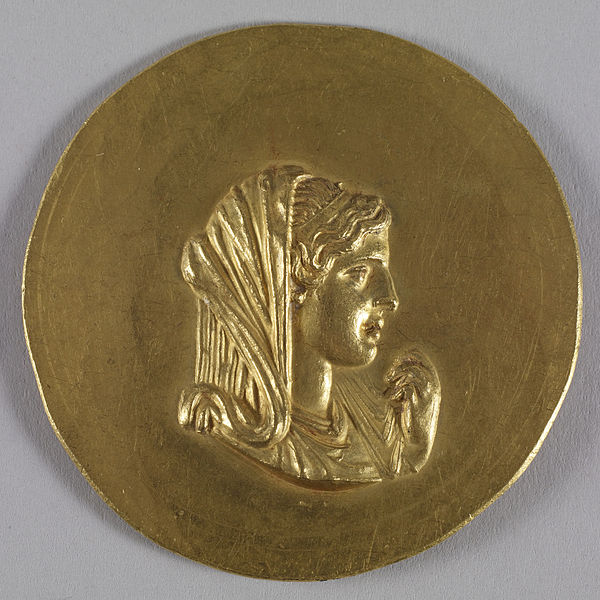
[Roman medallion depicting Olympias, early 3rd century, Walters Art Museum, source: Wikimedia Commons]
Alexander the Great would not have gotten as far as he did without the efforts of Olympias (c.375- 316 BCE), his mother.  Her exploits, though, didn’t center entirely on him.  For a while they did, but once he took power, she was able to focus on increasing her own standing and influence.  Unlike most women of her time, she is known to have acted in her own right and on her own behalf several times, especially after her son’s death.  But like many elites of her time period, regardless of gender, she came to what some would call “a bad end.”

In 358 BCE the daughter of the Molossian king Neoptolemus married the Macdonian king Phillip II and became his fourth wife (of seven) as part of a peace agreement.  A year later she took the name Olympias in honor of Phillip’s victory in the Olympic games.  She gave birth to her first child, the future Alexander the Great, shortly thereafter.  It was mostly through the efforts of his mother that Alexander became Phillip’s heir.  Some claimed she poisoned Phillip, but since she was actually in exile at the time, it seems, while not impossible, less likely.

Olympias didn’t have an official position once Alexander took power, but that doesn’t mean she rested on her laurels.  As her son conquered more and more territory, Olympias remained behind in Macedonia, playing politics.  Though a man named Antipater had been left in charge, Olympias took on as much responsibility and political power as she could, much to Antipater’s frustration.

With Alexander’s death, factions arose around his generals and other powerful people, each grabbing land and power for themselves.  Olympias, acting in her own right, claimed guardianship and control over Alexander’s infant son, Alexander IV.  She set herself against Antipater’s son Cassander, who controlled her son’s half-brother Phillip III.  She was able to temporarily oust Cassander from power and, as was relatively common at the time, do away with Phillip and his wife Eurydice.  In 316 BCE, however, Cassander managed to besiege Olympias in the city of Pydna and force her surrender, though on the condition that she would remain unharmed.  When he went back on his promise and tried to have her executed, his soldiers refused to obey.  Shortly thereafter, Olympias was stoned to death by the families of her victims, probably at Cassander’s instigation.  She had lived a politically active life and like most who played politics in these unstable times, she would not go quietly.

Sources/Further Reading:
Diodorus Siculus, Bibliotheca Historica Books 16-19 - Lacus Curtius
Plutarch's Life of Alexander - Lacus Curtius
Shipley, Graham. The Greek World after Alexander 323-30 B.C. New York: Routledge, 2000.
Pomeroy, Sarah. Goddesses, Whores, Wives, and Slaves: Women in Classical Antiquity. New York: Pantheon Books, 1995.
Olympias - Livius.org
Olympias - Ancient History Encyclopedia
0 Comments

Helots in Sparta

2/7/2015

0 Comments

 
Slavery in Ancient Sparta functioned a bit differently than it did elsewhere in Greece.  For a significant portion of Spartan history, until the 4th century or so, most of the unfree people in Sparta and the surrounding area were helots: unfree, publically owned people, who were probably tied to plots of land, more serfs than slaves.  Originally inhabitants of Messenia and Laconia, they had been conquered by the Spartans in the seventh century or so BCE and made property of the state, not of individuals.

Most helots presumably worked as farmers, something that was considered beneath the dignity of Spartan citizens.  They owed whichever Spartiate had been assigned their plot of land a certain portion of whatever they farmed.  Most of them probably lived out on that land rather than in the city.  A minority of them worked in Spartiate houses as servants, guards, and grooms.  The responsibility for clothing the Spartiate class fell almost entirely on them, since unlike citizen women elsewhere in Greece, Spartan women spent very little time on textile work.

Helots outnumbered Spartan citizens by around seven to one and unlike other slave populations, the number of helots expanded mostly through reproduction, meaning that their population could stay relatively stable without expansionist policies.  Given this difference in numbers, it’s not really surprising that the Spartiate class lived in fear of a helot rebellion.  Every year they declared “war” on the Messenians and during this time would actively hunt them down, especially the strongest among them.

There are also instances of Spartan men having children with helot women.  The resulting offspring were termed mothakes* and were free but not citizens.  Most remained in the lower levels of Spartan society, but a few rose to prominence as generals.  Spartans may also have recruited some helot men as soldiers, especially in the early 4th century, typically rewarding them with freedom if they survived the campaign.**

The helots of Sparta remained a distinct and subject population, considered part of Spartan society but also considered property.  When Epaminodas invaded the Peloponnese in 371 BCE, he freed the Messenian helots.  The Laconian helots wouldn’t be freed for another hundred years or so when the reformer kings came to power.

*Probably.  Ancient writers used this term to mean a couple of different, but similar, things.  We have no written sources from Spartans on the topic.  The closest we’ve got is Xenophon, an Athenian who lived in Sparta for much of his life.

**There’s some uncertainty regarding this claim.  It may be that they recruited already freed helots to fight instead.

Sources/Further Reading:
Pomeroy, Sarah B.  Goddesses, Whores, Wives, and Slaves. New York: Schocken, 1995.
Pomeroy, Sarah B. Spartan Women. New York: Oxford University Press, 2002.

Talbert, Richard J. A. "The Role of Helots in the Class Struggle at Sparta." Historia: Zeitschrift für Alte Geschichte 38.1 (1989): 22-40.
Hunt, Peter. "Arming Slaves and Helots in Classical Greece." In Arming Slaves: From Classical Times to the Modern Age, edited by Christopher Leslie Brown and Phillip D. Morgan, 14-39. Yale University, 2006. [Note: May be found on Google Books here.
Helot - Livius.org
0 Comments

    My Blog

    Translation of the above: where I post the interesting things I find researching the Classical and Medieval periods in my free time.

    Currently Reading:
    -
    Medieval Monasticism by C. H. Lawrence

    Archives

    March 2016
    February 2016
    January 2016
    December 2015
    November 2015
    October 2015
    September 2015
    August 2015
    July 2015
    June 2015
    May 2015
    April 2015
    March 2015
    February 2015
    January 2015
    December 2014
    November 2014
    October 2014
    September 2014
    August 2014
    July 2014
    June 2014
    May 2014
    April 2014
    March 2014
    February 2014
    January 2014
    December 2013
    November 2013
    October 2013
    September 2013

    Categories

    All
    Architecture
    Biography
    Classical
    Law
    Marriage (legal And Otherwise)
    Medicine
    Medieval
    Misconceptions
    Monasticism
    Overview
    References
    Religion
    Review

    RSS Feed

Powered by Create your own unique website with customizable templates.