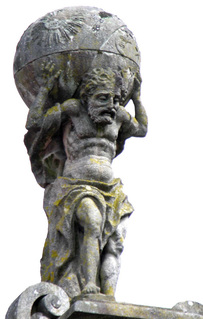
You may remember this guy from the Labors of Hercules
[Statue of Atlas at Santiago de Compostela]
[Photographed by Luis Miguel Bugallo Sánchez, Source: Wikimedia Commons]
[Statue of Atlas at Santiago de Compostela]
[Photographed by Luis Miguel Bugallo Sánchez, Source: Wikimedia Commons]
According to most sources, Atlas was the child of Iapetus, a Titan, and either Asia or Klymene, both Oceanids (daughters of Oceanus). This makes Gaia (Earth) and Ouranos (Sky) his grandparents through his father and his great-grandparents through his mother’s mother. You’ll see why that’s relevant in a moment. He is best known for the time Herakles tricked him into helping him retrieve the apples of the Hesperides.
Atlas fought against the Olympians with the other Titans and was defeated along with the rest of them. Unlike the rest of them, he was not confined to Tartarus afterwards. Instead, Zeus had him stand at the western edge of Gaia to hold Uranos on his shoulders and keep them apart. In other words, he is perpetually stuck between his grandparents.
Atlas fought against the Olympians with the other Titans and was defeated along with the rest of them. Unlike the rest of them, he was not confined to Tartarus afterwards. Instead, Zeus had him stand at the western edge of Gaia to hold Uranos on his shoulders and keep them apart. In other words, he is perpetually stuck between his grandparents.
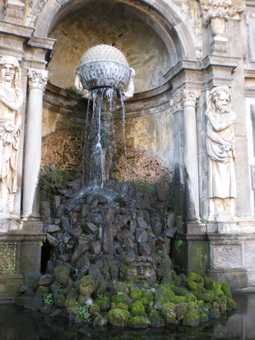
He's lucky he can't feel the temperature. It was cold that day.
[Atlas, Centerpiece of the Water Theater at Villa Aldobrandini in Frascati]
[Photographed by me]
[Atlas, Centerpiece of the Water Theater at Villa Aldobrandini in Frascati]
[Photographed by me]
Most sculptures of him show him holding a sphere on his shoulders and some of them, like the one above, are used in fountains. A lot of people think the sphere represents the earth, which it actually doesn’t. If you look back to the myth, he stands on the earth, holding the sky on his shoulders. It means the whole fountain idea makes a lot of sense, what with the water falling from the sky as rain.
I’m no art historian, but I’d guess that in that picture there the water falling out of the sphere, over Atlas, and onto the ground represents rain falling from the sky. This particular statue, by the way, comes from the Villa Aldobrandini, built in the mid 1500s. Rich people building gardens during what we call the Italian Renaissance liked to include references to Herakles and his encounter with Atlas because it allowed them to compare their own property to the Garden of the Hesperides.
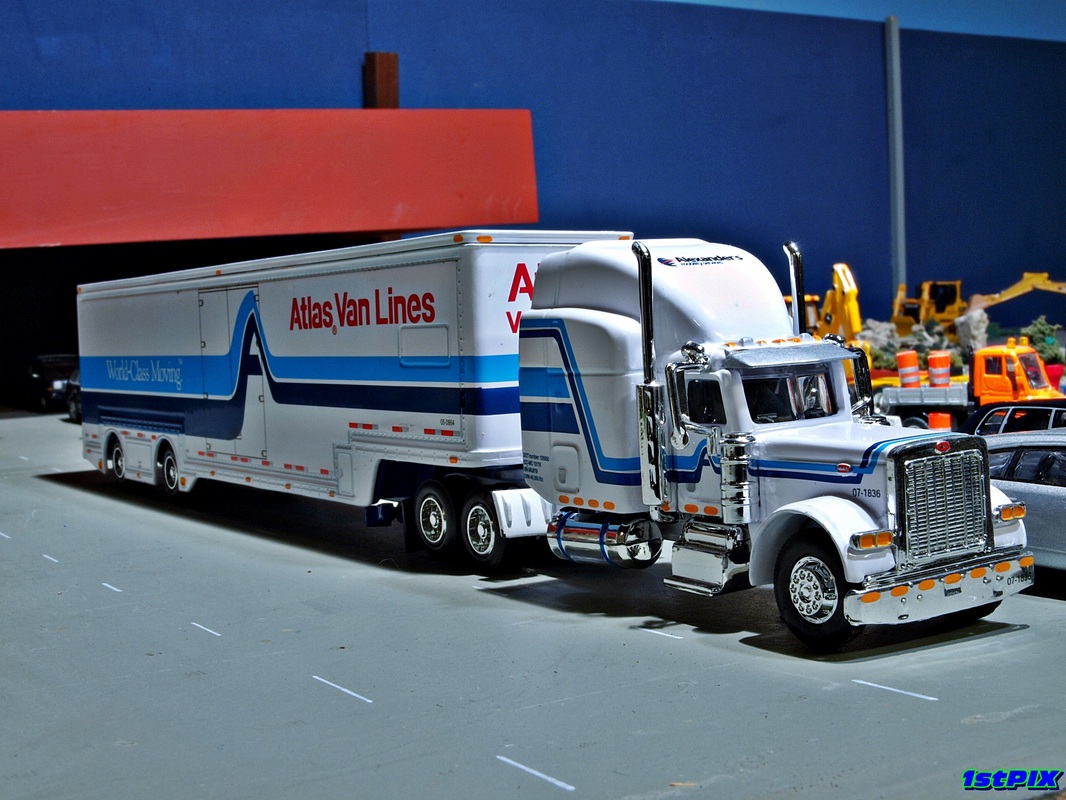
Unsurprisingly, that reference is less common nowadays. And no, those books full of maps are not named after him. The Atlantic Ocean is, though. And so is this:
I’m no art historian, but I’d guess that in that picture there the water falling out of the sphere, over Atlas, and onto the ground represents rain falling from the sky. This particular statue, by the way, comes from the Villa Aldobrandini, built in the mid 1500s. Rich people building gardens during what we call the Italian Renaissance liked to include references to Herakles and his encounter with Atlas because it allowed them to compare their own property to the Garden of the Hesperides.
Unsurprisingly, that reference is less common nowadays. And no, those books full of maps are not named after him. The Atlantic Ocean is, though. And so is this:

 RSS Feed



