Emily Kittell-Queller
  • Home
  • About Me
  • Blog
  • Projects
  • Resume
  • Contact Me

Marguerite of Flanders and Hainaut

28/9/2015

0 Comments

 
Picture
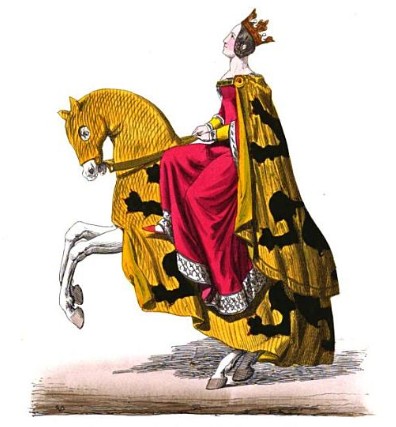
[Margaret II of Flanders, 1849, Félix de Vigne, Album du cortége des Comtes de Flandre, source: Wikimedia Commons]
Marguerite of Flanders and Hainaut (1202-1280) was the younger sister and heir of the previous countess, Jeanne of Flanders and Hainaut.  Her marriages and the ambitions of the children of said marriages led to a lot of conflict during her rule and resulted in the two counties being split from each other under different lords even before her death.  Like her sister, she was very invested in the wellbeing of the cities of Flanders and Hainaut and supported measures that helped them economically.  She also shared Jeanne’s investment in the religious women of her lands, especially the beguines.

Jeanne was only two or three when both of her parents died overseas in Constantinople and she and her sister were shuttled from one guardian to another, finally ending up in the care of the King of France, Phillip Augustus.  When she was ten, around the time her sister Jeanne married and moved to take control of Flanders and Hainaut, Marguerite married Bouchard of Avesnes, a nobleman from Hainaut without her sister’s permission.  The couple stayed married for nine years and had two sons

Sometime after her marriage, Marguerite fought with her sister and Jeanne tried to force the couple to separate.  She was successful and Marguerite remarried William of Dampierre.  This marriage produced three sons and at least one, maybe three daughters. Marguerite’s involvement in what some considered bigamous marriages along with the fact that she had sons by two different fathers eventually led to conflict.  The Avesnes sons fought the Dampierre sons for two years and even Louis IX’s intervention, giving Flanders to the Dampierres and Hainaut to the Avesnes,* only quieted it for a few years.

In terms of economic and religious policies, Marguerite very much followed and expanded on her sister’s work.  She worked to expand the cities’ power and increase international trade.  She supported the beguines and the Cistercians in particular founding communities and making laws to protect their members.  When she died in 1280, she left her grandson John of Avesnes count of Hainaut and her son William of Dampierre count of Flanders.


*Technically he may not have had the right to make those decisions, but he did and it worked.  For a short time anyway.

Sources/Further Reading:
Margaret of Constantinople, Countess of Flanders - Epistolae
Simons, Walter. Cities of Ladies: Beguine Communities in the Medieval  Low Countries, 1200-1565. Philadelphia: University of Pennsylvania  Press, 2003.
Margaret II, Countess of Flanders - Wikipedia
0 Comments

September 26th, 2015

26/9/2015

0 Comments

 
One of many reasons the beguines flourished in the Low Countries and why they are more often remembered in connection with that area than with any other part of Europe where they established themselves is because they had the protection and patronage of the local nobility.  Many of the greater court beguinages and hospitals were founded by countesses.  Later, in the 14th and 15th centuries, when the beguines faced scrutiny and repression, these greater beguinages were able to survive with the help of their patrons.

The interest in beguinages on the part of the nobility of the Low Countries seems to have started with the sisters and successive countesses Jeanne and Margaret of Flanders and Hainaut.  The pair of them set the precedent with their foundations in several cities, most notably Ten Wijngaerde in Bruges and the Groot Begijnhoof in Ghent.  The latter of these also shows the close association between the beguines and the Cistercians,* since it was closely associated with the convent of Mary’s Haven founded at the same time and the hospital associated with both communities was largely staffed by the beguines.  Both of these countesses also involved themselves in legal issues related the communities within their lands and took steps to protect the beguines living in them.**  They both left significant amounts of money in their wills to a number of communities, including many they had no hand in starting.

Jeanne and Margaret’s successors followed in their footsteps, as did many people of less powerful origins.  Patronage of the beguines increased in the 13th and early 14th centuries as new communities were paid for and various counts confirmed earlier donations.  But by the late 14th century, serious suspicions about the beguine’s morals and orthodoxy had begun to arise.  These were “disorderly” single women*** who were not enclosed and could move about among lay people.  Smaller convents began to disappear as their members died off, joined larger communities, or joined more regular Orders.  They lacked the resources to continue in the face of first Catholic and then later Protestant disapproval.  It was the courts that were best off, in part because they were big enough to have patrons among the nobility, who could provide resources and legal protection.  Some of these communities survived all the way into the late 21st century, with the last beguine, Marcella Pattyn dying in 2013.

*Both Countesses were closely tied with this Order too and may have developed their respect for it through their encounters with Blanche of Castile during their childhood.
**Not only from those who would take advantage of women living “on their own,” but also from family members who wanted to force them to renounce the life of a beguine to come home and marry.
***Literally.  They did not belong to any monastic Order.  And don’t blame me for the pun.  I stole it from Walter Simons’ Cities of Ladies.


Sources/Further Reading:
Simons, Walter. Cities of Ladies: Beguine Communities in the Medieval Low Countries, 1200-1565. Philadelphia: University of Pennsylvania Press, 2003.
Ward, Jennifer. Women in Medieval Europe: 1200-1500. New York: Routledge, 2002.
Joan of Constantinople, Countess of Flanders - Epistolae
Margaret of Constantinople, Countess of Flanders - Epistolae
0 Comments

Marcia

21/9/2015

0 Comments

 
Marcia (1st century BCE), second (and probably third) wife of Cato the Younger, second wife of Quintus Hortensius Hortalus, and technically stepmother to the orator Hortensia,* is mostly known for the rather curious incident of her marriages.  To be fair, we don’t have much evidence even of her existence outside this one particular incident, and while what happened is fairly clear, the why of it has remained quietly under dispute for a very long time.

Marcia was the daughter of Lucius Marcius Philippus and an unnamed first wife.  She married Cato the Younger in 63 BCE, becoming stepmother to his two children.  She was known at this time as “a woman of reputed excellence, about whom there was the most abundant talk.”  Marrying her proved a wise move.  She was the one who managed to repair the friendship between Cato and a fellow Stoic named Munatius when it was torn apart by jealousy.  Marcia also bore Cato at least two, maybe three children, one of whom was probably a son.  In 59 BCE her father remarried to Atia Balba Caesonia, making Marcia stepsister to both Octavia Minor and the future Augustus.

Seven years after her marriage to Cato, Marcia remarried to a man named Hortensius, one of Cato’s followers and friends.  The story goes that since he had no male heir and wanted to be more closely related to Cato, he went to him and asked to marry his daughter, Porcia.  When Cato refused on the grounds that the age difference was too great* and besides, he didn’t want to break up another man’s marriage.  Hortensius changed tactics, and asked to marry Marcia instead.  To this, Cato consented, provided her father agreed as well.  So Marcia married Hortensius and apparently bore him a son.

All of this turned into a minor scandal in Rome because after Hortensius died, Marcia inherited nearly everything.  And where did she take her wealth?  Back to Cato’s household.  Many powerful people seem to have felt that Cato used Marcia to get Hortensius’ wealth.  Whether the two actually remarried is uncertain, but when Marcia returned and Cato had to leave Rome because of the civil war, he put Marcia in charge of his household and all the people in it.


*By the time of Marcia’s marriage to Hortensius, Hortensia was already widowed and probably older than her stepmother.
**Hortensius being in his 60s while Porcia was about 20.

Sources/Further Reading:
Appian, The Civil Wars, Book II - Lacus Curtius
Plutarch, Life of Cato the Younger - Lacus Curtius
Plutarch, Life of Julius Caesar - Lacus Curtius
Means, Thomas and Sheila K. Dickinson. "Plutarch and the Family of Cato Minor." The Classical Journal 69.3 (1974): 210-215. [Found on Jstor]
0 Comments

Remarriage in Rome

17/9/2015

0 Comments

 
Despite the idealization of the univira, a woman only once-married, in practice things were generally rather different.  Remarriage of both women and men in Rome during the Late Republic and Early Empire seems to have been relatively common, especially in the upper classes.*  And since a marriage was expected to produce children, it should hardly be surprising that what we call “blended families” were normal enough to not be commented on much.

The number of marriages that ended with the death of a spouse in battle, childbirth, or disease was not small, while, among the upper classes especially, divorce was not uncommon, especially for political reasons, but also for moral ones.  For men there was the simple expectation that marrying again would provide political advantages, largely in terms of gaining and holding political allies.  Pompey the Great’s third marriage, to Julia Caesaris, bound him to her father, Julius Caesar.  Her death seriously weakened their alliance, the breaking of which led to civil war.

For women, the ideal of the univira competed with economic and political necessity sometimes combined with pressure from relatives to remarry.  Unless she already controlled her inheritance, as Cornelia Africana did, it would be difficult for her to survive on her own.  If she was still in her father’s power, he might well urge her to remarry or simply arrange another politically beneficial marriage for her.  By the 1st century BCE, the Augustan marriage laws made remarriage an even more attractive option by demanding higher taxes from the unmarried than from the married.

Some divorces, namely those for adultery, made it less likely that a woman would find a new spouse afterwards.  Others happened specifically so that one partner could marry someone else.  Livia Drusilla’s divorce from her first husband, for example, was immediately followed by her marriage to Octavian in 38 BCE.  Aside from those few women who took on the ideal of the univira in their widowhood or could not find a second husband, remarriage was encouraged.


*For whom, as usual, we have the most evidence.

Sources/Further Reading:
Bradley, K. R. "Remarriage and the Structure of the Upper-Class Roman Family." In Marriage, Divorce, and Children in Ancient Rome, edited by Beryl Rawson, 79-98. Oxford: Oxford University Press, 1991.
Corbier, Mireille. "Divorce and Adoption as Roman Familial Strategies. In Marriage, Divorce, and Children in Ancient Rome, edited by Beryl Rawson, 47-78. Oxford: Oxford University Press, 1991.
Pomeroy, Sarah. Goddesses, Whores, Wives, and Slaves: Women in Classical Antiquity. New York: Pantheon Books, 1995.
0 Comments

Jeanne of Flanders and Hainaut

15/9/2015

1 Comment

 
Picture
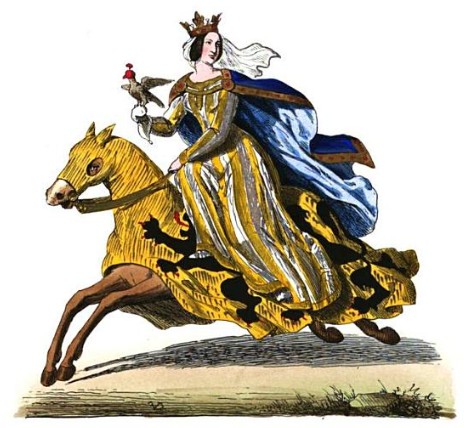
One of the only solo images of her I've been able to find.  I do have to wonder how she's staying on that horse without looking where she's going, but I'm going to attribute that to the fact that this image comes from the 19th century and leave it at that.
[Joan of Constantinople, 1849, Félix de Vigne, Album du cortége des Comtes de Flandre, source: Wikimedia Commons]
Jeanne, or Joan, countess of Flanders and Hainaut (1194-1244), ruled both those counties, on her own and with a husband for 22 years.  The position of her lands and her blood relationships to the kings of both France and England led her to involve herself heavily in French, English, and German politics alongside, or perhaps as a part of, her governance of her own lands.

Jeanne was the daughter of Baldwin IX of Flanders and Marie of Champagne, who was the granddaughter of Eleanor of Aquitaine and Louis VII of France.  Baldwin left on the Fourth Crusade in 1202.  Marie joined him two years later when he was crowned Latin Emperor of Constantinople, leaving Jeanne and her sister Margaret under the guardianship first of their uncle and regent Philip of Namur,* then the French king Phillip II.  The girls were raised at the French court where they almost certainly met Blanche of Castile, who would later be a political figure in both of their lives as Queen of France.

Picture
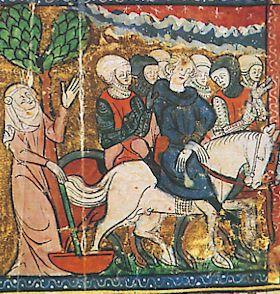
One of the only even close to contemporary images I've been able to find of Jeanne.  She's the one on the left, watching her husband being carried off to imprisonment.
[The capture of Ferdinand of Portugal, 14th century, Grandes Chroniques de France, source: Wikimedia Commons]
At the age of 18, Jeanne married Ferdinand of Portugal and took control of Flanders and Hainaut.  The people of Flanders, however, at first refused to recognize Ferdinand as their count since he had conceded Flemish lands to Prince Louis of France.**  Jeanne and her husband decided to ally themselves with King John of England*** and Holy Roman Emperor Otto IV.  Ferdinand, however, was soon captured by the French and spent the next 12 years as their prisoner.  Jeanne tried several times to ransom him, but the Flemish refused to authorize the funds.

This left Jeanne as the sole ruler of Flanders and Hainaut.  She aimed to build up the power of the towns against the barons, supporting the construction of markets, government buildings, and canals and reducing taxes on certain members of the wool trade.  She also lent her support to two religious groups: Cistercian nuns and the beguines.  In 1225 she faced a challenge to her position.  A man claiming to be her father tried to stir up trouble and win control of her lands.  He was exposed as a fraud not long after and imprisoned. 

Ferdinand was finally released in 1226 at the instigation of Blanche of Castile and joined his wife’s governance.  Jeanne ruled alone again for four years before marrying Thomas II of Savoy, partially at Blanche's urging.  She died in 1244, leaving Flanders and Hainaut to her sister Margaret.


*Baldwin’s younger brother
**Louis claimed it belonged to him, as it had been part of Isabelle of Hainaut’s dowry and he was her son.  Jeanne may or may not have been as much involved in the concession as Ferdinand, but the Flemish unilaterally blamed him.
***Her half-great-uncle.  He was her mother’s mother’s half-brother.

Sources/Further Reading:
Joan of Constantinople, Countess of Flanders - Epistolae
Simons, Walter. Cities of Ladies: Beguine Communities in the Medieval  Low Countries, 1200-1565. Philadelphia: University of Pennsylvania  Press, 2003.
Nichols, John A. and Lillian Thomas Shank, eds., Distant Echoes:  Medieval Religious Women, Volume One. Kalamazoo, MI: Cistercian  Publications, 1984.
Joan, Countess of Flanders - Wikipedia
1 Comment

The Camino de Santiago

10/9/2015

0 Comments

 
Picture
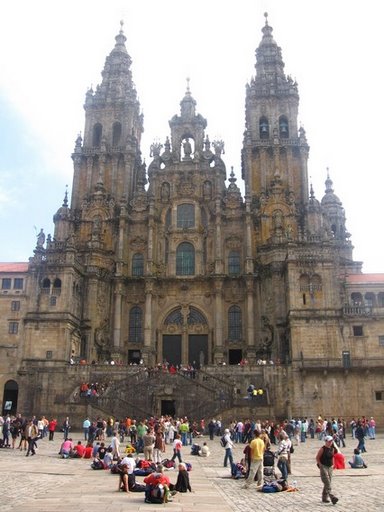
I could have picked a version without all the people, but in a way they're the whole point here.
[Cathedral of Santiago de Compostela (Church of St. James), Obradoio facade, 2007, photographed by jonathan jacobi, source: Wikimedia Commons]
At the height of its popularity, from the 10th century to the 14th, Santiago de Compostela was one of the three most important pilgrimage destinations for European Catholics.  According to tradition, St. James, one of Jesus’ disciples, preached for a time in Spain before returning to Jerusalem to be martyred.  After his death, his body was transported to what is now northwestern Spain.*  Over time, this saint in particular came to be associated with pilgrimage and took on the symbol of the scallop shell which was, and still is, used to identify pilgrims to his shrine.

Sometime in the late 9th century, Alfonso III of Asturias began promoting the shrine as a pilgrimage destination, rebuilding the church there and talking to French bishops about it.  This may have prompted the first French pilgrims to make their ways there.  By the late 10th century, the shrine was attracting people from as far away as Armenia and had become the third most important pilgrimage destination for Europeans after Jerusalem and Rome.

Picture
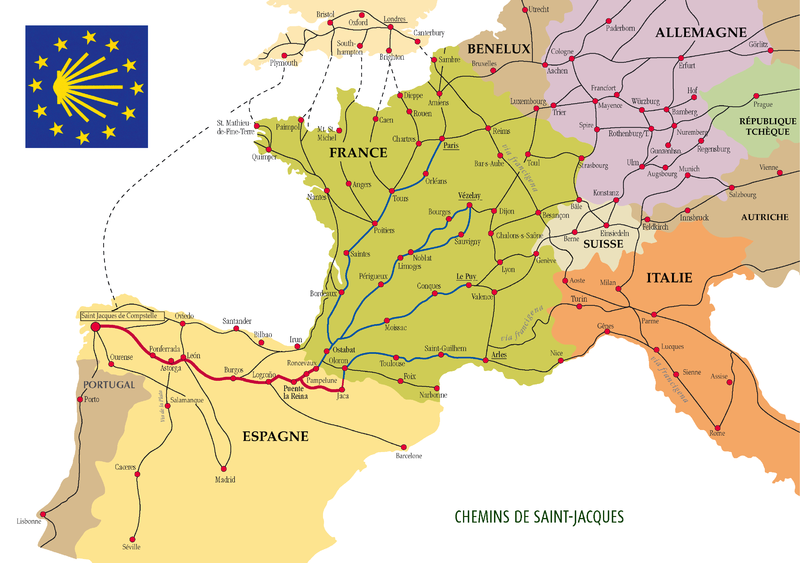
Seriously, if you like maps at all go look at the big version of this at its source.
[Map of the Camino de Santiago in Europe, Manfred Zentgraf, source: Wikimedia Commons]
Interest in the shrine would only grow, especially after Cluniac monks started actively promoting the pilgrimage.  With the large number of people along the Camino, as the route is now commonly known, came the need for services such as hostels and eating places.  Entire towns grew up or expanded to meet the needs of the numbers of people coming through.  Some of the shrines along the route became pilgrimage destinations in their own right.  Music was apparently quite common along the route.  An account from the 12th century describes pilgrims thronged in the Church of Santiago, many of them carrying instruments, others singing along.

Picture
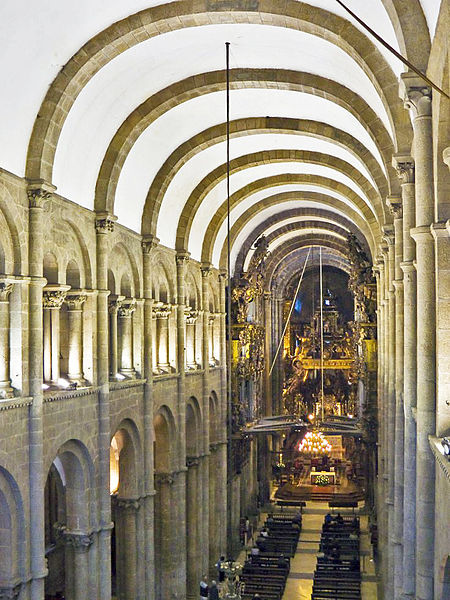
I'm a sucker for vaulting.  It would be more surprising if a picture like this weren't included in this post.
[Cathedral of Santiago de Compostela from the Tribuna, 2009, photographed by Lansbricae, source: Wikimedia Commons]
With the upheavals of the 14th century, pilgrimage to Santiago de Compostela became less popular.  It was never completely abandoned though, and pilgrims carrying the scallop shell can still be seen making their ways south and west through France and northern Spain.


*There are many stories as to how this is supposed to have happened.

Sources/Further Reading:
Webb, Diana. Medieval European Pilgrimage. New York: Palgrave, 2002.
Barber, Malcolm. The Two Cities: Medieval Europe 1050-1320. London: Routledge, 1993.
Search Google or Google Books and you'll find dozens of guidebooks and reflections on people's experiences.
The Way is a movie about an American eye doctor walking the Camino.  I found it rather uninspired but a lot of people seem to like it.
0 Comments

Aurelia Paulina

7/9/2015

1 Comment

 
Picture
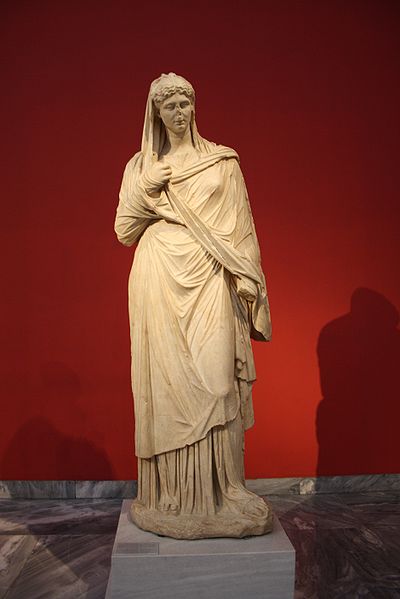
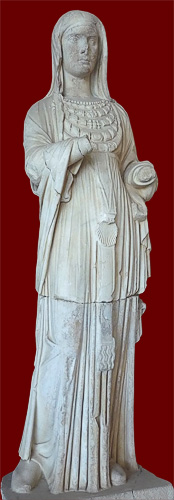
Hey look!  We actually have a statue of her for once.
[Aurelia Paulina, 2nd century CE, image courtesy of Linda Davis, source: vroma.org]
Aurelia Paulina (late 2nd century CE), like Plancia Magna before her, is known largely as a builder.  Along with several other wealthy women in the Roman provinces, she spent at least some of her money on public buildings for the city she lived in, enhancing not only Perge but also her own public standing.

An inscription gives us a little bit of Paulina’s ancestry.  Her parents were Dionysos and Aelia Tertulla, members of a wealthy non-citizen family in the province of Syria. She eventually married a man named Aquilus, who came from Sillyon and held a similar status to her own.  The pair of them were granted Roman citizenship by the Emperor Commodus.  Aquilus died before Paulina leaving her a widow.  At some point she moved from Syria to the city of Perge in the province of Pamphylia.  Whether this was before or after her widowhood is unknown, but probably before.  While still in Syria, she held the post of priestess of the Imperial Cult.  In Perge she took the post of priestess of Artemis.

Picture
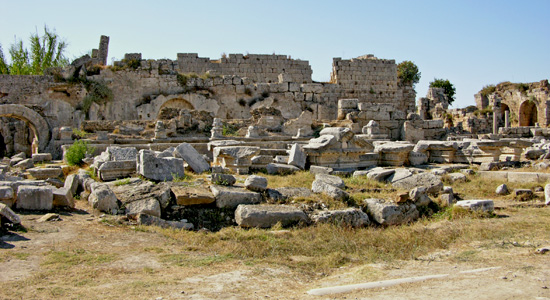
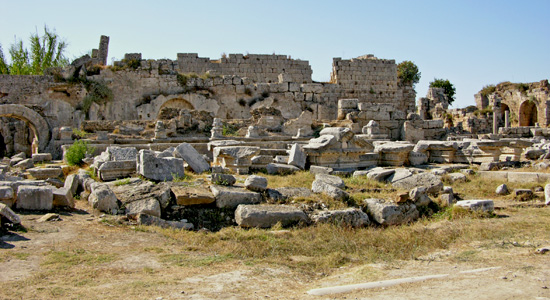
It's a bit less pretty than when it was built.
[Ruins of the Nymphaeum of Aurelia Paulina, Perge, Turkey, source: vroma.org]
It was in her widowhood that she built the nymphaeum by the south gate of the city, providing water for anyone going in or out of the city.  As was common, she dedicated it to Artemis (the patron of the city), to the imperial family, and to the city itself.  What was unusual about her dedication is that it included not just Emperors but also an Empress, Julia Domna, who, like Paulina, came from Syria.  Visually, her nymphaeum focuses heavily on Artemis her importance to Paulina and the city of Perge, more than on the imperial family.  Notably though, the presentation statue of Paulina herself in Syrian dress may have been intended to link her to Julia Domna.  The sculpture of the priestess of Artemis also resembles Paulina.

In building her nymphaeum, Paulina followed Plancia Magna in cementing her own public standing.  Through sculptures and inscriptions she linked herself both with the Empress Julia Domna and Artemis, for whom she was priestess.  Perhaps she acted on a smaller scale than Plancia Magna, but she had plenty to say of herself nevertheless.

Sources/Further Reading:
Longfellow, Brenda. Roman Imperialism and Civic Patronage: Form, Meaning and Ideology in Monumental Fountain Complexes. New York: Cambridge University Press, 2011.  [Parts of this book may be found on Google Books here.]
Boatwright, Mary Taliaferro. "Plancia Magna of Perge: Women's Status and Roles in Roman Asia Minor." In Women's History Ancient History, edited by Sarah B. Pomeroy, 249-272.  Chapel Hill: University of North Carolina Press, 1991.
Plancia Magna, Aurelia Paulina, and Regilla: Civic Donors - vroma.org
1 Comment

Citizen Women's Clothing in Athens and Sparta

4/9/2015

4 Comments

 
Picture
A thoroughly modest Athenian woman.
[Funerary statue, 1st cent. CE Roman copy of a 4th cent. BCE Greek original, Archaeological Museum of Athens, source: Wikimedia Commons]
At one point, according to Herodotus, all Greek women wore the same type of clothing: the Dorian peplos.*  But after the women of Athens stabbed the lone survivor of a battle to death with the pins on their dresses, the Athenians banned their women from wearing Dorian dress.  Instead, they were to wear the Ionic chiton, which didn’t necessarily require pins.  How true is this?  There’s really no way of knowing for sure.  But what we do know is that women in Classical Athens and Sparta typically wore two different kinds of clothing and had different relationships with them.

Picture
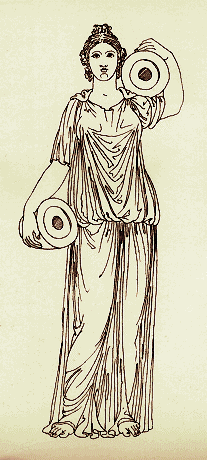
Maybe this shows her legs a bit better than a regular chiton would.
[Engraving of a woman in a chiton, 19th century, source: Wikimedia Commons]
Athenian women typically wore the Ionic chiton, which was essentially a long tunic, a rectancle of cloth sewed into a cylinder, belted at the waist and pinned or sewed at the shoulders.  It was usually worn by both men and women.  While a man’s chiton could be quite short, a woman’s had to reach her ankles.  The garment contained a lot of fabric and the lower it reached, the harder it was to move freely in.  It was usually made of linen or wool.  Over this went the himation, or cloak, draped not just over the shoulders, but around the entire body.

Picture
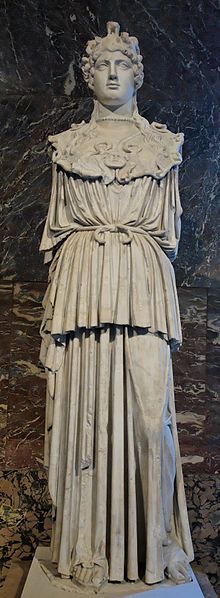
The fold over on Athena's peplos here hangs really low and her ornamentation obscures the neckline, but you get the gist of it.
[Athena Parthenos sculpture, 1st cent. CE Roman copy of a 5th century BCE Greek original, Louvre, source: Wikimedia Commons]
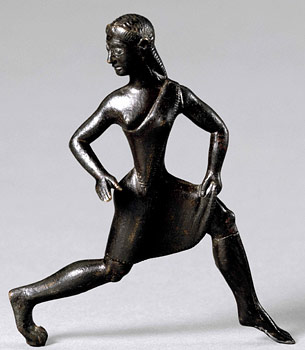
Spartan women probably dressed more for the weather than for modesty.  Certainly the Dorian peplos contained far less fabric and was generally less restrictive.  It was made much in the same way as a chiton, but with an extra fold of fabric hanging down from the shoulders over the torso.  It was pinned rather than sewn; the sharp pins could be used as weapons if necessary.  Spartan women wore chitons as well, but they were often sleeveless, or even covered only one shoulder and/or only fell to the knee rather than the ankle.  Sometimes women simply exercised naked.  At other times they wore a longer peplos that reached all the way to the ankle.  A himation could be worn because of weather or personal inclination, but it wasn’t required.

Picture
See how her clothes only cover one shoulder?
[Statue of a girl running or dancing from Prizren or Dodona, Spartan, c. 500 BCE, source: Wikimedia Commons]
An Athenian citizen woman would never dream going anywhere anyone besides immediate members of her household or birth family could see her without wearing a himation.  Modesty was incredibly important for her.  Often she wore clothing she herself had made or supervised the making of.  A Spartan citizen woman, meanwhile, usually dressed more for personal comfort than for modesty.  Very rarely would she have made her own clothing.


*Sometimes also called a chiton.  Yes, it’s confusing.

Sources/Further Reading:
Pomeroy, Sarah B.  Goddesses, Whores, Wives, and Slaves. New York: Schocken, 1995.
Pomeroy, Sarah B. Spartan Women. New York: Oxford University Press, 2002.

Greek Dress - Roman Life
4 Comments

    My Blog

    Translation of the above: where I post the interesting things I find researching the Classical and Medieval periods in my free time.

    Currently Reading:
    -
    Medieval Monasticism by C. H. Lawrence

    Archives

    March 2016
    February 2016
    January 2016
    December 2015
    November 2015
    October 2015
    September 2015
    August 2015
    July 2015
    June 2015
    May 2015
    April 2015
    March 2015
    February 2015
    January 2015
    December 2014
    November 2014
    October 2014
    September 2014
    August 2014
    July 2014
    June 2014
    May 2014
    April 2014
    March 2014
    February 2014
    January 2014
    December 2013
    November 2013
    October 2013
    September 2013

    Categories

    All
    Architecture
    Biography
    Classical
    Law
    Marriage (legal And Otherwise)
    Medicine
    Medieval
    Misconceptions
    Monasticism
    Overview
    References
    Religion
    Review

    RSS Feed

Powered by Create your own unique website with customizable templates.