Emily Kittell-Queller
  • Home
  • About Me
  • Blog
  • Projects
  • Resume
  • Contact Me

Contraception in Medieval Law

25/2/2016

0 Comments

 
Up until the 12th century or so, medieval legal writers weren’t particularly concerned with contraception.  They certainly didn’t look at it positively, but they also didn’t consider it an issue worth spending much time on except where it came up in connection with other concerns.  The 12th century saw greater focus on the issue, but specific condemnation of it independently of other issues only came 400 years later, in the 16th century.  It’s worth nothing though, that however much contraceptive practices were condemned, no serious effort was ever made to stop them.
 
St. Augustine argued that sex with any sort of contraceptive intent was a serious sin.  Married couples should simply stop having sex at all once they’d had a couple of children.  Beyond this statement, he seems not to have touched on the issue.  Similarly, the Penitentials of the next several centuries didn’t really focus on or specifically mention contraception much.  Instead, as a rule, they tended to discourage any sexual position that didn’t have a chance of resulting in a pregnancy as sinful in and of themselves.
 
The 11th and 12th centuries saw rising concern with what was “natural” and what wasn’t.  St. Peter Damian considered most forms of contraceptive sex to be “against nature.”  A bit more than a century later, Gratian called it “inappropriate use of sex organs,” but also considered such things only mildly sinful when the people involved were married to each other.
 
The 12th century was also when legal and religious writers began paying more attention to the issue.  A few people argued that both the use of contraception and sex with contraceptive intent invalidated a marriage entirely.  Others said that while marriages entered into with the intent to avoid having children were illegal, they were still binding.  Some compared the use of contraception to adultery, while many considered it serious spiritual pollution at the very least.
 
The thing is, though, for all that several writers had opinions on the topic, contraception wasn’t considered seriously as a separate issue until the 16th century.  It was mostly a minor point among far greater concerns.

Sources/Further Reading:
Brundage, James A. Law, Sex and Christian Society in Medieval Europe. Chicago: University of Chicago Press, 1987.
Birth Control and Abortion in the Middle Ages - Medievalists.net
0 Comments

Matilda of Tuscany

16/3/2015

0 Comments

 
Picture
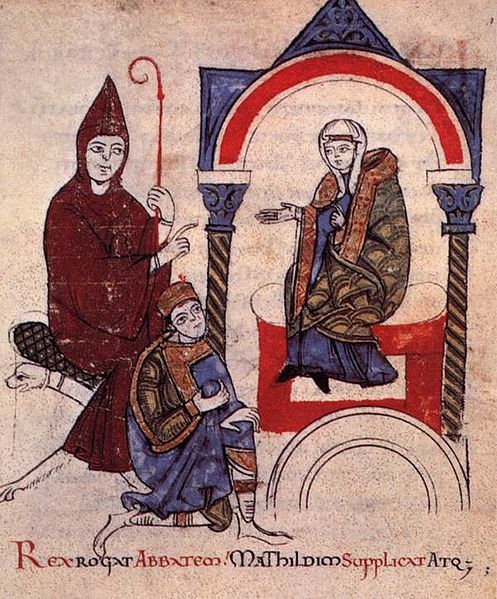
Yes, that is the Holy Roman Emperor on his knees begging a Countess to let him in.  The other guy is Abbot Hugh of Cluny.
[Miniature from the Vita Matildis, 1115, source: Wikimedia Commons]
Matilda, Countess of Tuscany and Duchess of Lorraine (1046-1115), also known as Matilda of Canossa, was one of the papacy’s most important supporters, politically and militarily, during the Investiture Controversy and subsequent moves for reform.  It was largely through her efforts that Henry was unable to maintain a foothold in Italy.

Her father, Boniface III of Tuscany died* when she was eight.  Her mother, Beatrice of Bar, married Godfrey the Bearded, Duke of Lorraine and betrothed Matilda to his son, Godfrey the Hunchback.  Godfrey and Beatrice saw to it that she was educated not just in governance, but also in military matters and fighting.  When the Duke died in 1069, the twenty-year-old Matilda and her mother ruled Tuscany together, while Matilda’s husband governed Lorraine.  The deaths of both her mother and her husband in 1076 left Matilda sole ruler of not only her Italian possessions, but also of the Duchy of Lorraine.

This was right around the height of the Investiture Controversy.  Matilda placed herself firmly on the side of the Pope and acted as one of his primary advisors.  When Henry sought out the Pope to receive forgiveness and have his excommunication lifted, it was at Matilda’s castle of Canossa that the reconciliation took place.  Matilda appears as one of the key witnesses to the events there.  When Henry went south to attack Rome, he had to go through Matilda’s lands first.  He defeated her and her forces, but she dealt him a more powerful blow: informing the German princes of his theft of the papal seal and encouraging their rebellion against him.**

After Gregory VII’s death in exile, Matilda took up the papal cause again, helped by a political marriage to Welf V.***  She led her armies against Henry once more and, though she was unable to drive him out of Italy entirely, she brought his influence there to almost nothing, capturing most of the towns loyal to him and humbling him at Canossa a second time, this time militarily.  In between fighting Henry, she founded a number of

Matilda died of gout in 1115 and was buried at Modena.  She left no heir, as her one child with Godfrey, Beatrice, did not survive infancy.  Her body was later moved to the Vatican, making her the first person who was neither a pope nor a saint to be buried there.


*Was murdered, actually.
**We actually have that letter of hers, along with quite a few others.  Go read it here if you have time.  It's really cool.
***He was 26 years younger than her.  She seems to have had no interest in him beyond the political support he brought and the marriage was never consummated.

Sources/Further Reading:
Barber, Malcolm. The Two Cities: Medieval Europe 1050-1320. London: Routledge, 1993.
Letters of Matilda of Tuscany - Epistolae
Matilda of Canossa - Catholic Encyclopedia
Matilda of Tuscany - Badass of the Week
Matilda of Tuscany - Wikipedia
0 Comments

Female Physicians in Ancient Rome

27/2/2015

0 Comments

 
It’s relatively easy to prove that some women in the Roman period practiced medicine and were accorded the title of physician on par with men.  For the most part, as with their earlier Greek colleagues, there is far more evidence for their existence than for the details of their practice.  We have funerary inscriptions for several, but perhaps the most valuable evidence is the work of Metrodora, the earliest surviving medical text written by a physician known to be female.

What inscriptions we have tell us a little bit about these women’s lives.  Neither marital nor slave status seems to have directly prevented a woman from practicing medicine and earning the title of physician, though under many circumstances being married or a slave would probably have made it significantly more difficult given the need to bow to the wishes of a husband or master.  It’s likely that most of these women were either the daughters or wives of fellow physicians.

As before, most female physicians seem to primarily have dealt with “women’s ailments” like menstruation, childbirth (especially difficult births), etc, but some spread their practice wider.  According to her epitaph, a physician named Domnina “delivered her fatherland from disease.”  Another, Aspasia, seems to have practiced surgery.  Female physicians are quoted alongside men by writers like Pliny the Elder, Galen, Aetius, and others.  Their words are given similar weight and show the same breadth of practice.

The only medical writer whose work we have independently of mere quotations is that of Metrodora, written sometime between the 2nd and 5th centuries CE.  She focused largely on illnesses and injuries of the womb and vagina, pathology more than midwifery or obstetrics, but also took an active part in contemporary debates over individual causes and symptoms.

There is no doubt that some women became physicians in the Roman period and that they were regarded as practitioners of medicine beyond midwifery.  Some were pigeonholed into more “feminine” specialties, but many were not.  Some performed extraordinary services and were rewarded with inscriptions in their honor.  Others wrote their own medical texts, one of which survives today.  There may not be very much information about them, but this much cannot be doubted.


*Often he was the one to have it put up in the first place.

Sources/Further Reading:
Several inscriptions regarding female physicians may be found in Lefkowitz and Fant, nos. 370-372, 376
Parker, Holt N. "Women physicians in Greece, Rome, and the Byzantine Empire." In Women Healers and Physicians: Climbing a Long Hill, edited by Lilian R. Furst, 131-150.  University Press of Kentucky, 1997.  [Note: can be found here on academia.edu]
Pomeroy, Sarah B.  Goddesses, Whores, Wives, and Slaves. New York: Schocken, 1995.

Metrodora - Wikipedia
0 Comments

Female Physicians in Ancient Greece

4/2/2015

0 Comments

 
I mentioned in my post about Ancient Greek midwives that some women held the title of physician rather than or in addition to that of midwife.  Though their writings mostly only come down to us through quotations in men’s work, there is significant evidence that they existed and, despite their small numbers, were considered ordinary enough a feature of life as to be largely unremarkable.  Later on at least, a few of them were recognized on relatively equal authority with their male counterparts.

Plato mentions them in passing in his Republic, less in a way that implies an argument that women should be allowed to work as physicians than simply taking the fact that they already did so as a matter of course.  Feminine forms of the Greek word were used widely enough and in such contexts as to make clear that these women were not merely midwives.  I would argue, however, that given Athenian attitudes towards women and freedom of movement, it would be unsurprising if there were fewer female physicians there than elsewhere in Greece.*

Most female physicians probably attended primarily to women and so-called female problems, but they also concerned themselves with the broader practice of medicine.  The civic honors granted to Antiochis in the 1st century CE argues she at least, probably had a wide variety of people with a wide variety of complaints as her patients.  Other evidence can be gathered from the quotations of the works of female physicians found quoted by male authors, though it weights more towards later periods than early ones.

The information we have is scarce enough that we cannot know what social class these women might have belonged to or just how common or uncommon they were.  All we can say for sure is that these women existed and that some of them, particularly but not only in later centuries, had enough training and enough prestige to be referred to as physicians, with the implication that this title was distinct from that of midwife.


*Though I will point out that this is pure guesswork.

Sources/Further Reading:
Plato, Republic (464d, 455e) - Perseus
Inscription regarding Antiochis of Tlos (Pleket 12), found in Lefkowitz & Fant
Parker, Holt N.
"Women physicians in Greece, Rome, and the Byzantine Empire." In Women Healers and Physicians: Climbing a Long Hill, edited by Lilian R. Furst, 131-150.  University Press of Kentucky, 1997.  [Note: can be found here on academia.edu]
Pomeroy, Sarah B.  Goddesses, Whores, Wives, and Slaves. New York: Schocken, 1995.
0 Comments

Abortion in Ancient Rome

7/1/2015

0 Comments

 
Note: Warning for discussion of abortion, miscarriage, and infanticide.
One of the major difficulties in writing about abortion in this time period lies in defining what precisely we are talking about.  Contraception, miscarriage, and infanticide all overlapped with abortion in the theory presented medical texts, in practice, or both.  The fact that some Romans believed pregnancy could last anywhere between seven and ten months* only serves to complicate the issue.  Additionally, though much of the information we have comes from texts written by male physicians, the people who usually handled such questions in practice were midwives.

Medical writers did make a distinction between contraception and abortion, but in practice it was often difficult to tell from case to case whether the procedure was in fact contraceptive or abortive.  As a result, prescriptions for contraception and early term abortions were often very similar.  Jumping up and down vigorously, for example, was a suggested way of both preventing conception (if done right after intercourse) or of expelling a foetus.

These texts also didn’t make much distinction between miscarriage and purposeful abortion and usually used the same word for both,** sometimes signifying the former by calling it “spontaneous.”  Many Hippocratics interpreted the line “I will never give a woman a destructive pessary” as forbidding methods of abortion.  Soranus, meanwhile pointed out that this left other methods available.  He also argued that if the foetus endangered the mother’s life and health, it should be aborted.

It is also important to remember here that the ethics surrounding this question had more to do with property rights than individual ones.  While some philosophers had things to say about when in a pregnancy abortion was allowable or not, this was a society that permitted fathers to discard unwanted infants.**  It is also worth noting that in the upper classes of Roman society, abortions were not uncommon and were used both as a way for women to keep their figures (at least, that was the accusation) and, more importantly, as a method of family planning.  According to law, however, the
right to make this decision lay with the father or the slave’s owner.


*There was apparently one case where a court accepted a woman’s claim that her pregnancy had lasted 13 months.
**As they still do in the medical field today.  “Abortion” simply means the end of a pregnancy.  A “spontaneous abortion” is one that happens without anyone taking any action to cause it, known colloquially as a “miscarriage.”
***Infanticide by exposure was certainly less common in Rome than in Classical Greece, but that doesn’t mean it didn’t happen.  It was also often viewed as little different from late term abortion.  Some physicians argued that abortion, particularly earlier abortion, was better than infanticide not because of the child but because it was safer for the mother not to have to go through childbirth.

Sources/Further Reading:
Soranus. Gynaecology 1.60-64 - Diotima
Pliny the Elder. Natural History 7.39-48 [Found in Lefkowitz & Fant]
Hippocrates. On the Generating Seed and the Nature of the Child 13, 25 - Diotima
Hanson, Ann Ellis. "Continuity and Change: Three Case Studies in Hippocratic Gynecological Therapy and Theory." In Women's History and Ancient History, edited by Sarah B. Pomeroy, 73-110. Chapel Hill, NC: University of North Carolina Press, 1991.

Pomeroy, Sarah. Goddesses, Whores, Wives, and Slaves: Women in Classical Antiquity. New York: Pantheon Books, 1995.
0 Comments

The Wandering Womb

10/12/2014

0 Comments

 
Note: Warning for cissexism and discussions of pregnancy and menstruation.
When it came to the cause of “women’s illnesses” in Ancient Greece and Ancient Egypt, most physicians laid the blame on their reproductive organs.*  More specifically, they believed that the uterus could move around the body, overcrowding the organs and causing suffocation, mood alterations, and other, potentially more serious ailments.

According to Plato’s Timaeus, people’s reproductive organs had minds of their own and since the uterus was not anchored down, it moved all over the body when it became agitated.  Aretaeus of Cappodacia took it further and explicitly compared the uterus to an “animal within an animal.”  Texts like the Hippocratic Corpus, the most commonly cited text on this belief, doesn’t state things nearly so strongly, suggesting that most Hippocratics believed its movements were confined to the torso, possibly only the lower section.  They also believed that this could cause the vagina to close off, preventing the woman from menstruating.

One reason for this was the related belief that the uterus had no particular place within the body.  After all, the penis was anchored externally and the male body was obviously the default.  Ancient physicians did, however, have the evidence of uterine prolapse,** having seen it in animals.  They then theorized that if the uterus could move downwards, it could also go the opposite direction.

There were two main theories.  One stated that the uterus sought moisture.  So if a woman had not had intercourse or been pregnant in too long, the uterus dried out and moved towards moister organs.  The other theory, most notably found in Hippocratic texts and the Ebers Papyrus was that the uterus was attracted to sweet smells and repelled by foul ones.  Thus, treatments tended to involve having a woman sit over something sweet smelling and having her inhale something nasty-smelling through her nose, with the recommendation that she get some guy to get her pregnant soon.

Almost anything that was physically wrong with a woman, any pain she experienced, any mood or reaction deemed “unusual” could be blamed on her uterus being out of place.  Not all ancient physicians agreed on this theory.  Soranus and Galen both opposed it, arguing that the uterus remained stationary.  Despite this, however, the idea of the wandering womb remained a popular one in the medical field until the early modern period.  It has since fallen out of favor, but it is impossible not to see traces of it in our attitudes today.


*Not too different from today, if you think about it.
**That is, when the uterus slips down into the vagina.

Sources/Further Reading:
Plato, Timaeus 90e-91d - Perseus
Hippocrates, Places in Human Anatomy 47 - Diotima
Aretaeus of Cappadocia, On the Causes and Symptoms of Acute Diseases 2.11 - Perseus
The Ebers Papyrus - University of Chicago
Hanson, Ann Ellis. "Continuity and Change: Three Case Studies in Hippocratic Gynecological Therapy and Theory." In Women's History and Ancient History, edited by Sarah B. Pomeroy, 73-110. Chapel Hill, NC: University of North Carolina Press, 1991.
Dean-Jones, Lesley. "The Cultural Construct of the Female Body in Classical Greek Science." In Women's History and Ancient History, edited by Sarah B. Pomeroy, 111-137. Chapel Hill, NC: University of North Carolina Press, 1991.
0 Comments

Midwives in Ancient Rome

19/9/2014

0 Comments

 
Picture
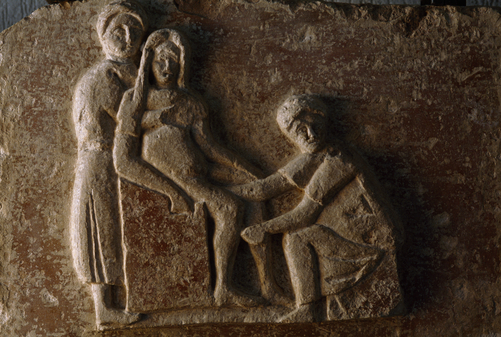
[Relief of a midwife delivering a baby, from a tomb on the Isola Sacra, 2nd cent. CE]
[Museo di Ostia, source: National Geographic]

As they had been in Greece, midwives in the Roman period were responsible for more than just childbirth.  They helped women through nursing, menopause, and difficulties related to menstruation.  Though physicians had themselves become more interested in these things, primary responsibility for dealing with them rested in the hands of midwives.

Not just anyone could be a good midwife.  She had to be quick to learn skills in several areas, up to and including some very basic surgical techniques.  She had to know what to do in the face of any complication that might arise.  She also had to be able to distinguish which infants might not be worth raising and should instead be exposed.*  She had to be quick-thinking and patient.  She also had to be discreet enough to keep the mother’s secrets.

Many of the midwives whose names we know (from funerary inscriptions) were slaves or freedwomen, though a few were freeborn.  It was not uncommon for a wealthy household to have a midwife who was either a slave or freedwoman client.  This was probably a matter of convenience for wealthier women, who were responsible for the health of their entire household.  Midwifery was also among the only training a woman captured elsewhere and enslaved in adulthood was likely to have, particularly if she was Greek, as the most skilled midwives of the time were.

Midwives handled not only the birthing process, but also concerned themselves with the mother’s health before and afterwards as well as dealing with other gynecological concerns.  They helped new mothers through nursing and presumably found a wet-nurse should one be needed.  They are also known to have performed abortions.

Midwives were important people in Roman society.  Perhaps they didn’t have quite the same prestige they held in Greek society, but they were invaluable nonetheless.  Childbirth was still dangerous, painful, and terrifying.  Death was not uncommon.  Midwives had to be able to navigate these metaphorical waters on a regular basis.


*This was less common in Rome than it was in Greece, but it definitely happened.

Sources/Further Reading:
Soranus, Gynaecology, 1.3-4, 1.67-9 - Diotima
Pomeroy, Sarah B.  Goddesses, Whores, Wives, and Slaves. New York: Schocken, 1995.
Childbirth and Obstetrics in Antiquity - Wikipedia
Diana - Wikipedia
0 Comments

Midwives in Ancient Greece

5/9/2014

0 Comments

 
In early Classical Greece, female reproductive health (menstruation, nursing, menopause, and, of course childbirth) was mostly handled by midwives.  It seems to have been a respected profession, though little is known of it due to the usual dearth of sources by or about women.  Over time, some of these responsibilities shifted into the hands of physicians (male and female), but midwifery still remained its own distinct profession.

Most Greek midwives seem to have been not to have been physicians, midwifery being a distinct and respected profession in its own right.  It has been claimed that it was forbidden in Classical Athens for women to become doctors.  The story of Agnodice, a woman who disguised herself as a man to get medical training, is based on this premise.  An Athenian memorial tablet from the 4th Century BCE, however, describes a woman named Philostrate as “a midwife and a physician,” stating that all lamented her death.

Even with help like this, childbirth was considered dangerous, painful, and terrifying.  Women were usually helped through this ordeal by both mothers and midwives.  They prayed and made offerings to Eileithyia, goddess of childbirth, and to Artemis, patron of women’s lifecycles, in the hopes that both mother and child would survive the process. In Sparta, of course, a woman’s name would only be inscribed on her tombstone if she died in childbirth. This was, however, an even more immediate concern to Athenian women, who began bearing at a much younger age, and were thus far more likely to experience potentially fatal complications.

Over time, the male god Asclepius became somewhat more popular among midwives and childbearing women.  Men began writing about childbearing in their medical books and physicians (male and female), began to take a more active interest.  None of this, however, seems to have led immediately to any sort of decline in the status of midwives.  Rather, it seems to have enhanced the profession’s prestige, at least in the eyes of those who had the time, money, and ability to read and write.

Sources/Further Reading:
Hippocrates, On the Generating Seed and the Nature of the Child 4-7, 13, 30.4 - Diotima
Pomeroy, Sarah B.  Goddesses, Whores, Wives, and Slaves. New York: Schocken, 1995.
Pomeroy, Sarah B. Spartan Women. New York: Oxford University Press, 2002.
Childbirth and Obstetrics in Antiquity - Wikipedia
Eileithyia - Wikipedia
Agnodice - Wikipedia

Herophilos - Wikipedia
0 Comments

    My Blog

    Translation of the above: where I post the interesting things I find researching the Classical and Medieval periods in my free time.

    Currently Reading:
    -
    Medieval Monasticism by C. H. Lawrence

    Archives

    March 2016
    February 2016
    January 2016
    December 2015
    November 2015
    October 2015
    September 2015
    August 2015
    July 2015
    June 2015
    May 2015
    April 2015
    March 2015
    February 2015
    January 2015
    December 2014
    November 2014
    October 2014
    September 2014
    August 2014
    July 2014
    June 2014
    May 2014
    April 2014
    March 2014
    February 2014
    January 2014
    December 2013
    November 2013
    October 2013
    September 2013

    Categories

    All
    Architecture
    Biography
    Classical
    Law
    Marriage (legal And Otherwise)
    Medicine
    Medieval
    Misconceptions
    Monasticism
    Overview
    References
    Religion
    Review

    RSS Feed

Powered by Create your own unique website with customizable templates.