Emily Kittell-Queller
  • Home
  • About Me
  • Blog
  • Projects
  • Resume
  • Contact Me

Priests' Wives and Concubines in Medieval Europe

30/5/2014

2 Comments

 
Up until the Reformation, the sight of a parish priest and his family was a quite usual one in Catholic Western Europe.*  I’m not talking about the family he was born into either.  I’m talking about his wife (or concubine, depending on the century) and his kids.  For centuries the Church tried to impose celibacy on all of its clerics, but for a long time it only succeeded in making them angry.**

Up until the First and Second Lateran Councils (early 12th century), it was perfectly legal within the Church for a priest to get married.  Many of them did just that.  Indeed, many parishes, especially those in rural areas, preferred that their priest have a wife.  A married man was considered more stable than an unmarried one, an idea that applied to priests as well as laymen.  In many places the priest’s wife held a certain amount of prestige and responsibility by virtue of being married to him.  Many sons of priests went on to be priests themselves.  People had so much invested in this system that many bishops who tried to tell their priests to give up their wives found themselves fleeing an angry mob.

Given all of that, it’s pretty unsurprising that the 12th century ban on clerical marriage didn’t have much practical effect.  In most places all that really happened was that priests continued to live with women as though they were married.  While this was technically concubinage and fornication, most priests and their parishes ignored what the higher-ups had to say and continued to do things the way they had previously.  Though they weren’t technically married, many of these concubines held much of the same status in the villages as a priest’s wife would.

The ban proved mostly ineffective, especially at first.  When their superiors cracked down on them, priests simply tried to be more discrete.  It was only during the Reformation, when the Church started educating its clerics much more systematically that the idea of the priest’s wife or concubine (his wife in all but law) as an integral part of the parish died out.


*Or really anywhere Christianity was prominent.  Neither the Eastern Orthodox nor the Coptic Churches have ever prohibited their priests from marrying.  A priest may not marry after his ordination, but being already married is no impediment.  Indeed, many Byzantine convents preferred that their priests and father confessors be married.
**The irony here is that the Church didn’t succeed in stopping most of its priests etc. from having sex or getting married until after the Protestants split off and decided that clerical celibacy was a stupid and unworkable idea.

Sources/Further Reading:

Brundage, James A. Law, Sex, and Christian Society in Medieval Europe
. Chicago: University of Chicago Press, 1987.

Parish, Helen L. Clerical Celibacy in the West, c. 1100-1700. Burlington, VT: Ashgate Publishing, 2010.

Armstrong-Partida, Michelle. "Priestly Marriage: the Tradition of Clerical Concubinage in the Spanish Church." Viator 40.2 (2009): 221-253.  (Also found here.)

Clerical Marriage - Wikipedia
Clerical Celibacy - Wikipedia
2 Comments

Vestal Virgins

28/5/2014

0 Comments

 
Picture
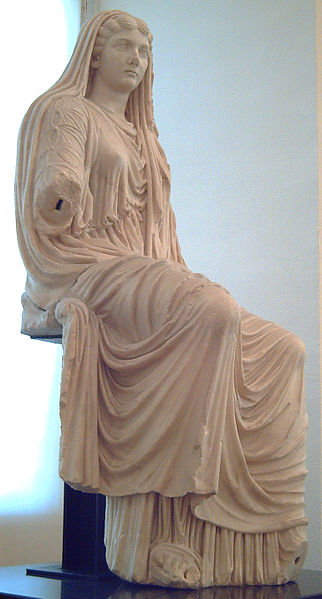
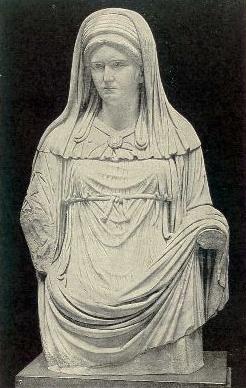
[Virgo Vestalis Maxima (Chief Vestal Virgin), Source: Wikimedia Commons]
The Vestal Virgins, six high priestesses of Vesta, held a special place in Ancient Rome.  They were responsible for maintaining and caring for the sacred fire in the temple of Vesta and, through that, for the well-being of Rome.  In order to do this, they were required to vow themselves to chastity.  If the fire went out or a Vestal broke her vow, disaster would surely follow.

According to Livy, Plutarch, and Aulus Gellius, the second king of Rome, Numa, appointed the first Vestals and laid out their responsibilities.*  New Vestals were taken when they were 6-10 years old and served for 30 years.  After this they retired and could marry if they so wished.  It was considered good luck to marry a former Vestal, but Plutarch also says that many of them refused to do so and were happier for it.

The Vestals were mainly charged with caring for Vesta’s sacred fire, guarding sacred objects and the wills of important people, and preparing the mola salsa, a special flour sprinkled on all public sacrifices. They were watched over by the pontifex maximus and the chief Vestal, who had a seat in the College of Pontiffs and many or may not have been subject to the 30-year limit on a Vestal’s service.

As anyone who talks about the Vestals will mention, the punishment for breaking her vow of virginity was to be buried alive.  It is worth noting though that all ten recorded accusations of unchastity took place during times of upheaval in Rome and it’s likely that all of them were politically motivated.  Nor did all of them end in the death of the accused.  Several were acquitted.

These women held a number of privileges.  They could act without a guardian and make wills.  Seats of honor were reserved for them at all public games and performances.  Their carriages had right-of-way in the streets and a person sentenced to death who accidentally encountered a Vestal was automatically pardoned.  The evidence given by a Vestal was trusted without her needing to take an oath.  By taking on the priesthood of Vesta they became more than ordinary women, holding extraordinary status and responsibility.


*Livy’s claim that Rhea Silvia, mother of the founders of Rome, was a Vestal herself would seem to contradict this.  Given the fact that he, Plutarch, and Aulus Gellius were all writing 600-700 years after the events they describe, we can pretty safely assume that the details of these accounts are more legend than fact.

Sources/Further Reading:
Plutarch, "Life of Numa Pompilius" 9.5-10, 2nd century CE - Diotima
Aulus Gellius, Attic Nights 1.12. L, 2nd century CE - Diotima
Livy, The History of Rome 1.20, 1st century BCE - Perseus
The Laws of the Kings, 7th century BCE - Diotima
The Twelve Tables (excerpts). Rome, 450 BCE (traditional date) - Diotima
On Guardianship (Gaius, Institutes 1. 144-5, 190-1) - Diotima
An Inscription in honor of C
oelia Concordia, Chief Vestal - Diotima
Vestal Virgin - Wikipedia
Vesta - Wikipedia
Oldest Roman Hairstyle Recreated for First Time - Live Science
Vestal Hairdressing - YouTube
0 Comments

Holy Roman Empress Theophanu

26/5/2014

0 Comments

 
Picture
[Statue of Theophanu at St. Dionysius in Eschwege, source: Wikimedia Commons]
Empress Theophanu (c. 955 – 991 CE) was a Byzantine princess who married into the Ottonian royal house.  Hers is a story of overt power and kingship.  In the course of her life she ruled both Italy and Germany as regent for first her husband, and then her son.  Though her power came through them, she issued charters in her own name and with her own seal, titling herself “Emperor” rather than “regent.”  She is also credited with introducing the fork to Western Europe.

We know nothing of Theophanu’s life prior to her marriage.  Her marriage certificate identifies her as the neptis (which can mean either niece or granddaughter) of Emperor John I Tzimiskes.*  Theophanu’s marriage to Otto II in 972 represents the culmination of more than a hundred years of effort on the part of the Carolingians and Ottonians to secure a Byzantine marriage.  She was crowned and anointed Empress the day after the wedding.**
Picture
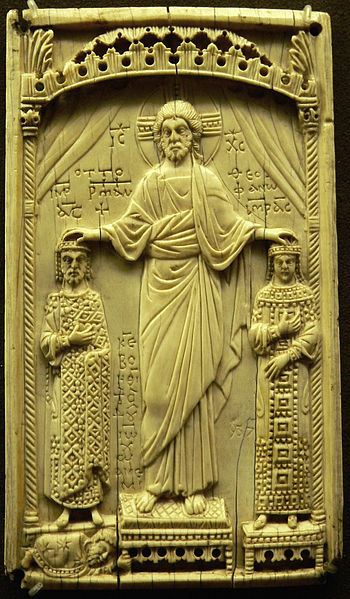
Can I just point out that the two of them are depicted as being the same height?  (And that I'm really hoping the person in the lower left corner is just bowing and isn't about to be used as a step-stool.)
[The Crowning of Otto II and Theophanu, book cover, 10th century]
[Source: Wikimedia Commons]

Between 975 and 980 Theophanu had six children (one of whom died in infancy) while accompanying her husband in his travels.  She spent a significant portion of her marriage as her husband’s regent in Italy.  When Otto II died in 983, Duke Henry the Quarrelsome attempted to take control of the three-year-old Otto III.  Theophanu allied herself with her mother-in-law, Adelaide of Italy, and defeated him a year later.  The two women, however, did not get along and Theophanu soon made herself sole regent.  Even as regent she ruled in her own name, not that of her son, issuing documents in her own name.

Like any other queen, she had her detractors and her admirers, though her situation was exacerbated by her status as a foreigner.***  Many thought her arrogant and extravagant.  She never got along with Adelaide and the two fought frequently.  Others, however, considered her cultured and wise.  After her death at Nijmegen in 991, the chronicler Thietmar called said that “she possessed moderation, trustworthiness and good manners” and that she “protected with male vigilance the royal power for her son, friendly with all those who were honest, but with terrifying superiority against rebels.”


*He was a former general who had usurped the throne in 969, but at this point the Ottonians would take what they could get.  It’s also entirely possible that Theophanu was related to the previous Imperial line on her mother’s side.  Like many things in history, it’s hotly contested by scholars.
**Her husband had been crowned co-emperor five years earlier.
***Which also meant that her family was farther away and probably less willing to help her should she end up in trouble.

Sources/Further Reading:

Stafford, Pauline. Queens, Concubines, and Dowagers: the King's Wife in the Early Middle Ages. Athens, Georgia: University of Georgia Press, 1983.

Theophanu - Epistolae (This link includes the text of nine letters written to her.)

The Princess Theophano - Byzantine Blog
Theophanu - Wikipedia
Otto II - Wikipedia
0 Comments

Roman Law on Adultery

23/5/2014

1 Comment

 
Roman law on adultery can’t simply be stated.  It changed over time (more than 1000 years) and didn’t always reflect how people actually behaved.  As with laws today, just because the law said something, didn’t mean that anyone paid attention.  One factor, however, remained constant: this was a crime that could be committed against a husband or a father, but not a wife.

The very earliest Roman laws to mention adultery are those attributed to Romulus, the first king, usually dated to the 8th century BCE.  They allowed the death penalty for both adultery and drinking wine, and it was a woman’s husband and his cognates* who judged her.
Picture
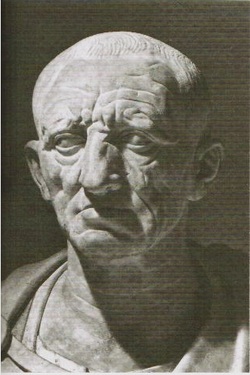
Cranky-looking old man.
[Bust assumed to be Cato the Elder, 2nd century BCE, source: Wikimedia Commons]

This rather extreme reaction to adultery (and to drinking wine) fell out of favor fairly quickly.  By the 2nd century BCE, Cato the Elder’s claim that a husband had the right to kill his wife for this offence was less an accurate description than the wishful thinking of a man looking back to the “good old days.”  If Roman men had any such right at this point, which is highly doubtful, it applied only to those few in marriages cum manu.  Usually it was the individual families who dealt with cases of adultery, with divorce and the wife’s loss of part of her dowry to her (now ex-) husband’s family.
Picture
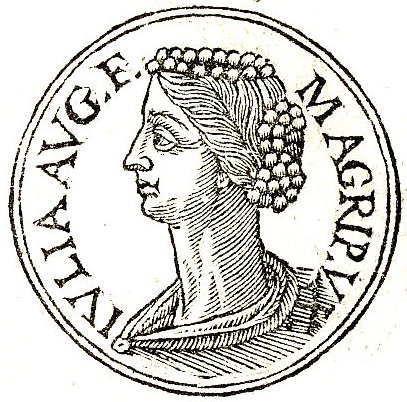
Julia the Elder, daughter of Augustus, fell afoul of her father's adultery laws and was exiled.
[Julia Augusti Filia, 1553, Guillaume Rouille, Source: Wikimedia Commons]
In 18 BCE, Emperor Augustus made adultery a legal crime once more.  His Julian Laws made it legal for a father or a husband to kill certain people if they caught them in the act with their daughter/wife.  People convicted of adultery became subject to a loss of some of their property and exile to an island.**  A husband whose wife was convicted was required to divorce her or be prosecuted as a pimp.  The laws go into great detail about various circumstances and who can and cannot commit or accuse someone else of adultery.  How much they were enforced, however, is up for debate.  The only example we have is of the exile of Julia, daughter of Augustus.  Given the jurists’ concern with it in the next three centuries, it seems likely that the laws had some effect.  If such things happened more often though, you would think that it would show up in the primary sources.


*It’s basically a fancy word for “relatives” (from the Latin co-, meaning “with,” and natus, meaning “born”).  Some people limit the term to mean only the mother’s side of the family, but in this case it seems to refer to both sides.  I used it here because it’s common enough in roman legal texts that it’s probably a good word to know.  And I wanted to call it a “fancy word,” which it is.
**People convicted of adultery with each other were to be sent to separate islands.

Sources/Further Reading:
The Laws of the Kings, 8th century BCE - Diotima
Cato the Elder on Adultery (from Aulus Gellius Attic Nights, 2nd cent.)
- Diotima
The Julian Marriage Laws (from various primary sources) - Diotima
Roman Jurists on Adultery - Diotima
Roman Jurists on the Right of Life and Death - Diotima
Marriage in Ancient Rome - Wikipedia
Lex Julia - Wikipedia
Cato the Elder - Wikipedia
Julia the Elder - Wikipedia
1 Comment

Lay Abbots and Abbesses

21/5/2014

0 Comments

 
Usually the head of a Catholic monastery, known as the abbot or abbess, is a member of that community, having taken the same vows and living under the same rule.  This has not always been the case.  From approximately the 8th to the early 12th centuries in Western Europe it was not uncommon for the abbot or abbess to be a lay person, often one with little to no real connection to the community.

This was particularly common in the Frankish kingdoms, though it happened elsewhere too.  Some important personage, usually but not always the king, would give a monastery to a friend, a wife, or a person they wished to reward.  Charles Martel, Mayor of the Palace to the Merovingian kings and grandfather of Charlemagne, was supposedly the first to do this.  Many subsequent kings continued this practice even while supporting the very reformers who called for an end to it.*

Queens and king’s daughters were common recipients of such honors, as were princess’s husbands.  Charlemagne made his friend Angilbert, who was also his daughter Bertha’s lover, abbot of St. Riquier.  After his death, the post of abbot was given to other laymen.  Gisla, daughter of Lothar II received charge of monasteries of Nivelles and Fosses (a male monastery).**  Richardis, wife of Charles the Fat, was variously the lay abbess of monasteries at Säckingen, Zurich, and possibly Andlau.

The Church as an institution was, unsurprisingly, not happy with this way of doing things.  The general claim was that lay abbots and abbesses led their monasteries into decay and degeneracy.  Given both the general lack of any close relationship between the lay abbot/abbess and the community and the usual lack of interest in monastic life on the part of said lay abbot/abbess, this is unsurprising.  (It is worth pointing out, however, that both Richardis and Agilbert (discussed above) are now considered saints.)  Several synods and church councils over the centuries condemned the practice, but it wasn’t until the Investiture Controversy*** came to a head in the 11th and early 12th centuries that the practice was ended and only people who had taken vows were allowed to become abbots and abbesses.


*The Rule of St. Benedict, for example, states explicitly that the abbot of a monastery should be elected by the members of the community.  It gives no option for appointment by an outsider.  Charlemagne had no qualms appointing people as lay abbots and abbesses while working to spread the use of this particular Rule.
**As far as I can tell, it was highly unusual for a woman to be given a male monastery or vice versa, but it apparently happened at least this once.
***Way oversimplified, this was a “No, me!” fight between secular rulers and the Church over who got to appoint the bishops.

Sources/Further Reading:
The Rule of St. Benedict, Chapter 68 (part 2) - Order of St. Benedic

Jo Ann McNamara. Sisters in Arms: Catholic Nuns through Two Millennia. Harvard University Press, 1998.
Lay Abbot - Catholic Encyclopedia
Lay Abbot - Wikipedia
Richardis - Wikipedia
Angilbert - Wikipedia

0 Comments

Aspasia

19/5/2014

0 Comments

 
Picture
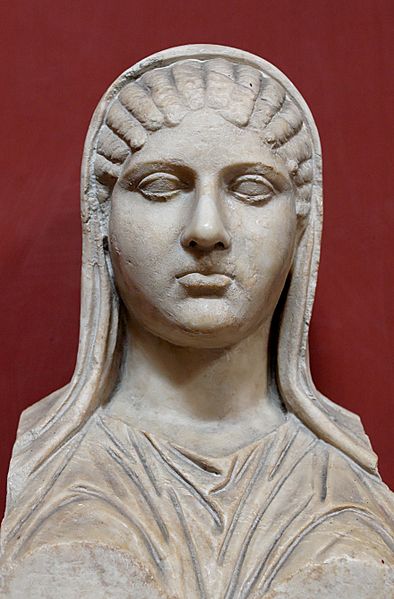
This bust has the name Aspasia inscribed on its base.  Was it intended to show the famous one?  Like so many things about Aspasia, we'll never know.
[Bust of Aspasia, Roman copy of a Hellenistic original, Vatican Museums]
[Source: Wikimedia Commons]

Aspasia (c. 470 – c.400 BCE), companion to Pericles, the great statesman of Athens, is said to have influenced not only his actions, but also the philosophies ofSocrates, Plato, and Alcibiades.  For all that many Greek and Roman writers mentioned her in various contexts, it’s difficult to write anything definite about her as a person.  Most of our information comes from Plutarch’s Life of Pericles, written seven centuries after she died.  Much of the rest of what we know, and probably much of Plutarch’s information, comes from comedies, not the best source if you want to know the truth and have little to no other context.

What we know as probably true is this: Aspasia was the daughter of Axiochus* and originally came from Miletus.  She was extremely well educated and highly intelligent, which may have been part of the reason she caught the eye of Pericles shortly after she moved to Athens.  The two of them lived together for the rest of his life and had a son, Pericles the Younger.*  She behaved as no proper Athenian wife would, participating in discussions at the symposia.***  Public sentiment towards her was not always positive, and many seem to have blamed her when Athens embroiled itself in a war with Samos on behalf of her home city, Miletus.

Given the Greeks’ concern for the sexual tethering of their women, it is unsurprising that whether she was a hetaera (courtesan) remains up for debate.  It is also entirely possible that she trained young hetaerae as well.  Plutarch says, however, that she was so compelling a speaker that men would take their wives to hear her speak despite her disgraceful occupation.

Many scholars call the suggestion made by contemporary sources that she was a brilliant speechwriter and teacher of rhetoric who influenced the works of Socrates, Alcibiades, and Plato a joke.  Perhaps it was.  Perhaps it was a case of literate men hiding the fact that a smart woman who was willing to speak publically made them uncomfortable.  Later writers like Plutarch and Cicero, however, took these claims seriously.  We can never know the exact truth of Aspasia’s life or the claims made about her, but it’s not just her life that was important.  The interpretation of later writers tells us that no matter what people in her own time though of her, she had an enduring reputation as a highly intelligent and influential woman.


*Not that we know anything for sure about him other than that he was Aspasia’s father.
**He went on to gain Athenian citizenship, become a general, and then get executed for leaving survivors of a naval battle to drown.
***Men’s drinking parties, where not only some of the behavior you would expect at a modern drinking party took place, but also philosophical discussions and political maneuvering.

Sources/Further Reading:

Translations of Plutarch's "Life of Pericles" (24.1-6) [I would suggest using the find function]
Plutarch's Parallel Lives - Project Gutenberg (This contains all of Plutarch's Lives.)
Pericles - MIT (This page doesn't divide by sections.)
The Life of Pericles - Penelope.uchicago.edu

Plutarch, Life of Pericles 24.1 - Perseus

Aspasia - Wikipedia
Aspasia - Nexus
Aspasia - Ancient History Encyclopedia
0 Comments

The Inquisition in the Languedoc

16/5/2014

0 Comments

 
Warning: Brief discussion of torture.

There were several official Inquisitions that were set up by the Catholic Church from the 12th century onward to deal with various heresies.  In the 1230s the Church had found that while secular leaders could be relied on should force be necessary, the Albigensian Crusade hadn’t actually done much to rid the countryside of Catharism.  It didn’t help that these close-knit communities had very little reason to open up to strange churchmen and tended to be unwilling to expose the Cathars among them, at least until Pope Gregory IX set up the first Papal Inquisition.

This was run primarily by the Dominican Order.  The inquisitors would travel around the countryside in pairs, giving the towns they went to very little notice of their arrival.  They gave the inhabitants a short period of time in which to come forward, repent if they themselves were heretics, and denounce any Cathars or those who harbored them in the town.  Accusations were made in secret and any who came forward were required to swear an oath of faith to the Catholic Church.*
Picture
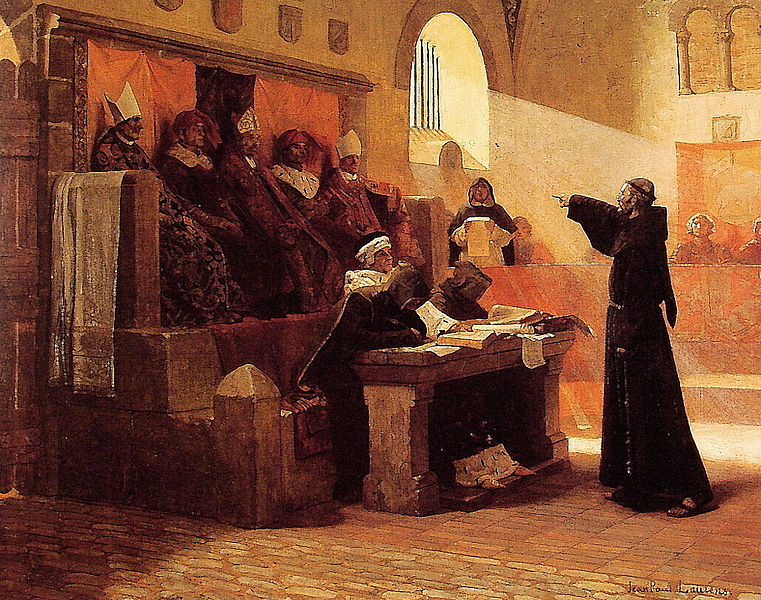
The Cathars weren't the only heretics to come up against the Inquisition.  This guy, Bernard Délicieux, was a member of the Spritual Franciscans.
[The Agitator of Languedoc, Jean-Paul Laurens, 1887, source: Wikimedia Commons]
After this, the inquisitors arrested those accused and imprisoned them.  The defendant was not informed who had accused them and they were not permitted an advocate.  Torture could be used to extract a confession, but only once per charge.**  The goal here was not punishment but reconciliation to the Church.  Should someone confess and repent, they were required to do penance, which involved wearing large, bright yellow crosses on their clothes for the rest of their lives at the very least.  Should they refuse to repent, as many bonnes did, they were passed on to the secular authorities and usually executed.  It’s important to note, though, that the vast majority of those accused were not killed.  Again, the goal here was conversion.
Picture
The cross repentant Cathars were required to wear.  Great way to ostracize people.
[The Cathar Cross, image created by R Neil Marshman, June 2006]
[source: Wikimedia Commons]

The Inquisition’s methods worked where military force hadn’t.  They made it impossible for one to trust one’s neighbors even if one were innocent.  After all, the inquisitors assumed that every accusation was a true one.  What was to prevent someone from accusing their neighbor against someone out of resentment over some previous altercation, regardless of how true or false it might be, especially when their name would be kept secret?  By the mid-14th century Catharism had disappeared entirely.


*This was intended to weed out any Cathars who were concealing that fact in order to accuse somebody else, as they would refuse to swear any oath, let alone one to the Catholic Church.
**The portrayal of how commonly torture was actually used against those accused of heresy is rather predictably correlated with the agenda and biases of the person talking about it.  I don’t claim to be innocent of this either.  I will, however, point out that the use of torture at this time was only slightly less unusual than witch hunts and witch burning.  (Hint: There wasn’t any hysteria over witches in Europe until a few centuries later.)  The Inquisition’s rather liberal use of it was the dramatic exception, not the rule.

Sources/Further Reading:

Barber, Malcolm. The Two Cities: Medieval Europe 1050-1320. London: Routledge, 1993.

Stephenson, Carl and Bryce Lyon. Mediaeval History: Europe from the Second to the Sixteenth Century. New York: Harper & Row, 1962.

Excerpts from Bernard Gui's Inquisitor's Manual (written early 14th century)
Inquisitorial Technique - Internet History Sourcebooks Project
On the Albigensians - Internet History Sourcebooks Project
On the Beguins or Beguines - Internet History Sourcebooks Project

The Medieval Inquisition
in Languedoc - Cathars and Cathar Beliefs in Languedoc
Catharism - Wikipedia
Medieval Inquisition - Wikipedia
Bernard Gui - Wikipedia
Bernard Délicieux - Wikipedia

0 Comments

Manus Marriage in Ancient Rome

14/5/2014

3 Comments

 
Note: Reading back over this I've noticed errors resulting from some confusion over the difference between being under someone's guardianship and being under their legal power.  I'll be fixing that soon.
Picture
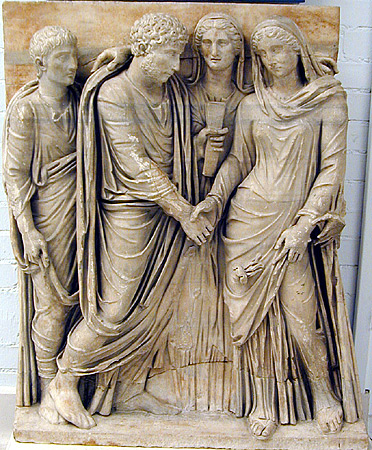
[Fragment of a sarcophagus depicting a Roman marriage ceremony, 2nd century (CE?)]
[British Museum, Sources: Wikimedia Commons, British Museum]

There were two major types of marriage in Ancient Rome: cum manu and sine manu.  The difference between them had to do with whom the wife had as a guardian during the marriage.

In a cum manu marriage, the bride legally became part of her husband’s family and came under the guardianship of either her husband or, if he was still under his father’s guardianship, her father-in-law.  Any property she acquired during the marriage belonged to her husband, with the exception of her dowry, which was supposedly held in common.  She was emancipated and became sui iuris (came under her own guardianship) on the death of her husband. 

A woman could enter a cum manu marriage in one of three ways: through confarreatio, coemptio, or usus.  The first of these, confarreatio, involved a special sacrifice to Jupiter and was restricted to the Roman elite since it required the presence of certain high officials. Priests of Jupiter, Mars, and Quirinus were required not only to be born of such marriages, but also to enter into them themselves.  A coemptio marriage was the fictitious sale of the bride and gave her the legal status and rights of a daughter in her husband’s house.*  However, by the 2nd century CE a woman in this sort of marriage could force her husband to emancipate her so that she could divorce him.  A marriage by usus was essentially the equivalent of a modern common-law marriage.  The couple simply had to live together for a year.

In a sine manu marriage, the bride remained part of the family she was born or adopted into as a child and stayed under her father’s guardianship.  Her property remained her own, again with the exception of her dowry, and she became sui iuris on the death of her father. As this type of marriage became more common it became difficult to find candidates for priesthood.  The solution was to treat priests’ wives as being under the guardianship of their husbands only during rituals.  The rest of the time they were considered to be married sine manu.  By the 1st century BCE, this was the predominant form of marriage in Ancient Rome.


*A woman could also contract a coemptio with someone she didn’t marry for the purposes of getting a different guardian from the one she already had or to gain the right to make a will.

Sources/Further Reading:
On Marital Subordination _(Gaius, Institutes 1.108-118, 136-137a)  - Diotima/WLGR
Consent as the basis of marriage - Diotima/WLGR (excerpts from Modestinus, Julianus, Celcus, Ulpian, and Paul)
Pronouncement of the emperors Diocletian and Maximian - found in hardcopy of WLGR (Lefkowitz & Fant), no link available
A funeral eulogy, ILS 8393, 1st century CE - Diotima/WLGR
Marriage in Ancient Rome - Wikipedia
Manus Marriage - Wikipedia
3 Comments

Judith of Flanders

12/5/2014

3 Comments

 
Picture
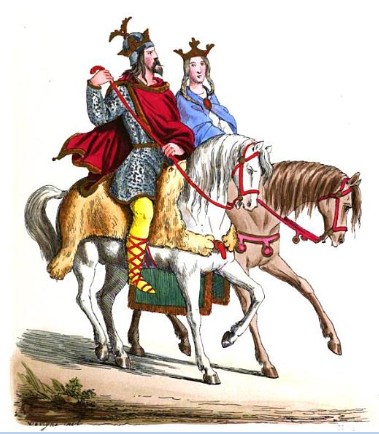
A 19th century image of Judith with her third husband, Baldwin.
[Baldwin I of Flanders and Judith of France, 1849, Félix de Vigne]
[Album du cortége des Comtes de Flandre, source: Wikimedia Commons]

Most of what we know of the life of Judith of Flanders (c. 843 – after 870) comes through information on her marriages, of which she had three, to Æthelwulf of Wessex, to Æthelbald of Wessex, and finally to Baldwin of Flanders.  She was the daughter of Charles the Bald, granddaughter of Judith of Bavaria, and ancestor of Matilda of Flanders, wife of William the Conqueror.

She was only twelve when she became the second wife of Æthelwulf of Wessex in 855.  Her father, perhaps remember what his own mother, Judith of Bavaria, had gone through as the second wife of a king who already had heirs, hedged the marriage around with as many safeguards as possible, including having her crowned and anointed as Queen.  The wives of the kings of Wessex were traditionally not queens, but merely king’s wives.  This is also the first recorded instance of the anointing of an early medieval queen.

When Æthelwulf died three years later, Æthelbald, his son by his first wife, married her, probably in order to keep the alliance with her father and the prestige that came with being connected to the Carolingians.  Many at the time condemned the marriage.

Two years later, in 860, Æthelbald died, leaving Judith twice widowed before the age of 20.  Since she had no children she had no ties to Wessex at this point either.  She sold her properties there and returned to France.  Her father sent her to the monastery at Senlis, probably hoping to arrange another marriage for her.  Judith, however, had other ideas.  Near Christmas 861 she ran off and married a count named Baldwin..  Her father was furious and tried to get them excommunicated, forcing them to flee first to Judith’s cousin, Lothar,* and then to Pope Nicholas I for protection.  It was Nicholas who persuaded Charles to accept the match and make Baldwin the Count of Flanders.  The couple was officially married in 863 and had 3 children together.  We don’t know when Judith died, only that she was still alive in 870.


*He was, by the way, in the middle of his own marriage problems.

Sources/Further Reading:

Stafford, Pauline. Queens, Concubines, and Dowagers: the King's Wife in the Early Middle Ages. Athens, Georgia: University of Georgia Press, 1983.

Judith of Flanders - Wikipedia
Æthelwulf of Wessex - Wikipedia
Æthelbald of Wessex - Wikipedia
Baldwin of Flanders - Wikipedia

3 Comments

Matrons in Ancient Rome

9/5/2014

2 Comments

 
Holding the title of “matron” in Ancient Rome was a sign of a certain status.  A matron was a woman with a certain amount of distinction.  She was freeborn and usually either married or a widow.  These are, however, ideals and the problem with ideals is that everybody references them but nobody explicitly defines them.  People are simply expected to understand the concept.  The status of Matron was a powerful concept to reference, but not a static one.
Picture
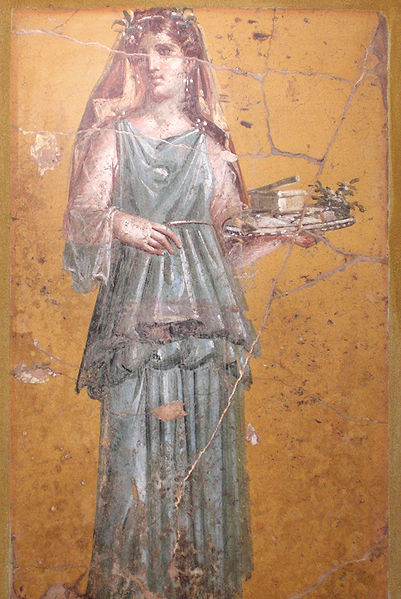
[Fresco of a woman with a tray, Villa San Marco at Stabiae, photographed by Luiclemens]
[Source: Wikimedia Commons]

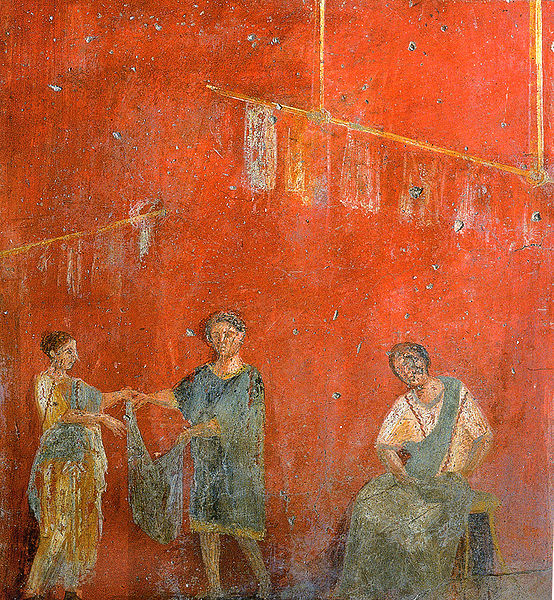
There were some concrete markers of this status, especially in terms of clothing.  During the late Republic and throughout the time of the Empire a matron generally wore two tunics covered by a long dress known as a stola.  When she went out she would add a palla, a mantle draped over the shoulders and sometimes over the head as well.  Young girls, prostitutes, and those who had forfeited the title of matron (usually through being caught in adultery) were not permitted to wear either of these garments.*
Picture
Livia Drusilla in a stola and palla.
[Livia Drusilla, early 1st century CE, National Archaeological Museum of Spain]
[Source: Wikimedia Commons]
Though matrons were generally expected to occupy themselves with running their households, as a group they also granted various honors and responsibilities on certain occasions and could get their voices heard in ways other women could not.  A Vestal Virgin who fell seriously ill would be given into the care of some well-respected and wealthy matron.  One of the reasons Hortensia and the women who accompanied her were listened to was because they were respected matrons.
Picture
[Fresco of women hanging clothes to dry, found in a dyer's shop, Pompeii]
[Museo Archeologico Nazionale di Napoli, source: Wikimedia Commons]

As I mentioned above, one could lose this status.  An adultery conviction was the most obvious way this could happen, but there were other reasons.  Cicero argued that that to use the title “matron” with any connection to Clodia, whom he accused of poisoning and seduction was the height of impropriety.  Concubinage, however, seems not to have necessarily caused a woman to forfeit the title of matron.  The jurist Ulpian, at least, argues that a concubine’s patron can only accuse her of adultery as a third party and then only if she has not already forfeited the name of matron.  So perhaps the title of matron and the ideal behind it had some flexibility, at least by the 2nd century CE.

*Young girls wore tunics while prostitutes and women convicted of adultery were required to wear togas.

Sources/Further Reading:
Papinian, Adultery, book 2 (Digest 48.5.11) - Diotima
Ulpian, On Adultery, book 2 (Digest 48.5.14) - No link available (found in Lefkowitz & Fant, see below)
Cicero, Pro Caelio 13-16. L - Wikisource (Latin text - Latin Library)
Pliny the Younger, Letters 7.19. L - Diotima
Excerpts from Sarah Pomeroy's "The Roman Matron of the Late Republic and Early Empire" - Stetson.edu
Women in Ancient Rome - Wikipedia
Lefkowitz, Mary R. and Maureen B. Fant. Women's Life in Greece & Rome: A sourcebook in translation. Baltimore, MD: Johns Hopkins University Press, 1992.
2 Comments
<<Previous

    My Blog

    Translation of the above: where I post the interesting things I find researching the Classical and Medieval periods in my free time.

    Currently Reading:
    -
    Medieval Monasticism by C. H. Lawrence

    Archives

    March 2016
    February 2016
    January 2016
    December 2015
    November 2015
    October 2015
    September 2015
    August 2015
    July 2015
    June 2015
    May 2015
    April 2015
    March 2015
    February 2015
    January 2015
    December 2014
    November 2014
    October 2014
    September 2014
    August 2014
    July 2014
    June 2014
    May 2014
    April 2014
    March 2014
    February 2014
    January 2014
    December 2013
    November 2013
    October 2013
    September 2013

    Categories

    All
    Architecture
    Biography
    Classical
    Law
    Marriage (legal And Otherwise)
    Medicine
    Medieval
    Misconceptions
    Monasticism
    Overview
    References
    Religion
    Review

    RSS Feed

Powered by Create your own unique website with customizable templates.