Emily Kittell-Queller
  • Home
  • About Me
  • Blog
  • Projects
  • Resume
  • Contact Me

Cleopatra Selene I

30/11/2015

0 Comments

 
Picture
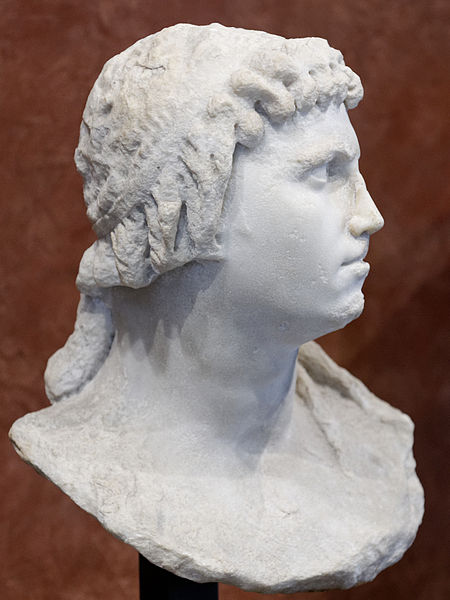
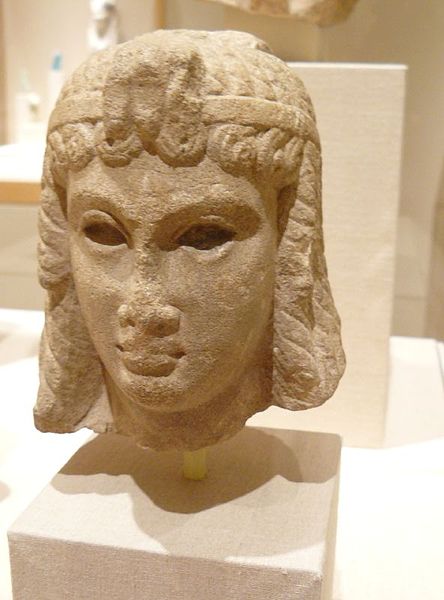
This may or may not be Cleopatra Selene I.  It's also been speculated to be Cleopatra VII (yes that Cleopatra).
[Head of a Ptolemaic Queen, Brooklyn Museum, source: Wikimedia Commons]
Cleopatra Selene I (d. 69 BCE), queen three times over with at least four marriages, appears more a pawn in the schemes of others than a major player in her own right.  She showed, however, a remarkable ability to survive violent regime changes.  Eventually, she ruled Syria as Queen Regent for a time and was able to make a play for the Egyptian throne on her sons’ behalf.
 
Cleopatra Selene, originally known only as Selene was the daughter of Cleopatra III and Ptolemy VIII.  She took the royal name Cleopatra when her mother had her marry her brother Ptolemy IX Soter as his second wife after her elder sister Cleopatra IV.  The marriage lasted at least eight years and may have resulted in one child, Berenike III.*  They may or may not have divorced when Ptolemy was deposed in favor of his younger brother, whom she may or may not have next married.
 
In 103, she once again followed in the steps of an elder sister, Cleopatra Tryphaena, who in this case had died rather than been divorced, and married Antiochos VIII Grypus, king of Syria.  They were married only five years before he died.  Cleopatra remained in power though, next marrying Antiochos IX Cyzicenus.  Whether or not she had children with either of these husbands is unclear.  When he was killed, she married his rival, Antiochos X Eusebes, by whom she had two sons.
 
After the death of her last husband, Cleopatra took over, ruling as regent for her two sons.  Meanwhile, back in Egypt, the question of the succession reared its head.  There were no legitimate male heirs in the male line.  Cleopatra seized her chance and pushed for her one of her own sons to inherit.  Instead, the ruling elite decided to legitimize one of Ptolemy IX’s illegitimate sons and make him king.  Cleopatra appealed to Rome to no avail.
 
Her reign ended not when her elder son came of age, but when the Armenian king Tigranes II overran the Seleukid kingdom.  Cleopatra found herself besieged in Ptolemais.**  She was captured and executed a few years later in 69 BCE.
 
 
*It’s also possible that Berenike was her sister Cleopatra IV’s daughter, but it appears less likely.
**Later known as Acre

Sources/Further Reading:
Strabo, Geography 16.2.3 - Lacus Curtius
Appian, Syrian Wars 11.69 - Perseus
Flavius Josephus, Antiquities of the Jews 13.16.4 - Perseus
Justin, Epitome of the Philippic History of Pompeius Trogus 39.3 - Forumromanum.org
Cleopatra Selene - Egyptian Royal Genealogy
Cleopatra V Selene - Livius.org
0 Comments

Sumptuary Laws in Athens

26/11/2015

0 Comments

 
Sumptuary laws are those that regulate consumption and display, particularly conspicuous consumption.  Most of what we know about Athenian sumptuary laws relates to funerals, regulating everything from where certain portions of the ceremonies could be held, to what people (especially women) could wear, to what the stela (tombstone) could look like.  They also regulated what people, once again, especially women, could wear in public and how extravagant dinner parties could be, usually in an effort to control the upper classes.
 
There were two particular instances when some rather strict laws were put in force in Athens.  The first was around the time of Solon in the 6th century BCE, while the second was several hundred years later, in the late 4th and early 3rd centuries BCE.  A good number of Solon’s restrictions concerned the behaviour and appearance of women, what they could wear, who could ride in a cart, how different classes were to be identified.  Now, some of this was to regulate the women themselves, but as several scholars have pointed out, a lot of it was to control their husbands.  At this point in time, especially among the wealthy of Athens, a man’s wife and daughter’s appearances were a big part of how he displayed his wealth and power.  By defining who could wear what and curbing the worst of the excesses, Solon reinforced the existing social order.  He limited obvious social mobility to ensure that people were more concerned about class differences than about taking his power and tried to minimize social friction between men of the same class.
 
The second major instance took place in the late 4th century BCE when Demetrios of Phaleron ruled the city for the Macedonian king Cassander.  Once again this was a man who needed to reinforce social distinctions.  At the time, the wealthy of Athens could be divided into two groups: old money and new money.  By passing strict sumptuary laws, especially those concerning funerals, he tried to curb displays of wealth that only fueled the antagonism between these two groups and maintain stability.

Sources/Further Reading:
Pomeroy, Sarah B.  Goddesses, Whores, Wives, and Slaves. New York: Schocken, 1995.
Small, David. "A Defective Master Narrative in Greek Archaeology" - Academia.edu
Shipley, Graham. The Greek World after Alexander 323-30 B.C. New York: Routledge, 2000.
0 Comments

Juana I of Navarre

23/11/2015

0 Comments

 
Picture
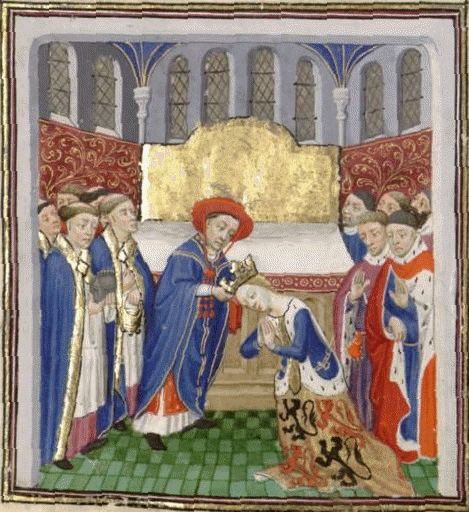
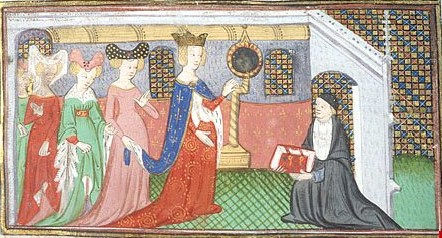
She's presumably the one in a crown instead of a fancy hat.
[Durand of Champagne presents Queen Joan with the Speculum Dominarum, 14th century, source: Wikimedia Commons]
Juana I (or Joan) of Navarre (1273-1305), Queen of France by her marriage to Phillip VI the Fair, in her own right Queen of Navarre and Countess of Champagne and Brie, was the ideal Queen Consort, mistress of the court, mother to Philip’s heirs, and beloved of his people.  She was a less ideal Queen Regnant for Navarre, never again setting foot there after her mother spirited her away to France when she was two.

Juana was the daughter of Enrique I and Blanche of Artois.  At the time of her birth, the likelihood of her becoming Queen was relatively small.  Though her uncle Teobaldo II had died on the Second Crusade, she still had a brother who would inherit before her and her father was young enough to live a while yet anyway.  But both her brother and father died within two years of each other,* leaving the infant Juana as Queen of Navarre and her mother as regent.

Blanche, rather than face four different kings itching to gobble up Navarre into their kingdoms, fled to the protection of one of them: Phillip III of France.  Juana would never return to Navarre, which would instead be ruled by deputies of the King of France, a move that was not at all popular with the Navarrese, who blamed the king and held Juana blameless.  Instead, she married the future Phillip VI when she was 11, becoming queen a year later.  The two were very close.

Juana was not a very politically active queen.  She had no say in the government of Navarre.  She did, however, take her position as the ruling Countess of Champagne very seriously, on one occasion raising an army to beat back Count of Bar’s invasion.  She was also active in areas other than politics.  She took a keen interest in religion in particular, founding churches in both France and Navarre.  She also involved herself in matters concerning the Inquisition in the Languedoc (now southern France), using her influence to get a royal audience for the agitator Bernard Delicieux and the wives of men wrongfully imprisoned as Cathars.

Juana and Phillip had several children together.  In 1294, Phillip named her regent should he die before her.  This was not to be.  Juana died before her husband in 1305, probably in childbirth.


*Her brother from accidental defenestration (i.e. falling out a window**) and her father from, apparently, choking on his own fat.
**I just really wanted to use the phrase “accidental defenestration.”

Sources/Further Reading:
Woodacre, Elena. The Queens Regnant of Navarre: Succession, Politics and Partnership 1274-1512. New York: Palgrave Macmillan, 2013.
O'Shea, Stephen. The Friar of Carcassonne: Revolt against the Inquisition in the Last Days of the Cathars. Bloomsbury Publishing, 2011.
0 Comments

Catholic Jubilee Years

19/11/2015

0 Comments

 
Pope Boniface VIII declared the first Jubilee, or Holy Year, in 1300.  Pilgrims were flocking to Rome in greater numbers than usual, and they seemed to expect something special beyond the usual indulgences for the turn of the century.  Though some cardinals complained about apocalyptic nonsense, some response had to be given.  Boniface hit on the idea of a Jubilee Year.*  Anyone who made the pilgrimage to Rome and visited the churches of Sts. Peter, Paul, and John the Lateran could gain remission of all penances for their sins.**  Smaller jubilees also happened at Canterbury Cathedral on specific anniversaries of the translation of St. Thomas Becket.
 
When Boniface introduced the idea in this form, he intended for Jubilees to happen every 100 years, but in 1343, Pope Clement VI shortened the interval to 50 years.  Their popularity was such that Urban VI declared 40 years later that every 33 years was an appropriate way to remember the life of Christ and made 1390 a Jubilee as well.  Enough people flocked to Rome in 1400 that an unofficial Holy Year took place then too.  Finally, people settled on 25 years as the appropriate interval.
 
The declaration of a Jubilee produced more than just spiritual benefits.  The great numbers of pilgrims crowding to Rome brought economic prosperity to the city and to those towns on the way there as well.  Charitable institutions, particularly religious ones, received large donations.
 
However, the large numbers had the potential to create problems too, some more serious than others.  As space ran out in inns and hospitals, some pilgrims found themselves without somewhere to sleep until householders began offering space in their homes.  More pressing was the danger presented by large numbers of people in small places.  A spooked donkey or simply a few individuals suddenly inspired to religious fervor could cause a crush of people, leading to a number of deaths and serious injuries, as happened in St. Peter’s in 1300 and on the Ponte Sant’ Angelo in 1450.
 
Jubilees have continued to occur every 50 years up to the present day, with the most recent in 2000.  While ordinarily the next one would not occur ‘til 2050, the current pope, Francis, has declared a special Jubilee from December 2015 to November 2016, the Year of Mercy.
 
 
*He pulled the idea from Leviticus and the Jewish idea of a Jubilee Year.  Jews, however, no longer celebrate Jubilees as they are only observed when the twelve tribes all reside in Israel.
**This would not gain them absolution.  It simply meant they did not have to perform the penance imposed.

Sources/Further Reading:
Webb, Diana. Medieval European Pilgrimage. New York: Palgrave, 2002.
Barber, Malcolm. The Two Cities: Medieval Europe 1050-1320. London: Routledge, 1993.
The First Jubilee - Medievalists.net
Francis Announces New Global Jubilee - National Catholic Reporter
0 Comments

Cleopatra III

16/11/2015

0 Comments

 
Note: Since I'm once again dealing with multiple women with the same name, in this post "Cleopatra" refers specifically to Cleopatra III.  Any other Cleopatra will have some sort of other identifier as well.
Picture
[Cleopatra III depicted along with Cleopatra II and Ptolemy VIII, Kom Ombo Temple, Egypt, source: Wikimedia Commons]
Cleopatra III Euergetis, Philometor Soteira (d.101 BCE), like her mother Cleopatra II, knew she was meant to hold power.  She ruled jointly alongside her mother, her uncle-husband, and eventually two of her sons.  She played an active role both in government and in determining who should hold official power.
 
Cleopatra was the daughter of Ptolemy VI and Cleopatra II, who were brother and sister, as their own parents had been.  Her childhood was presumably not a quiet or particularly stable one, considering the tumultuous relationship her parents had with each other and their brother and co-ruler, Ptolemy VIII.  Her father died in 145, when she was somewhere between the ages of 10 and 15, leaving the way for her uncle to take the throne and marry her mother.
 
Cleopatra married her uncle as well about three years later.  She was incorporated into the dynastic cult around the same time and provided with her own priest.  She, her mother, and Ptolemy VIII proceeded to rule as a triumvirate.  This lasted for about 10 years until her mother decided she would rule better on her own and kicked Cleopatra and Ptolemy out of Egypt for three years.*  The two of them eventually managed to depose Cleopatra II and return to their thrones in 127.  The three reconciled by 124 and returned to ruling as a triumvirate.
 
With Ptolemy, Cleopatra had five children, two sons (both named Ptolemy) and three daughters (Cleopatra VI, Cleopatra Tryphaena, and Cleopatra Selene).  On her husband’s death in 116, she and her mother continued as joint rulers with Ptolemy IX, the elder of Cleopatra’s sons until her mother’s death the following year.  Around this time, Cleopatra decided** that that her younger son should rule instead of the elder and so crowned him Ptolemy X, sending Ptolemy IX away.  Unfortunately for her, Ptolemy X would turn out to be perhaps the most unpopular ruler of the Ptolemaic dynasty, making the last five years of her life and rule very unstable.  She died in 101 BCE, possibly (possibly not) murdered by her younger son.
 
 
*The fact that Ptolemy VIII was not particularly well-liked probably made it easier for her.
**Or acted on an earlier decision.

Sources/Further Reading:
Shipley, Graham. The Greek World After Alexander. New York: Routledge, 2000.
Justin, Epitome of the Philippic History 38.8 - Forumromanum.org
Justin, Epitome of the Philippic History 39.4 - Forumromanum.org
Pausanias, Description of Greece 1.9.1 - Perseus
Cleopatra III - Egyptian Royal Genealogy
Cleopatra III - Livius.org
Cleopatra III Euergetes - virtualreligion.net
0 Comments

Foster Children in Rome

12/11/2015

0 Comments

 
Ancient Rome had no public institutions to care for so-called “irregular children,” that is illegitimate children, orphans, and foundlings.  There were public assistance programs, but there was no concept of children outside a family, so children who, for whatever reason, had no place with their birth parents generally wound up adopted, abandoned, or as alumni, foster children.  This last appears not to have been particularly common, but it did happen.
 
In cases like this, someone or someones, generally a married couple would raise a child as a member of their household, sometimes as their own child, sometimes also as part of their legal familia.  The problem is, it seems to have been uncommon enough that the term alumnus/a, here and elsewhere translated as “foster child,” covered a rather broad range of situations.  Essentially it covered any child raised by people not their birth parents and who didn’t go so far as to legally adopt them.
 
To some extent, these relationships also weren’t incompatible with the possible slave status of the child.  There was a term for a child born into slavery within the household: uernae.  Such children might also be considered alumni of the household though, especially if they were later freed.
 
One example of this might be the case of Petronia Iusta.  Her mother, Petronia Vitalis, a freedwoman of Petronius Stephanus and Calatoria Themis, had left Iusta to be raised her former masters for several years.  Eventually she returned to claim her daughter and pay them for the cost of maintaining her.  The subsequent legal dispute over Iusta’s status as freeborn or freed is interesting, but not relevant here.*  Iusta, whether she was born slave or free, was raised as a child of the household and was therefore considered an alumna, a foster daughter.  Because of that, while she wasn’t necessarily entitled to any inheritance, not having been adopted, she did have a certain social connection to them beyond being either their freedwoman or the daughter of one.
 
 
*Basically, Vitalis claimed that she had been free at the time of Iusta’s birth and that Iusta was therefore freeborn.  Calatoria Themis, on the other hand, claimed that Iusta had been born a slave and was later manumitted by Themis herself, making her Themis’s freedwomen.  Neither side had the documentation to back it up.

Sources/Further Reading:
Rawson, Beryl. "Adult-Child Relationships in Roman Society." In Marriage, Divorce and Children in Ancient Rome, edited by Beryl Rawson, 7-30. Oxford: Oxford University Press, 1991.
Weaver, P. R. C. "Children of Freedmen (and Freedwomen)." In Marriage, Divorce and Children in Ancient Rome, edited by Beryl Rawson, 166-190. Oxford: Oxford University Press, 1991.
0 Comments

Philippa of Hainaut

9/11/2015

2 Comments

 
Picture
The one written description we have of Philippa says she was "brown of skin all over" and yet she's ridiculously pale in every single image of her that I've been able to find.
[Coronation of Philippa of Hainault, 15th century, source: Wikimedia Commons]
Chroniclers contemporary to Philippa of Hainaut (1314-1369), Queen of England, seem to have nothing but good to say about her.  A highly intelligent and competent administrator, a prolific mother, and a kind and generous woman, with an impeccable pedigree (four of her great-grandfathers were kings), she appears in some ways the ideal queen.  She was certainly a popular queen, something that she used to help maintain peace in England and elsewhere.
 
Philippa was the second daughter of William I of Hainaut, Holland, and Zeeland and Joan of Valois.  As a child she was highly educated and seems to have maintained an interest in learning throughout her life.  She was already being considered as a potential bride for the future Edward III by the time she was eight.  Bishop Stapledon of Exter provides a detailed description of her at that age including that she was “brown of skin all over, much like her father.”
 
Four years later, in 1326, Queen Isabella came to Hainaut, bringing her son Edward with her, to ask for William’s help in deposing her husband, Edward II.  As part of their agreement, Philippa was betrothed to Prince Edward.*  Accompanied by her uncle, she arrived in England in late 1327 and was married at the age of 14 in January of the next year.

Picture
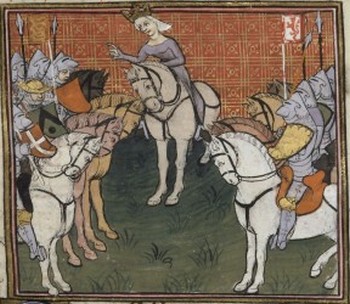
She may or may not have actually fought, but we do know she sometimes went on campaign with her husband.
[Philippa and her army, 15th century, source: Wikimedia Commons]
She wouldn’t be crowned queen until early 1330.  Though Edward was king, Isabella still ruled in practice and wasn’t yet ready to give up her title.  Only once they had a son, Edward,** born in mid 1330, did Philippa and Edward feel secure enough to stage a coup, executing Isabella’s lover, Roger Mortimer, and exiling Isabella from court.
 
Philippa ruled as regent when Edward went off to fight the Hundred Years War, though she did accompany him a few times, as did most of their children.  She was a popular queen, known for her kindness and generosity, as well as her patronage.  Queen’s College at Oxford is named for her and was founded at her instigation.  She also took an active interest in the textile trade, bringing several Flemish weavers to England.
 
She died of dropsy in 1369, survived by her husband and 9 of her 14 children.  She was buried in Westminster Abbey.
 
 
*They did have to get a dispensation from the Pope first, since they were second cousins.
**Known as the Black Prince.  Some say this is because of his black armor, but there is some evidence that he had the nickname even as a child.

Sources/Further Reading:
Philippa of Hainault - English Monarchs
Wagner, John A. "Philippa of Hainaut."  In Encyclopedia of the Hundred Years' War, 252. Westport, CT: Greenwood Press, 2006.
Queen Philippa - 100 Great Black Britons
England's "Black" Queens - Erin Lawless
2 Comments

Pensions and Maintenance Contracts

5/11/2015

0 Comments

 
In a primarily agricultural society, one of the questions that is going to come up is “What happens with the people who are too old to do the heavier farm work?”  Many of the peasants of High and Late Medieval England weren’t prepared to leave things to chance.  Some presumably made informal arrangements with their children or other family members.  Others made up more formal maintenance contracts with a person or people of their choice.
 
What this meant was that the elderly person or couple, the pensioner(s), would give their land and the associated rights and obligations to a younger person in return for material support and services.  So, for example, an elderly couple would hand over their land to their son, essentially allowing him to inherit before their deaths, in return for a place to stay (usually in the house with a spot by the fire), stipulated amounts of food, fuel, and clothing, the use of certain household goods,* and services like having their clothes washed regularly.
 
Most of these people were not inclined to leave things to chance.  They were very specific about what the contract entitled them to.  There was, though, a lot of variation in what that was and the more land a person had, the more they could bargain for.  Someone with 20 acres of land could go so far as to demand that an entirely separate cottage be built for them, while someone with only 2 or 3 might have to offer to work for as long as they were able to.  These things tended to be well enforced in the manor courts, with punishments for not providing the stipulated goods and services ranging from simple fines to the return of the land to its earlier owner, who could then make a new contract with someone else if they so wished.**
 
Before the 14th century and the plague, most of these contracts were made between family members.  Pensioners were far more likely to be single people than couples and they usually, though not always, made contracts for themselves rather than letting someone else do it.  They gave their land most often to single men, but sometimes to couples and occasionally to single women.  The number of contracts made with family members dropped dramatically with the advent of the plague.  Suddenly, people couldn’t count on their families to still be alive to care for them in their old age.  They did, however, have a way to ensure that someone would.


*Bed linens and the like, for example
**Of course, we only have the evidence of cases that actually made it to the courts.  Someone with less land and therefore less bargaining power was probably much less likely to make it to the courts.

Sources/Further Reading:
Clark, Elaine. "Some Aspects of Social Security in Medieval England." Journal of Family History (1982): 307-320. [Can be found online here.]
Gies, Frances and Joseph Gies. Marriage and the Family in the Middle Ages. New York: Harper & Row, 1987.
Hanawalt, Barbara. The Ties that Bound: Peasant Families in Medieval England. Oxford University Press, 1986.
0 Comments

Cleopatra II

2/11/2015

0 Comments

 
Note:  I find myself once more in the situation of having to deal with too many women who all have the same name.  So for the purposes of this post I’m going to refer to Cleopatra II simply as Cleopatra and use both name and number for the others.  As for the two Ptolemies involved, I’ve tried to make clear from context which one I’m talking about.
Picture
She looks rather angry actually, quite possibly with good reason.
[Cleopatra II as Isis, 2nd century BCE, source: Wikimedia Commons]
Cleopatra II (d. 115 BCE) was born to be queen.  At varying times she ruled Egypt alongside both of her brothers, the younger of her two brothers and her daughter, and her daughter and her grandson.  For about three years, she even ruled on her own and in her own right, not as regent for anyone.  Even after being deposed, she managed to return to the throne as queen until her death.
 
Cleopatra was the daughter of Ptolemy V and Cleopatra I.*  We don’t know exactly when she was born, but she probably married her brother Ptolemy VI shortly after her mother’s death in 178/7.  The two were incorporated into the dynastic cult shortly thereafter. They had at least four children together: two sons (both named Ptolemy) and two, maybe three daughters (Cleopatra Thea, Cleopatra, and possibly Berenike).  After a few years of ruling together they were joined by their younger brother Ptolemy VIII.  The three of them didn’t get along terribly well though and tried several times to remove each other from power.  When Ptolemy VI fled in 169, it was Cleopatra who negotiated his return.  She also supported the construction of a Jewish temple in Alexandria during the Maccabean revolt and, at some point during this portion of her reign, won a victory in the pan-Athenaic games.
 
Things didn’t quiet down when Cleopatra’s brother-husband died in 145.  She continued to rule alongside Ptolemy VIII and eventually married him.  In the year 140 or so, Ptolemy decided to marry again and chose his double niece and stepdaughter, Cleopatra III, as his second wife.**
 
The three ruled as a triumvirate for several years before Cleopatra rebelled against her Ptolemy and Cleopatra III and drove them out of Egypt.  She ruled on her own from 130 to 127 before they returned and deposed her, forcing her to flee to Syria, which was ruled by her daughter, Cleopatra Thea, and son-in-law, Demetrios II.
 
She did eventually reconcile with Ptolemy and Cleopatra III in 124 and returned to rule alongside them once more.  After Ptolemy VIII’s death in 116, she ruled briefly alongside her daughter and grandson Ptolemy IX.  She died in the early months of 115 BCE.
 
 
*Probably.  She was definitely Ptolemy V’s kid, but there’s no direct evidence that she was also Cleopatra’s.  All of the indirect evidence points to it though, since she was almost certainly legitimate and Ptolemy V never married any woman other than Cleopatra I.
**Some people claim he divorced Cleopatra to marry her daughter.  Others say he was married to both of them at the same time.  Since the only evidence for a divorce is the fact that he married again and since polygamy was a known practice among Hellenistic kings, I’m inclined to assume the latter.

Sources/Further Reading:
Justin, Epitome of the Philippic History 38.8 - Forumromanum.org
Livy, Ab Urbe Condita 45.13 - Marquette University
Cleopatra II - Egyptian Royal Genealogy
Cleopatra II Philometor - virtualreligion.net
0 Comments

    My Blog

    Translation of the above: where I post the interesting things I find researching the Classical and Medieval periods in my free time.

    Currently Reading:
    -
    Medieval Monasticism by C. H. Lawrence

    Archives

    March 2016
    February 2016
    January 2016
    December 2015
    November 2015
    October 2015
    September 2015
    August 2015
    July 2015
    June 2015
    May 2015
    April 2015
    March 2015
    February 2015
    January 2015
    December 2014
    November 2014
    October 2014
    September 2014
    August 2014
    July 2014
    June 2014
    May 2014
    April 2014
    March 2014
    February 2014
    January 2014
    December 2013
    November 2013
    October 2013
    September 2013

    Categories

    All
    Architecture
    Biography
    Classical
    Law
    Marriage (legal And Otherwise)
    Medicine
    Medieval
    Misconceptions
    Monasticism
    Overview
    References
    Religion
    Review

    RSS Feed

Powered by Create your own unique website with customizable templates.