Emily Kittell-Queller
  • Home
  • About Me
  • Blog
  • Projects
  • Resume
  • Contact Me

Cluny

28/11/2014

0 Comments

 
By the early 10th century, religious commentators had begun to feel that Benedictine monasticism had fallen far from its holy roots.  In particular they decried what they saw as excessive involvement of secular leaders in monastic business,* which then led to too many monastic leaders focusing too much on secular politics and not enough on religious matters.  The first well-known reform that came out of this was that of the Abbey of Cluny, founded in 910 by William I, Duke of Aquitaine.
Picture
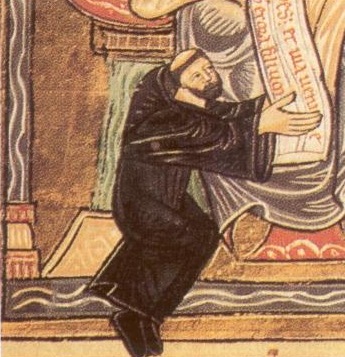
Is it just me or are his hands significantly larger than his head?
[St. Odo of Cluny, 11th century, source: Wikimedia Commons]
William took none of the founder’s rights for himself and his family, making the monastery subject only to the Pope.  It was their first and second abbots, Berno and St. Odo, who really started the reform, using the version of St. Benedict’s Rule provided by Benedict of Aniane.  They wanted to return Cluny to their idea of a more traditional, earlier form of monasticism.  Subsequent abbots followed their lead.  They refused to involve the community in fief-holding (as it incurred secular obligations) and made liturgy the monks’ main labor.  They decorated their church lavishly, to the glory of God.  On a broader scale, they worked to reform the Church, speaking out especially against simony and clerical concubinage.

As others began to see what was happening at Cluny, they began asking for help reforming their own monasteries.  Cluny began to build its own network of daughter houses, considered priories rather than abbeys, its independence allowing its influence to spread far and wide.  By the late 11th century, it was the grandest, most well-endowed monastic community in Europe.  It is worth noting, however, that nearly all of the communities Cluny took on, however, were male, with only one community of Cluniac women being founded before 1100.**
Picture
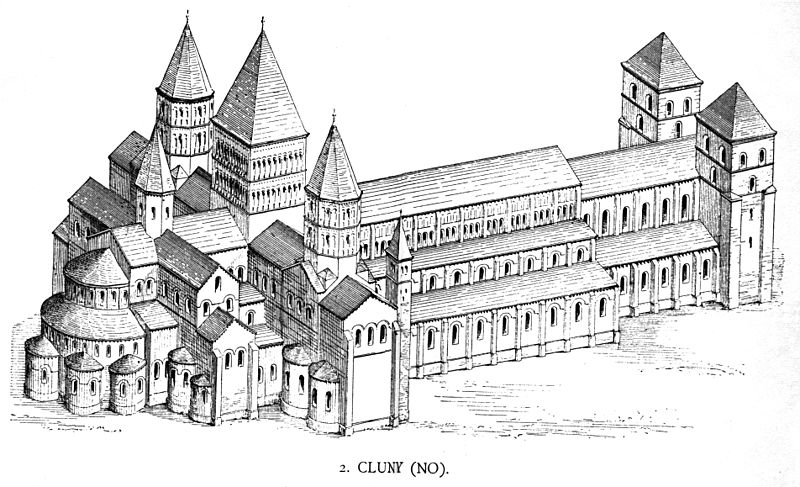
Now imagine you're a monk trying to sing the hours all day and they're building that nearby.
[Reconstruction of what Cluny III might have looked like, Georg Dehio & Gustav von Bezold, Kirchliche Baukunzt des Abendlandes, 1887, source: Wikimedia Commons]
By the early 12th century, however, Cluny had already begun to face harsh criticism, especially for its extravagance.  The mother house was rebuilding its church for the second time and the result was the largest building in Europe,*** and one of the most lavish, to boot.  The monks lived in luxury and ate sumptuous meals, while the monastery’s abbots and priors had become statesmen, involving themselves in politics all over Europe.  Far from separating themselves from the material and secular, they had become inextricably entwined with them.


*Citing, for example the right claimed by the families of monastic founders to appoint the abbot or abbess, usually installing someone related to them.
**It doesn’t help that this one was only founded to house the wives of men who wanted to become Cluniac monks.
***Until the rebuilding of St. Peter’s in Rome during the 16th century.  And then Cluny III went on to be destroyed in the French Revolution.

Sources/Further Reading:
Barber, Malcolm. The Two Cities: Medieval Europe 1050-1320. London: Routledge, 1993.
Cook, William R. and Ronald B. Herzman. The Medieval Worldview: an Introduction. New York: Oxford University Press, 2004.

Lawrence, C. H. Medieval Monasticism. London: Longman, 1984.
Stephenson, Carl and Bryce Lyon. Mediaeval History: Europe from the Second to the Sixteenth Century. New York: Harper & Row, 1962.
0 Comments

Children of Roman Slave Women

26/11/2014

0 Comments

 
In Ancient Roman law, the children of unmarried parents* followed the status of their mother.  A slave’s child would be a slave, while the child of a free woman would be free.  Or at least, that was the basic idea.  Not only did other laws make the whole question more complicated, but the life cycles of freedwomen in particular meant the free or unfree status of their children had an impact on the course of their own lives.

A free woman could not give birth to a slave child.  According to some jurists, however, a slave woman, however, could have a freeborn child.  She only had to have free status sometime during her pregnancy.  According to law, it didn’t matter if she had been enslaved or re-enslaved after the conception.  The child of a woman who should have been freed but wasn’t** was also free.

Of course, this didn’t play out as simply in practice.  How was a woman to enforce her child’s free status if she was a slave at the time of the child’s birth?  Even a freedwoman might have some trouble if, as in the case of Petronia Justa, a freedwoman left her child in the care of her patron until she could raise it herself.  In cases where the grant of freedom was in default, who knew when the woman or her child might actually obtain free status.  This is not to say that none did, merely that it would have been difficult.

The Augustan marriage laws granted freedom from guardianship to freedwomen with four children.  It is likely, however, that only her free children counted towards this total.  Add to this the fact that slave women were generally not manumitted until they were in their 30s at the earliest, well into their childbearing years.  As a result, the status of her children could have mattered to a freedwoman not only because of her own personal interest in them, but because it also had the power to affect her own as well.


*Marriage in Rome was limited to free (freeborn or freed) Roman citizens, with a few restrictions on who could marry whom and when.  A senator or the child or grandchild of a senator, for example, could not marry a freedperson or someone associated with an unsavory occupation like acting, prostitution, or tavernkeeping.
**If, for example, someone’s will gave her freedom, but their heirs ignored this or for some other reason didn’t manumit her.

Sources/Further Reading:
Paul, Opinions 2.24.1-9 - Diotima
The Julian Marriage Laws - Diotima
Pomeroy, Sarah. Goddesses, Whores, Wives, and Slaves: Women in Classical Antiquity. New York: Pantheon Books, 19.
0 Comments

Irene Doukaina

24/11/2014

0 Comments

 
Picture
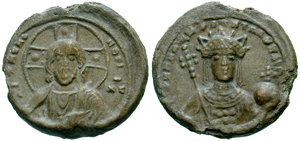
[Coin with the image of Christ on one side and Eirene Doukaina on the other]
[11th or 12th century, Classical Numismatic Group, source: Wikimedia Commons]
We know Irene Doukaina (c.1066-1138), empress consort of the Byzantine Empire, mostly through the people she was related to.  She was a daughter of the powerful Doukas family, wife of Emperor Alexios I Komnenos, and mother of Anna Komnene and Emperor John II Komnenos, but she was also a powerful person in her own right.  She involved herself heavily in politics and was unafraid to go up against even members of her own family, whether by marriage or by blood.

Irene was born the daughter of Andronikos Doukas and Maria of Bulgaria.  Through her parents she was related to both the Byzantine Imperial line and the rulers of Bulgaria.  She officially married Alexios Komnenos at age 11, cementing the alliance between Alexios and the powerful Doukas family that supported Alexios in his bid for the throne.  The former Empress, Maria of Alania, had also supported Alexios, and it was rumored after his coronation that he was carrying on an affair with her* and that the reason Irene was not immediately crowned as well was because his mother would rather have Maria as Empress again.  Nevertheless, Irene and her family marshaled their strength and forced the issue, leading to her own coronation a week after her husband’s.

The couple ruled together for 37 years and had nine children.  When Alexios went on campaign, Irene generally went with him.  When she did stay behind, she acted as regent with Anna and her husband to advise her.  She was very close with her eldest daughter and regarded her as a more worthy successor to Alexios than her son John, the assumed heir.  Her insistence on this point eventually led to a rift between her and Alexios, on whose death in 1118 John took the throne.

Irene went into mourning, but it was not long before she reentered the political arena to support Anna in her bid for power.  When they were discovered, John forced both his sister and his mother to retire from politics, causing Irene to enter the monastery of Kecharitomene, which she had founded a few years prior.  It was here that she lived out the rest of her life as a nun.  It was she, perhaps during these later years, who inspired Anna’s husband Nikephoros to start working on the history that Anna would later turn into her Alexiad.  Irene died peacefully in 1138.


*Anna Komnene, Irene’s daughter, vehemently denies the rumor in her Alexiad, one of the major primary sources here.

Sources/Further Reading:
Anna Comnena: The Alexiad - Internet History Sourcebooks Project
Empress Irene Doukaina, Typikon of Kecharitomene, 1110-1116, translated by Robert Jordan - Dumbarton Oaks
Irene Doukaina - Wikipedia
0 Comments

Contraceptives in Ancient Rome

21/11/2014

0 Comments

 
The plant Silphium, which was so commonly used as a contraceptive (and for other medical purposes) in ancient Greece and Rome that it became extinct through over-harvesting by the 2nd century BCE,* is probably the ancient contraceptive best known to people now.  This was not the only method used, however.  The Ancient Romans had a variety of ways to prevent pregnancy, some far more effective than others.

Some of these seem patently ridiculous today.  Pliny the Elder suggests cutting open a hairy spider to find two worms, which should be tied together, wrapped in deerskin, and attached to the woman’s body before sunrise.  The many suggestions Soranus gives include squatting down immediately after intercourse, sneezing repeatedly, and drinking something cold.  Some believed it possible to use willow or iron, both of which were thought of as sterile to prevent conception.

Other methods seem more likely to have worked.  Some used what we now call the rhythm method could have, but how well it actually worked was probably affected by the prevailing belief that conception was most likely to occur at the end of menstruation.  Women used various materials like soft wool dipped in various concoctions** as barriers to block off the os of the uterus, while wealthier men may have used goat bladders in the same way we use condoms now.  Pomeroy also suggests that coitus interruptus may have been common enough that no one felt the need to mention it.

Some Roman physicians also felt the need to distinguish between contraceptives and abortives.  Those who took the Hippocratic Oath swore never to perform any sort of abortion.  Others, Soranus included, were willing to perform abortions because, they argued, the health of the mother was more important.  Contraceptives, however, were perfectly acceptable.***  The wide variety of methods publically espoused tells us that much at least.


*According to Pliny the Elder, the last known stalk was given to Emperor Nero as a curiosity.
**Mostly to make them impermeable.

Sources/Further Reading:
Hippocrates, On Generating Seed and the Nature of the Child 4-7, 13, 30 - Diotima
Pliny the Elder, Natural History 19.15, 29.27 - Perseus
Soranus Gynaecology 1.60-62 - Diotima
Pomeroy, Sarah. Goddesses, Whores, Wives, and Slaves: Women in Classical Antiquity. New York: Pantheon Books, 1995
0 Comments

Women in Byzantine Male Monasteries

19/11/2014

0 Comments

 
Monks had an easier time excluding women from their monasteries than did nuns in keeping men out.  Nuns, after all, needed men to act as priests, spiritual fathers, and gravediggers, while monks could fill all of the necessary offices with members of their own communities.  Even so, male monastic communities could not keep women out entirely and sometimes found themselves either making accommodations or dealing with the consequences.

Some monasteries found themselves needing to allow certain women into the church* for specific ceremonies.  Female relatives of the founder, for example, had to be allowed to attend funerals, sometimes those of other women.  The burial of nobles in monastic churches was a source of income for these communities.  A few monasteries also allowed women into their churches for specific feast days, usually those associated with the Virgin Mary.  Kosmosoteira was one such, and on these specific days, female relatives of monks could also meet with their kin in the courtyard under the watchful eye of the abbot.

There was also the matter of the veneration of relics, especially those known to heal.  Some aristocratic women got around the problem by sending a male representative.  For other women, another solution had to be found.  Some monasteries kept certain relics in shrines more accessible to the public but closed off from the monastery.  Others brought their relics outside on specific days so that women could reach them.

Some women entered male monasteries disguised as men.  There were cases of monks sneaking prostitutes in, but there were also many instances of women disguising themselves for a more religious purpose.  Some did so in order to gain access to a particular relic.  A few of them had a more long-term idea in mind: becoming a monk.  How many women tried or accomplished this is impossible to guess at, but it did become a popular theme in hagiography,** perhaps because it reflected the gendered tension at the heart of monastic life.

The only communities that had any success in doing that were those groups of foundations like those on Mount Athos, which barred and still bars women from setting foot on any part of the mountain.  Even these, however, found themselves having to make accommodations for the female relatives of their monks by founding communities for nuns nearby.


*Either the monastic church or a secondary one at some sort of remove from the monastery proper.
**The writing of saints’ vitae or Lives.

Sources/Further Reading:
Thomas, John and Angela Constantinides Hero, eds. Byzantine Monastic Foundation Documents: A Complete Translation of the Surviving Founders’ Typika and Testaments. Washington, DC: Dumbarton Oaks, 2000. [Text may be found here.]
Isaac Komnenos, Typikon of Kosmosoteira, 1152, translated by
Nancy Patterson Sevcenko - Dumbarton Oaks
Talbot, Alice-Mary. "Women's Space in Byzantine Monasteries." Dumbarton Oaks Papers 52 (1998): 113-127.
0 Comments

Cleopatra Selene II

17/11/2014

0 Comments

 
Picture
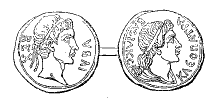
Not sure how accurate this image is, given the source, but what with the scarcity of images of ancient women, it's what I've got.  Most everything else I find is of her mother.
[Drawing of a coin depicting Juba II and Cleopatra Selene II, found in Smith, William, ed. Dictionary of Greek and Roman Mythology and Biography. Little, Brown, & Co.: Boston, 1867.  Also on Wikimedia.]
Cleopatra Selene II, also known as Cleopatra VIII Selene (c. 40 BCE – unknown), was the only daughter of Cleopatra VII and Mark Antony.  Born a princess, she went on to become queen and co-ruler of Mauritania with her husband Juba II.

The early years of her life were tumultuous.  She and her twin brother, Alexander Helios, were born after Antony had left Cleopatra to go back to Rome, and only met their father when they were around three.  It was possibly at this time that the children were given the names Helios and Selene.  During the Donations of Alexandria,* when Antony symbolically divided up Roman and Parthian lands between Cleoptatra’s children, Cleopatra Selene received Cyrenaica and Libya.  She would never actually rule these territories, partially because Antony didn’t actually have the power to grant them and partially because of the events that lead to her parents’ defeat and deaths when she was nine.  Instead, she and her brothers were brought back to Rome by Octavian and given into the care of his sister and their father’s former wife, Octavia.

From this point on, she was raised and treated as part Octavian’s family.**  She received a good education and arrangements were made for a good marriage to Juba II of Numidia.***  Though convention states that Octavian married her off, there is evidence that the match was actually at Octavia’s instigation and it proved a good one politically and perhaps personally as well.

Cleopatra and Juba only ruled Numidia briefly before it was made a province.  Augustus sent them to govern the then disorganized region of Mauretania**** instead in 46 BCE.  Cleopatra was as involved in governing the area as her husband and influenced many of his policies.  The couple made both trade and the patronage of art a priority and under them, the region flourished.  The date of Cleopatra Selene’s death is unknown and very much up for debate.  She was buried in the royal mausoleum in what is now Algeria.

Picture
[Tomb of Cleopatra Selene II and Juba II in Tipaza, Algeria, photographed 2012]
[Source: Wikimedia Commons]

*For more on that, see here.
**As were her two brothers.  They, however, seem to have died before reaching adulthood, possibly of natural causes.  At the very least, no further mention of them is made in the historical record.
***An ancient kingdom/Roman province that covered the northern parts of what are now Algeria, Tunisia, and Libya.
****What is now the Mediterranean coast of Morocco.

Sources/Further Reading:
Cassius Dio, Roman History 49.32, 49.41, 50.1, 51.15, 51.21 - Lacus Curtius
Plutarch, Life of Antony 87 - Lacus Curtius
Roller, Duane W. The World of Juba II and Cleopatra Selene. New York: Routledge, 2003. [text can be found here]
Cleopatra Selene II - Wikipedia
0 Comments

Medieval Concubinage in Law

14/11/2014

0 Comments

 
As I have discussed before, the Ancient Roman practice of Concubinage carried over into the medieval period.  Some legalists and theologians disapproved outright, while others attempted to compromise and work it into existing Christian morality.  This latter viewpoint was characterized by a certain ambivalence as its adherents had to sort out which cases of concubinage were acceptable and which were not.

Most legalists* held one of two opinions: 1) a concubine was a “one man harlot”** and both parties were guilty of fornication or 2) a man and his concubine should be considered spouses who had married clandestinely and neither party could be considered to have sinned unless they ended the union.  Both of these groups were working from the idea that both non-procreative and non-marital sex were entirely sinful.  The one, however, took the route of flat out condemnation, while the other attempted to modify the definition of concubinage to prove that it was really marriage.

Adherents of the first view looked primarily to the opinions of Saints Paul and Augustine.  Both men held that only two moral options were open to Christians: marriage or celibacy.  Concubinage, not being marriage, was therefore entirely immoral and had no place in Christian society.

Such a well-established tradition, however, could not so easily be eradicated and many legalists found it easier to compromise by declaring marriage and concubinage to be essentially the same thing.  Gratian, for example, held that partners in concubinage were bound together by marital affection and therefore should be considered to have married informally.  Such a designation, however, necessitated qualification.  If one were to declare concubinage to be marriage, any practices that were permissible in the former relationship that were not in the latter must then be discarded as unacceptable.  The same term was still used for both acceptable and unacceptable relationships.  So an informal union that was intended to be permanent and a temporary informal union were lumped under the same category of “concubinage” despite one being permissible and the other entirely sinful.

These opinions remained on a relatively equal footing, the one supported by the stringent morality of certain early Church Fathers, the other by longstanding common practice, up until the Reformation, when the stricter interpretation gained ascendance.  The Council of Trent banned concubinage entirely in the 16th century.


*Of those whose work we still have.
**Which then makes you wonder how they’re defining “harlot.”

Sources/Further Reading:
Brundage, James A. Law, Sex, and Christian Society in Medieval Europe. Chicago: University of Chicago Press, 1987.
Brundage, James A. "Concubinage and Marriage in Medieval Canon Law." Journal of Medieval History (1975): 1-17.
Dübeck, Inger. "Women, Weddings and Concubines in Medieval Danish Law." Scandinavian Journal of History 17.4 (1992): 315-322.
Marriage Canons in The Decretum of Gratian - Catholic University of America
0 Comments

Marriage at Gortyn

12/11/2014

0 Comments

 
Like the Spartans, the people of Gortyn were often at war and as a result, free men and women tended to lead largely separate lives.  Men stayed with their military groups until a certain age,* while women lived at home and were responsible for managing the household.

As I mentioned before, women at Gortyn owned and managed their own property.  They brought it with them to a family when they married and took it back again if they divorced.  Upon divorce, a woman took her property, half of what it produced, and half of what she had woven within the household away with her.  If she took away more than her share, she paid a fine.  If her husband was the cause of the divorce, he would be fined.**

Adultery did not necessarily lead to divorce.  A man caught with someone else’s wife paid a fine, the amount of which depended on where they were caught (the fine being higher if it was in her father’s, husband’s, or brother’s house), on the status of her husband, and on whether the man was a slave or free.  It has been argued that the prominence of her father’s house in this section of the Law Code suggests that while women at Gortyn married in their early teens, they did not move out of their parents’ house until they were of an age to run a household on their own.

A patroiokos, a woman with no living brothers when her father died, was required to marry someone on her father’s side of the family or pay off the prospective bridegroom, in which case she could marry someone else.  As her father’s heir, she and her children remained legally a member of her father’s family, not her husband’s, no matter who she wed.  Her husband then became an instrument for the perpetuation of her father’s line and its hold on the property rather than her helping to continue her husband’s.

There is some evidence for at least some recognition of slave marriages.  Certainly the law stipulated that if two slaves with different masters wed, the female slave and her property then belonged to the male’s master.  Upon divorce she returned to her former master.  If a free woman married an unfree man*** and lived in his house, their children would be slaves.  If they lived in her house, their children would be free.

*For men at Gortyn this age is unknown.
**Nowhere in what we have of the Law Code is there any mention of what would happen if the wife were the cause of the divorce.  Maybe there wasn’t anything.  Maybe that section is missing.
***The opposite, an unfree woman marrying a free man was not permitted.

Sources/Further Reading:
The Law Code of Gortyn (Crete), c. 450 BCE - Internet History Sourcebooks Project
Laws Relating to Women in Gortyn, Crete - Diotima
Pomeroy, Sarah. Goddesses, Whores, Wives, and Slaves: Women in Classical Antiquity. New York: Pantheon Books, 1995.
0 Comments

Hafsa bint al-Hajj al-Rukuniyya

10/11/2014

0 Comments

 
Shall I visit you or shall you visit me? For my heart always
bows to what you long for;
My mouth is a source of clear sweet water, and the hair of
my head is a leafy shade.
I hoped you were thirsty and struck by the sun, when the
noon hour would bring me to you;
Give me answer quickly: it is not nice, o Jamil, that you
keep Buthayna waiting!
-Hafsa bint al-Hajj, sent to Abu Ja'far
Hafsa bint al-Hajj al-Rukuniyya (c.1135-1190), an Al-Andalusian noblewoman from Granada, was a woman who flourished during the reign of the Almohads.  Like her predecessor Wallada bint al-Mustakfi, she wrote about her love affairs.  Unlike Wallada, however, some of Hafsa’s poetry on other topics survives as well, especially elegies, panegyrics, and satires.  Indeed, more of her work survives than of any other female Muslim poet.

We know little to nothing of her early life.  Her father was a wealthy Berber from Granada, so we may assume she grew up in luxury and received an excellent education.  By the time the Almohads wrested the rule of Al-Andalus from the Almoravids, when she was in her late teens or early twenties, she had already started a love affair with the Governor’s secretary and her fellow poet Abu Ja'far Ahmad ibn Sa’id.  From the evidence of both her poetry and his, it seems that she instigated the relationship and continued to visit him openly, despite the far stricter morality of the new Almohad rulers.

Sometime around 1160, Abu Ja'far joined a rebellion against his employer, Abd al-Mu’min, governor of Granada.  In 1163, he was captured and executed.  The story goes that al-Mu’min had other resons for executing Abu Ja;far as well, namely that he was in love with Hafsa, though the truth of this is impossible to tell.

Hafsa, however, was more than a poet and lover.  Many knew and respected her as a teacher.  Indeed, one of her colleagues described her as the most noteworthy teacher of her time.  Her students were numerous and after the death of Abu Ja'far* she traveled widely.  In the end she wound up in Marrakesh in Morocco, where the Almohad Caliph Abu Yusuf Yaqub al-Mansur engaged her to teach his daughters.  She would remain there for the rest of her life, dying in her 50s in the year 1190.


*Possibly before it as well.

Sources/Further Reading:
"Hafsa bint al-Hajj Arrakuniyya" in Poems for the New Millenium: Volume Four, edited by Pierre Jouris, Habib Tengour.  Berkeley: University of California Press, 2012. [text is here]
Louis Di Giacomo, Une Poétesse Grenadine du Temps des Almoḥades: Ḥafṣa bint al-Ḥājj, Collection Hespéris, Institut des Hautes-Études Marocaines 10, Paris: Larose, 1949.  [text is here]
Schippers, Arie.  "The Role of Women in Medieval Andalusian Arabic Storytelling."  In
Verse and the Fair Sex: Studies in Arabic Poetry and in the Representation of Women in Arabic Literature, edited by Frederick de Jong, 139-152. Utrecht: Publications of the M. Th. Houstma Stichting, 1993. [text is here]
Hafsa bint al-Hajj al-Rukuniyya - Wikipedia
0 Comments

Hiatus

2/11/2014

0 Comments

 
I have to take my computer in for repairs and won't have consistent internet access for about a week or two, so I'm going on hiatus here 'til I get her back.  See you then!
0 Comments

    My Blog

    Translation of the above: where I post the interesting things I find researching the Classical and Medieval periods in my free time.

    Currently Reading:
    -
    Medieval Monasticism by C. H. Lawrence

    Archives

    March 2016
    February 2016
    January 2016
    December 2015
    November 2015
    October 2015
    September 2015
    August 2015
    July 2015
    June 2015
    May 2015
    April 2015
    March 2015
    February 2015
    January 2015
    December 2014
    November 2014
    October 2014
    September 2014
    August 2014
    July 2014
    June 2014
    May 2014
    April 2014
    March 2014
    February 2014
    January 2014
    December 2013
    November 2013
    October 2013
    September 2013

    Categories

    All
    Architecture
    Biography
    Classical
    Law
    Marriage (legal And Otherwise)
    Medicine
    Medieval
    Misconceptions
    Monasticism
    Overview
    References
    Religion
    Review

    RSS Feed

Powered by Create your own unique website with customizable templates.